


Building a Team for a New Digital Bank in 2026
The first hire for a new digital bank may not be the person who builds its most visible feature. Building a team for a new digital bank starts with identifying the capabilities needed to launch safely and operate reliably, then hiring in the right order. A familiar banking structure may not suit a digital-first model, particularly when product, technology, risk and operations need to work closely together.
It’s understandable to be uncertain about which expertise must be in place before launch and which gaps could be covered with interim support. The answer depends on the bank’s operating plan, launch priorities and the capabilities it needs to own over the long term. A considered hiring sequence can help avoid premature appointments and make each recruitment decision more purposeful.
This article sets out a practical way to turn launch priorities into a phased hiring plan for a digital bank in the UAE. It explores which capabilities to establish first, how to assess permanent hires alongside contract and interim expertise, and how market mapping can inform recruitment decisions. The aim is a team shaped around the bank’s needs, not a generic organisation chart.
Key Takeaways
- Start with the services and launch priorities of your bank, then shape a team around the capabilities needed to deliver them.
- Map ownership across product, technology, operations, data, security, risk and compliance before settling on job titles.
- When building a team for a new digital bank, weigh permanent and interim talent against the need for lasting ownership, speed and knowledge transfer.
- Sequence recruitment by launch dependencies and capability gaps, with clear assessment criteria and onboarding plans for each hire.
- Use market mapping to understand talent availability and make workforce plans more realistic before recruitment begins.
Discuss your hiring brief with a specialist in digital banking recruitment.
Start with the digital bank you are building, not an off-the-shelf org chart
Hiring before the operating model is settled can leave a new bank with the wrong roles, duplicated ownership or important gaps. A structure borrowed from a traditional bank may not reflect how your digital service will be designed, delivered and supported. Start with the proposition and the work required to make it real.
For this purpose, a launch-led team means the capabilities and accountable owners needed to deliver the bank’s planned services. The Digital banking model can take different forms, so there is no single organisation chart to copy. The right structure depends on the customers you intend to serve, the journeys you plan to offer and how the operation will work behind the scenes.
Turn the business proposition into hiring priorities
Before opening roles, clarify which customer needs the bank will address, which products it intends to provide and what customers must be able to do, from sign-up through ongoing support. Then connect each service to the capabilities that will design, deliver and maintain it. For example, a digital account journey may need clear product ownership, suitable banking technology, operational support, and oversight of risk and compliance.
A launch-critical capability is a skill or function that must have a clear owner for the bank to deliver a planned service safely and reliably. This definition helps leaders distinguish an essential appointment from a role that can wait. It also keeps recruitment focused on outcomes, rather than job titles copied from another bank’s organisation chart.
Set the boundaries of the first hiring plan
Separate what must be ready for launch from later-stage ambitions and optional enhancements. Record the assumptions behind the plan, including the intended geography, customer groups, delivery channels and ownership of each operational activity. If the plan changes, these assumptions make it easier to see which hiring priorities may need to change too.
Be specific about the operating model. Decide which activities the bank expects to manage internally and where it expects to rely on external providers, then identify the capabilities needed to oversee those arrangements. Scope location-specific regulatory expertise with appropriate advisers rather than assuming that experience in another market transfers directly.
The initial team should cover launch dependencies and accountable ownership. Capabilities linked to future products, new customer groups or additional channels can be considered as the bank develops. This staged view gives leaders a disciplined basis for deciding what to recruit now and what to revisit later. Once priorities are clear, specialist digital banking recruitment can help explore the talent needed for the most pressing roles.
Explore digital banking recruitment with a clear view of the capabilities your operating model needs.
Map the capabilities a new digital bank needs before naming every role
Once the proposition is clear, map the work that must happen across the bank. This is more useful than starting with a long list of job titles, because the same capability may be organised differently depending on the services offered, technology choices and operating model. When building a team for a new digital bank, the aim is to give each essential activity a clear owner and identify how it connects to the others.
Connect customer journeys with product and technology
Trace the customer journey from account opening through everyday use, support and issue resolution. At each stage, ask what customers need, which systems enable the experience and who is accountable if something goes wrong. Product teams should shape the journey with engineering and technology leaders so that usability, reliability and operational needs are considered together.
Technology choices influence the expertise required. Core banking systems provide important account and transaction functions; APIs connect services and providers; cloud computing affects how platforms are built and operated; and payment rails shape how payments are routed and processed. These are capability questions before they become job descriptions. Once the expertise required is defined, teams assessing specialist technology needs may find fintech banking technology recruiters relevant.
McKinsey’s discussion of building a digital-banking business also highlights the importance of coordination across teams. The practical implication is that product, engineering and operational owners need shared priorities, rather than separate plans that only meet at launch.
Give operations, risk and data clear ownership
A polished app is only one part of the service. The bank also needs defined processes for handling customer requests, exceptions, payment issues and service disruptions. Assign ownership for these activities and clarify how operational teams work with product and technology when a process needs to change.
Map data, security, risk and compliance to the bank’s actual activities. Consider what information the service uses, how access and security are managed, and what oversight is needed for the planned products and customer journeys. Financial crime and compliance expertise should reflect the services and markets in scope. For a UAE launch, leaders should confirm location-specific requirements with appropriate advisers rather than assume a generic capability map is sufficient.
There is no universal template. A bank that uses external providers for parts of its operation will need clear internal oversight, while a different delivery model may require more capability in-house. Define the accountability first, then decide whether it calls for a permanent role, shared responsibility or specialist support.
If you’re shaping the capability map and want to discuss relevant hiring options, share your digital banking recruitment priorities.
Discuss specialist hiring options once you have identified which capabilities need lasting ownership and where flexible expertise may fit.
Choose the right mix of permanent, interim and specialist talent
There’s no single hiring route that suits every capability. The decision should reflect who needs to own the work, how soon the expertise is required, how long the need is expected to last and what knowledge must remain in the bank. When building a team for a new digital bank, assessing these factors side by side can prevent a temporary gap becoming an unclear permanent role, or an enduring responsibility being left without a lasting owner.
A simple comparison table can make the trade-offs visible. For each capability, record its urgency, expected duration, importance to ongoing strategy or governance, and the level of knowledge transfer needed. Then compare whether a permanent hire, contract or interim specialist, or a combination best meets the need. Treat the result as a decision aid, not a rule that one route is always preferable.
Decide which capabilities need permanent ownership
Permanent appointments may suit leadership roles and capabilities central to the bank’s continuing strategy, governance or daily operations. Consider whether the work depends on sustained relationships across teams, repeated decisions or detailed knowledge of the bank’s systems and customers. If so, continuity and retained organisational knowledge may matter as much as immediate delivery.
Senior appointments deserve particular care because they shape accountability and influence how teams work together. For more context on leadership search, see Fintech Executive Search and the Strategic Acquisition of Global Leadership in 2026. Define the role around the decisions and outcomes the leader will own, rather than title alone.
Use interim support for defined needs
Contract or interim expertise may suit a time-bound need, a clearly scoped project or a capability that has not yet been established as a permanent role. Before engaging someone, specify the work to be completed, the expertise required, who will make decisions and how knowledge will be transferred to the team. This matters especially if the specialist is introducing a process or supporting a launch milestone that internal colleagues will later own.
For an uncertain need, interim support can help the bank assess the work before committing to a permanent structure. But if the capability will remain central, relying on temporary expertise without a transition plan may leave ownership unresolved. Where payment services are part of the proposition, payments industry recruitment may be relevant to the talent search.
Organisational models can also evolve as digital maturity develops. Forrester’s Evolve Your Bank’s Organizational Structure offers a perspective on how structure may change over time. Review the hiring mix as the operating model matures, while keeping accountability clear from the outset.
Plan your digital bank hiring approach around the capabilities, decisions and launch milestones that matter most.
Build a phased hiring plan with clear assessment and onboarding
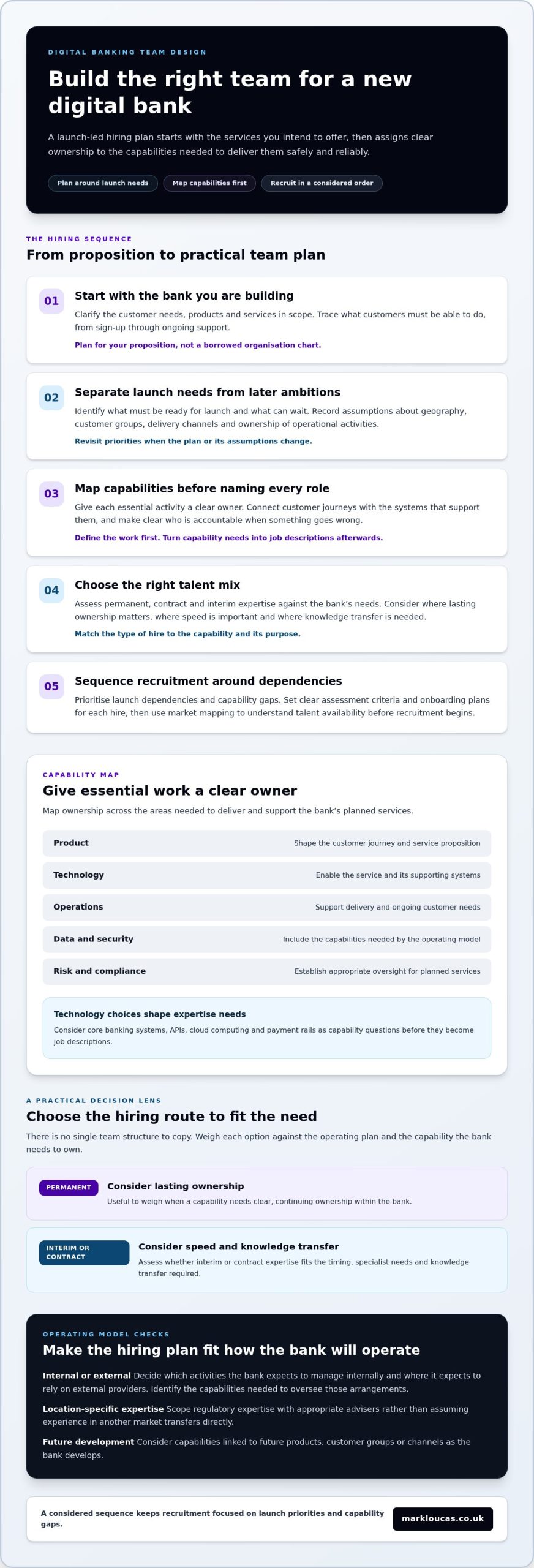
A phased plan turns capability needs into a sequence of hiring decisions. When building a team for a new digital bank, prioritise roles by asking what must be in place before another activity can proceed, where ownership is missing and how much time recruitment and onboarding may realistically require. Avoid assuming every appointment can be made at once.
- Set out launch dependencies. Identify the capabilities needed to design, test and operate each planned service. Note which decisions or deliverables depend on each capability.
- Compare priorities with current capacity. Record existing expertise, gaps and accountable owners. This helps distinguish a new role from work an established team can reasonably take on.
- Sequence the recruitment. Start with roles that unblock other work or carry essential decision ownership. Allow realistic time to define the role, reach suitable candidates, assess them, account for notice periods and plan onboarding.
- Review and adjust. Revisit the sequence as launch milestones, operating assumptions or capability needs change.
A clear sequence is not a fixed timetable. It makes dependencies visible and helps avoid treating every vacancy as equally urgent.
Create role briefs and assess candidates consistently
Build each brief from a defined capability gap. State the outcomes the person will own, their key interfaces with product, technology, operations or other teams, the experience essential to the work and the decisions they can make. Describe success in practical terms, such as establishing an agreed process or taking ownership of a defined area of delivery.
Use the same core questions and evidence criteria for candidates being considered for the same role. Ask for relevant examples, explore how they reached decisions and assess their experience against the stated responsibilities. This makes comparisons more consistent without relying on vague impressions. For further context on compliance responsibilities, see The Strategic Role of a Compliance Officer in the 2026 Fintech Sector.
Plan onboarding around collaboration and knowledge transfer
Onboarding should help each new hire understand the bank’s customer journeys, systems, ownership boundaries and working relationships. Introduce the people they will depend on, clarify how decisions are made and connect their initial priorities to the launch plan. For interim specialists, include an explicit handover so useful knowledge and documentation remain with the team.
Keep the plan under review. If a milestone moves or an assumption changes, reconsider which hire is needed next and whether the role brief still reflects the work. A measured process supports better recruitment decisions from initial planning through to effective contribution.
If you’re ready to turn capability gaps into a clear recruitment sequence, discuss your digital bank hiring plan.
Discuss your digital bank team once your proposition, capability needs and hiring priorities are taking shape.
Bring the team plan together with specialist digital banking recruitment
A sound hiring plan brings three decisions together: what the bank intends to offer, which capabilities are needed to deliver it and when each capability must be in place. This gives recruitment a clear purpose. Rather than opening roles against a generic structure, leaders can focus on the experience and ownership needed for launch and the bank’s next stages of development.
Market mapping can help test those priorities against the talent market. It can show where relevant experience may sit, whether a brief is too narrow and which capabilities may be difficult to source in the intended location. Used early, this intelligence can inform workforce planning: leaders might adjust the order of hires, refine role requirements or consider interim expertise for a defined gap. It is a planning aid, not a guarantee of candidate availability.
Know when external recruitment expertise may help
Specialist recruitment may be useful when a search involves senior leadership, niche digital banking or payments expertise, or a competitive talent landscape. A clear brief gives recruiters a better basis for assessing relevant experience and fit. Set out the outcomes, decision-making responsibilities, essential experience and working relationships required, alongside the market or customer context for the role.
Senior appointments can shape the bank’s direction and accountability. Leaders considering this route may also find Fintech Executive Search and the Strategic Acquisition of Global Leadership in 2026 useful context. For other needs, compare permanent recruitment with contract or interim support according to the duration of the work and the level of long-term internal ownership required.
Agree practical next steps before opening a search
Before starting recruitment, bring together the operating plan, priority capability gaps and role outcomes. Agree who will make hiring decisions, what evidence candidates will be assessed against and how the role fits the launch sequence. Then consider the suitable route for each need, whether permanent recruitment, executive search or interim support. Each choice should follow the brief, not a default preference.
Mark Loucas Ltd is an independent specialist recruitment consultancy founded in 2011, focused exclusively on fintech, payments and digital banking. Its services include permanent recruitment, executive search, contract and interim solutions, market mapping and talent advisory. These options can be considered once the bank’s needs are defined.
Building a team for a new digital bank is ultimately about aligning people with the proposition and the work required to deliver it. If your priorities are becoming clear, share your hiring brief with Mark Loucas Ltd to discuss the recruitment options that may fit.
Discuss your digital bank hiring requirements with Mark Loucas Ltd.
Set your digital bank team up for launch
Building a team for a new digital bank starts with the bank’s proposition, not a standard organisation chart. Define the customer journeys and services first, then map the capabilities and accountable owners needed to deliver them. From there, sequence recruitment around launch dependencies, balancing permanent ownership with interim expertise where the need is clearly defined and time-limited.
A considered plan makes recruitment more purposeful. Clear role outcomes, consistent assessment and focused onboarding help new hires understand how their work connects to the bank’s systems, customers and wider team.
Mark Loucas Ltd is an independent specialist recruitment consultancy founded in 2011, focused on fintech, payments and digital banking. Its services include permanent recruitment, executive search, contract and interim recruitment, as well as market mapping, intelligence and talent advisory. These options can support different hiring needs once your priorities are clear.
With a clear brief and a thoughtful sequence, you can build the capabilities your launch needs. Share your hiring brief with Mark Loucas Ltd to discuss the recruitment options that may fit.
Frequently Asked Questions
What roles should a new digital bank hire first?
Hire first for the capabilities that unblock launch work and need clear decision owners. Depending on the planned services, these may include product, banking technology, operations, risk and compliance leadership. Identify what must be designed, delivered and supported, then define the responsibilities and experience needed. The right job titles and order depend on the bank’s proposition, operating model and existing expertise.
How do you build a team for a new digital bank?
Build the team around the bank’s planned services and customer journeys, not a standard organisation chart. Map the capabilities needed to deliver each service, identify gaps and assign clear owners. Then sequence recruitment around launch dependencies, deciding which needs call for permanent hires and which may suit interim expertise. Use clear role outcomes, consistent candidate assessment and onboarding that reflects the bank’s systems and priorities.
Should a new digital bank hire permanent or interim staff?
Choose according to the capability’s duration, urgency and need for ongoing internal ownership. Permanent hires may suit leadership, governance or work central to daily operations, where continuity and retained knowledge matter. Contract or interim expertise may fit a defined project or time-limited gap. Set out the work, decision rights and knowledge transfer before choosing. Neither route is always best, and some teams may need a considered mix.
Which capabilities does a digital bank need before launch?
A digital bank needs the capabilities required to design, deliver and support its planned services. These may include product and customer journey design, banking technology, operations, data, security, risk and compliance. The exact mix depends on the proposition and operating model. Consider the systems and providers involved, who will oversee them and how customers will get support. For a UAE launch, confirm location-specific requirements with appropriate advisers.
Can a new digital bank outsource specialist expertise?
Yes, a bank may use external specialists for defined needs, such as project work or niche expertise, provided responsibilities and handover expectations are clear. Before engaging support, specify the scope, decisions the specialist can make and knowledge the bank needs to retain. Consider which activities still need an accountable owner within the bank. Market mapping and specialist recruitment can also help clarify where relevant talent may be found.
How should a digital bank assess fintech candidates?
Assess candidates against the outcomes and responsibilities set out in the role brief. Use consistent core questions and evidence criteria for everyone considered for the same position, and ask for examples that demonstrate relevant experience and decision-making. Explore how candidates work across product, technology, operations or risk where those interfaces matter. This supports a fairer, more comparable decision than relying on job titles or general impressions alone.
What happens if a digital bank hires before defining its operating model?
Hiring before the operating model is clear can lead to duplicated responsibilities, missing ownership or appointments that no longer match the bank’s needs. Teams may also find that roles have unclear decision rights or depend on capabilities that have not yet been established. Define the proposition, delivery approach and operational ownership first. If assumptions change, review role priorities and briefs before continuing the recruitment process.

Article by
Liam Henfrey
Liam Henfrey is a seasoned specialist in the payments and banking sectors with over two decades of experience. As the Founder and CEO of FINOPSIS and Managing Director at Mark Loucas Ltd, he advises organisations on complex financial operations and technology. His career includes senior roles at PwC, Deloitte, and Visa Europe.
Related Fintech Recruitment Guides
If you liked this guide then you may also like the following: