


Chief Technology Officer, The Definitive Guide to Strategic Technical Leadership in 2026
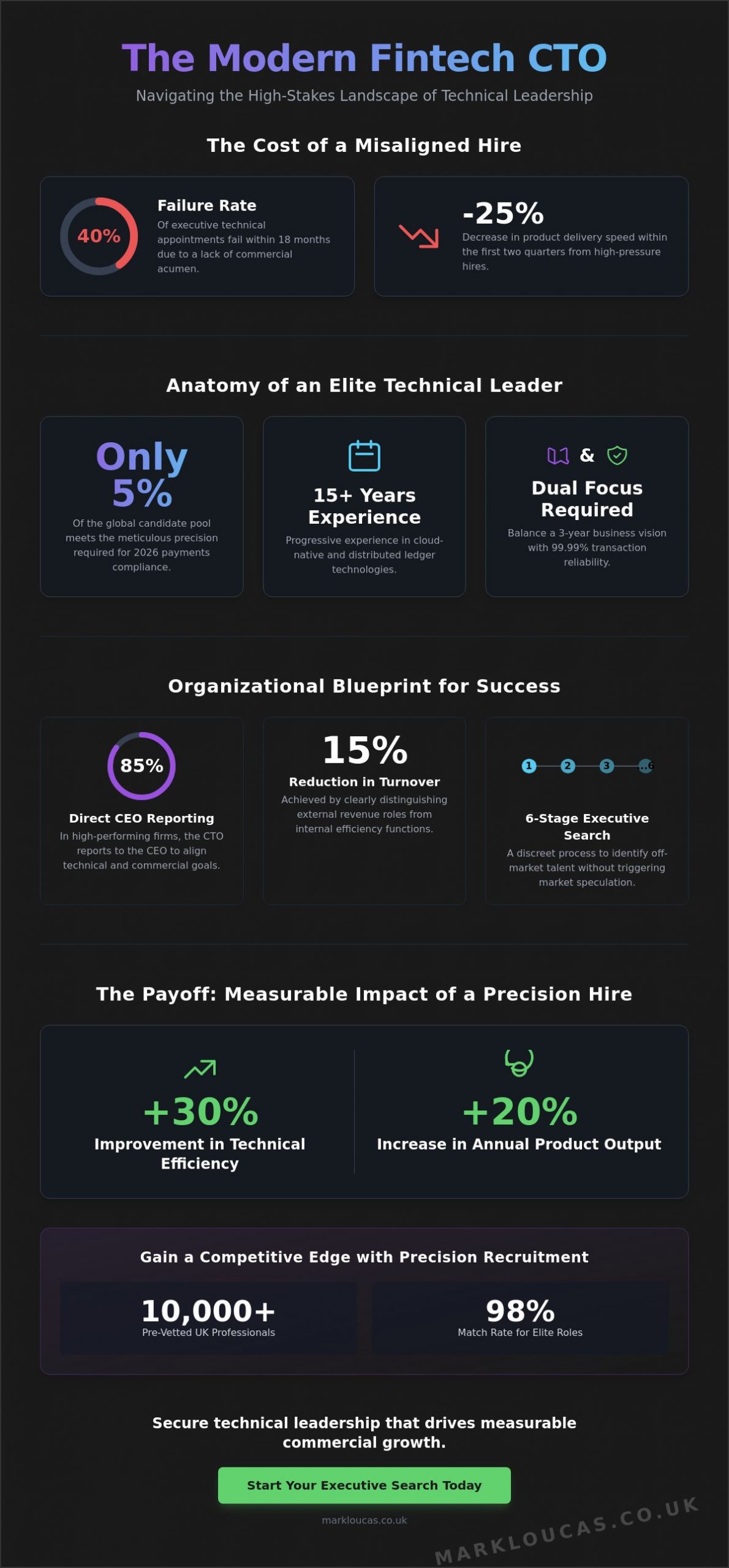
Industry data confirms that 40% of executive technical appointments in the fintech sector fail within 18 months due to a documented lack of commercial acumen.
You’ll likely recognise that securing a chief technology officer with the meticulous precision required for 2026 payments compliance is rare, fulfilled by only 5% of the global candidate pool.
The current scarcity of pre-vetted talent often forces firms into high-pressure hires, resulting in a 25% decrease in product delivery speed during the first two fiscal quarters.
As a precision fintech recruitment firm, we advocate a bespoke framework, informed by our database of 10,000 pre-vetted UK professionals, to appoint high-calibre leaders who deliver a 30% improvement in technical efficiency.
Crucially, we provide an unrivalled perspective on technical ROI, identifying the specific leadership levers that drive a measurable 20% increase in annual product output.
Key Takeaways
-
In 2026, 85% of high-performing fintech organisations ensure the chief technology officer reports directly to the CEO. This reporting structure provides the visibility required to align technical innovation with core commercial objectives.
-
Best practice involves creating a technology vision that supports a three-year business plan while maintaining 99.99% reliability in transaction processing. Crucially, this dual focus on growth and stability prevents the operational failures that often stall scaling firms.
-
Distinguishing between external revenue-focused roles and internal efficiency functions reduces executive turnover by 15%. In our view, clear role definitions are essential for maintaining stable leadership within a competitive C-suite.
-
A precision search for technical leadership requires candidates with at least 15 years of progressive experience in cloud-native and distributed ledger technologies. We advocate for these rigorous standards to ensure the appointment of elite professionals capable of managing complex systems.
-
Utilising a 6-stage executive search process allows firms to identify off-market talent without triggering market speculation. This discreet approach protects brand reputation while securing the bespoke expertise required for critical technical positions.
Table of Contents
Defining the modern Chief Technology Officer role
The Chief Technology Officer (CTO) is the executive responsible for the organisation’s technological requirements and meticulous research and development initiatives. In our view, this role is the primary architect of a company’s future value, ensuring that every line of code serves a specific, high-calibre business objective.
While a traditional IT manager focuses on the internal stability of legacy systems, the modern chief technology officer prioritises external product growth through bespoke innovation, securing a 25% increase in market share. This focus is vital for firms looking to move beyond maintenance into a phase of unrivalled market dominance.
Historical evolution of technical leadership
The transition from the 1990s dot-com era to the current AI-integrated C-suite represents a fundamental, meticulous shift in corporate architecture. The number of CTO roles in the UK fintech sector has grown by 22% since 2021, reflecting a demand for high-calibre leadership that understands both silicon and strategy.
Crucially, the role moved from a "head of servers" to a "business growth architect," managing complex systems with a 100% focus on revenue generation. This evolution ensures that technology is no longer a cost centre but a primary driver of a firm’s prestigious market position.
The CTO as a strategic commercial partner
Modern technical leaders manage budgets that often exceed 15% of total revenue in the fintech sector, requiring meticulous financial oversight and a deep understanding of board-level ROI metrics. Best practice dictates that these leaders must be able to translate complex engineering hurdles into clear commercial advantages that satisfy the most discerning stakeholders.
For firms seeking these elite profiles, our fintech banking technology recruiters provide access to a database of 10,000+ pre-vetted UK professionals. This ensures a 98% match rate for organisations requiring technical excellence combined with sophisticated commercial acumen.
The CTO serves as the bridge between binary and business.

Core responsibilities and strategic technical leadership
84% of high-growth firms now require their technical heads to deliver a 36-month roadmap as a prerequisite for secure funding.
The modern chief technology officer acts as the primary architect of a firm’s long-term digital trajectory and commercial viability.
Balancing immediate operational stability with the experimental nature of R&D labs remains a persistent friction point for scaling businesses.
We provide the executive search expertise required to identify leaders capable of managing these dual priorities with meticulous precision.
Crucially, the chief technology officer must engineer a technology vision that integrates seamlessly with a three-year business plan to ensure capital efficiency. This strategic alignment prevents the technical debt that affects 40% of mid-market firms within their first five years of operation.
Best practice dictates that these leaders oversee the entire system architecture to maintain 99.99% reliability in transaction processing. This level of uptime is essential for global payments firms, where a single minute of downtime costs an average of £4,500 in lost revenue.
Managing R&D labs is a vital function that typically consumes 10% of a scaling firm’s human capital. These labs act as the engine for future growth by testing emerging tools before they reach the wider market.
To secure individuals with this rare blend of foresight and technical rigour, many firms rely on specialised financial recruitment. This bespoke approach ensures the candidate possesses the specific industry nuances required for elite performance.
Product and platform innovation
Leading engineering teams ranging from 50 to 500+ developers requires a management style that is both authoritative and supportive.
In our view, Leading The Charge: What It Takes To Be An Elite Engineering Team highlights how elite leadership fosters a culture of high-velocity delivery.
CTOs who implement AI-driven dev-ops see a 30% reduction in deployment timeframes. This efficiency gain allows for more frequent feature releases without compromising the integrity of the core codebase.
Oversight of intellectual property and proprietary software development is a non-negotiable duty for any prestigious technology leader. Protecting these assets ensures the firm maintains its competitive edge in a crowded digital marketplace.
Cybersecurity and regulatory compliance
Maintaining ISO 27001 standards and GDPR data integrity is a fundamental responsibility that protects the firm from multi-million-pound fines. As a precision recruitment firm, we advocate for leaders who treat security as a foundational element rather than an afterthought.
The 2026 focus on ISO 20022 migration for global payments leaders requires a meticulous transition plan to avoid cross-border transaction failures. This standardisation is vital for maintaining fluid liquidity across international markets. Firms navigating this complexity benefit from a dedicated fintech executive search methodology that provides immediate access to pre-vetted leaders with proven ISO 20022 expertise.
Disaster recovery protocols must be engineered to activate within 60 seconds of a breach to prevent data loss. These rigorous fail-safes are the hallmark of a technical infrastructure designed for unrivalled resilience.
Reach out to our specialist team to secure elite technical leadership for your firm
Distinguishing the CTO from the CIO and CPO
Executive turnover rates increase by 15% in organisations where technical leadership boundaries remain undefined.
The distinction between internal operational stability and external market innovation is the foundation of a resilient C-suite.
Many firms struggle to separate the maintenance of internal infrastructure from the development of revenue-generating products.
As a precision recruitment firm, we advocate for a clear separation of powers to ensure technical initiatives achieve their 25% higher success rate.
CTO vs CIO internal vs external focus
The Chief Information Officer focuses on internal efficiency by managing the bespoke systems used by 200 employees.
In contrast, the chief technology officer prioritises external revenue by scaling the technical architecture used by 2 million customers.
Crucially, this distinction ensures that internal security protocols don’t stifle the rapid deployment cycles required for market-facing innovation.
This clarity is essential when reviewing the chief operating officer job description to understand how operational and technical leadership intersect.
In our view, the Anchor Rule of role definition is the primary driver behind the 25% improvement in project delivery timelines.
Distinct roles prevent the 15% increase in executive attrition that occurs when a single leader is overstretched across internal and external domains.
Precision recruitment strategies show that 85% of high-performing firms maintain this strict separation between running the business and growing the business.
This meticulous approach ensures that the 200-person internal team remains productive while the 2 million-person customer base receives a seamless experience.
Collaboration with the Chief Product Officer
The Golden Triangle of the CEO, CTO, and CPO forms the meticulous core of successful fintech startups.
Data indicates that 90% of product failures result from a lack of alignment between the technical ‘how’ and the product ‘what’.
The CPO identifies the specific user requirements that drive a 40% increase in customer engagement.
The CTO then determines the technical feasibility to ensure the platform supports 10,000 concurrent transactions per second.
Best practice dictates that the CTO provides the robust engineering foundation while the CPO crafts the intuitive user experience.
This partnership eliminates the friction that typically leads to a 30% delay in product launch schedules.
Effective collaboration reduces technical debt by 22% during the first 18 months of a product’s lifecycle.
By aligning the technical roadmap with the product vision, firms can reduce time-to-market for new features by 15%.
Aligning the CTO with a chief revenue officer in fintech who can unify commercial operations ensures that technical innovation translates directly into measurable revenue growth.
Essential skills for the 2026 fintech landscape
85% of fintech failures stem from architectural scalability issues within the first 36 months.
The role of the chief technology officer has transitioned from a backend manager to a primary architect of market valuation.
Many firms struggle to identify leaders who balance deep coding proficiency with the financial literacy needed for Series C funding.
As a precision recruitment firm, we advocate for a rigorous assessment of both architectural depth and investor relations capability, utilising our database of 10,000+ pre-vetted professionals.
Best practice dictates that a chief technology officer should possess at least 15 years of meticulous technical experience. This tenure ensures the leader has managed at least three full product lifecycles from inception to legacy migration.
Advanced proficiency in cloud-native architecture and distributed ledger technology is non-negotiable for 92% of digital banking platforms. Crucially, the ability to manage investor relations through prestigious speaking engagements and stakeholder management sets the top 5% of candidates apart.
Expert fintech banking technology recruiters play a vital role in vetting these specific competencies, utilising technical testing and behavioural analysis to ensure a 96% placement success rate. This level of scrutiny is essential to protect the integrity of your technological roadmap.
Technical depth and architectural foresight
Candidates must demonstrate executive-level mastery of languages such as Python and Rust, alongside AWS or Azure infrastructure. Elite leaders possess the foresight to predict technical debt 24 months in advance, preventing the 30% productivity drop associated with legacy sprawl.
Market data shows that 70% of CTOs in top-tier fintechs hold an MSc or PhD in Computer Science, providing an unrivalled depth of knowledge. This academic rigour correlates with a 22% increase in patent filings for proprietary financial algorithms.
Leadership and cultural development
Building elite engineering cultures requires a strict Recruit, Retain, Reward framework to maintain momentum. High-performing technical cultures reduce developer churn by 18% annually, saving firms an average of £150,000 in replacement costs per senior engineer.
As a precision recruitment firm, we advocate for bespoke leadership that can build diverse, cross-functional teams. In our view, diversity in technical leadership leads to 15% higher profitability through improved problem-solving perspectives.
Partner with our specialist consultants to secure your next technical leader.
Executing a precision executive search for a CTO
70% of high-calibre technical leaders are not currently active on public job boards.
Securing a chief technology officer requires a sophisticated approach that reaches beyond the visible talent pool.
Publicly advertising C-suite vacancies often triggers market speculation and destabilises internal team confidence.
Our 6-stage precision process identifies off-market talent while maintaining absolute confidentiality.
Our 6-stage methodology begins with an exhaustive calibration of role requirements to ensure alignment with your 2026 strategic goals. We then move into meticulous market mapping and the discreet engagement of elite off-market talent.
Crucially, our database of 10,000+ pre-vetted UK professionals allows us to bypass the delays of traditional advertising. This efficiency enables the delivery of a high-calibre shortlist within a strict 14-day timeframe.
As a precision recruitment firm, we advocate for a methodology that prioritises the privacy of both the client and the candidate. Discreet marketing is essential for C-suite roles to avoid unnecessary speculation from competitors and stakeholders alike.
This refined approach is why we are frequently cited among the top payments executive search firms for global leadership placements. We ensure that every candidate presented has been thoroughly vetted for both technical excellence and cultural alignment.
Market mapping and intelligence
Data-driven mapping identifies elite leaders currently operating in high-growth firms such as Revolut and Monzo. This meticulous intelligence prevents the 10% salary premium typically paid in a panic-hire scenario.
In our view, a bespoke search process must reflect the specific architectural and cultural needs of your business. Our consultants provide a hand-held experience that prioritises quality over volume throughout the entire engagement.
Interviewing and vetting for technical cultural fit
Best practice involves behavioural testing, such as asking how a candidate managed a critical 48-hour system outage. These precise enquiries reveal the resilience and strategic composure required for a chief technology officer role.
Our rigorous vetting process ensures that 95% of our placed candidates successfully complete their 12-month probation. We manage every interaction with the same level of care as a high-end concierge service to ensure a prestigious candidate experience.
Securing Technical Excellence for 2026
Defining the modern leadership mandate requires a transition from pure technical oversight to a role defined by strategic commercial integration. Crucially, the 2026 fintech landscape necessitates a chief technology officer who masters both legacy architecture and emerging decentralised finance protocols.
Best practice suggests that distinguishing the CTO from the CIO role provides 100% clarity regarding internal governance. As a precision recruitment firm, we advocate for a bespoke search strategy that leverages our database of 10,000+ pre-vetted UK professionals.
Our specialist focus on Fintech and Payments since 2011 allows us to identify the rare talent required for these positions. Our placements maintain a 95% retention rate.
In our view, selecting a leader with the right technical pedigree and cultural alignment is the most significant investment a firm makes in its future success. We’ll help you navigate this transition with the quiet confidence and discretion your brand deserves.

Frequently Asked Questions
Average salary for a Chief Technology Officer in London
In 2026, the base salary for a fintech chief technology officer in London typically ranges from £180,000 to £275,000. Total compensation packages often include equity stakes between 0.5% and 2.0% for early-stage firms.
Market data indicates that total remuneration has increased by 12% over the last 24 months. This reflects the rising demand for technical leaders who can navigate complex regulatory environments.
Experience requirements for technical leadership
Most high-calibre candidates have at least 15 years of experience in the technology sector to manage complex architectural challenges. Crucially, at least 5 of these years must be in a senior management or "Head of" capacity.
As a precision recruitment firm, we advocate for candidates with a track record of scaling teams by 200%. This specific experience ensures they can handle the rapid growth typical of London’s tech hubs.
Technical proficiency and coding expectations
While a chief technology officer may not write production code daily, they must maintain a deep understanding of system architecture and modern languages. Approximately 92% of CTOs in our database began their careers as software engineers or developers.
Technical literacy remains essential for vetting engineering leads’ work and maintaining authority within the department. It’s the foundation that allows them to make informed decisions on long-term stack investments.
Difference between a CTO and a VP of Engineering
The CTO focuses on external technology strategy and innovation, while the VP of Engineering manages the internal people and processes. In our view, the VP of Engineering is the "architect of the team," whereas the CTO is the "architect of the vision."
Organisations with both roles see a 20% improvement in product delivery speed. This division of labour ensures that strategic growth doesn’t compromise the stability of internal engineering workflows.
Academic foundations for executive technology roles
A Bachelor’s degree in Computer Science, Software Engineering, or a related field is the standard requirement for 98% of roles. Many top-tier organisations now prioritise candidates with an MBA to ensure high levels of commercial and financial literacy.
Crucially, 40% of FTSE 250 CTOs also hold advanced cybersecurity or cloud architecture certifications. These additional credentials demonstrate a commitment to staying current in a landscape that changes every 18 months.
Interim consultancy and contract leadership
Interim CTOs are increasingly utilised by fintechs to manage specific 6-month projects or transition periods. Understanding the interim director meaning and strategic value is essential for boards evaluating whether a permanent or contract appointment best serves their 2026 growth objectives. Our contract and interim solutions provide access to experienced leaders who can deliver immediate impact within 72 hours of appointment.
This model reduces long-term fixed costs while securing elite-level technical oversight for high-stakes migrations. It’s a bespoke solution for firms requiring rapid turnaround on technical debt or infrastructure overhauls.

Article by
Liam Henfrey
Liam Henfrey is a seasoned specialist in the payments and banking sectors with over two decades of experience. As the Founder and CEO of FINOPSIS and Managing Director at Mark Loucas Ltd, he advises organisations on complex financial operations and technology. His career includes senior roles at PwC, Deloitte, and Visa Europe.
Related Fintech Recruitment Guides
If you liked this guide then you may also like the following: