


How to Organise and Scale a Fintech Engineering Team in 2026
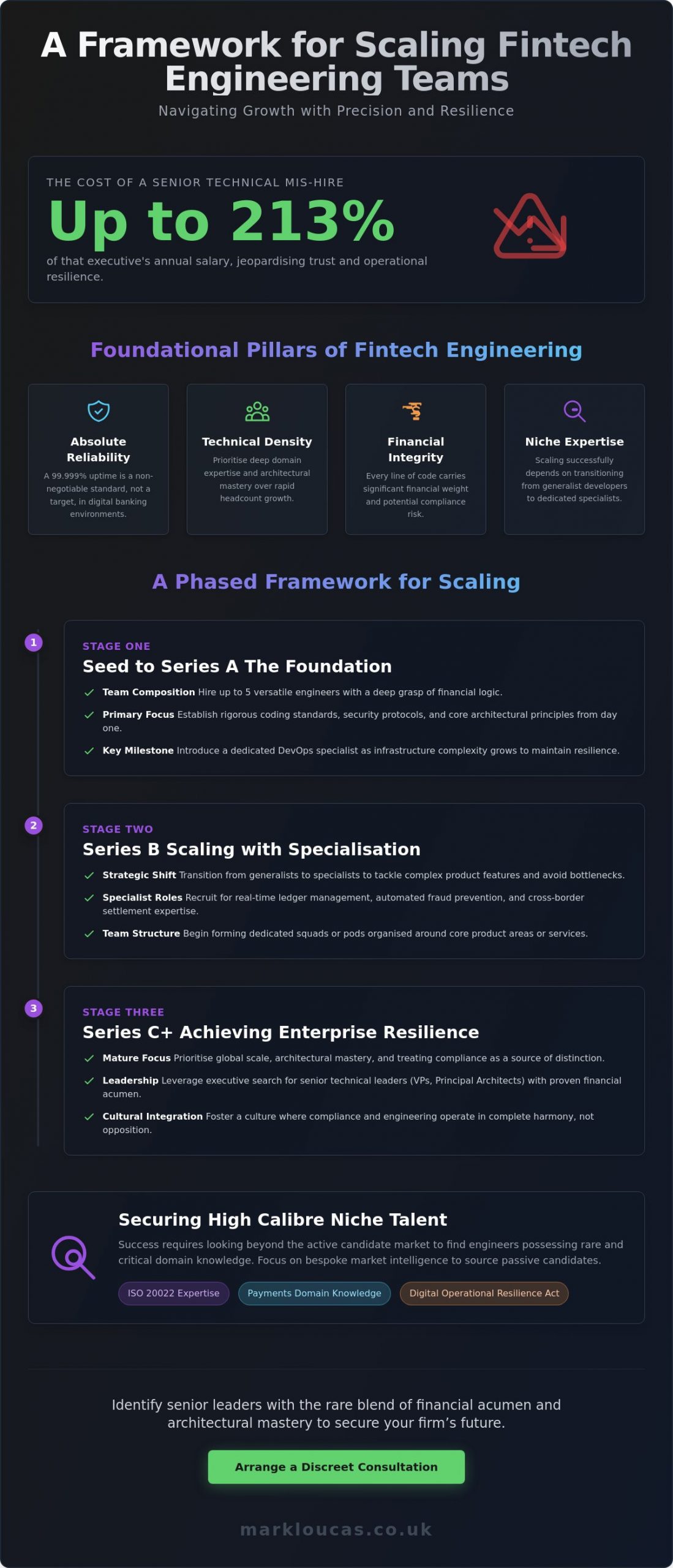
A single misstep in appointing a senior technical leader can cost your firm up to 213% of that executive’s annual salary. In the refined landscape of 2026, the era of unchecked expansion has been replaced by a focus on trust and operational resilience, meaning the stakes for scaling a fintech engineering team have never been higher. It is a world where meticulous precision is the only currency that truly matters.
You likely recognise the weight of the current talent shortage, particularly when seeking engineers who possess deep payments domain knowledge and an understanding of the Digital Operational Resilience Act. It is a delicate task to maintain a distinct culture whilst navigating the regulatory bottlenecks that can hinder your product releases. We understand that your goal is to grow with absolute excellence and discretion.
This article provides the strategic framework required to expand your technical department whilst maintaining the high standards necessary for global payments and digital banking. We will share a clear roadmap for hiring at different growth stages, techniques for accessing high calibre niche talent, and the methods for building a resilient engineering culture that treats compliance as a source of distinction.
Key Takeaways
- Appreciate the unique architectural demands of fintech where 99.999 per cent uptime is a non-negotiable standard for digital banking.
- Implement a refined framework for scaling a fintech engineering team that prioritises technical excellence over rapid headcount growth during critical funding stages.
- Secure specialist talent with niche domain knowledge, such as ISO 20022 expertise, by looking beyond the active candidate market.
- Foster a culture where compliance and engineering operate in harmony, ensuring that regulatory frameworks support rather than hinder product releases.
- Utilise bespoke market intelligence to identify senior technical leaders who possess the rare blend of financial acumen and architectural mastery.
To discuss how we can assist with your specific growth requirements, we invite you to speak with us via our contact page to arrange a discreet conversation.
Defining the Core Challenges of Fintech Engineering Growth
Fintech is not merely traditional software with a currency symbol attached. It is a rigorous discipline where the architecture must support the absolute integrity of global financial systems. Scaling a fintech engineering team requires a departure from the “move fast and break things” philosophy found in general consumer technology. In this sector, breaking things results in regulatory fines, lost capital, and a total erosion of user trust. The stakes are profoundly different.
Maintaining a 99.999 per cent uptime is a standard expectation in digital banking environments. Achieving this level of reliability whilst expanding requires more than just additional developers. It demands a focus on technical density. This metric represents the concentration of deep domain expertise relative to the total headcount. A strategy for scaling a fintech engineering team involves increasing this density rather than just inflating the number of seats in the office.
To begin understanding the fintech landscape, one must appreciate that every line of code carries financial weight. A minor logic error in a payment gateway is not just a bug; it is a potential capital loss or a compliance breach. Hiring generalist developers who lack an appreciation for these consequences often leads to expensive technical debt that must be untangled later.
Understanding the High Stakes of Payments Infrastructure
The complexity of modern fintech lies in the intersection of legacy banking rails and sophisticated modern APIs. Engineers are required to build bridges between decades-old mainframe logic and real-time cloud environments. This requires a meticulous approach to craftsmanship. In a regulated environment, technical density is defined as the collective ability of a team to ship compliant code that respects the nuances of financial law without sacrificing performance. Every engineer must understand the financial implications of the code they write to ensure the system remains resilient under the weight of global demand.
The Shift from Generalist to Specialist Knowledge
Early-stage startups often rely on generalist builders who can pivot quickly across the entire stack. These individuals are vital for reaching a minimum viable product. However, as a firm matures and begins the process of payments industry recruitment at scale, these generalists can become a bottleneck. Complex features like real-time ledger management, cross-border settlement, or automated fraud prevention require specialists. Generalists may struggle with the specific constraints of financial messaging standards or the intricacies of transaction atomicity. Success in 2026 depends on finding those rare individuals who have spent years mastering the specific plumbing of the financial world.
Should you wish to discuss your firm’s specific hiring roadmap, please contact us through our contact page for a confidential consultation.
A Step by Step Framework for Each Scaling Stage
Scaling a fintech engineering team requires a disciplined approach to timing. One cannot simply hire fifty developers and expect a coherent system to emerge. Instead, the process should be viewed as a series of architectural layers, each requiring a specific type of expertise to support the next level of growth. It is a journey from the intimate collaboration of a founding team to the structured precision of a global enterprise. Success in this endeavour depends on knowing exactly when to introduce new layers of leadership.
Building the Foundation from Seed to Series A
In the earliest stages, your focus must be on hiring five versatile engineers who possess a deep understanding of financial logic. These individuals act as the architects of your future platform, often wearing multiple hats across the full stack. They must establish rigorous coding standards and security protocols from day one, as retrofitting these into a live payments system is notoriously difficult. As the infrastructure grows in complexity, the point where a dedicated DevOps recruitment specialist becomes essential arrives. This specialist ensures that your deployment pipelines are as resilient as the financial transactions they carry. Security and quality assurance functions should be introduced early to ensure that the foundation is stable enough for mass hiring. This foundational work is the prerequisite for scaling a fintech engineering team successfully.
Managing Complexity from Series B and Beyond
Once a firm reaches Series B, the challenges shift from building the product to managing the people and the increasing number of stakeholders. This is the moment to introduce a VP of Engineering. This leader manages processes and ensures that the technical vision remains intact whilst the headcount expands. To maintain delivery speed, most successful fintechs transition from a flat structure to a cross-functional squad model. Each squad is centred around a specific product or feature, such as ledger management or card issuing. This decentralised approach prevents the bottlenecks often caused by traditional hierarchies. It allows for rapid iteration whilst maintaining the high standards required for digital banking. If you are currently navigating these structural shifts, our fintech talent advisory services can provide the market intelligence needed to make informed decisions.
If you are seeking to identify the rare individuals capable of navigating these complex technical landscapes, we invite you to explore our tailored solutions via our contact page for a confidential discussion.
Sourcing Specialist Talent Beyond Generalist Software Engineers
The pursuit of technical excellence in fintech is often a quiet and deliberate one. Whilst many firms focus on pure headcount, the most successful organisations understand that scaling a fintech engineering team effectively requires the acquisition of niche domain expertise. These individuals are the true craftsmen of the financial world. They are almost exclusively passive candidates, currently managing critical infrastructure for global institutions or prestigious boutique firms. Accessing them requires a level of discretion and market intelligence that traditional, volume-driven recruitment methods simply cannot provide.
In 2026, the technical landscape has become increasingly specialised. The global shift towards the ISO 20022 standard for financial messaging has created a high demand for engineers who possess more than just coding skills. They must understand the underlying logic of financial transactions and the implications of regulatory change. Partnering with fintech and banking technology recruiters allows firms to tap into these elite circles, identifying professionals who can navigate the complexities of modern payments infrastructure with absolute precision.
Identifying Niche Skills in DevOps and Data
Fintech DevOps is a distinct and rigorous discipline. It requires a profound understanding of data residency laws and the Digital Operational Resilience Act (DORA), which mandates uncompromising IT risk management. Engineers must now specialise in real-time gross settlement systems, ensuring that liquidity flows without friction across borders. When evaluating candidates, look for those who can articulate the risks associated with Circular ASFI/945/2026. Ask how they would design for atomicity in a distributed ledger during a network partition. Their response will reveal whether they possess true domain expertise or merely a surface-level understanding of the technology.
Attracting High Calibre Passive Candidates
Elite engineers are drawn to architectural challenges that others find daunting. To attract them, you must present a vision that transcends simple product growth. Discuss the meticulous attention to detail in your codebase or the impact of your work on global financial resilience. This outreach must be handled with the utmost privacy and professional care. A boutique advisor acts as a trusted intermediary, offering the tailored solutions and individualised attention that senior leaders expect. This approach ensures that your brand is presented with the sophistication it deserves, far removed from the impersonal nature of large corporate entities. Success is found in these curated, private connections.
If your firm requires a discreet partner to help build a team that balances innovation with absolute regulatory integrity, we invite you to reach out via our contact page to arrange a confidential discussion.
Integrating Compliance and Security into the Engineering Culture
A persistent fallacy suggests that compliance and development velocity are opposing forces. In the sophisticated climate of 2026, where the EU AI Act and the CFPB Section 1033 rule have established new benchmarks for data rights and algorithmic accountability, compliance has become the very foundation of speed. A team that attempts to build on shifting regulatory sands will inevitably be forced to pause and rebuild. When scaling a fintech engineering team, success is found by treating governance as a core architectural requirement rather than a final hurdle to be cleared.
The role of a compliance officer has evolved into a strategic partnership with the technical department. They act as a co-architect, providing the necessary constraints that allow engineers to build with confidence. By integrating automated compliance checks directly into the CI/CD pipeline, firms can ensure that every deployment respects global standards without manual intervention. This is supported by a rigorous schedule of security audits and penetration testing, which serves to reassure a discerning clientele that their interests are being managed with expert care.
Embedding Regulatory Awareness into Development Cycles
Adopting a shift-left approach ensures that security and compliance are considered at the earliest stages of the design process. This cultural shift requires engineers to possess a baseline level of regulatory literacy. To maintain these standards, senior technical staff can use compliance expert interview questions to vet their own peers during the hiring process. This practice ensures that every new hire understands the weight of their responsibility. Meticulous documentation is no longer a chore; it is a vital component of meeting FCA and global standards, providing a clear audit trail for every architectural decision.
The Necessity of Information Security Experts
Whilst security is a shared responsibility, it must be led by specialists who understand the unique threats facing digital banking in 2026. The rise of agentic AI fraud requires a sophisticated defence that generalist developers may not be equipped to build. Integrating dedicated security engineers into product squads ensures that protection is woven into the fabric of every feature. This model allows for a steady, reassuring pulse of delivery whilst maintaining the high-end concierge level of service that elite fintechs must provide. To explore how we can help you secure the specialists needed to bridge the gap between code and compliance, please visit our contact page.
To ensure your leadership appointments are handled with the level of care and market insight they deserve, please visit our contact page to begin a private consultation.
Leveraging Executive Search for Senior Technical Leadership
The journey of scaling a fintech engineering team eventually reaches a critical juncture where the architecture of the organisation becomes as important as the architecture of the software. At this stage, the requirement for senior technical leadership becomes paramount. Traditional recruitment methods, which often rely on active candidate pools and volume-driven metrics, frequently fail to identify the calibre of individual required for these high-stakes roles. Senior leaders who possess the rare combination of technical depth and commercial acumen are seldom looking for their next opportunity. They are the hidden architects of the industry, and reaching them requires a sophisticated approach rooted in market mapping and intelligence.
Partnering with fintech recruitment agencies in London provides access to these non-public opportunities. A high-level executive search is a meticulous process that begins with a deep understanding of your firm’s unique culture and technical challenges. It involves identifying individuals who not only have a proven track record of navigating complex regulatory shifts but who also possess the vision to lead a department through rapid growth. This is a discreet and unhurried endeavour, reflecting the patience required for high-value transactions.
Why Technical Leadership Requires Executive Search
The scarcity of leaders who can bridge the gap between engineering and the boardroom is a significant challenge for maturing firms. A discreet search protects your firm’s reputation and maintains internal morale whilst the transition occurs. It ensures that the eventual appointment is an individual of true distinction. Given that a comprehensive search for a senior leader can take between 90 and 120 days, the long-term ROI of a high-calibre executive is substantial. These leaders provide the stability and strategic direction needed to ensure that scaling a fintech engineering team does not compromise the operational resilience of the platform.
Partnering with Specialist Fintech Recruiters
There is a profound difference between volume-driven agencies and niche consultancies that offer a tailored approach. At Mark Loucas, we provide a bespoke fintech talent advisory service that functions as a highly connected boutique advisor. We shun the impersonal nature of large corporate entities in favour of an intimate, personalised service that suggests your firm is the sole focus of our attention. Our expertise is deeply rooted in the culture of premium urban centres, allowing us to provide the market intelligence necessary for successful executive search. If you are ready to scale your engineering leadership with absolute precision, we invite you to explore our fintech executive search solutions to secure the future of your technical department.
Securing Future Excellence in Technical Growth
The successful evolution of your firm depends on a transition from rapid expansion to the pursuit of technical density and architectural resilience. We have explored how scaling a fintech engineering team in 2026 requires a meticulous focus on niche domain expertise, where every hire is viewed as a strategic asset in a highly regulated landscape. By integrating compliance into the very fabric of your development cycles and adopting a squad-based model, you ensure that your platform remains as robust as the global financial systems it supports.
As a boutique advisor, we offer a level of individualised attention that volume-driven entities cannot match. Our expertise as specialist recruiters for the global payments industry and our expert talent advisory for digital banking ensures that your technical foundation is built with absolute precision. We also provide discreet executive search for senior technical leadership to help you secure the visionaries needed to navigate future complexities. To ensure your growth strategy is supported by the right talent, please get in touch with our specialist team for a confidential consultation. We look forward to helping you achieve a position of lasting distinction in the market.
Frequently Asked Questions
How to scale a fintech engineering team without losing quality
Scaling without losing quality requires a focus on increasing technical density rather than just headcount. You must prioritise hiring individuals who understand the high stakes of financial infrastructure. Implementing automated compliance checks within your CI/CD pipeline ensures that your standards remain uncompromising as you grow. This approach allows you to maintain the 99.999 per cent uptime required for digital banking whilst expanding your capabilities.
The most important roles when scaling a fintech team
Key roles include the VP of Engineering to manage people and processes, and specialist Payments Engineers who understand financial messaging standards. You also require Information Security Experts to navigate the complexities of the Digital Operational Resilience Act. These specialists ensure your platform is both innovative and compliant. Each role acts as a pillar that supports the weight of a larger, more complex technical department.
When a fintech startup should hire a CTO
A CTO should be appointed at the seed stage to establish the core architectural vision and security protocols. This early leadership ensures that the foundation is stable enough for future expansion. As the firm matures and begins the process of scaling a fintech engineering team, the CTO can focus on long-term strategy whilst a VP of Engineering manages the daily operations of the squads.
Why domain expertise is critical for fintech engineers
Domain expertise is vital because financial logic is exceptionally unforgiving. A minor error in a payment gateway can lead to significant capital loss or a breach of regulatory trust. Engineers must understand the nuances of transaction atomicity and global standards like ISO 20022. This knowledge ensures that the code they write respects the intricate requirements of the financial landscape.
Using remote engineers for regulated payments projects
Remote engineers are a viable solution for regulated projects if they operate within a framework that respects data residency laws. Many firms adopt a global hiring model to access specialised skills that may be scarce in their local market. It’s essential to ensure that your remote infrastructure is as secure as your on-site environment, maintaining the meticulous attention to detail required for payments.
How scaling an engineering team affects product delivery speed
Scaling can initially slow down delivery as new hires are onboarded and integrated into the culture. However, transitioning to a squad-based model helps to maintain speed by decentralising decision-making. Each squad focuses on a specific product area, which reduces the number of stakeholders involved in every feature release. This structure allows for rapid iteration without sacrificing the quality of the financial product.
The role of executive search in engineering scaling
Executive search is the most effective way to identify senior technical leaders who are not actively seeking new roles. It provides a discreet path to the passive candidate market, utilising market mapping to find individuals with a rare blend of financial and technical acumen. This approach ensures that your leadership appointments are handled with the level of care and exclusivity that your firm deserves.
How to attract senior engineers to a growing fintech firm
Attracting senior talent requires you to present complex architectural challenges that appeal to their sense of craftsmanship. You should highlight your commitment to technical excellence and a culture that values deep domain expertise. Using a boutique advisor for outreach ensures that the conversation is professional and discreet. Senior engineers are often drawn to environments where they can build resilient systems that have a genuine global impact.

Article by
Liam Henfrey
Liam Henfrey is a seasoned specialist in the payments and banking sectors with over two decades of experience. As the Founder and CEO of FINOPSIS and Managing Director at Mark Loucas Ltd, he advises organisations on complex financial operations and technology. His career includes senior roles at PwC, Deloitte, and Visa Europe.
Related Fintech Recruitment Guides
If you liked this guide then you may also like the following: