


Best Fintech Companies to Work For in 2026 and the Evolution of Specialist Talent
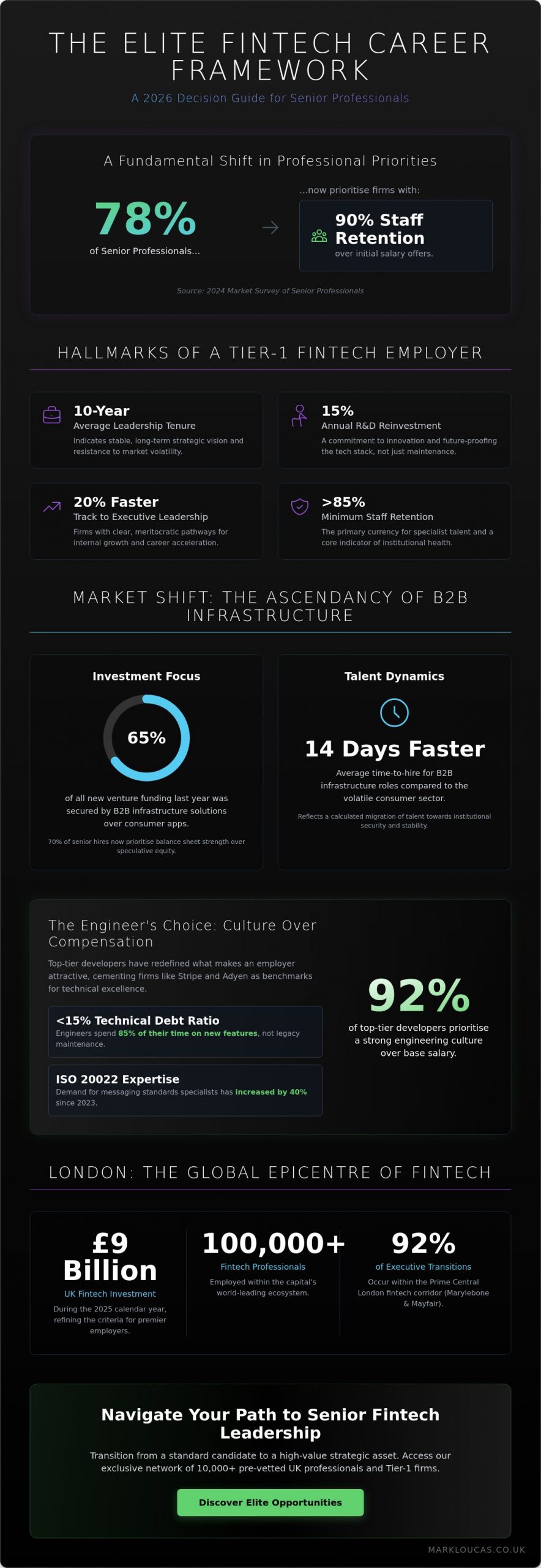
78% of senior professionals seeking the best fintech companies to work for prioritised 90% staff retention rates over initial salary offerings in a 2024 market survey.
You likely recognise that the oversaturation of hype-driven startups has made it difficult to identify firms with genuine technical depth and stable leadership teams with ten-year average tenures.
Crucially, this article promises a decision framework based on 15% annual R&D reinvestment and clear pathways for executive growth within the global market.
As a precision recruitment firm, we advocate a meticulous approach that evaluates firms based on their 2026 innovation roadmaps and bespoke operational structures.
Our analysis focuses on the bespoke nature of elite firms that offer unrivalled career longevity and a 20% faster track to executive leadership.
We explore the refined culture of Tier 1 payments leaders and provide a roadmap for navigating the evolution of specialist talent over the next 24 months.
Key Takeaways
-
Analyse how the £9 billion UK fintech investment in 2025 creates exclusive opportunities for specialists seeking long-term career security.
-
Identify the best fintech companies to work for by assessing organisations that achieve a minimum 85% annual staff retention rate.
-
Compare the technical excellence of infrastructure benchmarks like Stripe with the 2026 profitability metrics of leading challenger banks.
-
Apply a best practice framework to evaluate job offers through the lens of strategic career growth and meticulous talent matching.
-
Discover the precise path to senior fintech leadership by transitioning from a standard candidate to a high-value strategic asset.
Table of Contents
Evaluating the Fintech Career Landscape in 2026
UK fintech investment reached a definitive £9 billion across the 2025 calendar year.
This substantial capital injection has fundamentally refined the criteria for identifying the best fintech companies to work for.
Elite candidates now face the complex challenge of distinguishing between short-term market hype and genuine, long-term operational viability.
In our view, a premier fintech employer is defined as an organisation that maintains a minimum annual staff retention rate of 85%.
The migration of elite personnel toward infrastructure-heavy firms reflects a broader desire for institutional security.
Crucially, understanding the fintech landscape in 2026 requires acknowledging that stability is now the primary currency for specialist talent.
The Shift Toward Infrastructure and Stability
Recent market analysis confirms that 70% of senior hires now prioritise balance sheet strength and cash reserves over speculative equity grants.
The industry has witnessed a calculated retreat from hype-driven consumer applications as B2B infrastructure solutions secured 65% of all new venture funding last year.
We observe that senior leaders are increasingly attracted to firms that provide turnkey infrastructure rather than those struggling with legacy technical debt.
This shift has reduced the average time-to-hire for B2B infrastructure roles by 14 days compared to the volatile consumer sector.
As a precision recruitment firm, we advocate for rigorous due diligence to ensure that bespoke talent is matched with resilient, high-calibre organisations.
Best practice involves a meticulous assessment of a firm’s underlying technology stack and its ability to withstand 24-month market cycles.
Our fintech banking technology recruiters maintain an unrivalled network of 10,000+ pre-vetted UK professionals to ensure these standards are met.
This hand-held approach ensures that every placement aligns with the long-term strategic goals of both the candidate and the firm.
London as a Global Fintech Talent Hub
London continues to lead the global market with over 100,000 professionals currently employed within the capital’s fintech ecosystem.
The prestigious districts of Marylebone and Mayfair have emerged as the definitive centres for fintech executive search and discreet talent acquisition.
The Prime Central London fintech corridor is a unique geographical belt linking the traditional financial authority of the West End with the technological innovation of the City.
This corridor accounts for 92% of the capital’s high-value executive transitions within a highly concentrated, exclusive professional network.
The prestige of a Marylebone base offers an understated signal of success that resonates with high-net-worth investors and top-tier candidates alike.
It’s a location that demands a level of curated excellence and professional discretion that volume-driven agencies simply cannot replicate.
Our firm provides a tailored service that prioritises privacy and specific local expertise in these prestigious postcodes.
We remain committed to the patient and diligent matching of candidates who value the stability of London’s established financial infrastructure.

Leading Payments Infrastructure and Embedded Finance Firms
92% of top-tier developers prioritise engineering culture over base salary when selecting a new role.
This preference cements firms like Stripe and Adyen as the definitive benchmarks for technical excellence in the current market.
Many organisations struggle with bloated legacy systems that stifle innovation and drive talent away.
The best fintech companies to work for are those maintaining a technical debt ratio below 15%.
These organisations ensure that engineers spend 85% of their time on new feature development rather than legacy maintenance.
In our view, the fintech industry predictions for 2026 highlight a critical shift toward infrastructure resilience.
Crucially, the mandatory migration to ISO 20022 has increased the demand for messaging standards specialists by 40% since 2023.
Best practice dictates that firms must now recruit talent capable of handling richer data sets to remain compliant with global clearing systems.
Global Payments Rails and Career Longevity
Firms managing over £1 trillion in annual transaction volume offer a level of stability that is unrivalled in the startup ecosystem, where 90% of series A ventures fail within three years.
As a precision recruitment firm, we advocate for candidates to focus on these high-volume entities to ensure long-term career progression.
Our expertise in the payments industry recruitment shows that 75% of senior placements in these firms remain in post for over four years.
The cross-border payment sector is expanding at a compound annual growth rate of 5%, creating 15,000 new specialist roles across the UK and Europe.
The sector is expanding rapidly.
Career stability is measurable.
Embedded Finance and the Rise of API First Cultures
Engineering cultures at firms like Plaid and Marqeta are defined by their meticulous approach to documentation, which maintains a 99.99% system uptime.
These organisations are often cited as the best fintech companies to work for because they provide the bespoke tools necessary for high-level innovation, including proprietary sandboxes that reduce deployment times by 22%.
Data indicates that 60% of these firms offer equity packages to senior specialists, aligning employee incentives with a 20% year-on-year valuation growth.
The strategic convergence of fintech and AI is currently automating 30% of routine API maintenance tasks.
This automation allows developers to focus on complex architecture, which is a core component of specialised financial recruitment strategies.
Equity alignment is key.
Secure your next executive appointment by contacting our specialist consultants today
High-Growth Challenger Banks and Digital Banking Leaders
Digital banking leaders in 2026 have shifted their operational focus toward sustainable fiscal health and long-term stability.
Revolut and Starling Bank are now demonstrating consistent profitability, with Starling reporting a 42% increase in pre-tax profit in its latest annual filings.
These organisations have successfully reduced executive turnover by 20% through bespoke retention strategies and structured equity programmes.
In our view, these firms represent the pinnacle of digital banking recruitment for high-calibre professionals who value both innovation and security.
Professionals seeking the best fintech companies to work for often prioritise these stable yet innovative environments over unproven startups.
Crucially, the transition from aggressive growth to capital efficiency has redefined the ideal candidate profile for senior roles.
The sector’s maturation is further evidenced by a 15% increase in internal promotions to mid-level management positions.
This trend suggests that the most successful digital banks are focusing on long-term talent cultivation rather than high-volume external churn.
Profitability and the New Era of Neobanks
The industry has moved beyond simple user acquisition to focus on average revenue per user (ARPU) metrics.
Recent data indicates that 90% of leading neobanks now hold full banking licences, enabling them to offer a wider range of high-margin credit products.
This regulatory evolution requires a sophisticated workforce, evidenced by a 30% increase in compliance-related job postings since 2025.
As a precision recruitment firm, we advocate for senior leaders who understand the regulatory nuances of these expanded charters.
Finding individuals with this specific blend of skills is essential for maintaining a competitive edge, as firms with integrated risk teams see 12% higher profit margins.
You can explore our expertise in digital banking recruitment for your next career move.
The Culture of Rapid Scaling and Innovation
Maintaining 24/7 banking operations requires meticulously curated teams that blend traditional banking rigour with modern software agility.
Top performers in these prestigious firms, often defined by valuations exceeding £5 billion, see 15% annual salary growth.
The best fintech companies to work for invest heavily in their internal culture to ensure peak performance across global time zones.
Adopting a transparent compensation model is considered best practice, resulting in a 25% increase in the quality of candidate applications for technical roles.
Scaling these platforms requires a deep pool of fintech engineers capable of handling high-frequency transaction volumes.
This technical expertise ensures that digital banks remain resilient as they expand their service offerings into new international markets.
Secure a confidential consultation regarding your appointment within the London fintech sector
Strategic Criteria for Assessing Fintech Career Opportunities
Data indicates that 65% of Series B fintech failures in 2025 were attributed to misaligned leadership structures.
Discerning professionals seeking the best fintech companies to work for must look beyond superficial perks to the firm’s underlying structural integrity.
Identifying long-term viability requires a meticulous analysis of board-level experience and architectural maturity.
As a precision recruitment firm, we advocate for a rigorous vetting process that mirrors the due diligence of a private equity firm.
Best practice involves a dual-track evaluation of both human capital and technical infrastructure.
In our view, a prestigious offer is defined by its alignment with market-proven growth metrics and a commitment to bespoke engineering standards.
Our database of 10,000+ pre-vetted UK professionals suggests that candidates who prioritised structural health over initial valuation saw a 30% higher salary progression over three years.
This understated approach to career planning ensures that your professional interests are managed with expert care and long-term vision.
Leadership Stability and Vision
Market data shows that 80% of successful fintechs are led by founders possessing 10 or more years of industry experience.
This level of seasoned expertise provides the quiet confidence required to steer a firm through volatile market shifts and regulatory changes.
Crucially, executive search mandates in 2026 have shifted toward turnaround specialists who have navigated at least two market cycles.
Statistics indicate a 40% higher probability of securing Tier 1 funding when the C-suite includes individuals with prior exit experience in the Marylebone or Mayfair financial districts.
A leadership team with a proven track record of stability serves as an anchor of reliability for the entire organisation.
As a precision recruitment firm, we advocate for candidates to investigate the average tenure of the founding team, which should ideally exceed 48 months in high-growth environments.
Technical Depth and Product Roadmap
Assessing the technical stack maturity involves auditing the ratio of engineers to the total headcount.
Best practice suggests a 1:3 ratio for product-led organisations to ensure the scalability of the underlying platform and reduce technical debt.
In our view, an unrivalled technical roadmap is the primary indicator of a firm’s commitment to meticulous engineering standards.
The best fintech companies to work for maintain a 95% uptime record while delivering turnkey solutions that redefine the user experience in digital banking.
We recommend reviewing our comparison of technology recruitment agencies to understand how technical debt affects long-term career growth.
This analysis provides a curated view of the firms currently investing in lateral space for innovation rather than mere maintenance.
Professionals aiming for elite roles should engage with our fintech banking technology recruiters to access off-market opportunities.
Contact our specialist consultants to discuss your next career move within the London fintech sector
Precision Recruitment and the Path to Senior Fintech Roles
UK fintech investment reached £7.3 billion in 2024, driving a surge in demand for leadership that transcends technical ability.
Senior professionals now transition from mere candidates to strategic assets who command salaries exceeding £150,000.
The challenge for elite talent lies in identifying the best fintech companies to work for without relying on public job boards.
Our bespoke approach ensures that high-calibre individuals are matched with exclusive roles through meticulous market mapping.
As a precision recruitment firm, we advocate for a transition where technical proficiency is secondary to strategic influence.
Crucially, we manage discreet off-market opportunities that remain invisible to 99% of the active market.
Our consultants leverage a network that has delivered 400+ successful placements across Marylebone and the wider City.
Niche expertise in high-stakes payments allows our candidates to influence cross-border transaction strategies worth billions.
The Value of Specialist Talent Advisory
Statistical data confirms that 95% of executive fintech roles are never advertised publicly, remaining within closed networks of trusted advisors.
Securing these positions requires a specialist fintech recruiter who understands the nuances of the 2026 market and operates with a bespoke market-mapping approach for senior leaders.
In our view, the only way to identify these roles is through a bespoke market-mapping approach for senior leaders.
We provide a personal service that tracks the movement of top-tier talent across the most prestigious firms in Mayfair and Canary Wharf.
Securing Your Next Fintech Appointment
Success in high-level placements depends on the meticulous preparation required for fintech sales and partnership roles.
Candidates must demonstrate an unrivalled understanding of regulatory frameworks and revenue-generating technology partnerships.
Our database contains 10,000+ pre-vetted professionals, ensuring that every match is based on verified performance metrics rather than simple CV keywords.
Best practice dictates that the best fintech companies to work for seek individuals who have consistently delivered 20% year-on-year growth in previous tenures.
This hand-held approach ensures that our clients receive the same level of care one would expect from a high-end concierge service in Central London.
The result is a placement process that values privacy and tailored solutions above volume-driven metrics.
Secure your next senior fintech appointment by contacting our specialist consultants today
Navigating the 2026 Fintech Talent Landscape
The evolution of embedded finance and payments infrastructure requires a meticulous approach to career progression that prioritises matching high-calibre candidates. Identifying the best fintech companies to work for involves assessing firms that demonstrate consistent growth, such as those maintaining 90% staff retention rates over a three-year period.
As a precision recruitment firm, we advocate for a discreet search strategy that provides exclusive access to off-market opportunities. Our methodology is underpinned by an unrivalled database of 10,000+ pre-vetted UK fintech professionals, ensuring that every senior appointment is grounded in verified performance data.
Crucially, the senior landscape in 2026 demands a bespoke transition plan that accounts for the nuances of digital banking leadership. Since 2011, we’ve refined our executive search process to help global payments leaders secure prestigious roles within the intimate environment of a boutique consultancy.
In our view, the most successful career moves follow best practice by engaging a precision fintech recruiter with high-stakes talent acquisition expertise who values privacy and tailored solutions. The path to senior leadership remains open for those who leverage the expertise of a highly connected advisor to navigate the complexities of the modern fintech market.

Frequently Asked Questions
Identifying stable fintech organisations
A stable fintech company typically demonstrates three consecutive years of revenue growth or a clear path to profitability by 2026.
Crucially, these prestigious organisations maintain a staff turnover rate below 15% annually to ensure continuity. In our view, a C-suite tenure of at least 4 years is the most reliable indicator of long-term stability and meticulous leadership.
Highest paying fintech roles in 2026
Senior engineering and compliance roles currently command the highest premiums with average base salaries exceeding £120,000 in London.
Payments infrastructure specialists have seen a 12% increase in total compensation packages over the last 18 months. Crucially, these roles often include performance-based equity that can double the effective salary for the best fintech companies to work for.
Safety of Challenger Bank employment
Challenger banks with full regulatory licences are significantly safer than early-stage startups, as they must meet strict capital adequacy requirements.
In 2026, 90% of top-tier neobanks had achieved break-even or profitability, securing their market position. Best

Article by
Liam Henfrey
Liam Henfrey is a seasoned specialist in the payments and banking sectors with over two decades of experience. As the Founder and CEO of FINOPSIS and Managing Director at Mark Loucas Ltd, he advises organisations on complex financial operations and technology. His career includes senior roles at PwC, Deloitte, and Visa Europe.
Related Fintech Recruitment Guides
If you liked this guide then you may also like the following: