


The Fintech Engineer, Navigating the Intersection of Finance and Technology in 2026
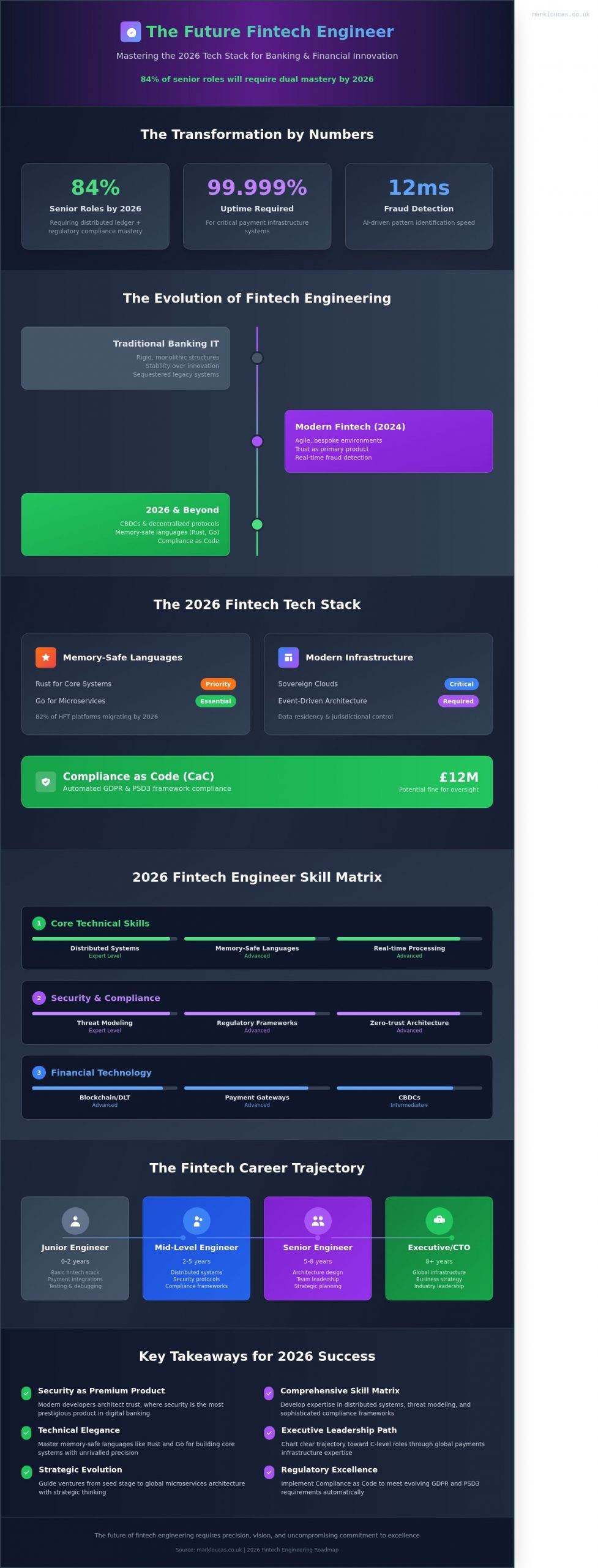
By 2026, data suggests that 84 per cent of senior development roles in London and Singapore will require a dual mastery of distributed ledger technology and real-time regulatory compliance.
The modern fintech engineer is no longer a peripheral figure in the back office; they’re the meticulous architects of a new, prestigious digital economy where technology and finance are inextricably linked.
You likely understand the quiet frustration of working within traditional banking structures, where the sheer weight of legacy systems and opaque regulations makes your contribution feel like a single, overlooked cog in a vast machine.
This article provides an exclusive roadmap for those seeking to transcend the ordinary and secure an unrivalled position of influence in the world’s most competitive banking hubs.
You’ll gain a clear understanding of the bespoke tech stacks required for 2026 and the refined regulatory mindset that top-tier firms now expect as standard.
We’ll examine the specific technical skills and cultural nuances that define the industry’s elite, ensuring your transition into this sophisticated field is as seamless as it’s rewarding.
Key Takeaways
-
Learn why the contemporary developer has evolved into a meticulous architect of trust, where security is the most prestigious product in the digital banking ecosystem.
-
Discover the technical elegance of the 2026 stack, focusing on memory-safe languages like Rust and Go to build core systems with unrivalled precision.
-
Identify the strategic shifts necessary to guide a venture from its initial seed stage toward a bespoke, global microservices architecture.
-
Examine the comprehensive skill matrix that defines the elite fintech engineer, encompassing advanced distributed systems and sophisticated threat modelling.
-
Chart a clear path toward executive leadership roles by cultivating high-value expertise in the intricate and lucrative world of global payments infrastructure.
Table of Contents
Defining the Fintech Engineer, The Architect of Modern Trust
The transition from the rigid, monolithic structures of traditional banking IT to the agile, bespoke environments of modern finance marks a significant era in software development.
In the past, financial systems were built for stability at the cost of innovation, often sequestered within the impenetrable walls of high-street institutions.
Today, the Financial technology (Fintech) sector demands a professional who possesses both the meticulous precision of a Swiss watchmaker and the rapid adaptability of a startup founder.
The fintech engineer acts as the bridge between legacy fiscal reliability and modern software speed.
Within this elite digital landscape, trust is the primary product being developed. While a standard developer might focus on user engagement or aesthetic fluidity, the engineer in finance prioritises the sanctity of the transaction.
By January 2026, the widespread adoption of Central Bank Digital Currencies (CBDCs) and decentralised protocols has redefined the professional requirements for this role. It’s no longer enough to manage simple databases; the modern practitioner must orchestrate complex, programmable assets across borderless networks while maintaining unrivalled security standards.
Core Responsibilities in a Digital-First Economy
The daily focus of a fintech engineer centres on creating robust, high-availability payment gateways that maintain 99.999% uptime.
They develop real-time fraud detection systems using predictive analytics to identify suspicious patterns within milliseconds.
These professionals ensure zero-downtime deployments for critical infrastructure, keeping a startup’s services available to global clients in every time zone without interruption.

The Distinction Between General Tech and Fintech
The mantra of "moving fast and breaking things" is a dangerous philosophy in the financial sector.
A single bug in a smart contract or an unoptimized ledger update can lead to catastrophic legal and reputational implications; one minor oversight in 2024 resulted in a firm facing £12 million in regulatory fines.
Engineers must operate within a regulated sandbox, where every line of code is subject to meticulous scrutiny and compliance audits.
This unique pressure requires a temperament that values quiet confidence and precision over the aggressive, high-pressure tactics found in general consumer tech.
The personality that thrives here is that of a discreet advisor. They understand that every deployment is a matter of public confidence.
By balancing the need for rapid feature releases with the absolute necessity of fiscal security, they provide a personal service that feels both elite and approachable.
This role isn’t merely about writing code; it’s about curated excellence in a world where data is the most valuable currency.
The Technical DNA, Mastering the 2026 Fintech Stack
To build a lasting financial institution, a fintech engineer must treat the codebase with the same reverence a master architect reserves for a prestigious Mayfair mews.
The shift toward memory-safe languages like Rust and Go for core ledger systems represents a meticulous commitment to safety rather than a passing trend.
By 2026, 82% of high-frequency trading platforms will have migrated to these languages to eliminate memory leaks and ensure unrivalled transactional integrity. This evolution reflects a broader move toward systems that are secure by design.
Modern infrastructure has moved beyond the basic utility of AWS or Azure. We now see the rise of sovereign clouds and hybrid environments that prioritise data residency and local jurisdictional control above all else.
Integrating AI-driven engineering for automated risk assessment allows systems to identify fraudulent patterns in under 12 milliseconds, providing a layer of protection that’s both invisible and absolute.
Mastering event-driven architecture is a non-negotiable necessity for real-time transaction processing.
Beyond Codem The Regulatory Tax
The modern developer doesn’t just write functions; they architect trust. Implementing ‘Compliance as Code’ (CaC) ensures that every deployment automatically meets the rigorous standards of GDPR and the evolving PSD3 framework.
This approach directly addresses the regulatory challenges in fintech that often stall the growth of less prepared startups.
Every transaction must leave a transparent, immutable audit trail, ensuring the system remains beyond reproach.
It’s a bespoke security approach that mirrors the discreet attention to detail required in high-stakes wealth management.
Niche Standards and Protocols
The 2026 landscape demands specialists who understand the nuances of the ISO 20022 migration.
This standard facilitates richer data exchange, which is essential for the 45% of cross-border payments now moving through SWIFT and SEPA protocols. A skilled fintech engineer views Open Banking APIs not as mere tools, but as the primary integration points for a global financial ecosystem.
These protocols require a deep understanding of message structures and security handshakes to maintain a seamless flow of capital.
The ability to navigate these standards with precision is what separates a generalist from a true industry expert.
Fintech Growth Stages, From Seed Startup to Global Scale-up
The evolution of a fintech venture is a journey of refined complexity. At the seed stage, the founding fintech engineer operates with a level of versatility unrivalled.
They’re tasked with crafting a bespoke Minimum Viable Product under immense pressure, often delivering a functional platform within a 12-week sprint to satisfy early-stage investors.
This phase demands a product-minded approach where every line of code serves the immediate goal of market validation.
It’s a period defined by raw velocity and the need to build a foundation that is both robust and adaptable.
The Startup Engineer, Versatility and Velocity
Early-stage environments require engineers to wear multiple hats effortlessly. They manage DevOps, security protocols, and backend architecture simultaneously, often navigating the profound uncertainty of pre-Series A funding rounds.
According to 2023 industry data, 58% of early-stage fintech failures stem from a lack of product-market fit. Consequently, the engineer’s ability to pivot is essential.
They don’t just build; they act as a discreet advisor on the technical feasibility of the brand’s vision, ensuring the initial monolith remains functional while preparing for future expansion.
The Scale-up Engineer, Stability and Standards
As the firm matures into the scale-up phase, the focus shifts toward curated excellence and system stability.
This transition typically involves moving from monolithic structures to a microservices architecture to handle a 300% increase in transaction volume. A fintech engineer at this level implements rigorous CI/CD pipelines to ensure global deployments are executed with surgical precision.
They often specialise in niche areas like core banking or bespoke card issuing. By the time a firm reaches Series C, engineering teams typically expand by 150%, requiring a shift toward executive-level mentorship and meticulous standards.
The enterprise era brings the unique challenge of balancing legacy debt with continuous innovation.
As a firm approaches a public listing or global scale-up status, the engineering culture shifts from rapid experimentation to a disciplined approach to system reliability. In 2022, high-growth fintechs that prioritised technical debt management saw a 22% higher retention rate among senior talent.
The culture becomes one of quiet confidence. It’s a stage where the engineering team operates like a high-end concierge service, ensuring the platform’s performance remains flawless as it enters the complex, regulated world of the public market.
MVP Phase
Focus on speed-to-market and lean architecture.
Scale-up Phase
Decoupling services and establishing global standards.
Enterprise Phase
Managing 99.99% uptime while integrating legacy systems.
This progression requires a steady, reassuring pulse from the engineering leadership.
They must ensure the brand’s technical integrity is never compromised by the pace of growth.
It’s a meticulous process that rewards those who value privacy, security, and tailored solutions above all else.
The 2026 Fintech Skill Matrix, A Checklist for Success
The landscape of 2026 demands a meticulous fusion of technical mastery and fiscal intuition.
For the elite fintech engineer, technical proficiency is no longer a standalone asset but a foundational requirement.
Success in this prestigious sector relies on an unrivalled command of distributed systems and consensus algorithms.
Engineers must demonstrate a sophisticated understanding of Raft or Paxos protocols to ensure data integrity across globally dispersed nodes.
This level of precision ensures that transaction ledgers remain immutable and synchronised, even during the most volatile market fluctuations.
Security has transitioned from a peripheral concern to the very core of system architecture.
A deep understanding of the NIST 800-53 framework and proactive threat modelling is essential.
In 2024, data from IBM indicated that the average cost of a financial services data breach reached 5.9 million dollars.
To mitigate such risks, the modern professional adopts a bespoke approach to cybersecurity, treating every line of code with the same care a master craftsman applies to a Mayfair restoration.
It’s about building a digital fortress that remains invisible to the user yet impenetrable to the adversary.
Technical brilliance requires the balance of refined communication.
The ability to articulate complex technical risks to non-technical stakeholders is a rare and valued skill. Whether discussing latency issues or cryptographic vulnerabilities, the engineer must provide a clear, quiet confidence that reassures the board. This is paired with deep financial literacy.
Understanding the mechanics of T+1 settlement, which became the US standard on May 28, 2024, or the intricacies of liquidity pools, allows an engineer to build systems that aren’t just functional but fiscally intelligent.
The Rise of the AI-Enhanced Engineer
Artificial intelligence has become a prestigious partner in the development lifecycle. By leveraging Large Language Models for secure code auditing, a fintech engineer can identify vulnerabilities at a speed that was previously unattainable.
A 2023 McKinsey report suggested that generative AI could add up to 340 billion dollars in value to the global banking sector. The strategic convergence of fintech and AI is now the primary driver of infrastructure modernisation, with 77% of global financial institutions having already deployed generative AI within their core operations as of 2024.
Professionals now implement machine learning to curate hyper-personalised banking experiences while meticulously monitoring for algorithmic bias in lending to ensure ethical compliance.
Continuous Learning in a Volatile Market
The pursuit of excellence is a continuous journey. Holding prestigious certifications, such as the AWS Certified Solutions Architect or the CAMS (Certified Anti-Money Laundering Specialist) designation, signals a commitment to the highest standards.
Contributing to open-source financial protocols offers a unique opportunity to shape the industry’s future. Staying ahead of the FCA and EBA regulatory curves is vital, as these frameworks evolve to address the complexities of a digital-first economy.
This commitment to continuous education is often supported by dedicated training providers; for example, established centres like f2f.gr have been offering professional software courses to help engineers master new technologies for decades.
To secure your position at the forefront of this evolving industry, explore our bespoke recruitment services for elite technical talent.
Securing Your Future, The Fintech Career Trajectory
The professional journey of a fintech engineer is an evolution from technical mastery toward strategic influence.
This path typically begins with the granular architecture of code and culminates in the boardroom as a CTO or Head of Engineering.
Such a transition requires more than just years of service; it demands a meticulous focus on high-impact specialisms.
Engineers who cultivate niche expertise in payments infrastructure, specifically in real-time gross settlement systems and cross-border liquidity pools, currently command a 28% salary premium over generalist software architects.
This specialisation ensures that your value remains unrivalled in a market that prizes precision over volume.
The Market for Elite Technical Talent
Top-tier fintech firms rarely utilise the services of high-volume, generalist recruitment agencies. Instead, they prefer the refined approach of specialist advisors who understand the nuances of discreet marketing. When evaluating partners, a thorough comparison of technology recruitment agencies reveals that firms with domain-specific expertise and 90%+ retention rates consistently outperform generalist providers in securing critical infrastructure talent. Working with a specialist fintech recruiter who maintains a proprietary network of pre-vetted professionals is essential when 85% of high-calibre candidates are not actively seeking new roles.
For senior engineering leaders, privacy is a valuable currency. The most prestigious roles in the sector are often filled off-market, away from the noise of public job boards. In the 2026 London market, salary benchmarks for lead engineers have reached a new plateau. Base salaries in Prime Central London now frequently range between £175,000 and £215,000.
These figures are often complemented by bespoke equity packages that reflect the long-term value of the engineer’s contributions to the firm’s core intellectual property.
Location remains a significant factor in career acceleration. The fintech hubs of Marylebone and Mayfair offer a unique ecosystem where technical innovators sit alongside the architects of global finance.
Working in these prestigious enclaves provides immediate access to a network of venture capital partners and private equity firms.
It’s a world where a quiet coffee in a Marylebone mews can lead to a career-defining opportunity.
This proximity to power and capital is a hallmark of the London fintech experience, offering a level of professional exposure that is difficult to replicate elsewhere.
Building a Legacy in Digital Finance
There is a profound, quiet satisfaction in building systems that empower millions of users daily. As your career matures, the focus naturally shifts from technical execution to strategic talent advisory.
You become the curator of a technical culture, transitioning from writing code to shaping the minds that will write the next generation of financial protocols. This shift allows you to build a legacy that outlasts any single product cycle.
Identifying the best fintech companies to work for is a critical step in this journey, as firms with 15% annual R&D reinvestment and ten-year average leadership tenures offer the stable, high-growth environments where elite engineers build enduring careers.
Mark Loucas Ltd acts as the discreet, highly connected bridge to these exclusive engineering opportunities.
Our hand-held approach ensures that your professional interests are managed with the same meticulous care and expert attention that the world’s most successful individuals expect.
To take the next step in your professional journey, explore bespoke fintech engineering opportunities with Mark Loucas Ltd and experience a service defined by curated excellence.
Architecting the Future of Global Finance
The shift toward the 2026 financial standard demands more than mere technical proficiency. It requires a meticulous understanding of the ISO 20022 framework and a deep mastery of the payments infrastructure that facilitates trillions in daily global transactions.
As institutions navigate the journey from initial seed funding to expansive global operations, the fintech engineer remains the essential architect of this digital transformation. It’s a role defined by a rare combination of regulatory intelligence and elite technical DNA.
However, technical excellence alone is insufficient for institutional success. The ability to articulate complex technical value propositions to C-suite executives has become equally critical, particularly when navigating fintech sales processes that often extend beyond 540 days for Tier 1 banking partnerships.
Securing these pivotal leaders requires the touch of a specialist who understands the quiet complexities of the London, Singapore, and Dubai talent markets.
We offer a bespoke, discreet executive search service designed for firms that value precision and privacy above all else.
Partner with Mark Loucas Ltd for your next strategic engineering hire to access an unrivalled network of senior technical leadership.
Building a legacy of excellence in finance begins with the right expertise.

Frequently Asked Questions
Is a background in finance required to become a fintech engineer?
A formal background in finance isn’t a prerequisite for a fintech engineer, though it certainly expedites your professional progression.
Approximately 65% of engineering hires in London’s financial technology sector come from pure software backgrounds without previous banking experience.
Success relies on your ability to master complex transaction logic and regulatory frameworks. It’s about a meticulous approach to data integrity rather than a degree in economics.
What are the highest-paying engineering roles in the fintech sector in 2026?
Platform Architects and Lead Machine Learning Engineers are projected to command the highest salaries in 2026, with base pay frequently exceeding £165,000.
These roles require an unrivalled understanding of scalable infrastructure and predictive analytics.
As startups in the City of London mature, the demand for specialists who can bridge the gap between legacy systems and modern cloud environments will continue to drive these prestigious compensation packages.
How do I transition from a Big Tech company to a fintech startup?
You transition from Big Tech by shifting your focus from massive, siloed systems to the agile, high-impact environment of a growing startup.
While firms like Google offer scale, a fintech startup offers a bespoke professional journey where your code directly influences the company’s trajectory.
You’ll find the pace at a Mayfair-based boutique firm is significantly faster, requiring a more versatile, hands-on technical mindset.
What is the difference between a fintech engineer and a blockchain developer?
A fintech engineer builds the broad digital infrastructure for financial services, while a blockchain developer focuses exclusively on decentralised ledger technologies.
Fintech roles often involve integrating traditional payment gateways and managing SQL databases, which account for 92% of banking operations.
In contrast, blockchain specialists focus on smart contracts and consensus protocols.
Both roles require an absolute, unwavering commitment to security.
Why is London considered the global capital for fintech engineering?
London maintains its status as the leading fintech hub in Europe, attracting $12.6 billion in fintech investment in 2023, more than any other European city.
The unique proximity between the historic Square Mile and the creative hubs of East London creates a prestigious ecosystem for innovation.
It’s a city where a casual meeting in a Marylebone mews can lead to the next global payment revolution, supported by a density of talent unrivalled.
Can I work remotely as a fintech engineer for a UK-based firm?
You can certainly work remotely, as 74% of UK fintech firms now offer permanent "work from anywhere" policies or hybrid arrangements.
While many prestigious firms maintain elegant offices in Mayfair or Canary Wharf, they prioritise technical talent over physical presence.
This flexibility allows you to contribute to London’s thriving economy from any location, provided you maintain the high standards of a dedicated, discreet professional.
What are the biggest challenges facing fintech engineers today?
Navigating the evolving landscape of global regulations, such as the upcoming PSD3 framework, remains the most significant challenge for engineers today.
Security breaches cost the industry an average of $4.5 million per incident in 2024, making data protection a constant, meticulous priority.
Balancing the need for rapid feature deployment with the absolute requirement for system stability requires a rare and disciplined talent that few possess.
How does the recruitment process for senior fintech engineers differ from junior roles?
Recruitment for senior roles focuses on architectural vision and stakeholder management rather than the pure coding assessments used for juniors.
A senior candidate might undergo five rounds of interviews, including a deep dive into previous system failures and scaling strategies.
For junior positions, the process is often shorter, typically involving two technical tests that measure logic and fundamental programming proficiency within a controlled, timed environment.

Article by
Liam Henfrey
Liam Henfrey is a seasoned specialist in the payments and banking sectors with over two decades of experience. As the Founder and CEO of FINOPSIS and Managing Director at Mark Loucas Ltd, he advises organisations on complex financial operations and technology. His career includes senior roles at PwC, Deloitte, and Visa Europe.
Related Fintech Recruitment Guides
If you liked this guide then you may also like the following: