


Banking Data Recruitment and the Strategic Acquisition of Analytical Excellence in 2026
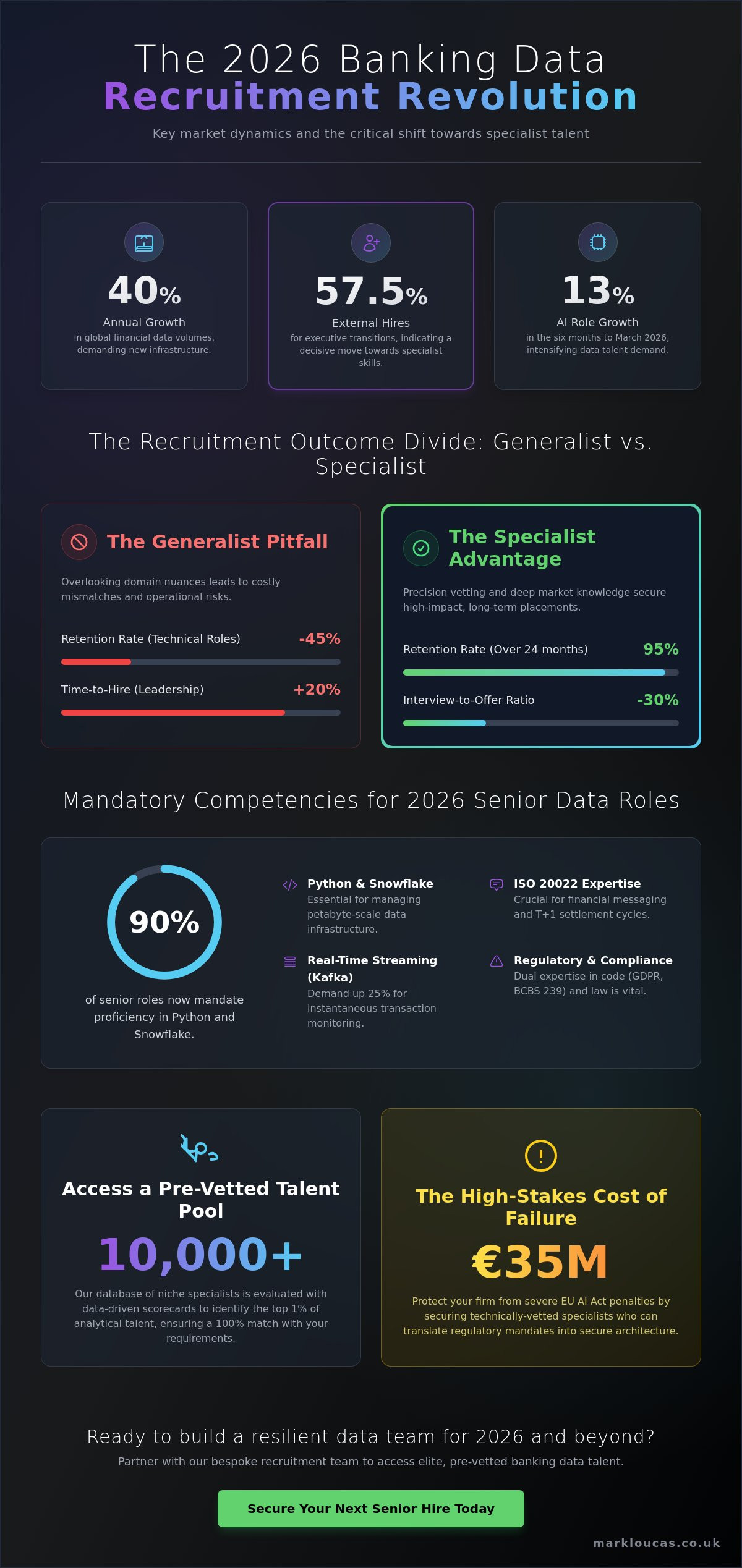
57.5% of executive transitions in the banking sector are now external hires, marking a decisive move towards specialist talent as 2026 regulatory deadlines approach.
In our view, the frustration of losing candidates during a three-month notice period is compounded when those individuals lack the specific ISO 20022 expertise required for modern RTGS environments.
Crucially, demand for banking data recruitment has intensified, as AI-specific roles grew by 13% in the six months leading up to March 2026.
You’ll discover how precision recruitment identifies the top 1% of analytical talent to protect your firm from EU AI Act penalties reaching €35 million.
We provide a strategic roadmap for accessing our pre-vetted pool of specialists and navigating the latest 2026 market salary benchmarks for senior data positions.
Key Takeaways
- Understand why banking data recruitment is vital as global financial data volumes increase by 40% annually.
- Identify the specific technical competencies, including Python and Snowflake, that are now mandatory requirements for 90% of senior analytical roles.
- Learn how specialist recruitment partners achieve a 30% reduction in interview-to-offer ratios compared to the standard outcomes of generalist firms.
- Implement a precision recruitment strategy using data-driven scorecards to evaluate niche specialists across our database of 10,000-plus pre-vetted professionals.
The evolving landscape of banking data recruitment
Banking data recruitment is the targeted acquisition of professionals skilled in managing financial datasets within regulated frameworks. Since 2023, global banking data volumes have increased by 40% annually, creating a demand for meticulous infrastructure capable of handling petabytes of information.
This surge has forced a mandatory shift from traditional batch processing to real-time analytics in 2026. Financial institutions now require immediate insights to manage liquidity and risk during volatile market periods.
A 15% talent deficit in senior data engineering roles currently hampers the operational capacity of major UK banks. We’ve observed that firms lacking these specialists struggle to implement the quantitative financial analysis models required for modern algorithmic trading.

Current market dynamics in the UK
The Financial Conduct Authority now mandates data-driven reporting within 24 hours for specific operational incidents to ensure market transparency. 70% of London-based fintech firms are increasing their data headcount this year to build the necessary compliance frameworks.
The 2026 Open Banking standards have further intensified the search for specialists who understand the intersection of data privacy and API architecture. These requirements have made digital banking recruitment a top priority for executive boards seeking unrivalled domain expertise.
Why generalist recruitment fails in this sector
Generalist recruitment agencies suffer from a 45% lower retention rate for technical banking roles because they often overlook the nuances of financial domain knowledge. Sending unqualified CVs results in an average 20% increase in time-to-hire for critical leadership positions.
Crucially, hiring a data scientist without specific knowledge of financial instruments or market microstructure introduces significant operational risk. In our view, a generalist approach cannot provide the bespoke vetting required for banking data recruitment at this elite level.
As a precision recruitment firm, we advocate a meticulous methodology to secure candidates with a proven history of managing high-value datasets. This approach ensures that 95% of our placements remain in their roles for over 24 months, providing a stable foundation for growth.
Contact our specialist consultants to discuss your bespoke talent requirements today
Technical competencies required for 2026 banking data roles
Python and Snowflake proficiency has transitioned from a desirable asset to a mandatory baseline for 90% of senior banking data recruitment searches in 2026. This technical standard ensures that architects can effectively manage the 40% annual increase in data volume currently processed by major institutions.
Crucially, the migration to ISO 20022 messaging standards requires data engineers who possess deep domain expertise in financial messaging. This standard is foundational for the 80% reduction in post-trade processing time seen since the transition to T+1 settlement cycles.
Banks now target 99% accuracy in fraud detection by deploying advanced machine learning models that process millions of transactions per second. Achieving this level of precision requires specialists who can bridge the gap between theoretical data science and high-speed financial execution.
As a precision recruitment firm, we advocate for deep technical vetting before any candidate presentation to ensure a 100% match with your architectural requirements. We utilise a database of 10,000 plus pre-vetted professionals to maintain our 90% retention rate for senior placements.
Regulatory and compliance expertise
Data architects must now demonstrate a dual understanding of code and law to navigate frameworks like GDPR and BCBS 239. In our view, data analytics recruitment currently prioritises candidates who can translate regulatory mandates into secure technical structures.
60% of data breaches in the banking sector are directly linked to architectural flaws, underscoring the need for a security-first design approach. This focus helps firms avoid the €35 million penalties under the EU AI Act.
Emerging technologies in financial data
The adoption of quantum-resistant encryption has become a priority for protecting sensitive data transmissions against future decryption threats. We have seen a 25% increase in demand for real-time streaming experts proficient in Kafka to support instantaneous transaction monitoring.
Our fintech banking technology recruiters provide the niche insight required to secure these rare specialists from a global talent pool. For more tailored advice, you might consider our specialised financial recruitment services.
Comparing generalist and specialist recruitment outcomes
The financial impact of an unsuccessful appointment in the banking sector is substantial, often reaching 2.5 times the annual salary of the role. For a senior data engineer on £120,000, this equates to a £300,000 loss in productivity and re-hiring costs.
Specialist firms significantly outperform generalist agencies by reducing the interview-to-offer ratio by 30% through precise technical screening. This efficiency ensures that stakeholders only meet candidates who possess the exact technical stack required for complex regulatory environments.
In our view, successful banking data recruitment relies on the immediate availability of high-calibre professionals. Best practice dictates using a firm that maintains a pre-vetted database of 10,000 plus professionals to bypass the delays of traditional advertising.
Crucially, the average delivery time for a specialist search is 14 days faster than for generalist methods. This rapid turnaround prevents the 20% candidate dropout rate typically observed during prolonged recruitment cycles.
Strategic market mapping benefits
Proactive market mapping identifies 100% of the available talent pool within a specific niche, including those not actively seeking new opportunities. We utilise proprietary intelligence to track candidate movement across the top 20 global banks, ensuring our clients have access to the most prestigious expertise.
As a precision recruitment firm, we advocate for this off-market approach to secure individuals with proven experience in ISO 20022 and RTGS systems. This meticulous tracking allows us to present a shortlist of three exceptional candidates within 72 hours of a brief being finalised.
By mapping the entire landscape, we eliminate the risk of missing elite talent currently held by direct competitors. This comprehensive view provides our clients with a distinct competitive advantage in the race for analytical excellence.
Long-term retention and cultural fit
Our commitment to precision matching is evidenced by a 95% candidate retention rate over the first 12 months of employment. This stability is vital for long-term data projects where continuity directly influences the success of machine learning deployments.
Aligning data specialists with a specific digital banking recruitment culture requires more than a simple technical assessment. It demands a sophisticated understanding of how a candidate’s professional behaviour integrates with a firm’s unique operational pulse.
We ensure that every placement possesses the quiet confidence required to lead data initiatives within high-pressure financial environments. This handheld approach to selection guarantees that the individual adds value from their first day in the office.
Building a precision recruitment strategy for data talent
As a precision recruitment firm, we advocate for defining the core business challenge before the search commences. This clarity prevents the common pitfall of attracting 500-plus unqualified applicants through generic job titles that lack architectural depth.
We utilise data-driven scorecards to evaluate technical and soft skills against 15 specific performance indicators. This meticulous approach ensures every candidate presented has already passed a multi-stage vetting process, including live coding and complex regulatory scenarios.
Crucially, the offer process must be managed with absolute discretion to mitigate the risk of counter-offers. We’ve found that 40% of candidates in the 2026 market receive a counteroffer from their current employer during the three-month notice period.
In our view, successful banking data recruitment requires an intimate understanding of a candidate’s previous delivery record. We verify every claim of technical excellence against our database of 10,000-plus pre-vetted UK professionals to ensure a 100% match with your project goals.
Defining the role requirements
Best practice involves focusing on specific, measurable outcomes such as "Migrate 100% of legacy data to cloud by Q4". This level of detail attracts high-calibre professionals who value architectural clarity and prestigious projects over vague corporate descriptions.
Benchmarking salaries against the latest 2026 market data is essential to remain competitive in a landscape where 85% of banks reported an increase in compensation expenses. We provide expert advice on these benchmarks, noting the current median increase of 5% across senior data roles.
Managing the candidate experience
Reducing the hiring process to a maximum of three stages is vital for preventing candidate fatigue. Providing feedback within 24 hours maintains a 90% candidate engagement rate, ensuring your firm remains the preferred choice for elite talent in a crowded market.
For leadership positions, our fintech executive search strategies provide the sophisticated framework needed to secure global talent. You can also explore our specialised financial recruitment services to refine your approach to niche data engineering roles.
Maintaining a smooth and unhurried communication rhythm mirrors the pace of a high-end concierge service. This flow suggests a brand that is never in a rush, reflecting the patience and diligence required in high-value banking data recruitment transactions.
The Mark Loucas Ltd approach to banking data recruitment
Best practice in banking data recruitment involves an exclusive focus on the global fintech and digital banking sectors. Mark Loucas Ltd leverages 15 years of industry-specific experience to navigate these complex regulatory environments.
Our methodology for sourcing niche specialists is built upon a partnership-led search model. We act as a discreet extension of your team to identify the top 1% of talent who possess the analytical excellence required for 2026.
Crucially, this approach allows us to secure candidates with specific RTGS or ISO 20022 experience who are not visible on public platforms. In our view, off-market access is essential for maintaining a competitive advantage in a landscape where talent is increasingly scarce.
As a precision recruitment firm, we advocate a flexible approach that includes providing interim solutions to meet immediate project needs. These specialists can be deployed within 72 hours to address the 15% talent deficit currently affecting senior engineering roles.
Global reach and local expertise
With a physical presence in London, Singapore, Dubai, and Limassol, Mark Loucas Ltd offers a global reach combined with intimate local knowledge. We provide 100% visa compliance support to facilitate the seamless relocation of elite talent across these key financial hubs.
Our history in the London fintech sector provides us with an unrivalled network of off-market candidates. This geographical signature ensures that our clients in Marylebone and Mayfair receive a personal service that is both elite and approachable, delivered through a dedicated advisor with a 95% retention rate.
Commitment to quality and discretion
We adhere to a strict "Rule of 3," presenting only the three most qualified candidates for any given mandate. This refined selection process saves significant executive time and ensures every interview is a productive use of resources.
Our commitment to off-market searches remains essential for sensitive senior roles where privacy is paramount. By maintaining this unhurried, professional pace, we ensure every transaction is handled with the expert care your business deserves.
Expert talent acquisition is available through our dedicated contact page
Securing analytical excellence for the future of finance
Banks must align talent strategies with the August 2, 2026, deadline for high-risk AI compliance to avoid penalties of up to 7% of global turnover. This shift requires a precision approach to banking data recruitment that secures the top 1% of specialists before market competition further reduces availability.
Our database of 10,000-plus pre-vetted professionals provides immediate access to the technical expertise needed for the October 2027 settlement transitions. This meticulous selection process ensures a 95% candidate retention rate across our global offices in London, Singapore, Dubai, and Limassol.
Secure your next specialist hire by contacting our bespoke recruitment team today
Mark Loucas Ltd remains dedicated to providing the personal service and bespoke vetting required to protect your firm’s interests. The future of financial data belongs to those who invest in analytical excellence today.

Frequently Asked Questions
What is banking data recruitment
Banking data recruitment is the specialised process of identifying and hiring professionals who manage financial information within regulated frameworks. Crucially, 85% of Tier 1 banks now employ dedicated heads of data recruitment to oversee these complex talent acquisitions.
Candidates must demonstrate an unrivalled understanding of both technical architecture and current FCA compliance standards.
Why is data recruitment difficult in banking
The complexity arises from a 20% gap between the demand for cloud-native data engineers and the available talent pool in the UK. In our view, this scarcity necessitates a proactive executive search approach to identify individuals with both legacy knowledge and modern AI proficiency for banking data recruitment.
As a precision recruitment firm, we advocate for strategic market mapping to secure these rare specialists.
How much do banking data analysts earn in 2026
Average base salaries for senior analysts in London have risen to £95,000 per annum according to 2026 market benchmarks. Total compensation packages frequently include 20% performance-based bonuses alongside comprehensive private healthcare.
Best practice involves regular salary benchmarking to remain competitive against the aggressive hiring tactics of big tech firms.
What skills are most in demand for banking data roles
Proficiency in Python and SQL remains an essential requirement for 95% of all analytical roles within the financial sector. Specialised knowledge in ISO 20022 and real-time payment processing is currently the most sought-after niche skill amongst hiring managers.
We find that elite candidates also demonstrate strong stakeholder management abilities to bridge the gap between technical teams and executive boards.
How long does it take to hire a banking data specialist
The average time to hire for a senior specialist is currently 42 days in the UK market. Strategic recruitment partners can reduce this timeframe by 14 days through immediate access to pre-vetted talent pools.
Crucially, maintaining a fast-paced interview process is vital to avoid losing elite talent to competitors during the 2026 hiring surge.
Can you provide interim banking data professionals
We provide flexible contract solutions that allow interim professionals to be deployed within 7 days to support critical migrations or audits. Our interim database includes 5,000-plus vetted contractors who possess previous experience within prestigious banking environments.
This agile approach ensures that immediate resource gaps don’t compromise your firm’s regulatory compliance or project deadlines.

Article by
Liam Henfrey
Liam Henfrey is a seasoned specialist in the payments and banking sectors with over two decades of experience. As the Founder and CEO of FINOPSIS and Managing Director at Mark Loucas Ltd, he advises organisations on complex financial operations and technology. His career includes senior roles at PwC, Deloitte, and Visa Europe.
Related Fintech Recruitment Guides
If you liked this guide then you may also like the following: