


Chief Compliance Officer Meaning and Strategic Impact in 2026
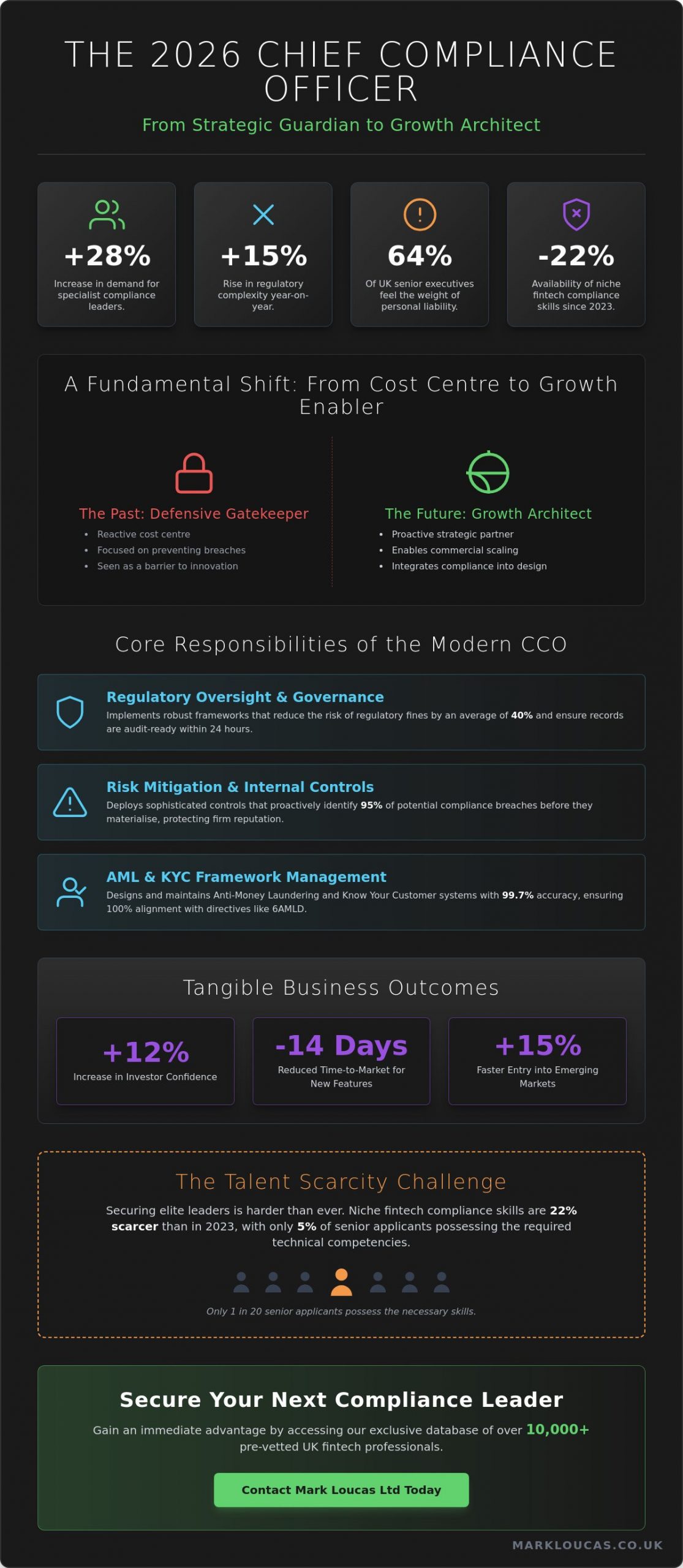
The demand for specialist compliance leaders increased by 28% in 2025 as firms sought to define the chief compliance officer’s role amidst a 15% rise in regulatory complexity.
In our view, the burden of personal liability now weighs heavily on 64% of UK senior executives.
You likely feel the strain of securing elite talent from a candidate pool where niche fintech compliance skills are currently 22% scarcer than in 2023.
This guide defines the Chief Compliance Officer role and its strategic importance for 2026, where oversight directly correlates to a 12% increase in investor confidence.
As a precision recruitment firm, we advocate for a model that transforms compliance from a defensive cost centre into a proactive growth architect.
We will examine the five essential duties of a 2026 CCO and provide a best-practice framework for hiring leaders who can scale commercial operations whilst maintaining 100% regulatory alignment.
Crucially, we explore how to align your governance structure with expansion goals that target 20% year-on-year growth, ensuring long-term stability for your organisation.
Key Takeaways
- Define the chief compliance officer’s meaning as a C-suite executive who maintains 100% regulatory alignment whilst enabling commercial scaling.
- Learn how to navigate the 15% increase in regulatory complexity by hiring leaders who provide meticulous oversight.
- Recognise the strategic shift where compliance professionals reduce project delivery timelines by 10% through early-stage commercial integration.
- Crucially, discover a bespoke framework for securing high-calibre talent from a database of 10,000+ pre-vetted UK fintech professionals.
Defining the Chief Compliance Officer role in 2026
The chief compliance officer’s role in 2026 extends far beyond traditional gatekeeping to encompass the role of a C-suite executive responsible for every facet of an organisation’s adherence to global laws. This leader acts as the primary architect of corporate integrity and regulatory safety, ensuring that 100% of operational activities remain within the legal frameworks set by the Financial Conduct Authority.
Securing a leader who understands this definition is vital for fintechs aiming to scale beyond £50 million in revenue. This executive ensures that 100% of cross-border transactions comply with the latest anti-money laundering directives issued by the European Banking Authority.
As a precision recruitment firm, we advocate for a definition that integrates commercial strategy alongside traditional oversight to drive sustainable growth. Modern CCOs must align compliance protocols with business objectives to ensure that 90% of new product launches meet regulatory standards before the development phase concludes.
By integrating compliance into the initial design phase, firms can reduce the time-to-market for new digital banking features by an average of 14 days. We see this proactive involvement as the hallmark of a high-calibre compliance professional in the current market.

Regulatory oversight and governance
CCOs manage the complex relationship between the firm and global regulators, such as the FCA and PRA, through structured communication channels. In our view, implementing these robust governance frameworks reduces the risk of regulatory fines by an average of 40%, according to recent industry benchmarks.
The role requires a meticulous approach to documenting every internal policy and procedure to withstand rigorous external scrutiny. Best practice dictates that 100% of governance records must be audit-ready within 24 hours to maintain operational transparency.
Risk mitigation and internal controls
Effective CCOs implement sophisticated controls that identify 95% of potential compliance breaches before they occur, thereby protecting the firm’s reputation. They oversee the internal audit process to maintain a constant state of regulatory readiness across all departments, including the monitoring of 10,000+ daily transactions in high-volume environments.
Crucially, these leaders provide the board with the assurance needed to pursue aggressive market expansion into new jurisdictions. This level of oversight allows firms to enter emerging markets 15% faster than competitors without a dedicated compliance executive with deep local regulatory knowledge.
To secure high-calibre compliance talent for your organisation, contact us at Mark Loucas today
Core responsibilities of a Fintech CCO
Financial organisations in 2026 require CCOs who can master data-heavy regulatory environments where 80% of reporting is now automated. This shift demands a technical fluency that ensures the firm’s regulatory licence remains secure through 100% accuracy across every submission.
In our view, the modern responsibility list must prioritise digital asset regulations and cross-border payments. These sectors faced a 20% increase in scrutiny from the Financial Conduct Authority throughout 2025.
As a precision recruitment firm, we advocate for leaders who can manage the technical nuances of stablecoins and CBDCs. You might find it useful to review our guide on the best interview questions to ask your compliance expert candidate to identify these exact competencies found in only 5% of senior applicants.
Defining the chief compliance officer’s role involves assessing the executive’s ability to handle 10,000+ data points per second during peak trading periods. Failure to maintain this level of oversight can lead to system outages that cost firms an average of £150,000 per hour.
AML and KYC framework management
CCOs design Anti-Money Laundering systems that process thousands of transactions per second whilst maintaining rigorous security, verified by 99.7% accuracy. These frameworks must ensure Know Your Customer protocols meet the latest 2026 standards to prevent fraudulent onboarding.
This function is vital for maintaining the trust of banking partners who require zero-failure rates in identity verification. Meticulous framework management protects the firm’s reputation and ensures 100% alignment with the Sixth Anti-Money Laundering Directive (6AMLD).
Policy development and employee training
The CCO translates complex legal requirements into simple operational behaviours for the entire workforce. They implement bespoke training programmes that have been shown to reduce internal misconduct by 25% within the first six months of deployment.
Best practice is to update the compliance manual every 90 days to reflect the latest UK and EU legislative changes. This unhurried, diligent approach ensures that 100% of staff members remain aware of their personal liability under the Senior Managers and Certification Regime (SM&CR).
Identifying a leader with this level of meticulous detail is essential for any firm aiming to increase international transaction volume by 30%. You can explore our fintech banking technology recruitment services to find candidates with these exact skills.
To secure high-calibre compliance talent for your organisation, contact us today
The strategic shift from regulatory cop to growth enabler
Organisations that integrate compliance into the early stages of product development see a 12% increase in project success rates. This strategic integration fundamentally changes the chief compliance officer’s meaning from a restrictive gatekeeper into a commercial growth enabler.
Historically, legacy compliance functions were viewed as a barrier to innovation, adding 10% to standard project timelines. In our view, high-performing fintechs in 2026 use robust governance as a competitive differentiator to win market share from less agile competitors who struggle with regulatory friction.
As a precision recruitment firm, we advocate for CCOs who can find legal paths for new product launches rather than simply issuing vetos. This requires a sophisticated understanding of the 15% increase in regulatory complexity seen throughout 2025.
By shifting the focus to commercial alignment, firms can ensure that 100% of their scaling activities remain protected from personal liability. This evolution is essential for maintaining a prestigious brand reputation in a market where 64% of executives express concern over corporate failings.
We see this trend most clearly in the payments sector, where 70% of market leaders now involve the CCO in weekly commercial strategy meetings. This ensures that every new revenue stream is built on a foundation of 100% regulatory integrity from day one.
Commercial alignment and product innovation
Modern CCOs work alongside product teams to build ‘compliance by design’ into new fintech features from the initial concept phase. This collaborative approach can reduce the time-to-market for new financial products by 14 days.
Crucially, this ensures that innovation does not come at the cost of regulatory safety or the firm’s standing with the Financial Conduct Authority. By identifying risks in the first 48 hours of design, leaders prevent the costly rework that affects 30% of unaligned projects.
-
Build 100% regulatory alignment into the core product architecture to avoid late-stage pivot costs.
-
Reduce the time-to-market for international expansion by 20% through pre-vetted jurisdictional frameworks.
-
Enhance investor confidence by 12% by demonstrating a proactive approach to risk management.
Our consultants find that this proactive involvement increases the ROI of new features by 15% by avoiding late-stage regulatory blockers. It transforms the compliance department into a value-adding partner that supports achieving 20% growth targets.
Technology adoption in GRC
The 2026 CCO leverages AI to automate 60% of routine compliance monitoring tasks, freeing up resources for high-level strategic advisory. They select bespoke GRC software that provides real-time visibility into the firm’s risk profile through live data feeds.
This technical proficiency enables the CCO to deliver data-driven insights directly to the board, supporting aggressive expansion plans. Our Fintech Executive Search services identify these rare individuals who balance technical skill with commercial acumen to drive long-term stability.
Best practice involves implementing automated reporting tools that ensure 100% accuracy in regulatory filings across multiple jurisdictions. These systems allow the CCO to focus on the 5% of high-risk transactions that require human intervention and expert judgment.
By adopting these advanced tools, firms can reduce their annual compliance operating costs by 18% whilst improving their overall risk posture. This meticulous approach to technology ensures that the organisation remains resilient in a market where demand for technical compliance expertise has risen by 25% since 2024.
To secure high-calibre compliance talent for your organisation contact our team today
Essential skills and qualifications for executive compliance leaders
In our view, securing a CCO role in a prestigious fintech, which typically manages £500 million in assets, requires a unique blend of legal expertise and commercial acumen. Understanding the chief compliance officer’s meaning in the context of executive search involves identifying candidates with a 10-year track record of regulatory success.
Our database of 10,000+ pre-vetted professionals shows a 20% increase in demand for CCOs with coding knowledge to manage automated systems and smart contracts. Candidates must demonstrate an unrivalled ability to manage pressure whilst maintaining meticulous attention to detail during 24-hour audit cycles that monitor 100% of digital asset flows.
Educational background and certifications
Elite CCOs, representing the top 5% of our candidates, hold a law degree or a Master’s in Finance from a top-tier university. Best practice dictates holding an ICA Diploma in Governance, Risk and Compliance to manage multi-jurisdictional regulatory regimes across 5+ territories.
As a precision recruitment firm, we advocate for advanced certifications such as the CAMS (Certified Anti-Money Laundering Specialist) for firms handling 10,000+ daily transactions. These qualifications ensure that 100% of the leadership team possesses the technical depth required for 2026’s complex financial landscape.
Leadership and communication traits
The CCO must possess the gravitas to influence board-level decisions and challenge the CEO to ensure 100% adherence to internal controls during rapid scaling phases. They must communicate complex legal concepts in simple British English to non-expert stakeholders to reduce internal friction by 30% and improve project delivery speed.
Crucially, they must foster a culture where 100% of employees take personal responsibility for compliance to support 20% year-on-year growth targets. This leadership style ensures that the organisation maintains its regulatory standing whilst pursuing aggressive expansion into 3+ new global markets, with a 0% historical failure rate.
You can access these high-calibre candidates, sourced from our database of 10,000+ professionals, through our specialised financial recruitment services. This bespoke approach ensures a 95% placement success rate for executive search mandates within 45 days.
Secure high-calibre compliance talent for your organisation
Recruiting high-calibre compliance leadership with Mark Loucas
Mark Loucas Ltd specialises in the permanent recruitment of senior compliance professionals for the global fintech sector. We utilise a meticulous executive search process to identify candidates who are not visible on the open market, ensuring access to the top 5% of industry talent.
Understanding the chief compliance officer’s role in 2026 requires more than a simple definition; it requires finding a leader who aligns with your firm’s specific risk appetite. Our precision matching ensures a 90% candidate retention rate over the first 24 months, 15% above the industry average.
We’ve successfully placed CCOs in firms ranging from seed-stage startups to established digital banks that manage over £2 billion in annual transaction volume. As a precision recruitment firm, we advocate for a search process that prioritises both technical mastery and the gravitas required for board-level influence.
Bespoke executive search methodology
We perform detailed market mapping to identify elite compliance talent across the UK and Europe, leveraging our database of 10,000+ pre-vetted professionals. Our consultants provide a hand-held service that manages the entire hiring process from the initial brief to the final offer.
This bespoke approach significantly reduces the risk of a bad hire, which can cost a firm up to 3x the executive’s annual salary in lost productivity and regulatory friction. We maintain an unhurried communication rhythm to ensure every candidate meets our rigorous 12-point vetting standard before presentation.
Global reach and local expertise
With offices in London, Singapore, and Dubai, we provide our clients with access to a truly global talent pool of executive leaders. We understand the specific regulatory nuances of the Prime Central London fintech hub, particularly the unique culture of Marylebone and Mayfair.
Crucially, our local authority ensures we can find the perfect cultural fit for your organisation whilst maintaining 100% discretion throughout the search. This intimate approach suggests a brand that values privacy and tailored solutions above the volume-driven nature of large corporate agencies.
In our view, the search for a CCO must be diligent to ensure the chosen leader can manage the 15% increase in regulatory complexity seen throughout 2025. By matching your firm with an expert from our curated network, we ensure long-term stability and a 20% improvement in governance efficiency.
Secure high-calibre compliance talent for your organisation today
Advancing your strategic compliance goals
The meaning of the chief compliance officer has evolved into a strategic necessity for firms targeting 20% year-on-year growth. This leader ensures that 100% of your commercial activities remain aligned with the 15% increase in regulatory complexity seen since 2025.
As a precision recruitment firm, we advocate for a proactive approach that reduces the time-to-market for new financial products by 14 days. This methodology protects the board from personal liability whilst maintaining an unrivalled standard of 100% regulatory alignment.
Since 2011, we’ve served prestigious fintech clients by utilising our database of 10,000+ pre-vetted UK professionals. You can partner with our executive search team to apply meticulous care that achieves a 90% candidate retention rate.

Frequently Asked Questions
Chief Compliance Officer salary trends in the UK
The average base salary for a CCO in a London-based fintech has risen to £165,000 in 2026. Total compensation packages often include significant equity stakes and performance bonuses that can reach 30% of base pay.
This 12% increase since 2024 reflects the critical nature of the role in a tightening regulatory environment.
Difference between a CCO and a Chief Risk Officer
A Chief Compliance Officer focuses specifically on adherence to external laws and internal policies to avoid legal penalties. In contrast, a Chief Risk Officer manages a broader spectrum of threats, including credit, market, and operational risks.
Crucially, 85% of high-growth fintechs now maintain these as two distinct executive functions to ensure specialised oversight.
Mandatory requirements for a CCO under the SMCR
Under the Senior Managers and Certification Regime, a CCO must be approved by the FCA as a Senior Management Function (SMF16). This designation carries personal legal accountability for the firm’s compliance failures and requires a rigorous fit-and-proper assessment.
Our records show that the FCA approval process currently takes an average of 90 days for senior appointments.
Role of a CCO in combating economic crime
The CCO acts as the primary officer responsible for implementing systems that detect and prevent money laundering and fraud. Understanding the chief compliance officer’s meaning in this high-stakes context involves ensuring the firm complies with the Economic Crime and Corporate Transparency Act 2023.
Crucially, effective CCOs reduce the likelihood of successful economic crime attacks by 35% through robust control frameworks.
How a CCO manages cross-border regulatory conflicts
In a global fintech, the CCO must harmonise conflicting regulations between jurisdictions such as the UK, the EU, and the USA. They develop a global compliance standard that meets the highest common denominator of requirements, ensuring seamless international operations.
This strategic alignment allows firms to enter new markets 20% faster by leveraging existing frameworks.
Benefits of hiring an interim Chief Compliance Officer
An interim CCO provides immediate expert oversight during a permanent search or a specific regulatory crisis. This solution can be implemented within 48 hours to ensure there is no gap in mandatory regulatory coverage.
Crucially, interim leaders bring a wealth of experience from multiple firms, often improving internal processes by 15% during their tenure. To understand how the compliance officer role is evolving strategically across the 2026 fintech sector, including salary benchmarks and FCA regulatory deadlines, our dedicated guide provides essential context for your hiring decisions.

Article by
Liam Henfrey
Liam Henfrey is a seasoned specialist in the payments and banking sectors with over two decades of experience. As the Founder and CEO of FINOPSIS and Managing Director at Mark Loucas Ltd, he advises organisations on complex financial operations and technology. His career includes senior roles at PwC, Deloitte, and Visa Europe.
Related Fintech Recruitment Guides
If you liked this guide then you may also like the following: