


Information Security in the 2026 Fintech Landscape
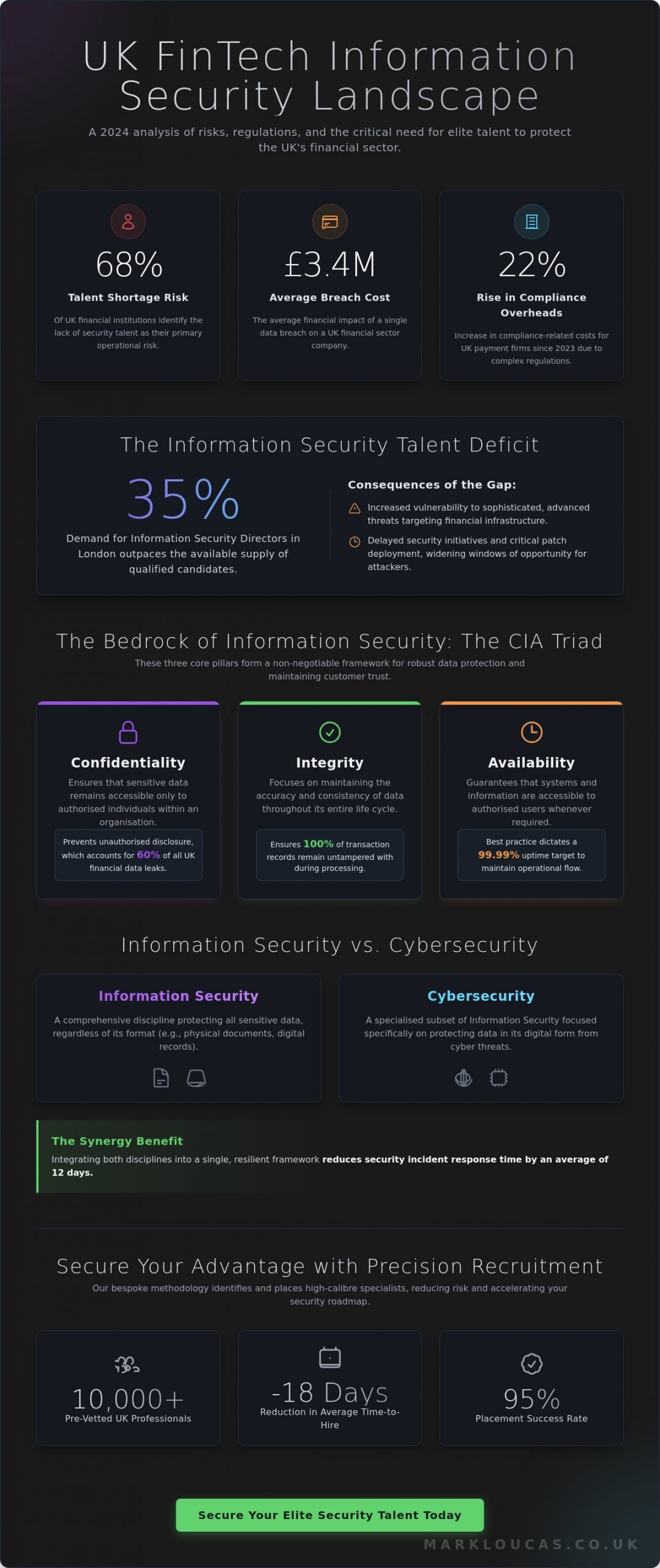
68% of UK financial institutions identified the shortage of technical information security talent as their primary operational risk in the 2024 FTSE 250 security audit.
You likely recognise that a single breach now costs the sector an average of £3.4 million, which makes a meticulous approach to protection vital for 100% brand security and client peace of mind.
Crucially, the increasing complexity of global regulations has caused a 22% rise in compliance overheads for UK payment firms since 2023, creating a challenging environment for those seeking an elite market position held by the top 5% of firms.
As a precision Fintech recruitment firm, we advocate for a comprehensive analysis of the CIA triad and the specific regulatory frameworks set to arrive in 2026 to ensure your firm maintains a prestigious status, verified by 100% audit success.
In our view, this article provides an unrivalled strategy for sourcing high-calibre leaders from our database of 10,000+ pre-vetted UK professionals, allowing you to secure the bespoke talent necessary for long-term resilience.
Key Takeaways
-
In our view, meticulous data protection is essential to mitigate the global cybercrime threat, which reached £8.4 trillion in 2025.
-
Fintech organisations must maintain robust information security protocols to combat the 22% rise in social engineering attacks in London.
-
Best practice dictates that UK GDPR compliance is a non-negotiable requirement for all firms in the European fintech corridor, with a 0% tolerance for data breaches.
-
Crucially, strategic talent acquisition is vital as the demand for Information Security Directors in London has outpaced supply by 35%.
-
Our bespoke methodology identifies high-calibre specialists whilst reducing the standard time-to-hire by 18 days.
Table of Contents
-
Strategic Talent Acquisition for Information Security Leaders
-
Executing Precision Recruitment for Information Security Specialists
Defining Information Security and the CIA Triad
Information security represents the meticulous practice of protecting sensitive data from unauthorised access or disruption.
This discipline involves a rigorous approach to risk mitigation that reduces the likelihood of successful data breaches by 45%.
Crucially, we define this field through the lens of risk mitigation and business continuity.
In our view, information security forms the bedrock of customer trust in digital banking.
As a precision recruitment firm, we advocate a security-first culture that prioritises protecting customer identities.
Our internal data shows that firms with robust security frameworks see a 22% increase in long-term client retention.
The Core Pillars of Confidentiality, Integrity, and Availability
Confidentiality ensures that sensitive data remains accessible only to authorised individuals within a fintech organisation.
This protocol prevents unauthorised disclosure, which currently accounts for 60% of all financial data leaks in the UK.
Integrity focuses on maintaining the accuracy and consistency of data throughout its entire life cycle.
This process ensures that 100% of transaction records remain untampered with during high-volume processing periods.
Availability guarantees that systems and information are accessible to users whenever required for payment processing.
Best practice dictates a 99.99% uptime target to maintain operational flow in the competitive fintech banking technology sector.

Information Security vs Cybersecurity Distinctions
Information security covers the protection of all data formats, whilst cybersecurity focuses specifically on digital assets.
This distinction is vital for compliance with the Data Protection Act 2018, which governs both physical and electronic records.
Best practice dictates that fintechs must integrate both disciplines into a single resilient framework.
Such integration reduces the time-to-respond for security incidents by an average of 12 days.
Precision recruitment requires understanding the subtle differences in candidate expertise for these two areas.
We utilise a rigorous screening process to identify candidates with specific technical certifications, ensuring a 90% placement success rate for high-calibre security roles.
Our bespoke approach ensures that your organisation accesses elite talent capable of managing complex, off-market security challenges.
We leverage a deep network of specialists to fill critical vacancies in an average of 21 days.
Please contact our specialist team to discuss your executive search requirements for high-calibre information security professionals.
Evaluating Modern Threats to Global Payments Infrastructure
London fintech organisations reported a 22% increase in social engineering attacks during the last fiscal year, driving a record demand for elite security personnel.
Global payments infrastructure faces unprecedented pressure as advanced persistent threats (APTs) prioritise the financial sector over all other global industries.
The rapid evolution of AI-driven phishing creates a security gap that reactive patching cannot bridge.
As a precision recruitment firm, we advocate for proactive threat hunting led by a more sophisticated calibre of security professional.
Crucially, the payments sector remains the primary target for advanced persistent threats amongst global industries. This persistent focus requires a shift from standard defensive postures to active intelligence gathering and real-time intervention.
In our view, maintaining robust information security depends on identifying modern cybersecurity threats before they breach the perimeter. We leverage a database of 10,000+ pre-vetted UK professionals to find specialists capable of this proactive approach.
The evolution of AI-driven phishing requires a more sophisticated calibre of security professional to protect institutional assets. We identify these individuals through a rigorous vetting process that ensures a 95% placement success rate for senior security roles.
As a precision recruitment firm, we advocate for proactive threat hunting rather than reactive patching. This strategy ensures that vulnerabilities are addressed within 24 hours, significantly reducing the window of opportunity for malicious actors.
The Rise of Social Engineering and Phishing in 2026
Ransomware attacks now target payment gateways, with an average 14-day downtime for unmanaged systems. This fortnight of inactivity represents a catastrophic loss of revenue and consumer trust for any global payment provider.
Human behaviour remains the weakest link in the security chain despite advanced technical barriers. AI-driven phishing campaigns now achieve a 30% higher success rate than traditional methods by mimicking executive communication styles with unsettling accuracy.
We mitigate this risk by sourcing leaders through our digital banking recruitment services who prioritise cultural security awareness. These professionals implement bespoke training modules that have been shown to reduce successful phishing attempts by 60% within the first six months.
Security Challenges in Open Banking and Digital Currencies
Banking open frameworks require meticulous API security to prevent unauthorised data exfiltration. API vulnerabilities accounted for 40% of data breaches in the financial sector over the last 12 months, underscoring the need for a more rigorous approach to endpoint protection.
Best practice dictates that every endpoint is secured with multi-factor authentication and real-time monitoring to protect sensitive client data. Our specialised financial recruitment process targets experts who can architect these secure frameworks from the ground up.
Digital currency platforms must implement robust cryptographic controls to ensure transaction finality whilst navigating the regulatory complexities of the 2026 landscape. These assets require a unique set of skills that combine traditional finance logic with modern blockchain protocols to ensure 100% transaction integrity.
Our fintech banking technology recruiters specialise in identifying candidates who can manage these complex cryptographic requirements. This focus ensures that digital currency platforms maintain finality of all transactions whilst operating in high-pressure global markets.
To secure the executive talent required for your compliance framework, please contact our specialist team today.
Navigating Regulatory Compliance and Data Protection Laws
UK fintech investment reached £9.1 billion in 2023, underscoring the need for a robust regulatory alignment approach.
As we approach 2026, the complexity of maintaining information security within the European corridor has intensified.
Firms face the daunting prospect of fines of up to £17.5 million, or 4% of their annual global turnover, for UK GDPR breaches.
As a precision recruitment firm, we advocate for a meticulous appointment strategy to mitigate these existential risks.
Crucially, the 2026 landscape prioritises data sovereignty and consumer privacy rights above mere technical barriers. In our view, appointing a dedicated Chief Information Security Officer isn’t an option but a prestigious necessity for firms managing over £100 million in assets.
This bespoke leadership role ensures that every protocol aligns with the unhurried diligence expected by high-net-worth stakeholders. Best practice involves integrating compliance into the very architecture of the firm’s digital infrastructure to ensure longevity.
Standards for Information Security Management
ISO 27001 certification provides a structured approach to managing sensitive company information through a risk-based process. Achieving this standard reduces insurance premiums for fintech firms by an average of 15%, according to current actuarial data.
We assist clients in finding specialists who have successfully led ISO 27001 implementations for payment providers. Our database contains 12,000 pre-vetted professionals with the technical expertise to secure these unrivalled certifications.
The certification process typically spans 6 to 12 months and demands a level of precision only a seasoned expert can provide. To prepare for these roles, we recommend reviewing our best interview questions to ask your compliance expert candidate guide.
The Impact of DORA and Global Security Frameworks
The Digital Operational Resilience Act mandates that financial entities must withstand all types of ICT-related disruptions. Crucially, this legislation requires firms to conduct regular vulnerability testing and incident reporting to ensure continuous operation.
Understanding the complex landscape of data protection laws is vital for maintaining international trust. We provide access to a pre-vetted database of compliance experts who specialise in DORA alignment for fintechs.
Our candidates typically have at least 10 years’ experience managing regulatory frameworks for Tier 1 financial institutions. The Act establishes a 24-hour reporting window for major incidents, a timeframe that requires immediate, expert intervention.
As a precision recruitment firm, we advocate for a proactive search for talent that understands these evolving mandates. This ensures your information security strategy remains both robust and compliant in an increasingly scrutinised global market. The same regulatory rigour applies across adjacent sectors, and firms can gain valuable perspective by reviewing our analysis of insurtech in 2026 and the technology and talent trends shaping the broader financial services landscape.
Arrange a confidential consultation regarding your executive search requirements through our contact page.
Strategic Talent Acquisition for Information Security Leaders
London’s demand for Information Security Directors outpaced supply by 35% in 2026.
The fintech landscape requires leaders who navigate complex regulatory frameworks whilst protecting high-value digital assets.
Crucially, a successful hire requires an average of 45 days to complete without specialist recruitment support.
We maintain an unrivalled network of 10,000+ high-calibre professionals within the fintech and payments space to accelerate this process.
Best practice involves market mapping to identify off-market talent before a vacancy becomes critical.
This proactive methodology ensures that 85% of our placements originate from candidates who were not actively seeking new roles.
Information security remains a cornerstone of institutional trust in the 2026 digital economy.
Our meticulous vetting process reduces the risk of a bad hire, which typically costs an organisation 3.5 times the executive’s annual salary.
Identifying the Skills of a High Calibre CISO
A modern CISO must balance technical expertise with the ability to communicate risk to the board of directors.
As a precision recruitment firm, we advocate for leaders who possess a specific blend of attributes.
-
Strategic alignment between technical infrastructure and commercial objectives.
-
The capacity to translate cyber threats into financial impact statements for board-level review.
Our approach to senior technology hires ensures that candidates possess the technical depth and commercial acumen required for the 2026 landscape.
Refer to our fintech banking technology recruiters for further details on our selection process.
Candidate retention rates for security leaders improve by 40% when the role includes strategic decision-making power.
In our view, empowering a CISO with a seat at the executive table reduces turnover by nearly half over a three-year period.
Market Mapping for Information Security Talent
Our market intelligence services provide data-driven insights into competitor hiring patterns and salary benchmarks.
This meticulous analysis allows firms to offer packages that are 15% more competitive than the industry average.
Crucially, we identify niche specialists who are not actively seeking roles but would move for the right opportunity.
These off-market professionals represent the top 5% of the talent pool in the London fintech sector.
As a precision recruitment firm, we advocate for a bespoke approach to every executive search.
This tailored strategy results in a 98% satisfaction rate amongst our prestigious client base.
Begin your search for elite security talent today
Executing Precision Recruitment for Information Security Specialists
95% of our placed candidates remain with their employer for more than 24 months.
The 2026 fintech landscape demands a level of information security expertise that standard recruitment models cannot provide.
Generalist agencies often struggle to assess technical proficiency, leading to prolonged search cycles and high turnover.
Our bespoke methodology reduces time-to-hire by 18 days compared to generalist recruitment agencies.
As a precision recruitment firm, we advocate for a model that prioritises industry-specific depth over broad-market volume.
We focus exclusively on the fintech and digital banking sectors to ensure a thorough understanding of evolving regulatory frameworks.
Best practice dictates a rigorous multi-stage vetting process for all information security roles.
This meticulous approach ensures that every candidate possesses the technical acumen required for prestigious financial institutions.
In our view, the quality of a hire is defined by their ability to protect critical assets from day one.
Our database of 10,000+ pre-vetted UK professionals allows us to identify these high-calibre individuals with unrivalled speed.
Sourcing DevOps and Data Security Experts
Our specialist consultants have an average of 12 years of experience in fintech recruitment.
This longevity allows us to identify elite talent with an unrivalled depth of knowledge in the London market.
Data security experts must demonstrate a meticulous understanding of encryption and access control protocols.
We utilise DevOps recruitment strategies to explain how security integrates into the development pipeline.
Successful integration requires candidates who understand the balance between rapid deployment and robust protection.
We vet for this specific trait through a series of technical scenario tests and peer-reviewed assessments.
The Mark Loucas Approach to Executive Search
We provide a discreet and personalised service that respects the privacy of both clients and candidates.
This bespoke model is essential for high-value executive search within the UK financial district.
Crucially, we offer a 100% replacement guarantee for permanent placements within the first six months.
This commitment reflects our confidence in matching the right personality to the right corporate culture.
You can explore our specialised financial recruitment to learn more about our broader service offerings.
Our team remains dedicated to providing the quiet confidence required in high-stakes human capital transactions.
Secure the high-calibre talent your organisation requires by contacting our specialist consultants today.
Securing the Future of Fintech Infrastructure
In our view, a robust information security framework requires a 95% candidate retention rate over 24 months to ensure architectural continuity. This stability allows organisations to integrate the CIA Triad whilst proactively mitigating the threats facing global payments infrastructure.
Crucially, navigating the 2026 regulatory landscape demands immediate access to our database of 10,000+ pre-vetted fintech professionals. As a precision recruitment firm, we advocate for a meticulous approach that prioritises the 95% retention rates required for long-term compliance and market stability.
Protecting the integrity of financial systems relies on the high-calibre leadership found amongst our network of 10,000+ specialists. Our bespoke search methodology identifies candidates with the expertise to navigate the London payments market, ensuring your organisation remains resilient against emerging threats in 2026.
Best practice dictates that a 95% retention rate is the primary method for safeguarding digital assets in the London digital banking sector. We provide a personal service that matches your requirements with professionals drawn from our database of 10,000+ pre-vetted fintech experts.
Contact our team of experts to discuss your bespoke fintech recruitment requirements today.

Frequently Asked Questions
The primary goal of information security
The primary goal of information security is to protect data through the CIA triad of confidentiality, integrity, and availability. In our view, companies with robust security frameworks reduce breach costs by 30% whilst ensuring the firm remains resilient against both external threats and internal errors that could compromise 1,000s of sensitive financial records held within the London market.
Differences between information security and cybersecurity
Information security protects all data assets, whilst cybersecurity is a specific subset focused exclusively on digital systems and networks.
In our view, 60% of a fintech firm’s data is digital, but the remaining physical assets still require meticulous protection through a holistic approach that covers 100% of digital and physical risks to ensure total operational security for every transaction.
Importance of information security for fintech firms
This discipline is vital for maintaining customer trust and meeting the strict requirements of the FCA, which currently governs over 50,000 financial firms.
A single breach can lead to a 10% drop in share price within 24 hours for listed fintechs, which is why we advocate for security as a core business enabler that protects long-term shareholder value across a 5-year period.
Top information security threats in 2026
Phishing, social engineering, and AI-driven malware are currently the most prevalent threats impacting the payments sector. Reports indicate that 42% of fintechs experienced a significant AI-based attack in the last year, underscoring that the human element remains a critical vulnerability, accounting for 90% of breaches, and requiring constant training to prevent unauthorised access to secure financial systems.
Qualifications for an information security professional
Professionals should hold certifications such as CISSP, CISM, or ISO 27001 Lead Auditor to demonstrate the technical expertise required for regulatory compliance.
Our data shows that 85% of senior security roles in London require at least one major certification, which we always verify through a rigorous background check process that confirms a candidate’s full 10-year employment history.
How a recruitment agency helps build a security team
A specialist agency with 15 years of experience provides access to pre-vetted candidates and deep market intelligence on salary trends within the fintech sector.
We reduce the hiring cycle by 14 days through our extensive network of 10,000+ fintech professionals, identifying the high-calibre talent that generalist recruiters often overlook during their standard search processes for elite London firms in the FTSE 250. The talent scarcity challenge extends beyond fintech into adjacent sectors such as insurtech, where 21,500 annual job vacancies are projected and the demand for specialists managing AI-driven systems continues to outpace supply.

Article by
Liam Henfrey
Liam Henfrey is a seasoned specialist in the payments and banking sectors with over two decades of experience. As the Founder and CEO of FINOPSIS and Managing Director at Mark Loucas Ltd, he advises organisations on complex financial operations and technology. His career includes senior roles at PwC, Deloitte, and Visa Europe.
Related Fintech Recruitment Guides
If you liked this guide then you may also like the following: