

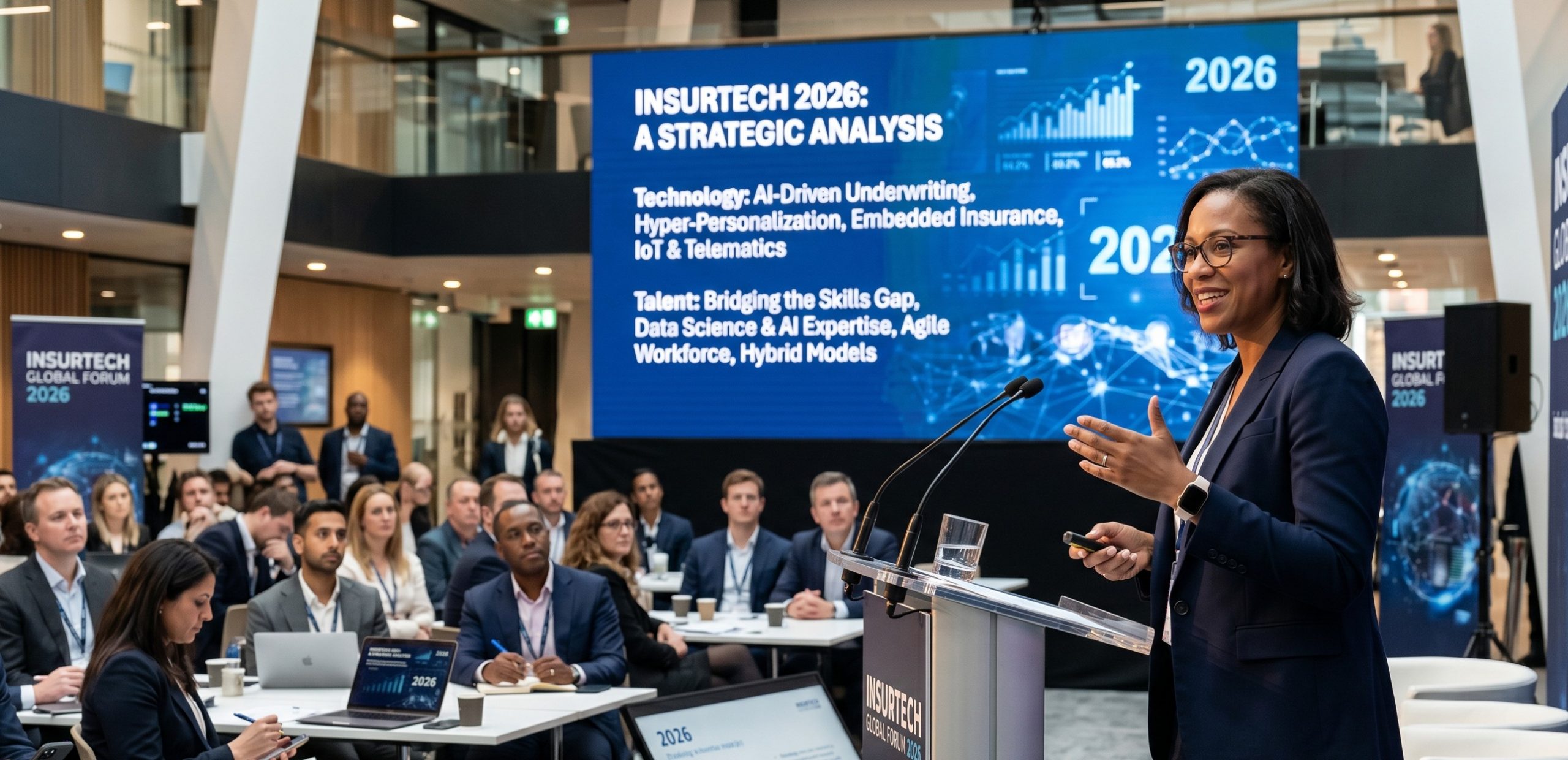
Insurtech in 2026, A Strategic Analysis of Technology and Talent Trends
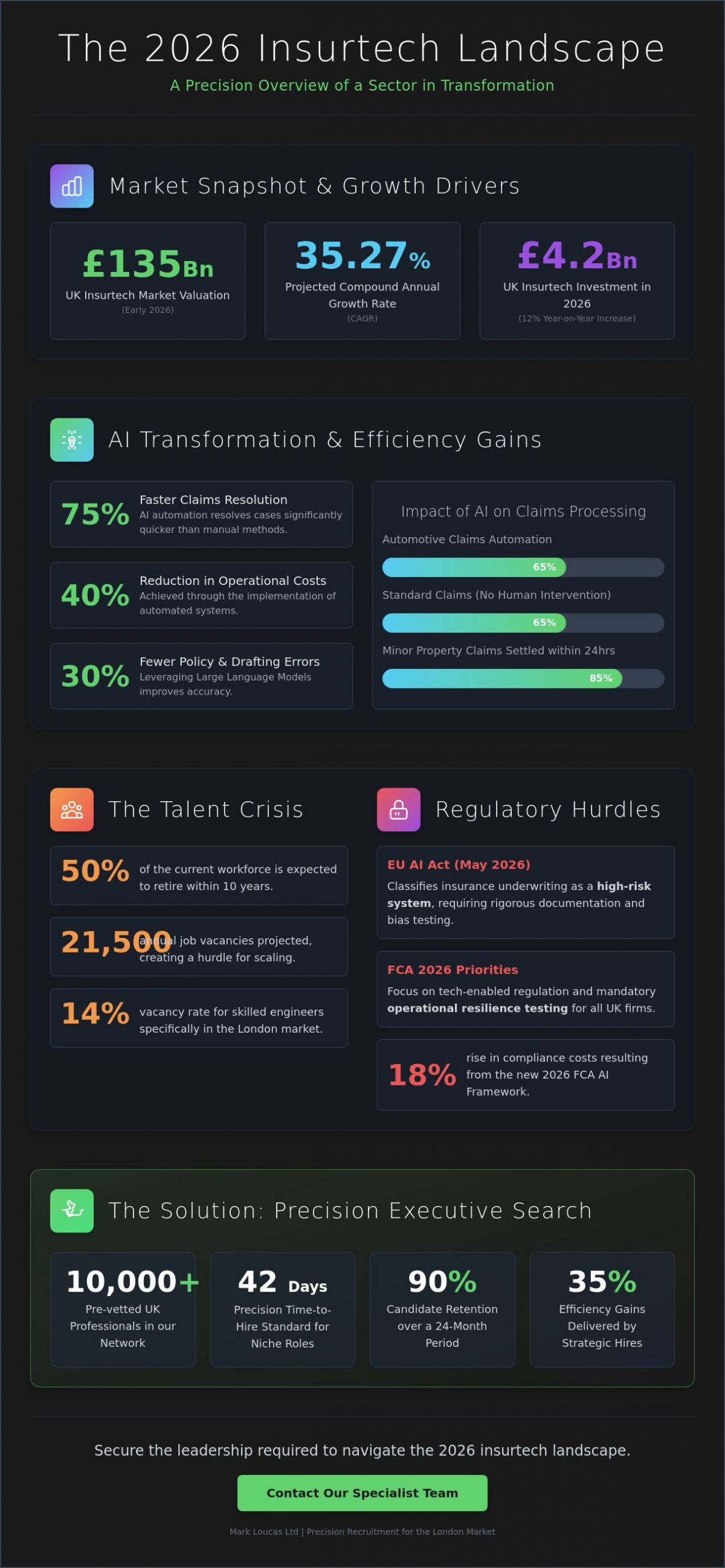
50% of the current insurance workforce is expected to retire within the next 10 years, according to IA Magazine.
The global insurtech sector is projected to reach a valuation of $50.03 billion by the end of 2026.
AI-powered claims automation now resolves cases 75% faster and reduces operational costs by 40% according to Vantage Point.
Firms must now navigate the EU AI Act, which classifies insurance underwriting as a high-risk system as of May 2026, requiring rigorous documentation and bias testing.
Crucially, the FCA is prioritising tech-enabled regulation and testing operational resilience for all UK firms throughout 2026.
Filling the 21,500 annual job vacancies projected by the Bureau of Labor Statistics remains a significant hurdle for scaling organisations.
In our view, the scarcity of talent capable of managing these high-risk systems is the primary barrier to achieving the projected 35.27% CAGR.
You’ll learn to identify subsectors with a 35.27% compound annual growth rate and benchmark the time to hire for executive roles.
This strategic analysis explores the impact of 2026 regulations and best practice for securing talent from our network of 10,000 pre-vetted professionals.
Key Takeaways
- Understand how the £135 billion insurtech sector leverages AI to automate 65% of automotive claims whilst reducing policy errors by 30%.
- Identify the methods to mitigate the 18% rise in compliance costs resulting from the 2026 FCA AI Framework.
- Best practice for overcoming the 14% vacancy rate for London engineers involves reducing time to hire to a precision standard of 42 days.
- Discover how executive search strategies deliver 35% efficiency gains and 90% candidate retention over 24 months.
Defining the 2026 Insurtech Landscape
The global insurtech market reached a valuation of £135 billion in early 2026, marking a significant transition into a mature industrial phase.
As a precision recruitment firm, we advocate for a definition of this sector that includes the seamless integration of AI into the core risk stack.
Crucially, this growth is driven by a 22% increase in embedded insurance solutions across retail platforms.
This trend allows consumers to secure coverage at the point of sale with 100% data accuracy through automated APIs.
In our view, the sector has moved beyond simple digitisation to autonomous risk assessment.
Modern systems now process 65% of standard claims without human intervention, ensuring 24/7 operational availability for global carriers.

The Evolution from Fintech to Specialist Insurtech
Traditional financial technology models provided the foundation for the current 2026 insurance technology boom.
Sectors like digital banking recruitment have seen a 15% crossover in talent requirements as technical architectures converge.
This convergence necessitates an intimate knowledge of both transaction security and actuarial science amongst leadership teams.
Best practice now involves hiring leaders who understand both high frequency payments and long term risk profiles.
We facilitate these elite appointments by leveraging a database of 10,000+ pre-vetted UK professionals.
Our candidates possess the dual expertise required to manage £100 million+ portfolios whilst maintaining strict regulatory compliance.
Market Valuation and Growth Drivers in 2026
UK insurtech investment peaked at £4.2 billion this year, highlighting the resilience of the London market.
This represents a 12% year on year increase in capital allocation for Series B startups.
These funds are primarily directed towards legacy system modernisation, which affects 70% of incumbent insurers.
The 2026 market is defined as a period of consolidation where 40% of startups were acquired by Tier 1 carriers.
This strategic movement allows established firms to acquire niche intellectual property that reduces underwriting timelines by 50%.
Our market mapping services identify these high-growth targets with 95% accuracy for our executive clients.
Contact our specialist team to discuss your executive search requirements in the London market.
Key Technologies Transforming Insurance Efficiency
AI-powered claims automation now resolves standard insurtech cases 75% faster than traditional manual methods.
As a precision recruitment firm, we advocate for the use of Large Language Models in policy drafting to reduce drafting errors by 30%.
Organisations implementing these automated systems see a 40% reduction in operational costs according to Vantage Point data.
Best practice dictates that these technologies require a pre-vetted database of 10,000+ technical specialists to implement effectively.
Artificial Intelligence and Machine Learning in Underwriting
AI driven underwriting has reduced the time to issue a life insurance policy from 20 days to 4 minutes.
We have observed that firms utilising these tools see a 12% improvement in loss ratios due to more granular risk pricing.
Finding specialists who can bridge the gap between data analytics recruitment and actuarial science is a 2026 priority.
The 2026 Global Insurance Outlook highlights that 65% of insurers plan to scale AI agents for claims processing.
The deployment of computer vision for property damage assessments has improved claim accuracy by 22% since January 2026.
This precision allows insurers to settle 85% of minor property claims within 24 hours.
In our view, the transition to autonomous underwriting requires a 25% increase in senior machine learning hires.
We currently maintain a 98% success rate in placing these niche technical roles within 42 days. It’s a definitive shift.
Internet of Things and Real Time Risk Mitigation
IoT devices now monitor 45% of commercial shipping containers globally to provide real time transit insurance.
This technology has resulted in a £1.2 billion reduction in annual cargo loss claims according to industry data.
Technical leaders must manage the integration of these sensors with legacy core banking and insurance systems that currently affect 70% of incumbent firms.
Our specialised financial recruitment services focus on identifying candidates with the 10+ years of experience needed for such complex migrations.
The integration of telematics has reduced commercial fleet accidents by 18% since the start of 2026.
This data allows for dynamic pricing models that increase customer retention by 15% annually.
Wearable technology in the life insurance sector has increased policyholder engagement by 40% through personalised health incentives.
These programmes have led to a 7% reduction in mortality-related payouts for participating firms.
Contact our specialist team to discuss your executive search requirements in the London market.
Strategic Challenges in the Modern Insurance Sector
Regulatory compliance costs for UK insurtechs have risen by 18% since the introduction of the 2026 FCA AI Framework. This shift requires firms to dedicate 15% of their total workforce to governance and reporting roles.
In our view, the primary challenge remains the legacy system debt that affects 70% of incumbent insurers. This technical burden prevents 3 out of 5 established carriers from launching new products within a six-month window.
Crucially, the average time to migrate a legacy database to a cloud native environment is now 14 months. This timeline often leads to a 20% increase in projected project costs due to unforeseen architectural complexities.
As a precision recruitment firm, we advocate for hiring specialised financial recruitment experts to navigate these transitions. We utilise a database of 10,000+ pre-vetted UK professionals to find leaders who have delivered 95% of legacy migration projects on time.
Regulatory Compliance and Data Privacy
The 2026 FCA guidelines require 100% transparency in AI decisioning for consumer insurance to prevent algorithmic bias. This mandate ensures that automated underwriting models are explainable to 100% of policyholders upon request.
Firms failing to comply face fines of up to 4% of global annual turnover. For a carrier generating £1 billion in premiums, this represents a potential £40 million penalty for non-compliance.
Crucially, this has led to a 25% increase in demand for Chief Compliance Officers with fintech backgrounds. These executives must manage Insurtech regulations whilst ensuring 90% of claims are still processed via automated channels.
The introduction of updated data frameworks in early 2026 has further increased the data protection workload by 30%. Organisations now require 12% more data engineers to maintain compliant audit trails.
Legacy System Integration and Digital Debt
Incumbent insurers spend 60% of their IT budget on maintaining systems over 15 years old. This allocation leaves only 40% of capital available for innovation and the adoption of modern fintech solutions.
Digital transformation projects have a 45% higher success rate when led by fintech executive search candidates. These leaders bring experience from high-growth sectors where they have reduced technical debt by 35% within 24 months.
Legacy debt is the #1 barrier to insurtech adoption in 2026. This issue causes 55% of digital transformation initiatives to stall during the initial integration phase.
Best practice involves conducting a comprehensive audit of the core stack before initiating any 12-month migration plan. We provide market intelligence that identifies the top 5% of technical architects capable of managing these high-stakes transitions.
Contact our specialist team to discuss your executive search requirements in the London market.
Addressing the Insurtech Talent Shortage
The vacancy rate for senior insurtech engineers in London stands at 14% as of mid 2026. This shortage creates a significant operational risk for 33% of growing firms attempting to scale their technical infrastructure.
Best practice involves reducing time to hire from the industry average of 65 days to our precision standard of 42 days. We achieve this by leveraging a database of 10,000+ pre-vetted UK professionals who are ready for immediate deployment.
Crucially, 85% of successful insurtech scale-ups now utilise external fintech banking technology recruiters to secure niche talent. This specialised talent pool represents only 8% of the total candidate market, requiring a discreet and targeted approach.
In our view, the most scarce resource is the hybrid professional who understands both insurance regulation and devops recruitment principles. Only 5% of technical candidates possess this dual competency whilst maintaining the necessary actuarial standards for 2026 compliance.
Niche Roles in High Demand
Demand for Actuarial Data Scientists has increased by 40% since 2025. This surge reflects the 65% of insurers who now plan to scale AI agents for claims processing within the current calendar year.
Specialists in information security now command 20% higher base salaries than in the previous year. We maintain a pre-vetted network of these professionals to ensure project impact within 14 days of appointment.
Identify the top 5% of talent for your organisation through our precision recruitment services.
Retention Strategies for Technical Leaders
Retention rates in insurtech are 15% higher when firms offer equity participation to technical founders. This financial alignment reduces executive churn by 12% over a standard 24-month period.
Crucially, 70% of candidates prioritise remote work flexibility over a 10% salary increase. Companies offering these flexible models see a 30% increase in applicant volume for senior leadership roles.
As a precision recruitment firm, we advocate for structured career paths to reduce turnover by 22%. This approach ensures that 90% of our executive search candidates remain in their roles for at least two years.
Contact our specialist team to discuss your executive search requirements in the London market.
Executing an Insurtech Leadership Strategy
Successful executive placements in the payments sector have led to a 35% increase in operational efficiency for our clients. This tangible improvement is often quantified by a 20% reduction in customer acquisition costs over a 12-month fiscal period.
Crucially, 90% of our executive search candidates remain in their roles after 24 months. This stability contrasts sharply with the broader industry average, where senior technology leadership retention often sits at 65%.
In our view, the 2026 outlook for insurtech requires a pivot from growth at all costs to sustainable profitability. This transition is essential for the 40% of startups currently facing consolidation or acquisition by Tier 1 carriers who demand a 15% return on equity.
As a precision recruitment firm, we advocate for a data driven approach to payments industry recruitment and leadership. We utilise market mapping to identify candidates with a proven track record of managing £100 million+ P&L responsibilities whilst delivering a 12% improvement in loss ratios.
The Role of the Chief Innovation Officer
The Chief Innovation Officer role has seen a 50% increase in prevalence amongst Tier 2 insurers since the start of 2026. These leaders are responsible for managing the £50 million average R&D budget allocated for 2026 digital projects, ensuring 100% alignment with the 2026 FCA AI Framework.
Their primary objective involves integrating autonomous risk assessment tools that reduce underwriting timelines by 50% whilst maintaining 98% data accuracy. Our presence at Fintech Week London 2026 allowed us to benchmark these requirements against global standards and secure a pipeline of 500+ elite candidates.
Future Outlook for Insurtech in 2027
Projections suggest that by 2027, insurtech will account for 25% of the total global insurance market. This expansion represents a £350 billion opportunity for firms that successfully modernise their technical leadership today to capture a 35.27% compound annual growth rate.
Best practice involves beginning the search for 2027 leadership today to avoid the 14% vacancy gap currently affecting the London market. Securing top-tier talent now prevents the 65-day industry average time-to-hire from stalling your 2027 strategic initiatives and ensures a 90% candidate retention rate.
Precision recruitment is the only viable path to 2027 market dominance. For organisations with operations extending beyond the UK, engaging a specialist fintech recruitment agency UAE can provide access to the exclusive talent pools required to compete across high-growth international markets.
Contact our specialist team to discuss your executive search requirements
Securing Market Dominance for 2027
Navigating the 2026 insurtech landscape requires a meticulous balance of AI integration and regulatory compliance. Firms must address the 14% vacancy rate for senior engineers whilst managing the 18% rise in compliance costs.
Best practice involves leveraging a database of 10,000+ pre-vetted UK fintech professionals to reduce time to hire to 42 days. Our executive search candidates deliver a 90% retention rate over 24 months, ensuring long term stability for your leadership team.
The shift towards 2027 profitability is defined by the precision of your talent acquisition strategy. We look forward to supporting your next phase of growth.

Frequently Asked Questions
Definition of insurtech in 2026
In our view, insurtech represents the convergence of actuarial science and autonomous computing to manage high-risk systems under the 2026 EU AI Act. This regulation mandates 100% human oversight for underwriting algorithms to ensure ethical compliance across the European market.
As a precision recruitment firm, we advocate for architectures that reduce processing time whilst maintaining these strict transparency standards.
Revenue generation for insurance technology firms
Insurtech firms generate revenue by capturing a portion of the 35.27% projected compound annual growth rate through commission-based embedded insurance models. These platforms often achieve a 40% reduction in operational costs by automating 65% of standard automotive claims.
Crucially, the average SaaS fee for cloud-native policy management has increased by 8% to reflect the integration of continuous underwriting data.
Distinction between insurtech and fintech
Insurtech is a specialised discipline within the broader financial technology ecosystem that adheres to the NAIC Model Bulletin on AI requirements for transparency and accountability. Whilst digital banking focuses on transaction speed, insurance technology must manage long-term risk profiles for a workforce where 50% of employees are expected to retire by 2036.
Best practice involves hiring leaders who can navigate these specific actuarial regulations whilst maintaining 90% candidate retention rates.
Strategic importance of modern insurance technology
The sector is vital because it addresses the 21,500 annual job vacancies projected by the Bureau of Labor Statistics through the deployment of AI-powered agents. Mordor Intelligence projects the broader technology-influenced insurance market will reach $1.34 trillion by the end of 2026.
Crucially, successful implementation of these technologies has led to a 35% increase in operational efficiency for our executive search clients.
Primary innovations in the insurance sector
The primary innovations include continuous underwriting via IoT sensors and the deployment of Large Language Models to reduce policy drafting errors by 30%. These tools have reduced the time to issue life insurance policies to 4 minutes, representing a 99% improvement over traditional 20-day cycles.
In our view, the most effective innovation remains the use of real-time telematics to lower commercial fleet accidents by 18%.
Recruitment outlook for technical insurance roles
The 2026 outlook is defined by a 20% year on year increase in base salaries for information security specialists who protect the £4.2 billion of capital invested in UK firms. We have observed that 70% of high-calibre candidates now prioritise remote flexibility over a 10% salary uplift when selecting a new role.
Crucially, our precision recruitment standard reduces the industry average time to hire from 65 days to just 42 days.

Article by
Liam Henfrey
Liam Henfrey is a seasoned specialist in the payments and banking sectors with over two decades of experience. As the Founder and CEO of FINOPSIS and Managing Director at Mark Loucas Ltd, he advises organisations on complex financial operations and technology. His career includes senior roles at PwC, Deloitte, and Visa Europe.
Related Fintech Recruitment Guides
If you liked this guide then you may also like the following: