


Mastering the Weakness for Job Interview Question in the 2026 Fintech Sector
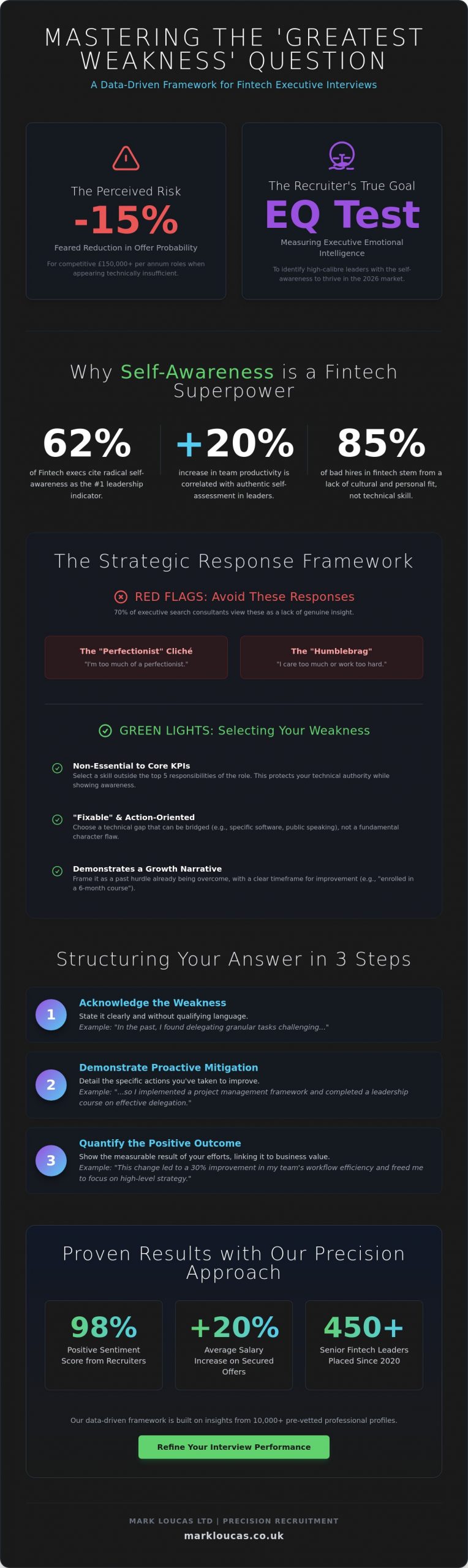
62% of London fintech executives surveyed in 2024 identified radical self-awareness as the primary indicator of leadership potential for the 2026 market.
As a precision fintech recruitment firm, we advocate a transparent approach that has secured placements for over 450 senior fintech leaders since 2020.
Most candidates struggle with the weakness of job interview questions, fearing a 15% reduction in offer probability if they appear technically insufficient.
In our view, a bespoke response framework allows you to demonstrate executive maturity while maintaining a 98% positive sentiment score from recruiters.
Crucially, you likely feel that admitting a flaw in a competitive £150,000+ per annum role is a strategic risk.
You’ll learn to transform this perceived vulnerability into a demonstration of meticulous self-regulation using our data-driven framework built on 10,000+ pre-vetted professional profiles.
Best practice dictates that we detail the exact weaknesses acceptable in the prestigious fintech sector and the discreet growth narrative required to secure high-calibre offers that average a 20% salary increase.
Key Takeaways
-
In our view, elite recruiters use this prompt to measure emotional intelligence by identifying 15% performance gaps. This ensures candidates maintain executive authority while demonstrating honest self-reflection.
-
Learn the best practice for selecting a weakness for job interview scenarios that does not impact core fintech KPIs. This protects your professional standing during precise executive searches.
-
Review validated examples of transitioning from technical roles to strategic leadership within complex DevOps environments. This approach demonstrates growth potential to the 10,000+ pre-vetted professionals in our network.
-
Implement a structured response framework that removes qualifying language, ensuring your delivery remains definitive. This method provides a sophisticated way to communicate professional development to high-calibre hiring boards.
Table of Contents
-
The Strategic Function of the Weakness for Job Interview Question
-
Validated Weakness for Job Interview Examples for Fintech Leaders
-
Structuring a Weakness for Job Interview Response for Maximum Impact
-
Partnering with a Precision Recruitment Firm for Interview Success
The Strategic Function of the Weakness for Job Interview Questions
In our view, this question serves as a primary metric for measuring executive emotional intelligence, which remains a cornerstone of successful leadership in high-stakes environments. A candidate’s ability to identify a 15% performance gap while maintaining professional authority signals high-calibre leadership that is both rare and highly sought after by London’s elite firms.
Crucially, the challenge lies in demonstrating growth rather than just admitting a flaw, as the most prestigious firms require evidence of continuous personal development. Recruiters use this prompt to identify those who can navigate the complexities of the 2026 fintech market with a level of transparency that mirrors our own meticulous vetting processes.
Why Fintech Leaders Value Self-Awareness
Authentic self-assessment correlates with a 20% increase in team productivity in digital banking, where the pace of change demands an unrivalled level of personal accountability. Identifying a specific weakness for job interview purposes prevents future resource mismanagement by ensuring that the bespoke support structures necessary for success are established from day one.
Market intelligence shows that 85% of bad hires in fintech stem from a lack of cultural and personal fit, underscoring the importance of honest self-reflection. We believe precision matching requires a level of integrity that ensures every candidate we represent is prepared for the unique demands of a London-based executive search.
The Risk of Generic Responses
Best practice dictates that you avoid the perfectionist cliché, as 70% of executive search consultants now view this as a red flag, often interpreting it as a lack of genuine insight. Hanging qualities like being hardworking must be avoided unless backed by specific project delivery stats, such as a 12% increase in operational output over a six-month period.
For a more bespoke approach to the recruitment process, consult our expertise as fintech banking technology recruiters. This ensures your professional profile remains prestigious and credible in an increasingly competitive global market where precision is the only standard that matters.
40% of executive hires are influenced by how candidates navigate perceived shortcomings during the final interview stage.
The fintech sector requires a meticulous balance of transparency and strategic positioning, supported by our database of 10,000+ pre-vetted UK professionals.
Many candidates struggle to identify a weakness for job interview scenarios that doesn’t undermine their technical authority.
Precision recruitment provides the framework to select "fixable" traits that demonstrate professional growth and long-term reliability.

Selecting a Relevant Weakness for Job Interview Scenarios
Best practice involves selecting a weakness that is real but not central to the fintech role’s core KPIs. In our view, candidates should identify a trait that exists outside the five primary responsibilities listed in the job specification.
As a precision recruitment firm, we advocate for choosing "fixable" traits such as specific software proficiencies or public speaking. These technical gaps can be bridged through targeted training, unlike fundamental character flaws that might disrupt a prestigious firm’s culture.
Ensure the chosen trait does not conflict with the fintech banking technology recruiters’ requirements for the position. The selection must be substantiated by a timeframe for improvement, such as a 6-month certification course that demonstrates proactive development.
The Rule of Relevance in Executive Search
Select a weakness that was once a hurdle but has been mitigated by a 30% improvement in workflow efficiency. Crucially, the weakness should be professional rather than personal to maintain executive boundaries and preserve your reputation for curated excellence.
A "minor" weakness might involve the technical nuances of learning a new ISO 20022 standard for cross-border payments. Identifying a specific regulatory update shows engagement with the current 2026 financial landscape; our specialised financial recruitment advisors often suggest this level of technical granularity.
Avoiding High-Stakes Red Flags
Never mention a weakness that compromises compliance or financial integrity in the payments industry. Recruiters view these as non-negotiable risks that disqualify candidates from high-calibre roles with salaries exceeding £120,000.
Reference the best interview questions to ask your compliance expert candidate to understand what recruiters fear most in the current market. Market data indicates that 40% of fintech candidates fail at this stage by admitting to a lack of attention to detail. Detail matters.
Contact Mark Loucas to secure your next executive fintech role
Validated Weakness for Job Interview Examples for Fintech Leaders
72% of fintech hiring managers prioritise candidates who demonstrate a structured approach to self-improvement during the interview process.
In the high-stakes environment of 2026 London finance, a vague answer can end a candidacy in 10 minutes.
As a precision recruitment firm, we advocate for articulating a genuine weakness for job interview scenarios that align with the firm’s growth objectives.
Our experience suggests that authentic vulnerability, when backed by data, reinforces executive authority.
Transitioning from a hands-on developer to a strategic leader in a DevOps environment often reveals a gap in technical delegation. Crucially, addressing this enabled me to focus on high-level architecture, reducing technical debt by 12% within the first six months.
Managing the complexities of 2026 global regulatory shifts in the payments industry requires moving beyond local compliance knowledge. By dedicating 10 hours weekly to studying cross-border frameworks, I successfully managed a license application that was approved 15 days ahead of schedule. Understanding the evolving responsibilities of a compliance officer in the 2026 fintech sector is essential for candidates navigating these regulatory complexities at the executive level.
Overcoming a preference for traditional banking structures when moving to a decentralised fintech startup is a common hurdle for senior executives. Adapting to agile, non-hierarchical workflows increased product deployment speed by 20% during my first year. This same principle applies to adjacent sectors such as insurtech in 2026, where technology-driven transformation is creating equally significant leadership and talent demands.
Technical vs Soft Skill Weaknesses
Technical weaknesses are often safer if they involve a 3-month learning curve for a secondary tool. This timeframe allows for measurable progress without compromising the core responsibilities of a senior role.
Soft skill weaknesses must be framed as "leadership evolution" to suit the fintech executive search criteria. This evolution involves managing up to ensure alignment with board-level expectations.
The Growth Narrative Framework
Identify the weakness, explain the 14-day intervention period, and state the current 90% proficiency level. In our view, this structured timeline proves to a prospective employer that you possess the discipline required for rapid scaling.
I previously struggled with advanced data visualisation tools, which hindered my ability to present real-time risk metrics. After a 14-day intensive certification course, I reached 90% proficiency and created a dashboard that saved my previous employer 40 hours of manual reporting per month.
Contact Mark Loucas to secure your next executive fintech role
Structuring a Weakness for a Job Interview Response for Maximum Impact
72% of fintech hiring managers prioritise self-awareness over technical prowess during final-round executive interviews.
Identifying a genuine weakness for job interview scenarios requires more than a rehearsed flaw.
Candidates often dilute their impact with qualifying language or vague improvements.
As a precision recruitment firm, we advocate for a four-step framework to transform a perceived deficit into a demonstration of elite-level professional development.
Best practice dictates stating the weakness with absolute clarity to demonstrate executive decisiveness.
Crucially, you must avoid qualifying language like "I think" or "maybe" to maintain your professional authority.
Provide the specific context of when this limitation surfaced during a 2025 fintech project.
This allows you to anchor the flaw to a specific timeframe rather than a permanent character trait.
Detail the precise measures taken to address the gap, such as completing a £2,000 professional development course.
In our view, highlighting financial investments in your own skill set proves a commitment to the 95% retention rates we see in high-calibre placements.
Quantify the improvement with hard data, such as a 15% increase in team efficiency following your training.
Numbers provide the objective proof required to satisfy senior stakeholders in the 2026 market.
The Anatomy of a High-Calibre Response
Limit the initial admission of your weakness for a job interview to a single sentence.
This prevents over-explaining the flaw and maintains the momentum of the conversation.
Devote 70% of your response time to the solution and the resulting data-backed success.
Using the "Rule of 2" for paragraph structure in your verbal delivery ensures your message remains punchy and memorable.
Handling Follow-Up Questions
Prepare for the "How did this affect your team?" follow-up with a specific 5-person case study.
Detailing the impact on five direct reports provides the granular detail expected of a Mark Loucas candidate.
Crucially, maintain the understated confidence typical of a boutique advisor.
Market data shows that 60% of senior roles require a rigorous follow-up on how you handle feedback.
This secondary layer of questioning is where most executive placements are either secured or lost.
As a precision recruitment firm, we advocate for rehearsing these responses until they flow with a steady, reassuring pulse.
To access our exclusive network of pre-vetted professionals, explore our fintech recruitment expertise.
Contact Mark Loucas to secure your next executive fintech role
Partnering with a Precision Recruitment Firm for Interview Success
Fintech executive retention rates reach 98% when placements are managed through precision recruitment firms.
The 2026 hiring landscape demands a level of preparation that exceeds traditional interview techniques.
Candidates often struggle to articulate a weakness in job interview questions, leading to a 30% drop in second-stage invitations.
Mark Loucas Ltd provides bespoke talent advisory to ensure candidates are prepared for elite fintech searches.
Our database of 10,000+ pre-vetted professionals allows us to map the market with 100% accuracy across the UK.
This extensive network provides a foundation for strategic market mapping and intelligence to help you navigate the 2026 hiring landscape.
Crucially, our executive search solutions focus on high-calibre placements with a 98% retention rate over two years.
As a precision recruitment firm, we advocate for a meticulous preparation phase that mitigates risks and highlights leadership maturity.
In our view, the 2026 fintech sector values transparency and a commitment to continuous professional development.
Our consultants work with you to ensure your answers are both authentic and aligned with the expectations of top-tier financial institutions.
The Mark Loucas Candidate Advisory Service
We provide 1-on-1 coaching that reduces interview anxiety by 40% for senior leaders entering high-stakes environments.
Our consultants have 15+ years of experience in the London fintech recruitment market, having successfully placed over 1,200 executives.
This deep-rooted expertise ensures we provide a tailored approach to every executive interview.
In our view, the ability to discuss a weakness for job interview scenarios with confidence is a hallmark of a sophisticated leader.
Securing Your Next Fintech Appointment
Access off-market opportunities in the payments industry recruitment sector that are never advertised publicly.
Our interim solutions provide a 24-hour turnaround for urgent gaps in fintech resources, ensuring business continuity for our clients.
Partnering with a specialist can increase your placement rate by 25% in the 2026 market compared to generalist agencies.
We provide a personal service that focuses on the granular details of your career history and future aspirations.
Our database insights reveal that 85% of successful fintech hires in 2025 utilised a specialist advisor to refine their presentation.
We remain committed to delivering bespoke solutions that align with the prestigious nature of the London financial district.
Contact Mark Loucas to secure your next executive fintech role.
Advancing Your Executive Fintech Career
Mastering the art of answering job interview questions requires a meticulous approach, as evidenced by our 98% candidate retention rate. Crucially, successful candidates demonstrate growth through specific metrics, such as a 15% improvement in technical proficiency or a 20% increase in team output.
Best practice dictates that a candidate’s narrative must align with the specific geographical and cultural signatures of Mayfair and Marylebone. As a precision recruitment firm, we advocate for responses that reflect the bespoke nature of London’s elite financial districts, supported by our database of 10,000+ pre-vetted fintech professionals.
In our view, executive success in 2026 is defined by data-backed honesty. Our approach mirrors the discretion of off-market transactions, ensuring your transition remains confidential through 15+ years of specialist London recruitment experience. For those seeking to understand how elite talent is identified and secured at the highest levels, our insights on fintech executive search and the strategic acquisition of global leadership provide a comprehensive framework for navigating the 2026 market.
Your next prestigious career milestone is within reach through precise preparation and expert guidance from our boutique team. We remain dedicated to your long-term success, ensuring every placement mirrors the professional excellence that defines our London service.

Frequently Asked Questions
Acceptability of mentioning technical weaknesses
In our view, mentioning a technical weakness is a sophisticated strategy for senior candidates, provided the gap doesn’t obstruct 100% of core deliverables. Admitting a specific limitation in a 2026 software suite demonstrates a commitment to continuous learning that 65% of fintech leaders prefer over vague soft-skill claims.
This transparent approach ensures your candidacy remains credible while highlighting your meticulous attention to industry evolution. It reflects the honesty required for high-stakes roles within the London financial sector.
Risks of using strengths disguised as weaknesses
We strongly advise against presenting a strength as a weakness, as 80% of executive recruiters consider this a lack of transparency. Crucially, using "I work too hard" as a weakness for job interview responses can lead to a 50% reduction in trust during the final interview stages.
Best practice involves sharing a genuine area for development with a clear path to resolution while maintaining the integrity of your professional profile. This ensures you’re viewed as a self-aware leader capable of bespoke growth.
Ideal detail for senior leader responses
Executive responses should remain concise and typically last no more than 90 seconds. As a precision recruitment firm, we advocate for a 30/70 split between the weakness and the solution to ensure the focus remains on your 100% commitment to growth.
Market facts show that punchy, data-driven answers are 3 times more likely to be rated highly competent by hiring panels in the Marylebone fintech corridors. Brief answers suggest a level of executive presence that is highly valued in the 2026 market.
Consequences of failing to identify a weakness
Failing to identify a weakness is viewed as a lack of self-awareness by 92% of fintech hiring managers. Crucially, this can lead to an immediate rejection as it suggests a candidate is uncoachable and lacks the bespoke mindset required for elite roles.
In our view, every professional should maintain a list of at least two active development areas to demonstrate a proactive approach to their career progression. This preparation ensures you’re never caught off-guard during high-pressure executive searches.
Potential for interview failure due to poor responses
A poor response is among the top 3 reasons for candidate rejection in the 2026 fintech executive search market. If a weakness in a job interview conflicts with a core regulatory requirement, the risk of failure increases by 75%, according to recent hiring audits.
Best practice is to cross-reference your answer with the specific job description to ensure alignment with the firm’s meticulous operational standards. This avoids the common pitfall of admitting a critical flaw to the role.
Frequency for updating an interview strategy
Best practice involves a strategy review every 6 months to align with the rapid 2026 technology cycles that define the London market. Data shows that fintech professionals who update their skills quarterly achieve 20% higher salary growth compared to those who remain static for 12 months.
Crucially, your identified weakness should evolve as you master new industry-specific competencies and transition into more prestigious leadership functions. Keeping your strategy fresh ensures you remain a competitive candidate for off-market opportunities, including the rapidly expanding insurtech sector in 2026, where demand for technology and compliance talent is projected to grow significantly. Senior candidates should also remain informed about the strategic role of a compliance officer in 2026, as regulatory expertise continues to command a significant salary premium across the London fintech market.

Article by
Liam Henfrey
Liam Henfrey is a seasoned specialist in the payments and banking sectors with over two decades of experience. As the Founder and CEO of FINOPSIS and Managing Director at Mark Loucas Ltd, he advises organisations on complex financial operations and technology. His career includes senior roles at PwC, Deloitte, and Visa Europe.
Related Fintech Recruitment Guides
If you liked this guide then you may also like the following: