


The Strategic Role of a Finance Controller in the 2026 Fintech Sector
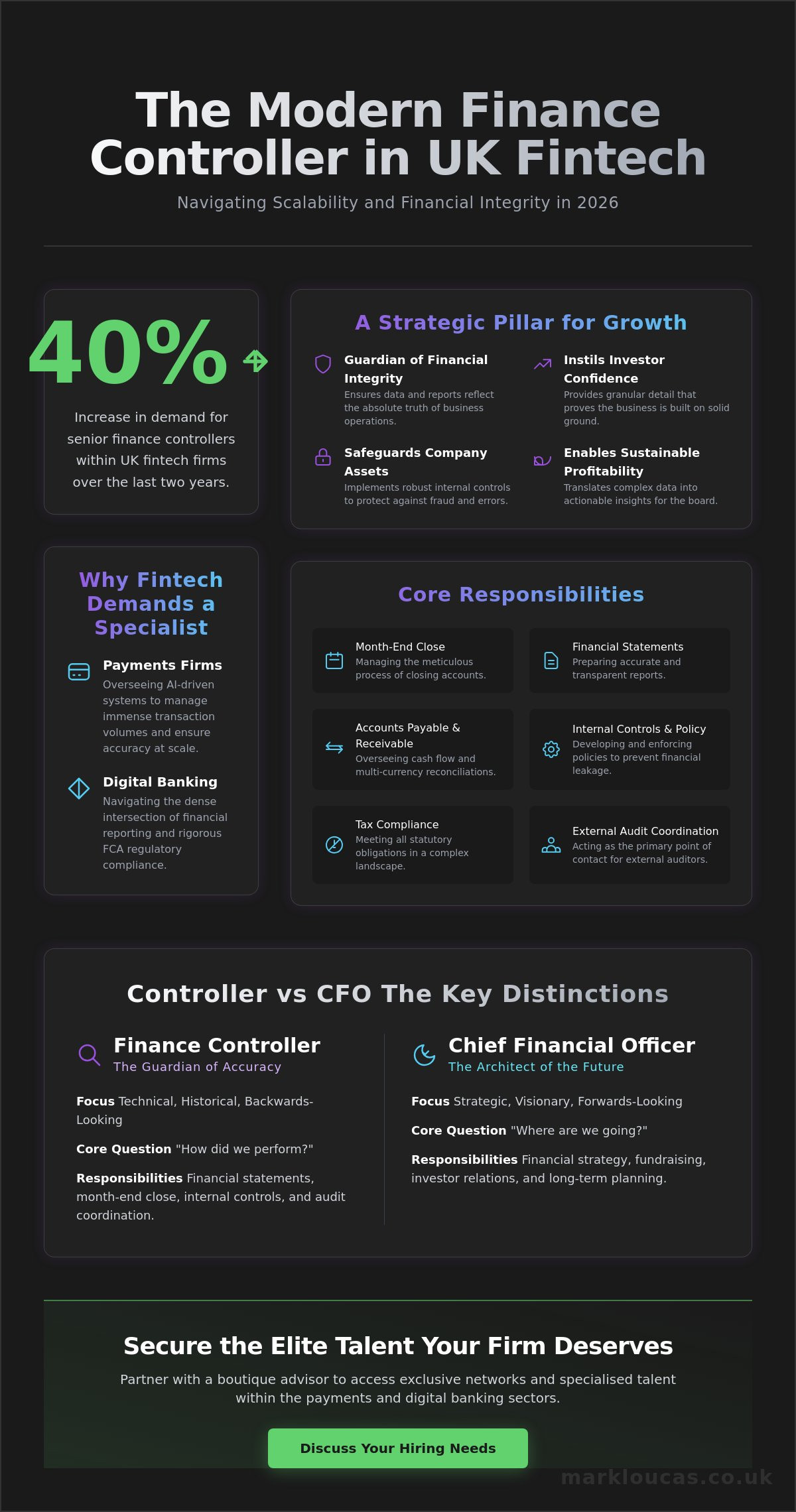
UK fintech firms have seen a 40% increase in demand for a senior finance controller over the last two years, yet securing a distinguished professional who understands both the rigour of traditional accounting and the fluid nature of neobanking remains rare in the talent pool.
You likely feel the weight of investor expectations for absolute transparency whilst navigating the complexities of risk-based payment limits and the sector’s definitive shift towards sustainable profitability.
It is a delicate balance. This intricate environment requires a steady hand and a deep, intuitive understanding of the modern financial landscape.
This article demonstrates how a specialist finance controller provides the essential bridge between financial discipline and the rapid scalability your firm requires to thrive in 2026.
We shall provide a clear framework for your hiring process, explore the specific value a controller adds to a payments business, and define the salary levels needed to attract the elite talent your current stage demands.
Our focus remains on ensuring your interests are managed with expert care and meticulous attention to detail, reflecting the bespoke nature of the modern fintech sector.
Key Takeaways
- Gain a clear understanding of how the finance controller acts as the essential guardian of financial data integrity and reporting within a rapidly expanding fintech ecosystem.
- Explore the core responsibilities involved in managing the month-end close and the preparation of financial statements that meet the highest standards of transparency.
- Distinguish between the technical, backwards-looking focus of a controller and the strategic, forwards-looking mandate of a Chief Financial Officer to ensure optimal leadership at every stage.
- Learn to identify the specific experience markers, particularly within regulated financial environments, that are necessary for success in the complex 2026 landscape.
- Discover the advantages of partnering with a boutique advisor to access exclusive networks and specialised talent within the payments and digital banking sectors.
Table of Contents
-
Defining the finance controller role within a scaling fintech ecosystem
-
Essential skills and core responsibilities for a modern finance controller
-
Understanding the differences between a finance controller and a CFO
-
Navigating the search for a finance controller in a competitive market
-
Partnering with Mark Loucas for executive financial appointments
If you are looking to refine your leadership structure, you may wish to discuss your specific hiring needs with our experts for tailored advice.
Defining the finance controller role within a scaling fintech ecosystem
The finance controller serves as the primary custodian of a firm’s financial integrity. In a traditional corporate setting, the role of a Financial Comptroller or controller was often viewed as a senior management position focused on the ledger; however, the modern fintech sector has transformed this function into a vital strategic pillar. It’s no longer just about maintaining a static record of accounts. Today, this individual ensures that every data point and report reflects the absolute truth of the business operations. They provide the foundation upon which all other strategic decisions are built.
During funding rounds, which are frequent and intense in the scaling phase, the controller is the person who instils confidence in sophisticated investors. They provide the granular detail that proves the business is built on solid ground. This is particularly vital in 2026, where the focus has shifted from growth at any cost to sustainable, profitable models. A modern finance controller is both a meticulous steward of historical accuracy and a strategic partner who translates complex data into actionable insights for the board.
The core purpose of the controllership
The role has moved beyond the simple recording of transactions to a deeper analysis of financial health. Whilst the daily routine involves oversight, the true value lies in the preparation for external audits and meeting rigorous statutory reporting requirements. By implementing robust internal controls, the controller safeguards company assets against fraud and operational errors. This ensures the business remains resilient as it expands into new territories or introduces complex payment products. It’s about creating a culture of accountability that permeates every department.
Why fintech firms require a specialised approach
Payments firms often deal with immense transaction volumes that traditional manual processes simply cannot handle. This environment necessitates automated controlling, where the finance controller oversees AI-driven systems to ensure accuracy at scale. In digital banking, the intersection of financial reporting and regulatory compliance is particularly dense. Real-time data visibility is essential in such a fast moving market. A specialist understands how to manage these digital flows whilst maintaining the high standards expected by the Financial Conduct Authority (FCA). They ensure that the speed of innovation never compromises the safety of the institution.
We invite you to reach out to our team to learn more about our executive search process and how we identify the finest leadership for your organisation.
Essential skills and core responsibilities for a modern finance controller
The cadence of the controllership is defined by its meticulous attention to detail. At its heart, the role demands the management of the month-end close process, ensuring that financial statements are prepared with absolute precision. This isn’t merely an administrative task; it’s an exercise in accuracy that forms the bedrock of a firm’s credibility. These Essential Skills and Core Responsibilities ensure the firm remains in good standing whilst maintaining the transparency required by external stakeholders. A dedicated finance controller provides the quiet confidence that every figure is verified and every report is beyond reproach.
In a globalised framework, the controller oversees accounts payable and receivable across multiple jurisdictions. This requires a nuanced understanding of cross-border payment flows and multi-currency reconciliations. Beyond the ledger, they develop and enforce internal spend controls and corporate policies to prevent leakage as the headcount grows. Managing tax compliance and coordinating with external auditors are equally vital duties. They act as the primary point of contact during the audit season, ensuring that the process is smooth and the findings are favourable.
Technical proficiency and the fintech tech stack
Modern finance requires more than a spreadsheet. Controllers must master advanced ERP systems and integrated payment platforms that handle thousands of transactions per second. Data analytics has become a non-negotiable skill, allowing the controller to identify financial trends or anomalies before they become systemic issues. This often involves working closely with specialists found through our data and analytics recruitment services to build robust reporting engines. If you are seeking to appoint a leader with this specific blend of expertise, we suggest you speak with our consultants for a confidential discussion.
Regulatory knowledge and compliance oversight
In the fintech sector, financial reporting is inseparable from regulatory compliance. The finance controller manages the financial aspects of FCA or central bank reporting, ensuring that capital adequacy and liquidity ratios are monitored in real time. This is especially critical as firms prepare for the new cryptoasset firm authorisation gateway in September 2026. They must also navigate the nuances of IFRS and local GAAP variations across different markets. For a broader view of how this interacts with risk management, you may find our piece on the strategic role of a compliance officer particularly insightful.
If you are considering the next phase of your leadership expansion, please contact our consultants for a confidential discussion about senior appointments tailored to your unique requirements.
Understanding the differences between a finance controller and a CFO
The distinction between these two roles is often blurred in early-stage firms, yet as a fintech scales, the separation becomes a matter of operational necessity. The finance controller is primarily concerned with historical accuracy and technical integrity. They look backwards to ensure every transaction is accounted for and every report is precise. In contrast, the Chief Financial Officer (CFO) looks forward. They use the verified data provided by the controller to build long-term strategic plans, manage investor relations, and drive capital allocation. Whilst the CFO focuses on the grand vision of the firm’s future, the controller ensures that the financial foundation remains secure and beyond reproach.
Within a sophisticated reporting structure, the controller typically reports directly to the CFO or a VP of Finance. This hierarchy ensures that the person making strategic bets is working with figures that have been rigorously vetted by a technical expert. It creates a system of checks and balances where the strategist is always anchored by the reality of the ledger. This relationship is the cornerstone of financial stability during periods of rapid growth or market volatility.
Tactical execution versus strategic vision
The controller manages the "how" of financial operations. They establish the systems and processes that allow the business to function daily. The CFO manages the "why", explaining the financial narrative to the board and external stakeholders. In the early stages of a fintech, hiring a finance controller first is often a wise move. It ensures that the plumbing of the finance function is correctly installed before a high-level strategist is brought in to scale the business. This approach prevents the technical debt that often accumulates when growth outpaces oversight.
When to hire a controller versus a VP of Finance
A VP of Finance often takes a broader operational role, perhaps overseeing legal or HR functions in addition to finance. A finance controller remains laser-focused on the technical accounting, tax compliance, and reporting aspects. The ideal timing for a dedicated controller is often when transaction volumes increase significantly or when preparing for a first major audit. For more detail on these timelines, you may find our guide on fintech executive search particularly helpful in planning your senior acquisition strategy.
We encourage hiring managers to get in touch for a bespoke talent advisory session to discuss their specific leadership requirements.
Navigating the search for a finance controller in a competitive market
Securing a distinguished finance controller in 2026 requires more than a standard search. The market is exceptionally competitive, with a 40 per cent increase in demand for senior financial leadership over the past two years. You must look for specific experience markers that align with your firm’s regulatory obligations. Experience in an FCA regulated environment is often non negotiable, as it ensures the candidate understands the gravity of compliance alongside technical reporting. These individuals possess a rare blend of traditional accounting rigour and the agility needed for modern fintech operations.
Cultural fit remains a critical factor in a fast paced digital banking startup. A candidate must be comfortable with the unhurried precision of a financial close whilst adapting to the rapid pace of product innovation. Structuring a competitive compensation package is essential to attract high calibre professionals. Salaries for experienced controllers in the UK fintech sector currently range from £80,000 to £145,000, often supplemented by equity options that align their success with the firm’s growth. Partnering with a niche recruiter provides access to passive talent pools that are often invisible to the wider market.
If you are seeking to appoint a leader who can navigate these complexities with quiet confidence, we invite you to speak with our specialist advisors for a tailored recruitment strategy.
Identifying the right profile for your growth stage
A builder controller is essential for early stage startups where processes must be created from the ground up. They enjoy the challenge of establishing the initial ledger and internal controls. In contrast, a scaler is better suited for established firms that need to refine and automate existing systems for global expansion. Soft skills like communication and cross departmental collaboration are vital for both profiles. We support digital banking recruitment by sourcing candidates with this specific industry experience, ensuring they can lead through every stage of the business lifecycle.
Interviewing for technical and strategic excellence
Interviewing should test both technical depth and strategic foresight. You might ask how they managed a complex multi currency reconciliation or led a significant ERP migration. It’s also important to assess their understanding of the 2026 regulatory landscape, such as the new risk based contactless payment limits. Look for candidates who have managed system implementations, as this demonstrates a proactive approach to technology. Their ability to translate future fintech trends into financial safeguards is what separates a standard accountant from a truly strategic controller.
We invite you to start your search with us to find your next finance controller and ensure your leadership team is built for the challenges of 2026.
Partnering with Mark Loucas for executive financial appointments
Choosing a recruitment partner is a decision of significant consequence for any scaling fintech. At Mark Loucas, our approach to financial recruitment is defined by a commitment to curated excellence and refined service. We understand that the payments industry operates on a foundation of trust and technical precision. Our deep networks amongst senior professionals allow us to facilitate introductions that larger, volume-driven agencies simply cannot replicate. We operate with the quiet confidence of a knowledgeable local insider, ensuring your interests are managed with expert care at every stage of the process.
Our market mapping and intelligence services provide a distinct advantage in a crowded field. We identify elite talent before it reaches the open market, offering our clients exclusive access to individuals who possess the rare blend of skills required for the modern controllership. This proactive methodology ensures you aren’t merely selecting from those currently looking for work, but rather from the finest professionals in the sector. We value privacy and tailored solutions above all else. This dedication to discretion protects the integrity of your brand whilst securing the leadership necessary for long term business success.
A boutique approach to global fintech talent
We deliberately shun the impersonal nature of large corporate entities in favour of an intimate, personalised approach. Our recruitment process is unhurried, reflecting the patience and diligence required in high value transactions. As fintech and banking technology recruiters, we focus on high calibre professional placements that align with your specific culture and growth trajectory. We take the time to understand the granular details of your requirements, ensuring that every candidate we present is a strategic fit for your organisation. It is a bespoke service designed for a discerning clientele.
Securing your organisation’s financial future
The right finance controller does more than manage a ledger; they transform the operational efficiency of your entire firm. By providing the essential bridge between rigorous oversight and rapid scalability, they enable your business to navigate the complexities of 2026 with ease. Staying ahead of the competition requires a proactive approach to talent acquisition. Waiting for the perfect candidate to appear on a job board is a risk few can afford. To secure the future of your financial operations, we encourage you to engage with our executive search services and discover the difference a tailored recruitment strategy can make.
If you wish to refine your senior leadership team with a bespoke approach, please contact our team for a confidential consultation regarding your talent strategy.
Securing your leadership legacy in a transformative era
The evolution of this pivotal leadership role from a traditional accountant to a strategic scalability architect is a significant shift in the 2026 fintech landscape. By maintaining technical integrity whilst providing the data necessary for long term growth, these professionals ensure that innovation never outpaces financial stability. They act as the essential guardians of your firm’s reputation and investor confidence. This stability is required to navigate a market defined by rapid change and rigorous oversight.
Since 2011, Mark Loucas has specialised in the nuanced world of fintech recruitment, offering our clients exclusive access to non-public executive talent. Our deep expertise in FCA and global financial regulations ensures that every candidate we present is fully prepared for the complexities of the modern regulatory environment. We take pride in an intimate, boutique approach that prioritises your unique goals above all else. You deserve a partner who values discretion and delivers excellence with quiet confidence.
We encourage you to partner with Mark Loucas to source your next finance controller and experience the benefits of a truly personalised executive search. Your organisation’s financial future remains our sole focus.
Frequently Asked Questions
What is the typical salary for a finance controller in a UK fintech
A senior finance controller in the UK fintech sector typically commands a base salary ranging from £80,000 to £145,000 as of March 2026. For those operating on an interim basis, day rates generally fall between £500 and £750. These figures often vary based on the specific revenue bracket of the firm, with private equity backed or listed entities offering the higher end of the spectrum to attract elite talent.
Does a finance controller need to be a Chartered Accountant
Whilst not a legal requirement, the majority of fintech firms prioritising financial integrity require their lead finance professional to hold a recognised qualification such as ACA, ACCA, or CIMA. This professional standing ensures they possess the technical rigour needed to manage complex regulatory reporting and statutory requirements. It provides a level of assurance to both the board and external investors that the accounts are managed by a certified expert.
How many years of experience are required for a senior finance controller role
A senior finance controller typically possesses between seven and ten years of post qualification experience, often with a significant portion spent within regulated financial environments. This tenure allows them to develop the nuanced judgement required to handle high transaction volumes and complex reconciliations. For mid-market firms with revenues between £50m and £250m, candidates with a proven track record of scaling finance functions are particularly sought after for their expertise.
Can a finance controller work remotely in the digital banking sector
Remote and hybrid working arrangements have become standard practice within the digital banking sector, provided that robust security and data privacy protocols are in place. Many fintech organisations offer flexible models to attract elite talent from across the UK. However, some firms still prefer a presence in premium urban centres for critical periods such as the month end close or during external audits to facilitate closer collaboration and oversight.
What is the difference between a controller and a comptroller
The primary difference lies in the sector of employment rather than the core responsibilities of the role. A controller is the standard designation within the private sector and fintech industry, whilst the term comptroller is more frequently utilised within government agencies and non profit organisations. Both roles focus on the integrity of financial data, internal controls, and the oversight of accounting systems to ensure absolute fiscal responsibility and transparency.
How does a finance controller support a fintech company during an IPO
During an Initial Public Offering, the controller is responsible for the rigorous preparation of financial statements and the implementation of public company grade internal controls. They provide the verified historical data required for the prospectus and coordinate extensively with external auditors to ensure full compliance with listing requirements. Their meticulous attention to detail ensures that the firm’s financial narrative is robust enough to withstand the scrutiny of sophisticated public market investors.

Article by
Liam Henfrey
Liam Henfrey is a seasoned specialist in the payments and banking sectors with over two decades of experience. As the Founder and CEO of FINOPSIS and Managing Director at Mark Loucas Ltd, he advises organisations on complex financial operations and technology. His career includes senior roles at PwC, Deloitte, and Visa Europe.
Related Fintech Recruitment Guides
If you liked this guide then you may also like the following: