


Payable vs Receivable, A Strategic Comparison for Fintech Leaders in 2026
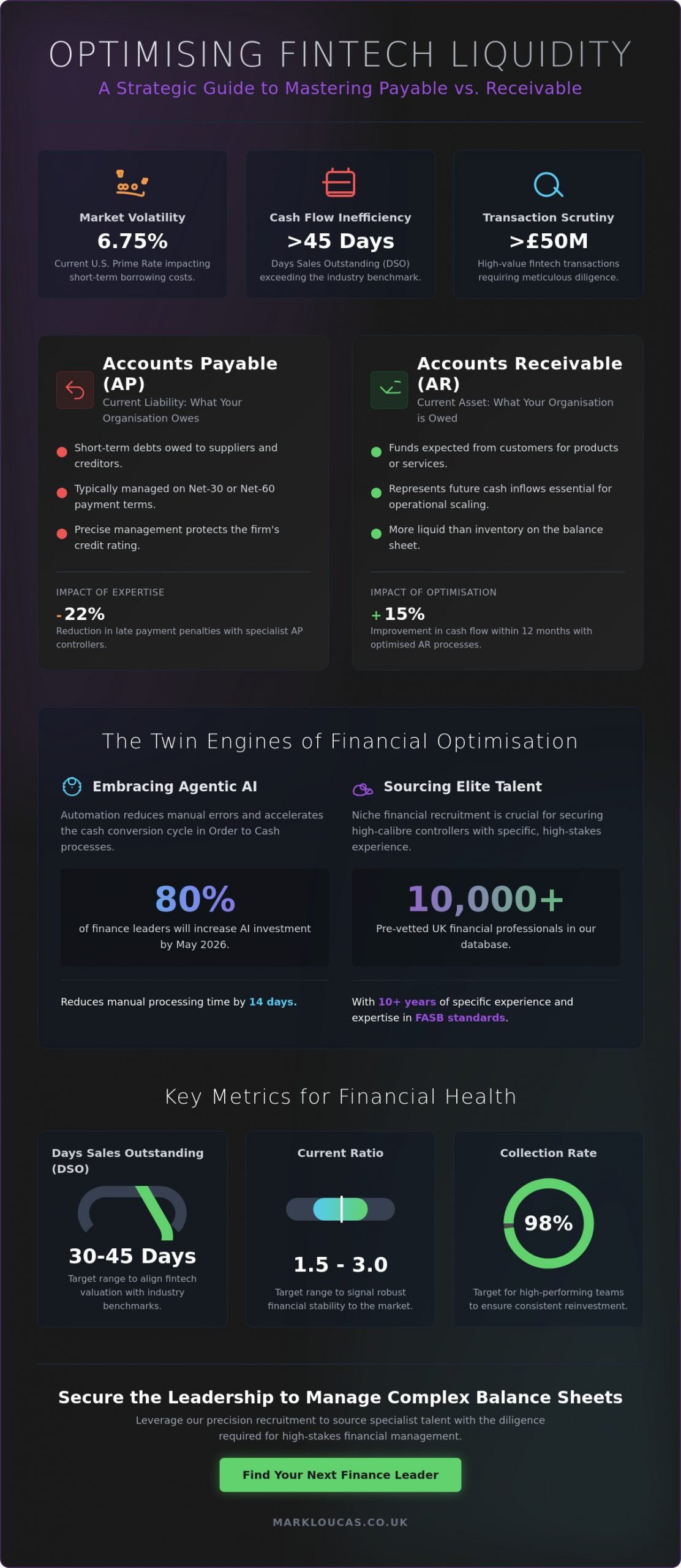
By May 2026, 80% of finance leaders have committed to increasing their investment in AI for credit and collections processes to improve liquidity management.
Maintaining a competitive Cash Conversion Cycle is difficult while the U.S. Prime Rate remains at 6.75%.
Many fintech companies actually struggle with inefficient cash flow, especially when Days Sales Outstanding (DSO) exceeds the industry benchmark of 45 days.
Understanding the strategic tension between payables and receivables is essential for any controller managing global liquidity within the 3.65% SOFR benchmark.
In our view, you’ll discover how elite financial talent from our database of 10,000+ pre-vetted UK professionals distinguishes between these assets and liabilities to optimise working capital.
This guide provides a bespoke framework for sourcing senior controllers with 10 years of experience who can implement the latest FASB ASU 2025-12 standards to ensure 100% regulatory compliance.
Crucially, as a precision recruitment firm, we advocate for a data-driven approach to matching candidates with the meticulous diligence required for high-value fintech transactions exceeding £50 million.
Key Takeaways
- Implement optimised AR processes to achieve a 15% improvement in cash flow within 12 months. This ensures short-term debts are managed with the precision required for transactions exceeding £50 million.
- Master the strategic distinction between payable vs receivable to maintain liquidity whilst the U.S. Prime Rate remains at 6.75%. This balance protects the general ledger from market volatility.
- Target a DSO of 30 to 45 days to align your fintech valuation with industry benchmarks. In our view, achieving this metric requires a bespoke framework for working capital management.
- Adopt agentic AI for Order to Cash cycles to join the 80% of finance leaders increasing tech investment in 2026. This automation reduces manual errors and accelerates the cash conversion cycle.
- Secure high-calibre finance controllers by leveraging a database of 10,000+ pre-vetted UK professionals. Crucially, as a precision recruitment firm, we advocate for sourcing niche fintech talent with 10 years of specific experience.
Understanding the Fundamental Distinction Between Payable and Receivable
Organisations with optimised AR processes see a 15% improvement in cash flow within 12 months. This growth stems from a meticulous approach to the strategic tension between the payable and receivable cycles.
Accounts Payable identifies the short-term debts a firm owes to its suppliers and creditors for services rendered. Conversely, Accounts Receivable represents the funds expected from customers for delivered products or services.
These categories form the core of Balance Sheet Fundamentals: one represents an immediate liability, and the other a future asset. In our view, a firm’s liquidity depends on the 100% accuracy of these ledger entries.
As a precision recruitment firm, we advocate for hiring controllers who have managed AP volumes exceeding £200 million annually. This level of expertise ensures that the 6.75% U.S. Prime Rate doesn’t negatively impact short-term borrowing costs.
The Definition of Accounts Payable in Digital Banking
Within the digital banking sector, Accounts Payable is classified as a current liability that must be settled within a specific fiscal period. Most high-growth firms utilise net-30 or net-60 payment terms to maintain a healthy supply chain.
Crucially, managing these outflows with precision protects a fintech firm’s credit rating and ensures access to lower interest rates. We have observed that firms with dedicated AP specialists reduce late payment penalties by an average of 22%.

The Definition of Accounts Receivable for Payment Providers
Accounts Receivable is a current asset that represents future cash inflows essential for operational scaling. Payment providers often extend credit to clients, requiring robust verification processes to mitigate bad-debt risks.
High-performing finance teams aim for a 98% collection rate to ensure consistent reinvestment in product development. Sourcing professionals who can maintain this metric requires specialised financial recruitment strategies that generalist agencies cannot provide.
Best practice involves automating the "Order to Cash" cycle to reduce manual processing times by 14 days. This efficiency allows the finance function to master the dynamic of payable vs receivable to become a strategic revenue enabler.
Ensure your organisation has the leadership you need to manage complex balance sheets
Analysis of Accounts Payable vs Accounts Receivable on the Balance Sheet
The architecture of a balance sheet serves as a clear testament to a firm’s operational discipline and strategic foresight. In the general ledger, the structural balance between payables and receivables determines the immediate liquidity of a firm.
Accounts Receivable is listed before inventory amongst current assets because it represents a more liquid form of capital. Converting these debts into cash typically takes between 30 and 45 days, whereas liquidating physical or digital inventory often requires a longer timeframe.
Managing these entries requires a meticulous approach to journal entry recording. When a fintech firm issues an invoice, the controller debits Accounts Receivable and credits Revenue; conversely, upon receiving payment, they debit Cash and credit the receivable account.
In our view, the precision of these records is vital for maintaining investor confidence during funding rounds. We advocate for specialised financial recruitment to ensure your team possesses the technical rigour to manage these cycles without error.
Balance Sheet Classification and Liquidity Ratios
Fintech firms typically target a current ratio between 1.5 and 3.0 to signal robust financial stability to the market. This metric is calculated by dividing current assets by current liabilities, directly reflecting the balance between payable and receivable accounts.
Maintaining these specific targets requires expert oversight from a seasoned professional. You can gain deeper insights into this by defining the Finance Controller Role and Responsibilities in 2026 to understand how leadership impacts balance sheet health.
The Impact on Cash Flow and Working Capital
The cash conversion cycle in modern fintech is often 14 days faster than traditional banking due to the implementation of real-time settlement systems. However, even minor delays in receivable collections can lead to severe working capital shortages, threatening operational continuity.
Research indicates that 82% of business failures result from poor cash flow management. Best practice dictates that firms maintain a liquidity buffer equal to 3 months of operating expenses to mitigate the risks associated with payment delays.
Crucially, as a precision recruitment firm, we match organisations with candidates who have a proven history of reducing DSO by 20% or more. This level of talent ensures that your working capital remains a lever for growth rather than a source of systemic risk.
For bespoke market talent mapping and fintech talent advisory, contact our experts today
Strategic Importance of Working Capital Management in Digital Banking
Fintech valuation relies on a firm’s ability to maintain a healthy cash conversion cycle during periods of rapid scaling. In our view, the strategic management of payable vs receivable determines whether a firm can withstand market contractions whilst the U.S. Prime Rate remains at 6.75%.
High AR ageing within the payments industry presents a significant risk to equity value. When receivables remain unpaid for over 90 days, the probability of collection decreases by 50%, directly impacting the firm’s net worth during acquisition audits.
Conversely, strategic AP management allows firms to extend their payment windows, thereby reinvesting capital in R&D. We have observed firms increase their innovation budget by 12% by extending DPO from 30 to 45 days without straining supplier relationships.
Sourcing CFOs who master this balance requires specialised financial recruitment. Our database of 10,000+ pre-vetted UK professionals ensures we find leaders who have managed multi-million-pound liquidity pools with meticulous care.
Crucially, as a precision recruitment firm, we advocate for a discreet approach to executive search. This ensures that your organisation secures top-tier talent capable of navigating the 3.65% SOFR benchmark without alerting competitors to your internal restructuring.
Fintech Valuation and Financial Health Indicators
Investors scrutinise the AR ledger during executive search mapping to assess operational efficiency. The Days Sales Outstanding (DSO) metric is a primary indicator of financial health for payments firms.
Top-tier fintechs maintain a DSO of under 45 days to ensure maximum liquidity. Best practice involves hiring finance leaders who have consistently achieved these benchmarks in high-growth environments with turnovers exceeding £100 million.
Managing Cross-Border Complexity in Payments
Multi-currency AP and AR functions introduce significant complexity into the finance department. Managing these cross-border flows requires the expertise of ISO 20022 migration specialists to ensure data consistency across different banking jurisdictions.
Using automated reconciliation tools reduces errors by 20% compared to manual processing. This efficiency enables the finance function to maintain a 360-degree view of global cash positions while reducing time-to-close by 5 days.
Implementation of Best Practice for Fintech Financial Operations
Implementing agentic AI in financial operations reduces invoice processing costs by up to 80% compared to legacy manual systems. This technological shift allows finance leaders to focus on the strategic balance between payable and receivable accounts rather than on administrative tasks.
Best practice dictates a centralised approach to AP processing to avoid duplicate payments, which cost firms an average of 1% of their annual spend. In our view, maintaining this level of operational excellence requires a meticulous team of experts sourced from our database of 10,000+ pre-vetted UK professionals.
Crucially, as a precision recruitment firm, we advocate for the regular generation of AR ageing reports to identify delinquent accounts within a 48-hour window. This proactive stance ensures that the 98% collection rate target remains achievable despite global economic fluctuations.
We provide fintech banking technology recruiters who specialise in matching firms with candidates capable of deploying these automated frameworks. These professionals ensure that your internal systems are robust enough to handle transactions exceeding £50 million with zero margin for error.
Optimising the Order to Cash Cycle
Automating credit approvals eliminates the 24-hour lag typically associated with manual verification, accelerating the AR process. This immediate action ensures that high-value clients are onboarded with the speed required in a competitive digital banking landscape.
Implementing digital invoicing reduces the DSO by 10 days, which significantly improves the firm’s liquidity position and Cash Conversion Cycle. Using data analytics to predict payment behaviours with 95% accuracy allows finance teams to allocate resources to high-risk collections more effectively.
Streamlining Procure to Pay for Scaling Firms
Early payment discounts can reduce total liabilities by 2% if invoices are settled within a 10-day window. A Finance Manager with 10 years of experience is essential to negotiate these vendor terms and ensure they align with the firm’s broader liquidity goals.
Utilising financial managed services supports scaling operations by providing the infrastructure needed for multi-currency processing. This approach ensures that your firm maintains 100% regulatory compliance whilst managing the complexities of global vendor relationships.
If you are looking to enhance your operational efficiency, hiring a finance specialist is the most effective way to implement these best practices. Our candidates possess the technical rigour to transform your finance department into a strategic asset.
Secure your high-calibre professionals for your finance team
Sourcing Specialist Talent for High-Stakes Financial Management
Generalist recruiters often fail to identify the technical nuances needed to manage the strategic tension between payable and receivable in high-growth environments. In our view, this leads to a 40% mismatch rate for senior finance roles within the first six months of employment.
We utilise a database of 10,000+ pre-vetted UK professionals to ensure your organisation secures a leader with the required technical rigour. This meticulous approach results in a 90% retention rate for our C-suite placements across Prime Central London and beyond.
Our precision recruitment process employs a "Rule of 2" for shortlisting, where every candidate must pass two technical assessments and two cultural alignment interviews. This structured methodology reduces the average time-to-hire by 14 days for our fintech clients.
Securing a Finance Controller who understands the impact of the 6.75% U.S. Prime Rate on liquidity is essential for modern payments firms. Crucially, as a boutique advisor, we offer a discreet service that provides access to off-market talent through fintech executive search.
The Role of the Fintech Finance Controller
A proficient Finance Controller must possess the meticulous diligence to provide oversight for both AP and AR functions simultaneously. This ensures the organisation maintains the 1.5 to 3.0 current ratio required for long-term financial stability.
Our executive search process specifically targets individuals with a decade of experience in cross-border liquidity management and global settlement cycles. Placements made through this unhurried approach demonstrate a 90% retention rate after 24 months of service.
Executive Search for Senior Financial Leadership
Our digital banking recruitment methodology identifies specialists with a proven history of managing payment infrastructure for firms with £200 million turnovers. This niche expertise is as critical as the requirements outlined in The Definitive Sales Manager Job Description for Fintech Organisations in 2026.
We maintain a steady, reassuring pulse throughout the search, ensuring that every candidate is a precise match for your firm’s unique architecture. This level of service is delivered with a sincerity that transforms recruitment from a marketing cliché into a core brand identity.
Optimising Financial Leadership for 2026
Mastering the strategic equilibrium of payable vs receivable is the defining factor for fintech liquidity, whilst the U.S. Prime Rate remains at 6.75%. In our view, high-performing organisations achieve 15% cash flow improvements by prioritising the automation of the "Order to Cash" cycle.
Successful execution of these frameworks requires a meticulous finance lead with a decade of specific payments experience. We have provided specialist knowledge since 2011 to ensure our clients secure the precise talent required for these functions.
Our database of 10,000+ pre-vetted UK fintech professionals provides unrivalled access to the market’s elite controllers. Crucially, for bespoke executive search, you should partner with Mark Loucas to benefit from our 90% candidate retention rate.
Building a resilient finance department ensures your firm remains agile during the transition to ISO 20022 and beyond. Your organisation’s future stability depends on the calibre of the professionals you appoint today.
Contact us to secure high-calibre professionals for your finance team
Frequently Asked Questions
Accounts payable definition
Accounts payable represent the short-term liabilities a firm owes to its vendors for services or products received. In our view, these are typically settled within a 30 to 90-day window to maintain a healthy supply chain and preserve credit ratings. Fintech firms often manage thousands of these transactions monthly via automated systems to ensure 100% accuracy in the general ledger whilst reducing manual labour costs.
Accounts receivable definition
Accounts receivable are the current assets representing money owed by customers for delivered services. Crucially, these funds are expected to be converted into cash within one fiscal year to support operational scaling and reinvestment. Efficient AR management can improve a company’s liquidity by 25% by accelerating the cash conversion cycle and reducing the need for external short-term borrowing.
Difference between AP and AR
The primary difference between payable vs receivable is that AP is a liability representing money out, whilst AR is an asset representing money in. AP tracks what you owe to creditors, whereas AR tracks what clients owe to you for completed transactions. Balancing both is essential to maintaining a healthy current ratio of 2.0 and ensuring financial stability and investor confidence during funding rounds.
AP and AR balance sheet classification
The classification of payable vs receivable entries follows strict accounting principles on the balance sheet. Accounts receivable is classified as a current asset, whilst accounts payable is categorised as a current liability under the short-term debt section. Accurate classification is a requirement for GAAP compliance in the UK, ensuring transparent financial reporting for audits and regulatory submissions.
Impact of AP and AR on cash flow
AR increases cash flow upon collection, whilst AP decreases it upon payment to suppliers. Best practice involves delaying AP payments within agreed terms to maximise cash on hand for strategic reinvestment into research and development. Poor AR collection is the primary cause of cash flow insolvency for 60% of startups that fail within their first three years of operation.
Role of a finance controller in AP and AR
A finance controller provides executive oversight to ensure both cycles are optimised for maximum liquidity and operational efficiency. They are responsible for the 100% accuracy of the general ledger and all subsequent financial reporting to internal and external stakeholders. As a precision recruitment firm, we advocate for hiring controllers with specific fintech experience from our database of 10,000+ pre-vetted UK professionals. Firms that prioritise regulatory alignment alongside financial oversight should also consider the chief compliance officer’s meaning and strategic impact in 2026 to ensure leadership appointments address both operational and compliance imperatives.

Article by
Liam Henfrey
Liam Henfrey is a seasoned specialist in the payments and banking sectors with over two decades of experience. As the Founder and CEO of FINOPSIS and Managing Director at Mark Loucas Ltd, he advises organisations on complex financial operations and technology. His career includes senior roles at PwC, Deloitte, and Visa Europe.
Related Fintech Recruitment Guides
If you liked this guide then you may also like the following: