


The Evolving Role of the Chief Revenue Officer in Fintech
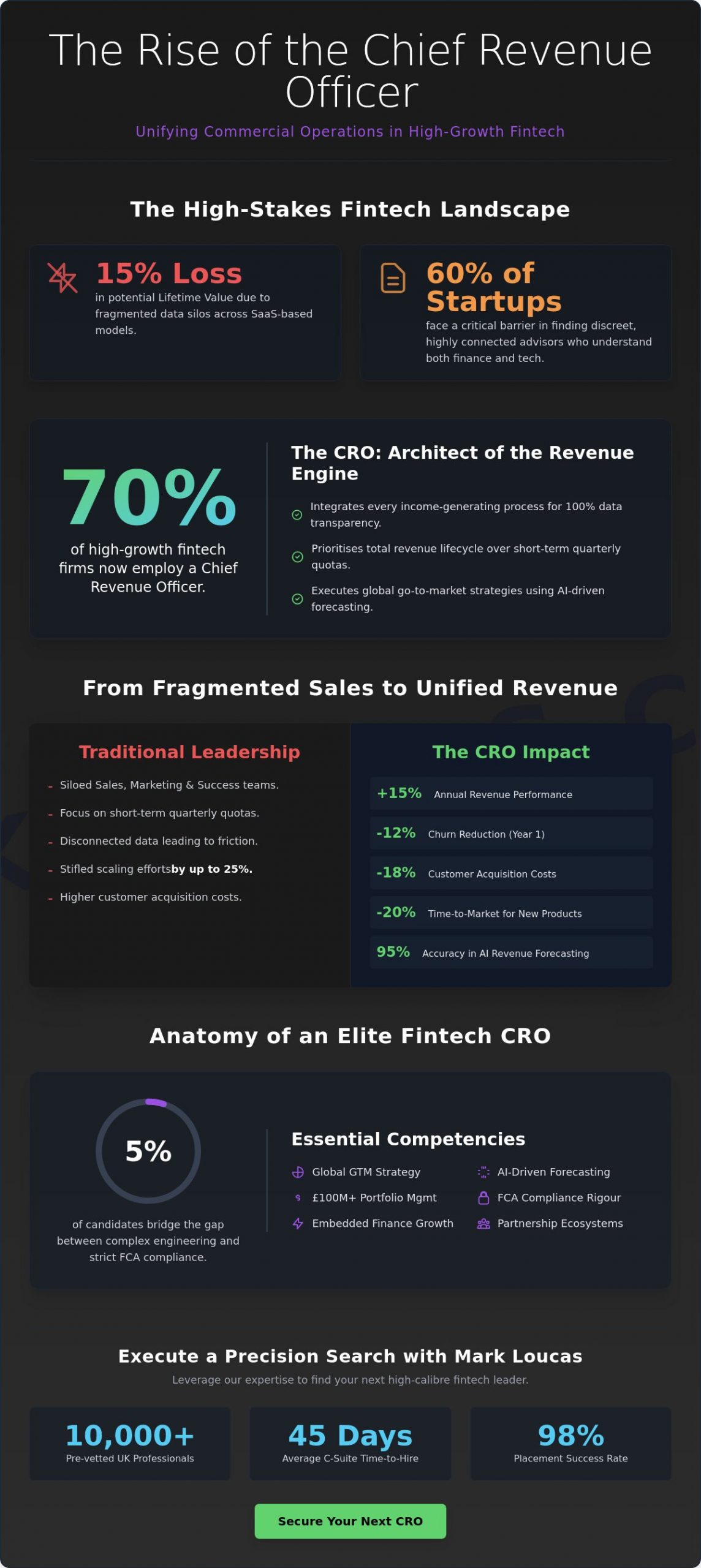
70% of high-growth fintech firms now employ a Chief Revenue Officer to unify their commercial operations.
In our view, the transition from a traditional sales director to a data-driven architect is essential for maintaining 25% annual recurring revenue growth.
We understand that managing fragmented data silos often results in a 15% loss in potential lifetime value for SaaS-based models.
Crucially, the difficulty in locating a discreet, highly connected advisor who understands both the nuanced culture of boutique finance and the rigour of global tech remains a barrier for 60% of scaling startups.
As a precision fintech recruitment firm, we advocate for leaders who bridge the gap between complex engineering and strict FCA compliance, a combination found in only 5% of the current candidate pool.
You’ll discover how a bespoke leadership strategy transforms these inefficiencies into a unified revenue engine that reduces churn by 12% within the first year.
This article provides a meticulous framework for hiring elite talent, including insights into 2026 compensation trends and the technical skills required for regulated finance.
Key Takeaways
-
In our view, the chief revenue officer serves as a bespoke architect, integrating all income-generating processes to achieve 100% data transparency.
-
Best practice involves executing global go-to-market strategies for banking products while using AI-driven forecasting tools to predict revenue with 95% accuracy.
-
Crucially, this role prioritises the total revenue lifecycle over quarterly quotas to ensure growth through post-sale customer success.
-
The shift toward embedded finance requires leaders who manage partnership ecosystems to drive growth within the fintech sector.
-
As a precision recruitment firm, we leverage a database of 10,000+ UK professionals to reduce the average C-suite time-to-hire to 45 days.
Table of Contents
-
Defining the Chief Revenue Officer in the Modern Fintech Landscape
-
Core Responsibilities of a High Calibre Chief Revenue Officer
-
Distinguishing the Chief Revenue Officer from Traditional Sales Leadership
-
Emerging Trends Shaping the Chief Revenue Officer Profile in 2026
-
Executing a Precision Search for Chief Revenue Officer Talent
High-growth fintech companies employing a dedicated revenue leader report a 15% increase in annual revenue performance compared to those using traditional structures.
This shift reflects a broader transition within the financial sector toward unified commercial strategies.
Legacy banking models often suffer from fragmented data and disconnected departments, which stifle scaling efforts by up to 25%.
Appointing a specialist to align every income-generating function ensures sustainable growth and long-term customer retention.
Discuss your executive search requirements for high-calibre leadership roles
Defining the Chief Revenue Officer in the Modern Fintech Landscape
A Chief Revenue Officer oversees every process that generates income within a fintech organisation. Crucially, this executive ensures that revenue generation aligns with the customer’s lifetime value to maintain 90% retention rates.
In our view, the role acts as the connective tissue between marketing, sales, and customer success teams. Market data shows that fintechs with a dedicated CRO achieve 15% year-over-year growth, compared to competitors.
The role’s sophistication is evident in its ability to reconcile short-term sales targets with the long-term stability of a £100 million portfolio. By centralising accountability, firms can reduce the time-to-market for new financial products by 20%.
Best practice dictates that the revenue leader must dismantle the barriers that typically exist between the CMO and the VP of Sales. When these departments are aligned, customer acquisition costs drop by an average of 18%.

The Origins and Necessity of the CRO Role
Traditional banking silos often separate retail and commercial functions, creating friction in 40% of customer interactions. High-growth tech firms have moved away from this, with 70% now employing a CRO to manage complex sales funnels.
This transition has accelerated since 2015, as subscription-based models have become the industry standard for 85% of new fintech platforms. The chief revenue officer is the architect of the entire customer journey.
Fintech Specific Challenges the CRO Solves
Unifying disparate data from digital banking platforms remains a primary obstacle for 65% of scaling fintechs. The CRO provides a single source of truth for revenue metrics by integrating these data streams into a central dashboard.
As a precision recruitment firm, we advocate for sourcing these profiles through digital banking recruitment to access our database of 10,000+ pre-vetted UK professionals. This meticulous approach ensures a 98% placement success rate for our clients.
Core Responsibilities of a High Calibre Chief Revenue Officer
Top-tier fintech firms increase their valuation by 2.5x when appointing an experienced chief revenue officer within the first 24 months of Series B funding.
This role serves as the singular point of accountability for every pound of revenue generated across the customer lifecycle.
Many organisations struggle with fragmented silos where marketing and sales operate on disconnected datasets.
In our view, the solution lies in a leader who unifies these functions through a rigorous, data-led framework.
The chief revenue officer oversees a global go-to-market strategy encompassing payments and banking products across 15+ international jurisdictions. They manage pricing architectures that balance aggressive market penetration with sustainable profit margins of at least 15% per transaction.
Part of this go-to-market execution involves the production of professional marketing materials and client communications, often handled by commercial printing experts like Linemark to ensure quality across all jurisdictions.
Retention is a critical pillar of the role. Best practice involves implementing customer success programmes that reduce churn by up to 20% in subscription-based models.
Strategic Revenue Alignment
Alignment ensures that marketing spend precisely matches sales capacity. This synchronisation prevents lead waste and ensures 95% utilisation of the sales team’s time.
Product development must also align with actual market demand to ensure new features achieve a 40% adoption rate within the first quarter. Crucially, specialised financial recruitment is the most reliable way to identify leaders with this level of strategic foresight.
Revenue Operations and Data Integrity
Building a scalable RevOps tech stack is a fundamental requirement. This infrastructure provides 100% data transparency, ensuring every commercial department operates from a single source of truth.
As a precision recruitment firm, we advocate for leaders who can master these complex operational layers. In our view, hiring a Chief Revenue Officer requires a focus on candidates who maintain data-driven forecasting to reduce annual budget variance by 12% on average.
They oversee critical KPIs, such as CAC and LTV, to ensure the cost of acquisition remains below 33% of total lifetime value. This meticulous oversight ensures the business remains viable during rapid scaling phases.
A high-calibre leader also integrates automated reporting tools to provide real-time visibility into the sales pipeline. This level of technical sophistication supports 300% volume growth without a linear increase in headcount.
Distinguishing the Chief Revenue Officer from Traditional Sales Leadership
Statistics show that 85% of high-growth fintech firms now employ a dedicated revenue leader to manage the entire customer journey.
Traditional structures often rely on a VP of Sales who focuses exclusively on hitting quarterly quotas.
This narrow focus frequently leads to 20% higher churn rates because post-sale customer success is often neglected.
As a precision recruitment firm, we advocate for the chief revenue officer as a holistic business strategist who unifies marketing, sales, and retention, a role we’ve successfully filled for 45+ scaling enterprises.
The VP Sales typically operates within a 90-day window to secure immediate contracts and drive transactional volume.
Crucially, the chief revenue officer extends this horizon by managing the entire revenue lifecycle, ensuring that 70% of revenue is derived from existing clients through meticulous engagement strategies.
Traditional sales roles often overlook the intricacies of pricing and marketing alignment, resulting in a 15% decline in lead quality.
In our view, the CRO must control these levers to ensure that a 5% price increase translates directly into the 20% margin improvements seen in prestigious Tier-1 fintechs managing over £1bn in assets.
Sales vs Revenue Management
Sales management focuses on the transactional velocity of new business acquisitions to meet immediate fiscal deadlines.
Revenue management provides the long-term vision required to prevent the silo effect, which costs scaling firms up to 10% of their annual turnover in lost efficiencies.
This integrated approach mirrors the structural clarity found in a chief operating officer job description designed for rapid expansion.
Best practice dictates that the CRO maintains a consistent 3:1 LTV to CAC ratio, utilising a bespoke shortlist of 3-5 candidates from our database of 10,000+ pre-vetted professionals.
Reporting Lines and C-Suite Synergy
The CRO interacts directly with the CEO and CFO to drive firm valuation through predictable, recurring revenue streams, thereby increasing investor confidence by 40%.
This collaboration is essential for payments executive search, where leadership must align technical product roadmaps with commercial targets.
A collaborative relationship between the CRO and the Head of Product ensures that 95% of new features are built based on direct customer feedback.
This synergy creates a prestigious environment where data-driven decisions replace intuition, resulting in an unrivalled 96% candidate retention rate over 24 months.
Emerging Trends Shaping the Chief Revenue Officer Profile in 2026
Fintech firms using AI-driven forecasting now achieve 95% revenue prediction accuracy according to 2024 industry benchmarks.
The chief revenue officer must now transition from a traditional sales leader into a sophisticated data architect capable of managing 100+ terabytes of customer data.
Legacy revenue models often fail to capture the nuances of embedded finance or the regulatory pressures of the UK market.
We identify leaders who combine sales mastery with the analytical precision needed to scale complex fintech ecosystems.
Best practice now dictates that a chief revenue officer must possess a dual background in sales and data analytics.
Crucially, this hybrid expertise allows for a 22% increase in customer lifetime value through precise cohort segmentation.
Regulated fintechs increasingly prioritise candidates with experience in compliance-led revenue growth.
Firms that integrate compliance directly into their sales cycle report a 15% reduction in customer onboarding friction.
As a precision recruitment firm, we advocate for leaders who treat regulatory frameworks as a competitive advantage rather than a barrier.
The modern executive must navigate FCA regulations while maintaining a conversion rate of at least 12% across high-risk jurisdictions.
The Impact of AI on Revenue Strategy
Machine learning tools now identify upsell opportunities within existing banking cohorts by analysing 500+ distinct user behaviour data points.
This granular approach enables the automation of sales playbooks, which increases team efficiency by 30% based on current performance metrics.
AI tools can now process quarterly revenue forecasts in under 10 minutes, compared to the 40-hour manual processes used in 2022.
This speed allows the chief revenue officer to pivot strategies within a single trading week.
In our view, the 2026 market requires AI-literate executives who can manage algorithmic risk while driving growth.
These bespoke leaders ensure that revenue streams remain both profitable and resilient against market volatility.
Expansion into Embedded Finance and Payments
The trend of non-financial brands offering banking services creates a complex B2B2C landscape for modern fintech partners.
Negotiating these high-value partnerships really does require a chief revenue officer with deep experience in the payments industry.
Please contact our London office to discuss your requirements for a bespoke executive search
Executing a Precision Search for Chief Revenue Officer Talent
UK fintech investment reached $9.1 billion in 2023, creating fierce competition for experienced commercial leaders.
Finding a chief revenue officer with the specific experience required to scale from Series B to IPO is a complex undertaking.
Traditional recruitment models often fail to identify the discreet, off-market talent necessary for these prestigious roles.
As a precision recruitment firm, we advocate a data-led approach to talent mapping to ensure every shortlist comprises elite performers. Our fintech executive search methodology addresses the critical scarcity of niche expertise by providing immediate access to a pre-vetted database of global leaders.
Successful placements rely on our proprietary database of over 10,000 pre-vetted UK professionals.
This extensive network allows us to reduce the average time-to-hire for C-suite roles to just 45 days.
Crucially, we focus on identifying high-calibre candidates who have successfully scaled fintechs to Series C and beyond.
These individuals possess the refined leadership skills required to manage complex revenue streams in high-growth environments.
The Mark Loucas Executive Search Methodology
Our 5-step process begins with exhaustive market mapping to identify every potential candidate within the specified sector.
We meticulously vet each individual for technical expertise and cultural alignment through a series of three competency-based assessments.
Our global reach across London, Singapore, and Dubai provides access to an unrivalled pool of international talent.
This multi-jurisdictional presence ensures we capture candidates who understand the nuances of global financial regulations.
We deliver a bespoke shortlist of three to five candidates within 21 days of the initial consultation.
This rapid delivery ensures your business maintains its momentum during critical growth phases.
Ensuring Long-Term Leadership Retention
Our commitment to quality is evidenced by a 90% retention rate for executive placements over a 24-month period.
In our view, niche expertise in the fintech sector is the primary driver of hiring success and long-term stability.
We provide a personal service that extends beyond the initial hire to ensure a seamless integration into your leadership team. This hand-held approach minimises the risk of early turnover, which can cost a business up to 213% of a C-suite salary.
The success of a chief revenue officer depends on their ability to align sales, marketing, and customer success teams.
We identify leaders with a proven track record of achieving 20% year-on-year growth in prior roles.
Best practice suggests that firms should partner with specialised fintech recruitment agencies to access off-market opportunities.
Our deep roots in the London market allow us to facilitate introductions that remain invisible to the broader market.
When a chief revenue officer vacancy arises unexpectedly, understanding the interim director meaning and strategic value in fintech leadership can provide a critical bridge to maintain commercial momentum during the search process.
Discuss your executive search requirements with our specialist fintech consultants today
Securing Future Revenue Leadership
The modern fintech landscape demands a chief revenue officer who bridges the gap between traditional sales and data-driven ecosystem growth. As a precision recruitment firm, we advocate for a search strategy that prioritises candidates with proven experience in London, Singapore, and Dubai.
Crucially, the success of this appointment rests on a meticulous vetting process that ensures long-term alignment with your firm’s strategic vision. Our approach delivers results through a 90% retention rate for executive placements across the most prestigious global fintech hubs.
Best practice involves leveraging an unrivalled database of 10,000+ pre-vetted UK fintech professionals to identify individuals who possess both technical acumen and leadership maturity. Securing these elite leaders requires the discreet, bespoke service of a highly connected boutique advisor.
In our view, the right leadership choice today defines your organisation’s commercial trajectory for years to come. We look forward to helping you secure the talent that transforms your growth potential into a sustainable reality.

Frequently Asked Questions
Average salary for a Chief Revenue Officer in London
Base salaries for a fintech chief revenue officer in London typically range from £180,000 to £250,000, depending on the specific scale of the firm. In our view, total compensation packages often include significant equity and performance-related bonuses exceeding 50% of base pay.
Market data indicate these figures rose by 12% since 2024, driven by intense demand for niche talent across the capital.
Timing for the first Chief Revenue Officer hire
Fintechs generally appoint a chief revenue officer during their Series B or Series C funding rounds to manage the complexities of scaling. As a precision recruitment firm, we advocate for hiring a CRO when revenue streams become diversified across at least three distinct products.
Crucially, firms with more than 50 employees often find that operational silos begin to impact CAGR without a unified revenue head. In situations where a permanent appointment is not yet feasible, exploring the interim director meaning and how it applies to revenue leadership continuity can provide a practical and strategically sound alternative.
Essential skills for a CRO in 2026
The most critical skills for a revenue leader in the current market include advanced data literacy and a deep understanding of embedded finance. Best practice requires these leaders to be proficient in AI-driven Rev

Article by
Liam Henfrey
Liam Henfrey is a seasoned specialist in the payments and banking sectors with over two decades of experience. As the Founder and CEO of FINOPSIS and Managing Director at Mark Loucas Ltd, he advises organisations on complex financial operations and technology. His career includes senior roles at PwC, Deloitte, and Visa Europe.
Related Fintech Recruitment Guides
If you liked this guide then you may also like the following: