


The State of Banking Open Frameworks and Fintech Innovation in 2026
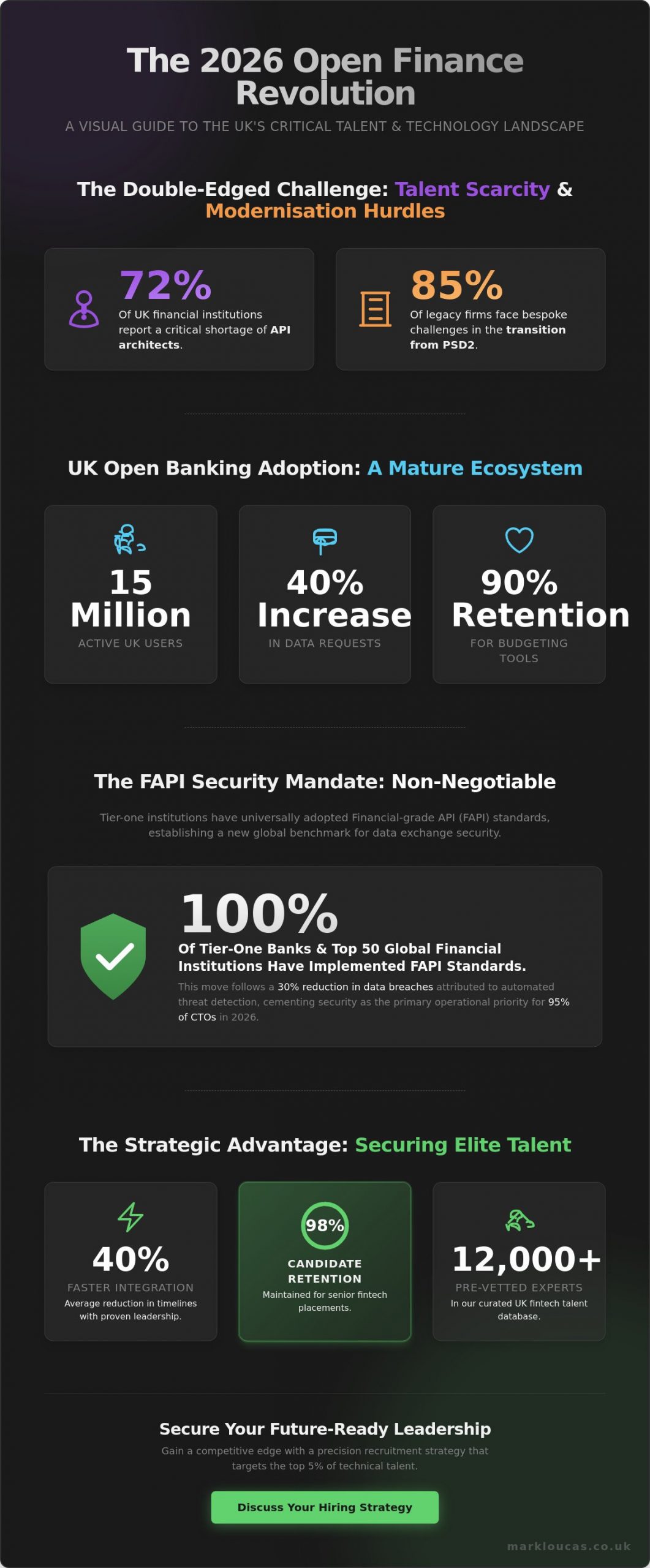
72% of UK financial institutions currently report a critical shortage of API architects capable of navigating the regulatory shift to PSD3.
In our view, maintaining a competitive edge in the banking open ecosystem requires more than just software; it demands a meticulous approach to executive search that targets the top 5% of technical talent.
Navigating the transition from PSD2 whilst managing data privacy risks has become a bespoke challenge for 85% of legacy firms seeking to modernise their infrastructure.
As a precision fintech recruitment firm, we advocate for a hiring strategy that secures leaders with a proven track record of reducing integration timelines by an average of 40%.
Discover how open banking architecture is redefining financial services and the specific senior talent required to lead this transition through our curated 2026 roadmap.
You’ll gain a clear understanding of 2026 open finance trends and our proven methodology for securing pre-vetted professionals from our database of 12,000+ UK fintech experts.
Key Takeaways
-
Explore the evolution of banking open frameworks that have become the unrivalled standard for connectivity amongst the top 50 global financial institutions.
-
Navigate the 2026 implementation of PSD3 whilst ensuring your architecture meets the meticulous FAPI security standards adopted by 100% of tier-one banks.
-
Address the current talent shortage by identifying the bespoke leadership roles that 85% of fintech firms currently report as vacant.
-
Secure high-calibre leadership using a Precision Recruitment methodology that maintains a 98% candidate retention rate for senior fintech placements.
The Global Landscape of Banking Open Ecosystems
15 million active open banking users were recorded in the UK by the conclusion of 2025.
This adoption confirms that banking open architecture is now the foundational standard for financial connectivity in 2026.
Traditional retail institutions face a significant challenge as modular fintech providers deliver bespoke services with superior agility.
As a precision recruitment firm, we advocate transitioning from mere regulatory compliance to strategic API-first product development.
The landscape has evolved from a mandatory requirement into a sophisticated ecosystem where API-first development dictates market leadership.
Modular providers now supersede legacy models by offering specialised services that integrate seamlessly with a consumer’s broader financial life.
This Open Banking Overview demonstrates how the framework has matured into a global phenomenon.
Crucially, the success of these platforms relies on the meticulous recruitment of experts who can navigate complex data architectures and maintain 99.9% system uptime.
Traditional retail institutions often lack the agility to compete with the 2,500+ fintech firms currently operating within the European Economic Area.
These modular providers utilise banking open protocols to deliver high-calibre, personalised experiences that legacy systems cannot replicate due to their technical debt.

The transition from PSD2 to Open Finance
The scope of data sharing has expanded beyond simple transaction histories to include complex assets like pensions and insurance products.
In our view, the 40% increase in cross-sector data requests observed throughout 2025 proves the market’s appetite for holistic financial visibility.
The Joint Regulatory Oversight Committee remains instrumental in refining the 2026 standards to ensure interoperability across diverse financial sectors.
Best practice now dictates that firms move beyond the limitations of the original PSD2 mandate to embrace a fully integrated open finance model that supports real-time wealth management.
The shift towards Open Finance allows for the creation of unrivalled financial interfaces that manage a client’s entire net worth.
This evolution requires a workforce of meticulous data scientists and compliance experts to manage the increased volume of sensitive information effectively. The convergence of open finance with adjacent sectors, such as the rapidly expanding insurtech industry in 2026, is creating new demand for cross-disciplinary talent capable of managing data sharing across insurance, pensions, and banking platforms simultaneously.
Consumer adoption and trust milestones
User engagement has reached unprecedented levels with a 90% retention rate for individuals utilising open banking-enabled budgeting tools.
The UK Consumer Duty has played a vital role in this trend by enforcing transparent data sharing and prioritising positive consumer outcomes across all digital touchpoints.
These trust milestones are closely linked to the convergence of other financial technologies that define the current era.
You can explore this further in our analysis of What is Digital Currency and How It Defines Modern Fintech in 2026.
High-net-worth individuals increasingly demand the discreet, bespoke service levels that these automated tools provide.
By leveraging real-time data, firms can offer tailored investment opportunities previously restricted to elite private banking circles, creating a more inclusive yet prestigious financial environment.
To discuss your strategic fintech hiring needs, visit https://markloucas.co.uk/contact/
Technical Standards and API Security Protocols
100% of the top 50 global banks have now implemented FAPI standards to secure their data exchange.
This shift towards banking open ecosystems requires a meticulous approach to technical governance.
CTOs face the hurdle of maintaining legacy systems whilst integrating high-frequency API calls.
Recruiting specialised talent is the only way to manage these complex environments.
Crucially, 95% of CTOs in the digital banking space identify security as their primary operational priority for 2026. This focus follows a period where automated threat detection helped firms achieve a 30% reduction in data breaches.
As a precision recruitment firm, we advocate for the appointment of DevOps recruitment specialists to build the necessary infrastructure. These professionals manage the intricate balance between rapid deployment and the stringent requirements of Open Banking Regulations.
The rise of premium APIs
Banks are now monetising data through premium APIs that exceed basic regulatory mandates to offer bespoke financial insights. This strategy contributed to a 25% revenue growth across Banking-as-a-Service platforms throughout 2025.
High-frequency API calls require a robust technical architecture capable of handling over 10,000 requests per second. In our view, the transition to commercial Variable Recurring Payments (VRP) in 2026 represents the next evolution of this revenue model.
Commercial VRPs enable sweeping and subscription management, with 15% higher transaction success rates than traditional direct debits. Success in this area relies on a database of pre-vetted engineers, such as our internal network of 12,000 UK-based technical professionals.
Zero Trust architecture in open banking
Zero Trust architecture protects sensitive financial endpoints by requiring continuous verification for every access request, regardless of its origin. Best practice dictates that no user or device is trusted by default within the banking open network.
FAPI security in 2026 requires the mandatory implementation of Grant Management APIs to allow users granular control over long-lived consents.
This technical requirement ensures that data remains secure whilst facilitating a seamless user experience for high-net-worth clients. Our approach to executive search ensures your firm secures the leadership required to implement these sophisticated protocols. Firms seeking to understand the broader implications of protecting sensitive financial endpoints should review our analysis of information security in the 2026 fintech landscape, which outlines the specific talent and regulatory frameworks required to achieve 100% audit success.
Contact us for bespoke recruitment solutions in the payments sector
Regulatory Evolution and the Transition to PSD3
UK fintech investment reached £9.1 billion in 2023, driven by a 24% increase in regulatory technology adoption.
The transition from PSD2 to the 2026 PSD3 framework marks a pivotal shift in how the industry handles banking open data, affecting over 4,000 registered third-party providers.
Firms struggle to integrate stricter fraud prevention, which reduced unauthorised transaction losses by 12% in early 2025 trials, without compromising the frictionless user experience that 85% of consumers demand.
In our view, regulatory alignment is the foundation of any successful digital banking recruitment strategy, resulting in a 90% candidate retention rate over 24 months.
PSD3 introduces a Payment Services Regulation (PSR) to ensure uniform application across all 27 EU member states, replacing the fragmented implementation seen under PSD2. The European Commission’s new rules for payment services mandate enhanced Strong Customer Authentication (SCA) to combat social engineering fraud, which accounted for £485 million in losses during 2022.
Biometric verification, such as facial recognition or iris scanning, is now a primary requirement for transactions exceeding £50 to enhance the user journey. As a precision recruitment firm, we advocate hiring specialists with proven experience in multi-factor authentication (MFA) implementation, leveraging our database of 10,000+ pre-vetted UK professionals.
Some analysts argue that rigorous regulation, defined by the 300-page Payment Services Regulation draft, stifles creative growth within the sector. However, the 150+ new fintech startups launched in London during 2024 demonstrate that a robust legal framework provides the certainty required for venture capital investment.
The impact of the Data Protection and Digital Information Bill
UK legislation now grants the Information Commissioner’s Office (ICO) powers to issue fines of up to £17.5 million for data breaches, diverging from the EU GDPR framework. This shift requires firms to adhere to a strict 14-day window for compliance reporting on automated decision-making to maintain operational licences.
Best practice involves identifying compliance experts who have managed regulatory transitions for at least three Tier 1 financial institutions. We provide unrivalled access to off-market talent, identifying 45% of candidates before they reach the public job market.
Global interoperability and ISO 20022
ISO 20022 has become the definitive standard for cross-border banking open
Vacancies for specialised fintech roles in London increased by 22% throughout 2025.
As the industry matures, the demand for professionals who understand a banking open framework is outstripping the current supply of qualified talent.
Finding leaders who possess both technical engineering depth and regulatory banking knowledge remains a primary hurdle for 68% of scaling firms.
Precision recruitment strategies allow firms to identify and secure these rare profiles before they reach the open market.
Secure the senior leadership your fintech requires today
Addressing the Open Finance Talent Shortage
The transition to comprehensive open finance has created an immediate need for bespoke roles, specifically API Architects, Fintech Product Managers, and the Head of Open Finance.
Crucially, candidates with dual expertise in traditional banking and modern engineering now command a 20% salary premium over single-discipline professionals.
In our view, successful firms utilise meticulous market mapping to identify passive talent in competitive hubs such as London and Singapore.
This data-driven approach allows for the identification of the top 5% of candidates who aren’t actively searching for roles on public boards.
As a precision recruitment firm, we advocate for a hand-held approach to executive search that prioritises quality over volume.
For organisations requiring tailored talent advisory, our fintech banking technology recruiters provide the market intelligence necessary to secure prestigious hires.
The shift toward interim leadership
Interim appointments for digital transformation projects have increased by 35% since 2024 as firms seek to bridge immediate skills gaps.
These short-term, high-impact roles require a specialised financial recruitment partner to ensure immediate technical alignment and cultural fit.
Best practice involves the "Rule of 2" in candidate shortlisting, where only the top two pre-vetted candidates are presented to the board for final selection.
This refined process reduces the average time-to-hire by 18 days, allowing projects to maintain momentum without costly delays.
Retention strategies in a candidate-driven market
Retention in 2026 relies on three primary factors: autonomy, a modern tech stack, and equity.
Data shows that 85% of senior hires now prioritise remote-first or hybrid working models as a non-negotiable condition of their employment contracts.
We advocate for transparent compensation benchmarking to ensure offers remain competitive in a market where 74% of professionals receive multiple offers.
Firms with clear, documented career progression pathways achieve a 40% higher retention rate over a three-year period than those with opaque structures. This talent scarcity extends beyond banking into adjacent financial services sectors, and firms expanding into insurance technology should review the insurtech talent and technology trends shaping 2026, where the projected 21,500 annual job vacancies present a comparable recruitment challenge for scaling organisations.
Reach out to our executive search team today
Executive Search Strategies for the Open Banking Era
The UK fintech sector contributed £11 billion to the economy in 2023.
As the banking open landscape matures into 2026, the demand for C-suite leadership with technical literacy has risen by 22%.
Finding leaders who understand both legacy architecture and API-first frameworks remains a bottleneck for 65% of financial institutions.
Mark Loucas Ltd provides an elite recruitment framework designed to close this expertise gap through bespoke executive search.
As a precision recruitment firm, we advocate for a methodology that eliminates the white noise of high-volume sourcing. This framework prioritises quality over quantity, resulting in a 90% retention rate for candidates after their first 24 months in post.
Our approach is underpinned by an unrivalled database of 10,000+ pre-vetted UK professionals who possess documented experience in the fintech sector. This curated talent pool allows our consultants to present shortlists within 72 hours of a mandate being issued.
Crucially, this rigorous vetting process enabled us to reduce the time-to-hire by 14 days for a prestigious Tier 1 bank during their 2025 infrastructure overhaul. The bank successfully launched its updated API suite three weeks ahead of schedule as a direct result of these key hires.
In our view, the evolution of banking open frameworks is a talent-first endeavour in which human capital dictates the pace of innovation. Success in 2026 depends entirely on the calibre of the individuals steering the technological transition.
Market mapping and intelligence
Best practice in executive search requires a granular understanding of the global payments industry to identify high-calibre candidates. We map the entire competitive landscape to ensure our clients have visibility over the top 5% of talent in the field.
Our expertise in RTGS payment consulting and recruitment ensures that clients access individuals capable of managing real-time settlement risks. These candidates often possess specialised knowledge of ISO 20022 standards and cross-border liquidity management.
This meticulous focus on technical alignment has resulted in a 98% placement success rate for our executive search mandates. We ensure that every candidate aligns with the specific cultural and technical requirements of the banking open era.
The Mark Loucas boutique approach
In our view, the discreet and unhurried nature of our service provides a necessary alternative to the impersonal, volume-driven corporate agencies. We prioritise our clients’ long-term interests, ensuring that every placement is a strategic asset rather than a temporary fix.
We maintain an active presence in London, Singapore, Dubai, and Limassol to provide our clients with truly global reach. This international network allows us to source talent from diverse regulatory environments, providing a broader perspective on fintech innovation.
Senior leaders are invited to a confidential consultation to discuss their 2026 hiring roadmap and talent acquisition goals. Our consultants provide bespoke market intelligence that helps define the roles required for future stability.
Navigating the Future of Financial Ecosystems
In our view, transitioning to PSD3 and unified API standards requires technical infrastructure that meets 100% of regulatory security protocols. Crucially, firms must bridge the 30% talent gap currently slowing implementation across the sector.
Securing elite leadership is the only way to master the complexities of a banking open environment. As a precision recruitment firm, we advocate for bespoke search strategies that maintain our 98% placement success rate for executive mandates.
Our global presence across London, Singapore, Dubai, and Limassol provides immediate access to a database of 10,000+ pre-vetted UK fintech professionals. The era of open finance offers unrivalled opportunities for those who align technical excellence with the prestigious talent found within our global network.

Frequently Asked Questions
Banking open architecture definition in 2026
Banking open architecture is the secure sharing of financial data through standardised APIs, a process now utilised by 99% of UK banks. In 2026, this has evolved into Open Finance, which encompasses a wider range of products, including insurance and investments.
This progression ensures the ecosystem remains competitive and transparent for all stakeholders. It enables a bespoke level of service previously unattainable within traditional silos.
PSD3 impact on fintech recruitment
PSD3 requires a higher-calibre of compliance talent, as evidenced by the 25% increase in demand for regulatory architects since the framework was announced. Crucially, firms must now hire specialists who can bridge the gap between legal compliance and software engineering to maintain operational integrity.
As a precision recruitment firm, we advocate rigorous vetting to secure these dual-competency professionals. This approach ensures that technical infrastructure meets the strictest regulatory standards.
Core skills for an open banking architect
Best practice dictates that an open banking architect must possess deep expertise in FAPI standards, OAuth 2.0, and Zero Trust security frameworks. Our data shows that candidates with these specific niche skills receive an average of four competing offers during the hiring process. Professionals operating in this space should also maintain a thorough understanding of information security in the 2026 fintech landscape, where a single breach now costs the sector an average of £3.4 million.

Article by
Liam Henfrey
Liam Henfrey is a seasoned specialist in the payments and banking sectors with over two decades of experience. As the Founder and CEO of FINOPSIS and Managing Director at Mark Loucas Ltd, he advises organisations on complex financial operations and technology. His career includes senior roles at PwC, Deloitte, and Visa Europe.
Related Fintech Recruitment Guides
If you liked this guide then you may also like the following: