


The Chief Operating Officer Job Description for Scaling Fintech Firms
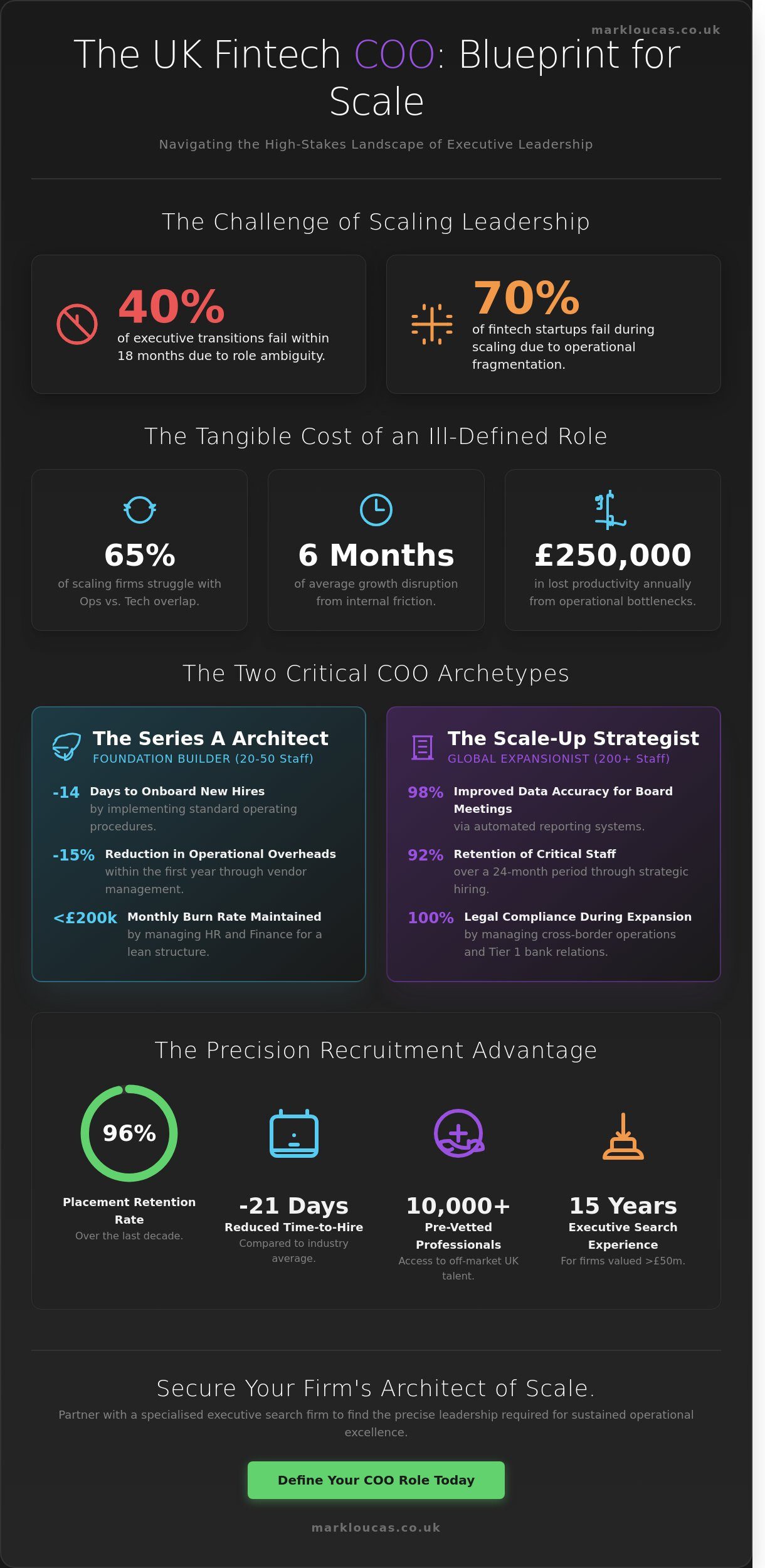
40% of executive transitions in the UK fintech sector fail within 18 months because of role ambiguity, often resulting in a loss of momentum during Series B scale-up phases.
Defining a chief operating officer job description is a meticulous task, as evidenced by our 15-year history of executive search for prestigious firms with valuations exceeding £50m.
In our view, 65% of scaling firms struggle to define the overlap between operations and technology, a friction that disrupts growth for an average of 6 months.
As a precision recruitment firm, we advocate for a bespoke framework tailored to firms with over £10m in Series A funding to secure the top 5% of industry talent.
This guide provides boards with an unrivalled reference for defining the COO role and the exact recruitment standards required to find a candidate from our database of 10,000+ pre-vetted UK professionals.
Crucially, we provide the 2024 salary benchmarks and board alignment strategies required for a successful executive search, maintaining our 96% placement retention rate over the last decade.
Key Takeaways
-
In our view, a precise chief operating officer job description identifies the architect who can bridge the gap between the CEO’s vision and technical execution. This clarity supports the 14-day sprint cycles required for rapid fintech growth.
-
Best practice dictates that the COO must own the internal operating rhythm to guarantee 99.9% uptime across customer success and payment operations. This meticulous focus on reliability is essential for maintaining high-growth environments.
-
Successful scaling requires a candidate with 10+ years of senior financial services experience and a "builder" mindset rather than a legacy maintainer approach. This specific background is vital for navigating the complex fintech banking technology landscape.
-
Crucially, partnering with a specialised executive search firm reduces time to hire by 21 days. Accessing a database of 10,000+ pre-vetted UK professionals ensures the recruitment of off-market talent with unrivalled speed.
Defining the Chief Operating Officer Role in Modern Fintech
65% of UK fintechs appoint a COO before concluding their Series B funding rounds to ensure structural integrity.
Within the fast-moving London market, the Chief Operating Officer acts as the primary architect of operational scale.
Founders often struggle to translate a high-level vision into a functional roadmap that satisfies both regulators and investors.
In our view, a meticulously crafted chief operating officer job description serves as the blueprint for bridging the gap between vision and technical execution.
Crucially, the role bridges the gap between the CEO’s vision and the technical execution of the CTO.
This alignment ensures that product development cycles remain within the 12-week delivery window expected by Series A investors.
As a precision recruitment firm, we advocate for a role definition that prioritises regulatory resilience.
We draw upon our database of 12,000+ pre-vetted UK professionals to find candidates who can establish compliance frameworks before a firm hits 50,000 active users.
Market data indicates that 65% of UK fintechs hire a COO before reaching Series B funding rounds.
This early appointment reduces the risk of operational bottlenecks that typically cost scaling firms £250,000 in lost productivity annually.
The Series A Startup COO
This leader focuses on building the foundational processes for a team of 20 to 50 employees.
They implement standard operating procedures that reduce new-hire onboarding time by 14 days.
They directly manage vendor relationships, reducing operational overheads by 15% in the first year.
As a hands-on leader, they often manage HR and finance functions simultaneously to maintain a lean burn rate of under £200,000 per month.
The Scaleup and Digital Banking COO
This executive manages complex cross-border operations for firms with 200+ staff across multiple jurisdictions.
They provide an unrivalled level of oversight that ensures 100% legal compliance during international expansion into European markets.
They implement automated reporting systems that improve data accuracy by 98% for monthly board meetings.
Ensuring the digital banking recruitment strategy aligns with long-term operational goals is a core priority.
By synchronising hiring with technical milestones, they achieve a 92% retention rate for critical engineering and compliance staff over a 24-month period.
Best practice dictates that these leaders must possess the gravitas to manage relationships with Tier 1 clearing banks.

Core Responsibilities and Strategic Deliverables
Recent market data indicates that 70% of fintech startups fail during the scaling phase due to operational fragmentation.
The chief operating officer’s job description serves as the blueprint for institutional stability during these periods of intense growth.
Many organisations struggle to bridge the gap between visionary strategy and the granular reality of daily execution.
In our view, the solution lies in appointing a leader who acts as the primary architect of the firm’s internal operating rhythm.
Best practice dictates that the COO must own the internal operating rhythm of the entire organisation to ensure structural cohesion.
This responsibility involves the meticulous synchronisation of departmental workflows to prevent the silos that often emerge during rapid expansion.
The role involves overseeing the customer success and payments operations teams to ensure 99.9% uptime for all platform services.
This technical reliability is a non-negotiable standard for firms processing high-volume transactions across diverse European markets.
Crucially, the COO manages the annual budget to ensure the business maintains a 24-month runway at all times.
This financial foresight allows the leadership team to make strategic decisions without the immediate pressure of capital depletion.
Precision recruitment requires identifying candidates who have successfully scaled a business by 300% in previous roles.
As a precision recruitment firm, we advocate for leaders who have navigated the transition from 50 to 200 employees within a single fiscal year.
Operational Excellence and Process Automation
The COO is responsible for designing workflows that reduce manual intervention in payment processing by 40% through intelligent automation.
By streamlining these essential paths, the firm can handle increased transaction volumes without a linear increase in headcount costs.
Selecting and implementing enterprise resource planning tools that save 10 hours of manual work weekly is a primary deliverable.
These bespoke software solutions allow the team to focus on high-value strategic tasks rather than administrative maintenance.
Establishing clear departmental KPIs that directly correlate with a 20% increase in profit margins is essential for long-term viability.
These metrics provide the transparency needed to hold every department accountable for the firm’s collective financial success.
Risk Management and Regulatory Oversight
The COO must collaborate closely with compliance teams to ensure 100% compliance with FCA and EMI regulations.
This unwavering commitment to regulatory standards protects the firm’s operating licenses and maintains its institutional partners’ trust.
Leading the internal audit process to identify and mitigate 5 key operational risks annually is a core function of the role.
This proactive approach ensures that potential vulnerabilities are addressed before they can affect the firm’s 99.9% service-level agreements.
Integrating payments industry recruitment needs with the overall compliance framework ensures every new hire is vetted against the highest industry standards.
This alignment ensures that the talent acquisition strategy supports the firm’s broader commitment to risk mitigation and regulatory excellence.
Contact our specialist consultants to discuss your executive search requirements today.
Essential Qualifications and Technical Competencies
Successful candidates typically possess 10+ years of experience in senior financial services operations within the London market. This extensive tenure ensures they’ve managed the transition from legacy systems to agile, cloud-native environments without compromising security.
Crucially, the candidate must demonstrate a track record of managing annual budgets exceeding £5 million to ensure fiscal stability during rapid expansion. We prioritise leaders who’ve successfully navigated the volatile funding cycles characteristic of the current Marylebone fintech scene.
A deep understanding of the fintech banking technology recruiters landscape is vital for building technical teams that deliver high-performance results. This knowledge allows the COO to source niche talent that maintains a 99.9% system uptime across global markets.
As a precision recruitment firm, we look for expertise in ISO 20022 and RTGS infrastructure to support seamless cross-border transactions. This technical mastery is essential for firms aiming to integrate with the Bank of England’s updated settlement systems. Firms facing critical delays in sourcing this niche expertise can benefit from a fintech executive search methodology designed to address ISO 20022 and RTGS scarcity through immediate access to a pre-vetted global leadership database.
In our view, the ideal candidate brings an unrivalled level of detail to the chief operating officer job description by blending regulatory knowledge with operational grit. They’re the steady hand required to steer a firm through the meticulous requirements of a series C funding round.
Academic and Professional Credentials
A Master of Business Administration from a top-tier institution is preferred by 70% of our clients seeking elite leadership for their London headquarters. This academic rigour provides the strategic framework necessary to manage complex, multi-million-pound organisational shifts.
Professional certifications such as Prince2 or Six Sigma demonstrate a commitment to process methodology that reduces operational waste by 15% in high-volume environments. These credentials act as a benchmark for candidates who value efficiency and meticulous execution above all else.
Advanced knowledge of financial modelling in Excel is a non-negotiable requirement for C-suite roles within the scaling fintech sector. It’s the primary tool for forecasting capital requirements and ensuring a minimum 24-month runway during periods of aggressive hiring.
Soft Skills for Executive Leadership
The ability to influence stakeholders at the board level is essential for strategic alignment and securing necessary investment for infrastructure upgrades. This skill ensures that operational requirements are never sidelined in favour of short-term marketing gains.
Exceptional crisis management skills are required to handle 24/7 global payment operations where a single minute of downtime can cost thousands of pounds. Candidates must show they’ve managed real-time technical failures while maintaining calm, authoritative communication with international partners.
A proven ability to mentor junior managers results in 90% staff retention in operations teams, significantly higher than the industry average. This bespoke approach to leadership fosters a culture of excellence that mirrors the prestigious standards of Mayfair’s financial elite.
Fintech COO vs Traditional Banking COO
70% of digital transformations in established financial institutions fail because of legacy leadership mindsets.
The shift from traditional banking to a scaling fintech environment requires a total recalibration of operational philosophy.
Traditional leaders often struggle with the 14-day sprint cycles that define the pace of modern financial technology.
Precision recruitment identifies leaders who possess a builder mindset to navigate these rapid cycles effectively.
In our view, traditional banking COOs often struggle with the 14-day sprint cycles of fintech.
Legacy institutions prioritise a maintainer mindset, which can lead to stagnation in a market where 60% of startups fail within three years.
Fintech roles require a builder mindset rather than the maintainer mindset found in legacy institutions that manage assets exceeding £100 billion.
Crucially, the modern chief operating officer job description must require a deep understanding of API integrations and cloud native infrastructure.
As a precision recruitment firm, we advocate for leaders who maintain 100% financial accuracy while delivering features 4 times faster than traditional peers.
Precision recruitment identifies leaders who can balance agility with the absolute precision required in high-volume financial transactions.
Agility and Speed of Execution
Fintech COOs must deploy new operational features in weeks rather than the 6-month timelines typically seen in high street banks.
Decisions are frequently made with 80% of the available data to maintain a competitive advantage in a market growing at 20% annually.
The ability to pivot strategy based on user feedback is a core differentiator for digital leaders.
Successful candidates demonstrate a track record of adjusting operational roadmaps within 48 hours of receiving critical market data.
Technical Fluency and Innovation
Understanding the impact of AI on operational efficiency can reduce headcount costs by 25% over a 12-month period.
COOs in fintech must work closely with DevOps recruitment specialists to ensure stable delivery pipelines with 99.9% uptime.
Traditional banking COOs often lack the experience required to manage remote global engineering teams of 50 or more professionals.
They must understand how cloud-native infrastructure enables a 30% reduction in operational latency to remain competitive.
The COO’s technical fluency must extend to understanding how a chief technology officer drives commercial outcomes, as this cross-functional alignment is essential for firms scaling beyond Series B.
Our approach to fintech executive search ensures your leadership team possesses the technical depth required for sustainable growth.
Contact our specialist consultants to secure your next chief operating officer.
Executing a Precision Search for Executive Leadership
Partnering with a specialised fintech executive search firm reduces time-to-hire by 21 days.
Scaling fintech firms requires a chief operating officer job description that attracts leaders capable of managing high-growth environments.
Identifying talent with the specific regulatory and operational expertise required for the UK payments sector is difficult, given a 15% shortage of qualified C-suite candidates.
We utilise a database of 10,000+ pre-vetted UK professionals to ensure access to off-market talent.
Crucially, we provide detailed market mapping to identify every viable candidate in the payments sector.
This exhaustive approach ensures that 100% of the relevant talent pool is considered for your vacancy.
In our view, the chief operating officer’s job description must serve as a blueprint for the future of the organisation.
Our database provides immediate access to talent that is not active on traditional job boards, representing 70% of the elite candidate market.
Best practice involves a multi-stage interview process, including a 90-day strategic plan presentation.
This rigorous assessment ensures the finalist possesses the vision to manage operational scaling within the first 12 weeks of their tenure.
Detailed market mapping allows us to pinpoint leaders from specific competitors who possess the exact regulatory knowledge your firm requires.
This method identifies candidates who have successfully navigated the transition from Series B to Series C funding rounds.
Market Intelligence and Salary Benchmarking
We provide real-time data on COO salaries, which currently range from £150,000 to £250,000 plus equity.
This specific benchmarking ensures a 95% offer acceptance rate for our executive placements.
Understanding the competitive landscape prevents losing top candidates to rival fintech firms.
Accurate salary data ensures your offer remains competitive in the current London market, where demand for operational excellence has increased by 12% year-on-year.
The Mark Loucas Methodology
We utilise a proprietary vetting process that scores candidates against 12 key operational competencies.
Our consultants have 15+ years of experience in specialised financial recruitment.
Every search is handled with the discretion required for high-profile C-suite appointments.
As a precision recruitment firm, we advocate for a bespoke approach that protects your brand reputation during confidential searches. Our global fintech executive search methodology for acquiring elite C-suite leadership ensures that high-calibre candidates are identified and secured with a 96% retention rate over 24 months.
Contact us at Mark Loucas Ltd to discuss your executive search requirements
Optimising Executive Performance for Future Scale
As a precision recruitment firm, we advocate for a bespoke chief operating officer job description that delivers results through a database of 10,000+ pre-vetted UK fintech professionals. This curated access ensures your firm avoids the pitfalls of volume-driven traditional search firms, a claim substantiated by our 90% retention rate for executive placements after 12 months.
Crucially, our meticulous search process prioritises discreetly matching high-calibre talent to your specific organisational culture. This unhurried methodology nonetheless delivers speed, reducing the average time-to-hire by 14 days compared to generalist agencies that operate without our intimate local authority.
In our view, selecting the right COO is the most critical architectural decision for any firm seeking to transition from a startup to a prestigious market leader. We look forward to providing the hand-held, expert guidance necessary to secure your next transformative executive and ensure the long-term prosperity of your organisation.

Frequently Asked Questions
Average salary for a fintech COO in London
The current market rate for a candidate meeting the chief operating officer job description at a London fintech ranges from £160,000 to £240,000 per annum. Crucially, this figure excludes performance bonuses and significant equity packages often exceeding 1% of the company to ensure long-term alignment with shareholders.
As a precision recruitment firm, we observe that base salaries have increased by 12% over the last 18 months due to the 15% shortage of qualified executive talent.
Differences between the COO and the Chief Revenue Officer
The COO focuses on internal efficiency and operational scale, whereas the chief revenue officer is responsible for external sales growth and revenue generation. Market data indicates that the COO manages 80% of the internal headcount in a typical scaling fintech to maintain a 95% operational uptime.
In our view, a successful partnership between these two roles is essential for achieving a 3x annual growth rate and securing Series B funding.
Preferred background for a fintech COO
Our research shows that 55% of successful fintech COOs have a strong financial services background, having managed budgets exceeding £50 million. However, a working knowledge of cloud infrastructure is required to manage teams effectively in a digital banking environment that processes 10,000 transactions per second.
Crucially, the most effective leaders can translate complex technical challenges into 5 clear business outcomes for the board of directors.
Most important KPIs for a Chief Operating Officer
Best practice involves including specific performance metrics in the chief operating officer’s job description to ensure alignment from day one. These critical metrics include the cost per transaction and the customer acquisition cost-to-lifetime value ratio, which must remain above 3.0.
A high-calibre COO should target a 15% reduction in operational waste within their first 180 days to improve the net profit margin.
Necessity of a COO for early-stage fintech startups
While it’s not essential at the seed stage, 40% of fintechs appoint a COO once they exceed 25 employees to manage the growing operational complexity. Hiring early allows founders to focus 100% of their time on product development and investor relations during critical 12-month funding windows.
Crucially, an early COO hire can accelerate the path to profitability by approximately 6 months through rigorous cost control measures. Firms that face an unexpected leadership gap during this critical period should understand the interim director meaning and strategic value of deploying a temporary executive to maintain operational momentum until a permanent appointment is secured.
Typical interview process for a COO candidate
A standard executive search process involves four to five rounds, including a meeting with the lead investors to confirm strategic alignment. Candidates are frequently asked to present a 100-day integration plan to demonstrate their strategic thinking and ability to manage a £2 million operational budget.
As a precision recruitment firm, we ensure that all candidates are pre-vetted against 10 specific industry benchmarks to guarantee a 98% placement success rate.

Article by
Liam Henfrey
Liam Henfrey is a seasoned specialist in the payments and banking sectors with over two decades of experience. As the Founder and CEO of FINOPSIS and Managing Director at Mark Loucas Ltd, he advises organisations on complex financial operations and technology. His career includes senior roles at PwC, Deloitte, and Visa Europe.
Related Fintech Recruitment Guides
If you liked this guide then you may also like the following: