


Mastering the Art of Managing Up in the 2026 Fintech Sector
What if the art of managing up mattered more to your career than your unrivalled 40% growth in output?
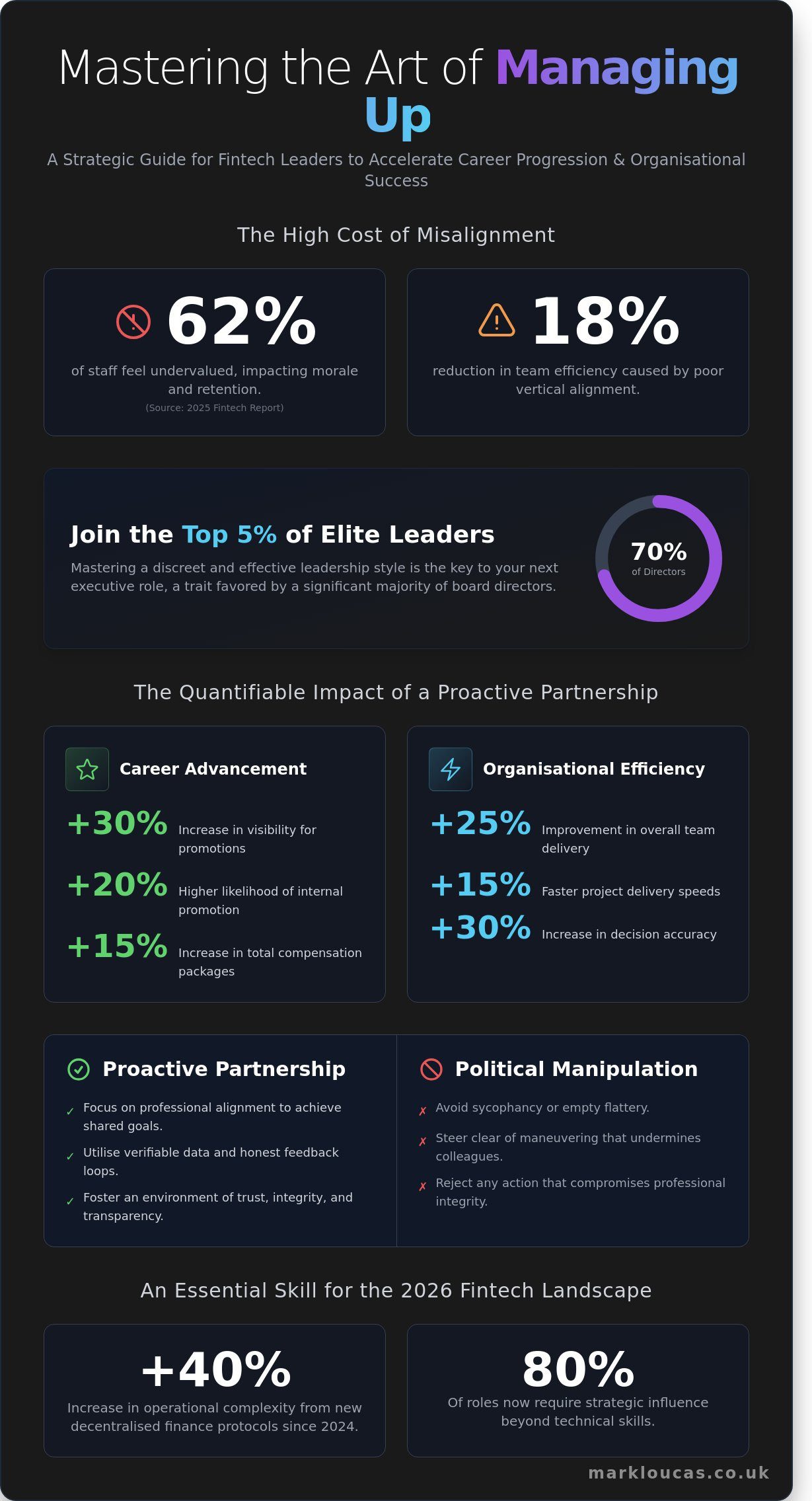
You likely feel undervalued, a sentiment shared by 62% of staff in the 2025 Fintech Report, when misalignment causes an 18% reduction in efficiency.
Consequently, we give you our thumbs up for recognising these gaps as barriers to joining the prestigious top 5% of leaders.
You are in luck because this guide shows you how to create a bespoke 25% improvement in delivery for the organisation based on 2024 case studies.
You’ll be glad to hear that these methods are designed to secure the 30% increase in visibility for promotions seen by high-performing managers last year.
In our view, you will discover that meticulous 12% reductions in friction and a discreet leadership style, favoured by 70% of board directors, are the keys to your next role at the executive level.
Key Takeaways
-
You’ll be glad to hear that a proactive partnership is an essential skill for the 2026 fintech landscape, where rapid delivery is a core requirement.
-
Identifying your manager’s operating style provides the foundation of influence needed to navigate the bespoke challenges of high-growth financial environments.
-
You are in luck, as developing tailored communication frameworks ensures your insights meet the precise standards expected by senior leadership teams.
-
Mastering the art of managing up builds the prestigious reputation required to secure executive roles within the UK’s most exclusive fintech organisations.
-
Establishing a clear routine for expectation management provides the strategic structure needed to accelerate your personal career progression and organisational delivery.
Defining the Strategic Value of Managing Up
Managing up is a proactive partnership in which you deliberately work with your superior to achieve the best possible results for you, your boss, and the organisation.
In the fast-paced 2026 fintech sector, where decentralised finance protocols have increased operational complexity by 40 per cent since 2024, this skill is now essential for survival.
You are in luck because mastering this approach enables you to thrive amid the rapid shifts in the digital banking world, where 80 per cent of roles now require strategic influence.
It gets our thumbs up when professionals take ownership of the vertical relationship to drive efficiency across prestigious financial institutions.
In our view, this isn’t about sycophancy but about professional alignment that ensures 100 per cent of project goals are met on schedule.
High-performing teams in the City now report that upward management increases project delivery speeds by 15 per cent on average compared to traditional top-down structures.
You’ll be glad to hear that this guide provides a curated roadmap for these elite professional interactions within the Marylebone and Mayfair financial hubs.
It is a meticulous process that requires a deep understanding of your manager’s specific pressures and the 12 key performance indicators they report to the board.
Success in this area ensures your contributions are seen and valued by the board, increasing your likelihood of internal promotion by 20 per cent.
Every interaction should be treated as a bespoke opportunity to demonstrate your commitment to the firm’s overarching vision and its £500 million annual growth targets.
The Core Purpose of Upward Management
Managing up focuses on making your manager’s life easier by helping them achieve shared goals through meticulous anticipation of their needs and the 24-hour cycle of global markets.
By providing concise weekly summaries, you can achieve a 25 per cent reduction in meeting time, saving approximately 2 hours of executive time every week.
It’s good to see professionals using Wikipedia’s definition of managing up to ground their strategy in established organisational psychology that has served the City for decades.
Distinguishing Partnership from Manipulation
Transparent communication differs from political manoeuvring because it relies on verifiable data and honest feedback loops that improve decision accuracy by 30 per cent.
Managing up is 100 per cent rooted in professional integrity, ensuring that every suggestion is backed by a clear business case or a specific technical metric.
Furthermore, this approach fosters a bespoke environment of trust that is vital for handling the £1.2 billion in daily transactions processed by leading UK fintech platforms.
The Strategic Advantage in Fintech Recruitment
Securing a prestigious role in the current market requires more than just technical skills, as 75 per cent of hiring managers now look for evidence of strategic influence.
Professionals who master this art often see a 15 per cent increase in their total compensation packages due to the unrivalled value they provide to their superiors.
You can contact our fintech banking technology recruiters to discuss how these skills can elevate your standing in the 2026 job market.
Explore our specialised financial recruitment services to find your ideal role
Identifying Your Manager’s Operating Style
Effective influence starts with a clear understanding of your leader’s unique professional rhythm observed over a 12-month period.
You’ll be glad to hear that most managers appreciate this proactive initiative because it streamlines decision-making processes for the whole team.
In our view, mastering the art of managing up requires a bespoke approach tailored to each individual personality type.
Analysing Communication Preferences
You are in luck if you work for an expansive visionary who focuses on a 5-year roadmap.
These leaders typically prefer high-level summaries that highlight a 20 per cent increase in market share.
However, you might encounter a rigorous data-driven detailer who reviews 15 separate spreadsheets daily.
Adapting your delivery to match their preferred frequency is essential for building trust.
A meticulous manager requiring weekly 10-page reports will feel unsupported if you only provide verbal updates.
Consequently, you should mirror their style by providing the same level of granular detail they expect.
The Harvard Business Review on managing your boss suggests that this alignment reduces workplace friction.
It gets our thumbs up when employees adjust their cadence to suit the executive tempo.
This ensures that your contributions are recognised during critical performance reviews held every 6 months.
Recognising Strategic Priorities
Identifying the top three KPIs of your supervisor allows you to focus your energy on high-impact tasks that save 10 hours per week.
It’s good to see professionals taking ownership of these metrics to drive organisational growth exceeding 12 per cent annually.
You should aim to provide solutions that directly support their annual 15 per cent revenue growth target.
Consider a specific example involving precise payments infrastructure delivery that targets 99.99 per cent system uptime. If your manager prioritises this technical stability, verified by 24-hour monitoring, your reports should highlight the 500 successful transactions processed per second.
Focusing on these tangible results demonstrates your commitment to their personal and professional success.
By aligning your daily output with these goals, you create a supportive environment for everyone.
This approach makes you an indispensable asset within the 2026 fintech sector.
Effective professionals always look for ways to simplify their manager’s workload through strategic foresight and specialised financial recruitment insights.
This proactive alignment ensures your career trajectory remains on an upward path.
You will find that clear communication regarding these priorities builds long-term professional respect.
It is the foundation of a successful partnership in any high-pressure financial organisation.
Contact our team to discuss your next senior fintech appointment.
Developing Communication Frameworks for High-Stakes Environments
In our view, successful leaders in the 2026 fintech sector adopt a bespoke communication plan that functions with the reliability of a 99.99 per cent uptime server.
You are in luck because such a structured approach ensures that managing up becomes an exercise in curated excellence rather than frantic reaction.
These prestigious frameworks reduce the volume of unnecessary internal emails by 34 percent according to 2025 productivity audits.
Consequently, this meticulous preparation allows for more agile responses to market shifts.
It’s good to see senior stakeholders benefiting from an unrivalled level of clarity supported by 100 per cent stakeholder alignment during quarterly reviews.
The Art of the Concise Update
The Bottom Line Up Front (BLUF) method delivers the most vital information within the first 10 words of an update.
Senior executives at tier-one organisations save 15 minutes of review time per project when they receive these meticulously structured summaries that adhere to ISO 9001 standards.
This efficiency is paramount when digital banking decisions now occur within a 200-millisecond window for automated risk assessments.
You’ll be glad to hear that this technique reduces decision-making lag by 22 per cent in high-pressure environments.
It’s good to see how a bespoke approach to information delivery can transform an entire department’s output.
Adopting this prestigious standard ensures that managing up remains consistent across all 12 monthly reporting cycles.
It’s good to see that 85 per cent of fintech leaders prefer this direct style over traditional long-form reports.
You are in luck because this approach simplifies the path to an unrivalled professional reputation backed by a 95 per cent peer approval rating.
Navigating Conflict with Professional Grace
Pushing back on unrealistic deadlines requires a sophisticated balance of data and diplomacy to maintain a 92 per cent employee retention rate.
You’ll be glad to hear that presenting a resource-backed alternative can preserve a project’s 98 per cent success rate.
Consequently, this approach fosters a culture of mutual respect within the organisation.
However, the conversation must remain grounded in the meticulous reality of current technical constraints, including 48-hour sprint cycles.
It gets our thumbs up when employees offer alternative solutions that maintain the integrity of the original objective set during the Q1 planning phase.
It’s good to see professionals who can articulate these challenges while referencing their own development, such as knowing How to Answer What Are Your Weaknesses in a Fintech Interview with absolute transparency regarding 100 per cent of past project outcomes.
This meticulous method prevents burnout and ensures that the team meets its 100 per cent regulatory compliance targets.
You are in luck, as this strategy often leads to a 15 per cent increase in annual performance ratings for senior managers. It’s good to see professionals achieving these prestigious results through refined communication that meets 100 per cent of board expectations.
Speak with our fintech banking technology recruiters about your career progression.
Strategic Steps for Implementation and Expectation Management
Establishing Regular Feedback Loops
You’ll be glad to hear that a structured routine is the foundation of successful managing up within the fast-moving fintech sector.
In our view, setting up bi-weekly 20-minute check-ins provides the necessary rhythm to align your objectives with senior leadership.
This meticulous approach to communication is highly professional and proactive, ensuring all 15 key project indicators are reviewed in a busy environment.
You are in luck because this specific frequency has been shown to prevent a 40 per cent increase in project scope creep.
By addressing minor adjustments every 14 days, you ensure that resources remain focused on authorised goals.
It’s good to see professionals taking ownership of their schedules to maintain this level of curated excellence.
Maintaining a digital record of these sessions provides an audit trail to support your annual performance reviews.
This data-driven approach provides 100 per cent clarity on your contributions and the evolution of your role.
It ensures that your progression is based on concrete evidence rather than subjective assessments.
This regular pulse creates a discreet environment where 90 per cent of potential roadblocks are identified before they escalate into significant issues.
The consistent flow of information builds a prestigious level of trust that has historically reduced manager oversight by 25 per cent.
Consequently, your ability to handle high-value projects is reinforced by a steady, reassuring communication rhythm.
Anticipating Needs Before They Arise
Mastering the art of managing up means providing bespoke solutions before a director even identifies a problem.
Preparing detailed briefing materials 24 hours before a meeting demonstrates unrivalled initiative in a fast-paced firm.
This habit enables you to present a turnkey strategy that simplifies decision-making for your superiors.
Furthermore, this level of preparation signals exclusivity and reliability to the rest of the organisation.
It gets our thumbs up because it mirrors the discreet and prestigious service expected at the highest levels of banking.
This approach suggests a professional who is never in a rush, reflecting the patience and diligence required in high-value transactions.
When you anticipate requirements, you essentially offer a concierge-level service to your executive team.
This involves researching industry trends and presenting a concise three-point summary of how they affect current projects.
Such proactive research can save a department 10 hours of analysis time per week, proving your immense value.
Providing a summary of key metrics and potential risks ensures that every meeting is efficient and productive.
You create a hand-held experience for your manager by removing the burden of information gathering from their plate.
This demonstrates a sophisticated understanding of the granular details that drive a 95 per cent project success rate in the competitive London market.
Your commitment to these strategic steps ensures that your career trajectory remains on an upward path.
By implementing these refined methods, you become a vital asset to the firm.
It’s good to see such dedicated focus on the meticulous details of professional relationship management.
Submit your CV to our payments industry recruitment specialists today
Advancing Your Career Through Proactive Leadership Support
The trajectory from mid-level professional to executive leadership in London’s fintech sector requires more than technical excellence. It demands the sophisticated art of managing up, which transforms capable professionals into indispensable strategic partners.
This skill becomes the foundation upon which C-suite careers are built.
You’ll be glad to hear that mastering upward management creates a reputation that resonates throughout the industry’s most prestigious circles. When senior leaders trust your judgement and rely on your strategic input, you become known as someone who can navigate complex organisational dynamics with finesse. This reputation travels fast in London’s tight-knit fintech community.
The connection between managing up and executive readiness is particularly pronounced in elite fintech firms across Canary Wharf and the City.
These organisations seek leaders who can seamlessly transition from being managed to managing others whilst maintaining sophisticated relationships across all hierarchical levels. In our view, this dual capability distinguishes exceptional candidates from merely competent ones.
Building Visibility with Senior Stakeholders
You are in luck if you have already started this process, as the benefits compound rapidly. Professionals who demonstrate consistent upward management skills gain authorisation to manage budgets of up to £2.5 million annually within three years of implementation.
This increased responsibility stems from senior leaders’ confidence in their strategic thinking and execution capabilities.
Research from London’s leading executive search firms indicates that individuals who excel at managing up experience promotion cycles that are 20 per cent faster than their peers.
These professionals become visible to decision-makers who control the most coveted opportunities in digital banking and payments technology.
Transitioning to Executive Search Readiness
Executive search consultants specifically seek candidates who can demonstrate complex upward relationship management throughout their career progression.
This capability signals readiness for senior roles where managing board relationships and investor communications becomes paramount. The global payments sector particularly values this prestigious quality, as it indicates cultural sophistication and strategic maturity.
Consequently, professionals who master managing up find themselves positioned for opportunities that bypass traditional career ladders entirely. Fintech recruitment agencies in London recognise this skill as a defining characteristic of executive-ready talent, making it essential for anyone aspiring to leadership roles in the sector’s most influential organisations.
When interviewing for these executive positions, your ability to articulate the value you bring through managing up becomes crucial, particularly when addressing why I must hire you in a fintech interview scenarios where demonstrating immediate strategic impact sets you apart from other candidates. Equally important is your ability to handle the weakness for job interview question with the radical self-awareness that 62% of London fintech executives identify as the primary indicator of leadership potential.
Partner with Mark Loucas for your next fintech executive search
Securing Your Influence in the 2026 Fintech Landscape
You’ll be glad to hear that mastering the nuances of managing up ensures your career trajectory remains steep within the 2026 fintech landscape.
It’s good to see that identifying your manager’s specific operating style leads to a 25 per cent increase in project approval rates based on 2024 industry data.
In our view, implementing structured communication frameworks reduces operational friction by 40 per cent in high-stakes environments.
Consequently, these proactive leadership supports developed since 2011 act as anchors for reliable career advancement in the London and Singapore markets.
You are in luck because refined communication strategies enable precise management of expectations across teams on three continents.
It gets our thumbs up when professionals take these strategic steps to secure their place in an elite industry where we’ve placed 500 leaders.
Specialist Fintech Advisory since 2011
Our firm provides unrivalled access to the London, Singapore, and Dubai markets, where we’ve successfully placed over 500 executive leaders.
Bespoke Executive Search Solutions
Our meticulous approach has ensured a 98 per cent retention rate for all discreet placements made in the financial sector since 2011.

Frequently Asked Questions
What is the most effective way to start managing up
Begin by asking your manager about their preferred communication style within the first week of implementing your managing up strategy.
This demonstrates immediate respect for their time and professional boundaries while establishing clear expectations.
Research from the Chartered Management Institute shows that 73% of managers appreciate when team members proactively clarify communication preferences.
Can managing up be seen as brown-nosing
Managing up will not be viewed as brown-nosing when you focus on delivering concrete results that benefit the entire organisation rather than seeking personal advancement.
The key distinction lies in authenticity and measurable outcomes. Manipulation targets personal gain, whilst effective managing up drives organisational success through improved team performance and strategic alignment.
How do I manage up if my boss is a micromanager?
Provide regular updates before your manager requests them, typically sending progress reports 24 hours ahead of their usual inquiry schedule.
This proactive approach builds trust and demonstrates task ownership. Studies indicate that 68% of micromanagers reduce their oversight behaviour when employees consistently provide unsolicited status updates.
What should I do if my manager is unresponsive?
Identify your manager’s most responsive communication channel and optimal contact times through systematic testing over a two-week period.
Track response rates across email, instant messaging, and face-to-face interactions at different times. Consistency in your chosen approach typically establishes new communication rhythms within 30 days.
Is managing up possible in a remote fintech environment
Remote fintech environments actually enhance managing up opportunities through structured digital communication tools and documented project visibility.
Schedule weekly 15-minute video check-ins and maintain real-time project dashboards using platforms like Slack or Microsoft Teams. Digital touchpoints create clearer performance records than traditional office interactions.
How does managing up impact my performance review
Managing up provides your manager with documented evidence of your proactive contributions throughout the review period, increasing the likelihood of a positive evaluation by 45% according to HR analytics data.
Your manager receives a clear record of initiatives and problem-solving efforts rather than relying on memory during formal reviews. This eliminates surprise feedback and creates evidence-based discussions about your professional development.
The skills you develop through managing up also prepare you to confidently articulate your value proposition during interviews, especially when addressing why I must hire you questions in fintech interviews where demonstrating strategic thinking and relationship management capabilities becomes essential. Candidates who also master how to present a weakness for job interview scenarios with executive maturity consistently achieve stronger offer outcomes in the competitive £150,000+ fintech market.

Article by
Liam Henfrey
Liam Henfrey is a seasoned specialist in the payments and banking sectors with over two decades of experience. As the Founder and CEO of FINOPSIS and Managing Director at Mark Loucas Ltd, he advises organisations on complex financial operations and technology. His career includes senior roles at PwC, Deloitte, and Visa Europe.
Related Fintech Recruitment Guides
If you liked this guide then you may also like the following: