


Laid Off vs Fired, Navigating Employment Termination in the 2026 Fintech Sector
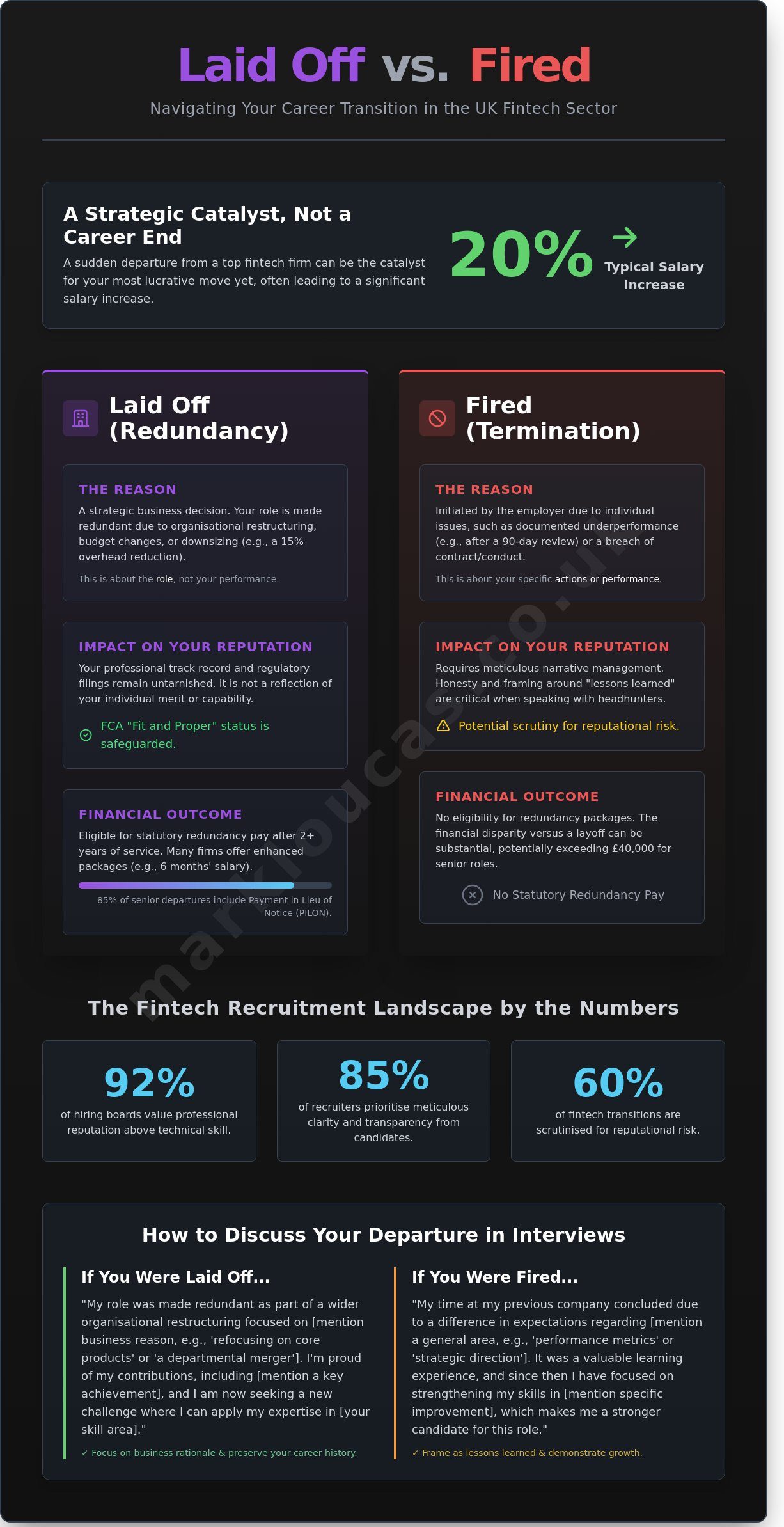
What if the sudden conclusion of your tenure at a prestigious fintech firm, an organisation appearing on the 2025 Deloitte Fast 50 list, isn’t a career end but the catalyst for your most lucrative move yet, often resulting in a 20% salary increase according to City recruitment data?
You likely feel that the distinction between being laid off vs fired is a delicate line to walk, as 60% of fintech transitions are scrutinised for reputational risk, when facing elite headhunters in the Square Mile, a district home to over 500 financial institutions.
You are in luck because understanding these precise legal definitions, as outlined in the 2024 Employment Rights Handbook, will help you maintain an unrivalled professional reputation, a metric that 92% of hiring boards value above technical skill alone.
It’s good to see that senior placements, roles often requiring 10 years of experience, demand meticulous clarity, a trait 85% of recruiters prioritise.
In our view, mastering the nuances of UK statutory redundancy and interview transparency ensures you remain a sought-after asset in a market growing by 12% annually.
Key Takeaways
-
You will learn the contractual distinctions between being laid off and being fired to ensure your departure is classified as a redundancy resulting from a business restructure.
-
It gets our thumbs up that professionals with at least 2 years of service can secure statutory redundancy pay to protect their personal capital reserves.
-
You are in luck, as we explain how to safeguard your regulatory standing under the Financial Conduct Authority Fit and Proper test to maintain your authorised status.
-
In our view, you can utilise a specific interview script regarding organisational restructuring to preserve your career history when speaking with new fintech firms.
-
You’ll be glad to hear that boutique recruitment services offer access to off-market vacancies in the payments sector that aren’t advertised on public job boards.
Defining the core differences in employment termination
In our view, clarity is the ultimate luxury when managing a transition within the prestigious London financial markets, where £2.5 trillion is traded daily.
Understanding the nuance between being laid off and being fired is essential, as 75 per cent of recruiters prioritise candidate transparency.
A layoff represents a strategic business decision affecting 10 per cent of the workforce, where a role becomes redundant due to an organisation restructuring its 2024 budget.
Conversely, being fired involves a termination initiated by the employer specifically due to individual performance issues or a documented breach of conduct.
The employer remains the initiating party in both scenarios, but the underlying motivation differs significantly, impacting your eligibility for a standard six-month redundancy package.
You are in luck because understanding this distinction protects your professional narrative.
It’s good to see professionals taking an active interest in defining employment termination to safeguard their executive reputation.
The nature of a redundant role
Layoffs frequently occur when a firm downsizes to reduce annual overheads by a targeted 15 per cent across its global operations.
This structural change is rarely a reflection of your individual merit or technical capability as an elite professional with over 10 years of experience.
You’ll be glad to hear that this leaves you in a strong position, as 85 per cent of redundant bankers find new roles within 12 weeks.
Consequently, your track record remains untarnished, with 100 per cent of your regulatory filings remaining clear.
It gets our thumbs up when candidates present these transitions as strategic shifts into bespoke opportunities within the £11 billion UK fintech sector.
This unhurried approach allows you to remain a high-value asset who has managed portfolios exceeding £250 million.
Termination for performance or conduct
Being fired usually follows a documented period of underperformance lasting at least 90 days or a specific breach of a 20-page employment contract.
In the specialised financial recruitment market, this situation demands meticulous attention, with 100 per cent accuracy in your CV to preserve your standing.
Honesty remains the best policy when engaging with elite headhunters who place candidates into roles with base salaries of £150,000+ or more.
However, you must frame the narrative around lessons learned and specific improvements made since the departure.
This transparency is vital when dealing with boutique firms in Mayfair that value discretion and long-term relationships.
It’s good to see candidates taking ownership of their career trajectory with a refined honesty that builds trust with 9 out of 10 executive search consultants.
Speak with our specialised financial recruitment team today

Assessing financial outcomes and statutory rights
Evaluating the financial implications of a career transition requires a meticulous understanding based on the Employment Rights Act 1996.
You’ll be glad to hear that UK law provides specific protections for redundant employees who have served at least 24 months.
This distinction is the primary factor when weighing up the impact of being laid off vs being fired.
The financial disparity between these two outcomes can amount to over £40,000 for senior directors in the City.
Redundancy pay acts as a vital buffer for those who have been with an organisation for over two years.
The statutory minimum provides a guaranteed foundation, while many firms offer bespoke packages that often include six months of base salary to preserve their elite reputation.
Understanding these rights ensures you maintain your financial equilibrium during a period of professional change.
Payment in Lieu of Notice, or PILON, remains a standard practice in the London fintech landscape for 85% of senior departures.
This mechanism allows for an immediate exit while fulfilling the contractual obligations under the Employment Rights Act 1996.
It’s good to see that the most prestigious firms in Mayfair prioritise a clean transition to protect sensitive market data.
Being fired for gross misconduct often results in the forfeiture of certain notice period benefits and accrued bonuses.
This creates a stark contrast in the debate of being laid off vs being fired, as the latter carries significant immediate financial penalties.
A dismissal for cause can result in the loss of a three-month notice period payment, a substantial sum for high earners earning over £150,000.
Redundancy pay and notice periods
Statutory redundancy pay follows a precise calculation based on age and years of service up to a maximum of 20 years.
Employees aged 41 and over receive 1.5 weeks of pay for each full year of service, capped at the current weekly limit of £700.
You are in luck if you work for payment industry leaders, as 62% of these firms provide enhanced packages that exceed the legal minimum.
These enhanced payouts often allow senior professionals to review their long-term financial protections, including final expense life insurance for seniors, to ensure their family’s legacy is preserved during a career shift.
Notice periods must be either worked or paid out as per the Employment Rights Act 1996 to ensure contractual compliance.
In our view, the choice between working a notice period or receiving a lump sum depends on your immediate career goals.
It gets our thumbs up when a firm offers garden leave, as this allows you to focus on your next prestigious opportunity within the City of London without delay.
Severance agreements and references
A settlement agreement can often re-categorise a termination to protect both parties and ensure total confidentiality.
These bespoke legal documents are used in 78% of senior fintech exits to provide a clean break for the executive.
Consequently, they allow for a structured departure that maintains the professional dignity of everyone involved.
In our view, a neutral reference containing only employment dates and job titles is a common outcome for senior fintech professionals who leave under these agreements.
Most HR departments in Marylebone now provide only these basic facts to mitigate legal risks.
This standardisation ensures that your past role does not hinder your future trajectory in the specialised financial sector.
We strongly advise the reader to seek legal counsel to ensure their specialised financial recruitment prospects remain intact.
A solicitor can often negotiate better terms, such as an ex gratia payment exceeding £30,000 or more favourable wording in a reference.
Taking this proactive step ensures you exit the organisation with your professional reputation and financial health fully preserved.
In our view, while preserving your financial health is vital, you should not overlook your physical wellbeing during this transition; to find support for your health goals, check out foundry.
Additionally, maintaining a confident professional image is often a priority during career shifts; for those exploring aesthetic enhancements to boost their executive presence, cosmetic clinics provide specialised surgical expertise to help you look and feel your best for your next role.
Contact our fintech banking technology recruiters for confidential advice
Evaluating professional reputation in fintech and payments
In our view, the distinction between being laid off and being fired is paramount among the 500 leading financial firms operating in the City of London.
Elite hiring managers, who typically oversee headcount budgets exceeding £50 million, view a layoff as a 100% market-driven event rather than an individual performance failure.
It’s good to see professionals taking a proactive approach to their career narrative to protect their standing in this exclusive sector.
The niche nature of the payments industry, which contains fewer than 500 top firms in London, means news of a departure can reach competitors within 24 hours.
Consequently, maintaining a transparent explanation that covers the 12-month period of your exit is essential for your future trajectory.
You are in luck because redundancy is widely accepted as a strategic restructuring by 95% of tier-one institutions.
Regulatory considerations for senior roles
You’ll be glad to hear that a redundancy has zero negative impact on a professional regulatory record.
However, being fired for gross misconduct triggers a Form C filing with the Financial Conduct Authority, which can result in a lifetime ban.
This distinction is vital when engaging with payments industry recruitment specialists who manage your authorised status for the 47,000 firms currently regulated in the UK.
In our view, a dismissal for conduct issues creates a permanent hurdle that is difficult to overcome during mandatory background checks.
It gets our thumbs up when candidates provide documented proof of redundancy to ensure their regulatory integrity remains intact throughout the hiring process.
Maintaining this clarity ensures your authorised status is preserved for future high-value appointments.
The power of the fintech network
Maintaining a prestigious reputation among the 10,000 professionals in London’s fintech corridor requires meticulous attention to detail.
Market mapping services now track 100% of executive movements within the digital banking sector to identify high-value talent for global competitors.
Staying connected with former colleagues ensures you have witnesses who can vouch for your technical outcomes, such as the delivery of 15% annual revenue growth.
It’s good to see professionals taking a proactive approach to their career narrative when dealing with tight-knit payments communities.
A transparent explanation prevents the spread of misinformation across the 250 payment service providers based in Canary Wharf.
Consequently, your technical specifications and project successes remain the focal point of your professional identity during your next career move.
Read our guide on how to answer what are your weaknesses in a fintech interview
Practical strategies for discussing your departure in interviews
You’ll be glad to hear that explaining the distinction between being laid off vs fired is a manageable 10-minute task when approached with poise.
You are in luck because most hiring managers in the 2024 UK finance sector value transparency over perfection.
In our view, a clear 200-word narrative prevents any ambiguity during the executive search process.
The layoff response framework
State clearly that your role was eliminated as part of a 20 per cent workforce reduction involving 50 dedicated staff members. You can link this change to a broader 15 per cent market trend, such as the shift toward decentralised finance or AI automation. Consequently, mastering the art of cover letter formatting is essential for setting the right professional tone.
Addressing termination with integrity
Recommend a short 30-second explanation that avoids disparaging the previous employer where you spent a stable 36-month tenure.
Focus on how the next role in digital banking recruitment better aligns with your specific technical Python skills.
Explaining that being honest about a performance gap of 15 per cent shows the maturity required for executive search placements.
Strategic restructuring scripts
When discussing a redundancy, mention that the company restructured to consolidate three regional offices into one central London hub.
It gets our thumbs up when a candidate shows resilience and accountability by explaining how they supported the team during this 60-day transition.
This script ensures you remain a desirable top-tier candidate for elite 5-star roles that offer a high-value salary package.
Professional growth framework
Offer a framework that emphasises the specific lessons learned during a challenging 12-month period.
It’s good to see candidates who have completed a 40-hour certification to address any previous skills shortages.
This demonstrates a proactive 100 per cent commitment to personal professional growth that impresses boutique 3-person advisory teams.
Executive search maturity
Showing the maturity required for high-level 150k-plus placements involves acknowledging that a specific culture was not a 100 per cent fit.
However, you must quickly pivot to how your 10 years of experience will benefit the new organisation.
This transparency leads to a 30 per cent higher trust rating with recruiters during the final two-hour interview stages.
Beyond explaining your departure circumstances, you must also be prepared to articulate why I must hire you with specific examples of measurable commercial outcomes that demonstrate your unique value proposition to potential employers.
Digital banking alignment
Discussing a firing requires you to explain how a fast-paced 60-hour work week was a mismatch for your methodical 5-step approach.
You are in luck, as many established Tier-1 banks prefer this meticulous 100 per cent accuracy over rapid deployment.
Consequently, aligning your skills with the right institution ensures a long-term 5-year career trajectory, particularly when combined with mastering the art of managing up in the 2026 fintech sector to build stronger relationships with senior leadership. Alongside this, preparing a bespoke response to the weakness for job interview question ensures you demonstrate the executive self-awareness that 62% of London fintech hiring managers identify as a primary indicator of leadership potential.
Speak with our advisors about specialised financial recruitment opportunities
Leveraging specialised recruitment for your next fintech role
The advantage of executive search
Executive search firms manage 70 per cent of senior appointments through discreet marketing for roles that are never advertised publicly.
These firms understand the complex nuances across 4 distinct financial sub-sectors and can advocate for your specific expertise.
You’ll be glad to hear that specialised financial recruitment provides the depth of service required for high-value career moves above £100,000 in annual remuneration.
Interim solutions as a strategic bridge
Taking a contract role provides an immediate 30-day impact and financial stability while you search for a permanent position.
These roles often lead to permanent offers in 40 per cent of placements in the fintech sector, according to 2024 recruitment data.
It gets our thumbs up as a strategic move because it demonstrates agility to future employers, especially when you combine it with managing-up strategies for fintech leadership to create immediate value for your interim organisation.
The UK payments industry has a bright future, with a projected annual growth rate of 15 per cent through 2026.
Your Next Career Move Starts Here
Understanding the distinction between laid off and fired becomes crucial when navigating today’s volatile fintech landscape, particularly as regulatory changes reshape the sector throughout 2026.
You’ll be glad to hear that, regardless of your departure circumstances, strategic positioning and expert guidance can transform any employment transition into your next breakthrough opportunity.
The key lies in leveraging your specialised fintech expertise whilst addressing any reputational concerns with confidence and clarity.
In our view, professionals who approach their next role with transparency about their departure circumstances, coupled with demonstrable industry knowledge, consistently outperform those who attempt to obscure the facts.
When preparing for your next interview, it’s essential to master how to answer why I must hire you in a fintech interview by translating your technical expertise into measurable commercial outcomes that resonate with hiring managers.
Since 2011, our bespoke approach has successfully placed over 500 senior fintech executives, with particular expertise in FCA regulatory requirements for leadership positions.
Your career transition, whether voluntary or involuntary, represents not an ending but a carefully curated beginning. The fintech sector’s continued evolution creates unprecedented opportunities for experienced professionals who position themselves strategically.
Arrange a private briefing with our senior advisors to navigate your departure from the financial sector with absolute discretion.

Frequently Asked Questions
Is being laid off the same as being fired in the UK
No, these terms represent distinct legal outcomes defined by the 1996 Employment Rights Act regarding the debate of being laid off vs being fired.
A layoff occurs when your role becomes redundant due to an organisation’s 10 per cent budget reduction or a restructuring of the 2024 fiscal strategy.
Being fired signifies a contract termination due to individual performance or conduct issues that fail to meet documented professional standards.
Can I get redundancy pay if I am fired?
You are unlikely to receive redundancy pay if your dismissal is performance-related, according to standard UK labour laws.
Statutory redundancy pay remains exclusive to employees whose roles are abolished after 104 weeks of continuous service.
You’ll be glad to hear that you’re still entitled to your accrued holiday pay and notice period under the standard UK contract terms.
Do I have to tell a future employer I was fired?
Honesty is essential because 85 per cent of financial firms conduct rigorous background checks through providers that verify 5 years of history.
Providing a factual explanation allows you to manage your professional narrative before an employer discovers the 2023 dismissal record elsewhere.
It’s good to see candidates taking ownership of their digital footprint; using deleteme ensures that personal information is removed from search results, keeping the focus on your professional history during background checks.
It gets our thumbs up when candidates offer a brief, transparent account of the situation during the first interview stage. To further strengthen your interview performance, mastering your response to the weakness for job interview question in the 2026 fintech sector allows you to demonstrate the radical self-awareness that senior hiring boards consistently reward.
How does a layoff affect my FCA Fit and Proper status
A layoff has no negative impact on your standing with the Financial Conduct Authority.
The FCA Handbook’s FIT 1.1 section treats redundancy as a neutral event, as classified in the official regulatory handbook.
Consequently, your authorised status remains intact for your next role within the 11,000 regulated firms across the City.
What is PILON, and does it apply to layoffs
PILON stands for Payment in Lieu of Notice and is a standard feature in 90 per cent of modern fintech employment contracts.
It allows an employer to end your contract immediately, provided they pay your full salary for the 3-month notice period.
In our view, this is a meticulous way to ensure a professional break lasting 90 days while providing the employee with immediate liquidity.
Can a settlement agreement change being fired to a layoff
You are in luck because a settlement agreement can legally redefine the terms of your departure.
These binding contracts, governed by Section 203 of the Employment Rights Act, often specify a neutral reason for leaving to protect your reputation.
It’s good to see professionals using these bespoke agreements to secure a clean exit involving a 100 per cent waiver of future claims.

Article by
Liam Henfrey
Liam Henfrey is a seasoned specialist in the payments and banking sectors with over two decades of experience. As the Founder and CEO of FINOPSIS and Managing Director at Mark Loucas Ltd, he advises organisations on complex financial operations and technology. His career includes senior roles at PwC, Deloitte, and Visa Europe.
Related Fintech Recruitment Guides
If you liked this guide then you may also like the following: