


Mastering Diversity and Inclusion in Fintech Hiring for 2026
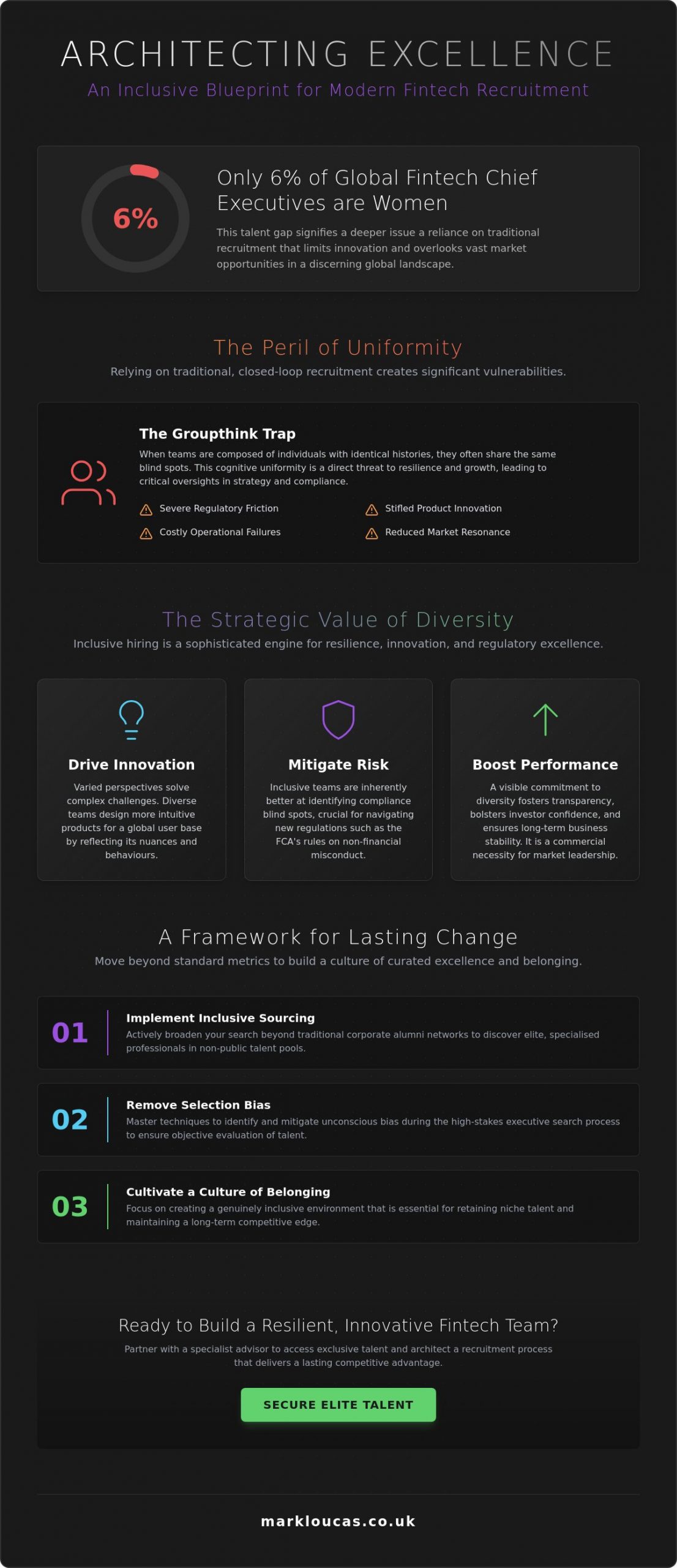
If only 6% of global fintech chief executives are women as of 2026, is your recruitment strategy truly accessing the full spectrum of elite talent? The challenge of diversity and inclusion in fintech hiring often feels most acute when searching for specialised experts in payments or compliance, where the talent pool can seem deceptively narrow. You likely recognise that a team reflecting a variety of lived experiences is no longer just a social goal, it’s a fundamental requirement for driving innovation in a discerning global market.
We understand the pressure to meet stringent regulatory targets whilst maintaining the high standards your organisation demands. This guide provides a sophisticated blueprint for fintech leaders to architect inclusive recruitment processes that secure elite niche talent. You will learn how to navigate the 2026 regulatory landscape, implement a repeatable framework for inclusive hiring, and move beyond standard metrics to create a culture of curated excellence and lasting belonging.
Key Takeaways
- Recognise how diversity and inclusion in fintech hiring acts as a sophisticated engine for innovation within the 2026 digital banking sector.
- Identify the limitations of traditional recruitment channels and learn how to reach elite, specialised professionals through more inclusive sourcing strategies.
- Master the techniques required to identify and mitigate unconscious bias during the high-stakes fintech executive search process.
- Discover why cultivating a genuine culture of belonging is essential for retaining niche talent whilst maintaining a competitive edge.
- Understand the strategic advantage of partnering with a boutique advisor to access exclusive and non-public talent opportunities.
To explore how bespoke talent strategies can enhance your firm’s competitive standing, please contact our boutique advisory team.
The Strategic Value of Diversity and Inclusion in Modern Fintech Hiring
Within the landscape of 2026 digital banking, diversity and inclusion in fintech hiring has become a sophisticated architectural discipline rather than a simple HR metric. It represents the deliberate assembly of varied backgrounds and perspectives to mirror a complex global marketplace. By integrating established frameworks for diversity, equity, and inclusion, fintech leaders can build resilient structures that withstand the pressures of a shifting global economy. This strategic alignment is essential for navigating the intricate landscape of modern payments and digital finance.
Groupthink remains one of the most significant risks to any high-growth financial institution. When teams are composed of individuals with identical educational and professional histories, they often share the same blind spots. In critical areas like risk management and compliance, these oversights can lead to severe regulatory friction. Diversity acts as a safeguard. It introduces a healthy friction that challenges assumptions and identifies vulnerabilities before they manifest as operational failures. This cognitive variety ensures that every potential risk is viewed through multiple lenses.
Fintech firms that prioritise inclusive teams are better positioned to design products that resonate with a global customer base. In the payments industry, where local nuances and cultural behaviours dictate user adoption, a team that reflects that diversity is a powerful asset. It allows for the creation of intuitive interfaces and seamless cross-border experiences that a more insular team might struggle to conceptualise. Success in 2026 requires an intimate understanding of the diverse end-user, which can only be achieved by a workforce that embodies those same varied perspectives.
Diversity, equity, and inclusion serve as a catalyst for fintech resilience and regulatory excellence.
Driving Innovation through Varied Perspectives
Product innovation in 2026 relies on understanding the nuanced friction points of a global user base. Diverse engineers and product managers bring unique insights into user journeys that a homogenous team might overlook. Solving complex payments infrastructure challenges requires cognitive diversity, which allows for multifaceted problem solving. When collaborating with fintech recruitment agencies in London, the focus should remain on these elite cognitive traits that drive genuine differentiation in a crowded market.
Mitigating Risk and Improving Financial Performance
Inclusive teams are inherently better at identifying compliance blind spots, particularly as the UK’s Financial Conduct Authority enforces new rules on non-financial misconduct as of September 2026. Diverse leadership teams foster a culture of transparency that bolsters investor confidence and long term business stability. The data is clear; inclusive hiring is a commercial necessity for any firm aiming to lead the next generation of financial services. Demonstrating that leadership is not a monolith signals a forward-thinking organisation capable of navigating high-stakes transitions with expert care.
For those seeking to refine their recruitment architecture through expert guidance, we invite you to connect with our specialist advisors.
Implementing Inclusive Sourcing Strategies for Niche Fintech Roles
Traditional recruitment methods often act as a closed loop, inadvertently reinforcing existing demographic structures by relying on familiar corporate alumni networks or a handful of prestigious universities. When seeking specialists for highly technical transitions, such as ISO 20022 migration or RTGS infrastructure upgrades, these narrow channels frequently fail to surface the full breadth of available expertise. Recent research on inequality in the tech sector highlights the persistent disparities that occur when firms don’t actively broaden their horizons. True excellence in diversity and inclusion in fintech hiring requires a departure from the status quo, moving towards a more deliberate and curated search for talent.
To move beyond these limitations, leaders must embrace a more sophisticated approach to market mapping. Partnering with fintech banking technology recruiters who maintain deep, non-public networks allows firms to access elite professionals who are not actively seeking roles on public platforms. These specialists often operate within discreet circles, and reaching them requires the unhurried, meticulous attention of a boutique advisor. Engaging with a partner who understands these nuances can transform your recruitment outcomes. You might find it beneficial to discuss your specific talent requirements with an advisor who prioritises discreet, high-value connections.
To initiate a meaningful audit of your current sourcing, evaluate the demographic data of your applicants from the initial point of contact through to the final shortlist. If specific job boards or referral programmes consistently produce a narrow range of candidates, those channels should be recalibrated or supplemented with more targeted outreach.
Expanding the Talent Pool beyond Traditional Circles
Finding elite candidates requires looking into underrepresented communities and professional groups that larger corporate entities often overlook. Cognitive diversity is frequently found in adjacent sectors. A professional with a background in high-integrity data science or complex cybersecurity may possess the exact cognitive architecture required for sophisticated payments roles. Engaging with these passive candidates requires a personalised approach, ensuring they feel their unique perspective is truly valued rather than just filling a quota.
Crafting Job Descriptions that Encourage Diverse Applicants
The language used in technical requirements can inadvertently signal an exclusionary culture. Removing gendered language and overly aggressive jargon is a simple yet effective step toward inclusivity. By articulating the desired impact of a role rather than listing an exhaustive set of historical credentials, you invite a broader range of elite professionals to see themselves within your organisation. Highlighting your commitment to flexibility and individualised growth pathways further signals that your firm is a place where rare talent can truly flourish.
If you would like a bespoke review of your current recruitment architecture, please reach out to our team for a discreet consultation.
Removing Bias from the Fintech Selection Process
Unconscious bias is a subtle yet powerful force that can quietly undermine even the most well-intentioned diversity and inclusion in fintech hiring strategies. It often manifests as a preference for the familiar, where hiring managers gravitate towards candidates who share similar backgrounds or communication styles. In the context of high-stakes executive search, this bias can lead to a narrow definition of leadership that excludes elite professionals with non-traditional career paths. Recognising these invisible patterns is the first step towards building a truly meritocratic selection process. With the EU Artificial Intelligence Act classifying recruitment tools as high-risk as of 2026, the need for stringent bias testing and human oversight has never been more critical.
A standardised framework acts as a reliable anchor of directness and reliability. To ensure fairness, your organisation should adopt a clear protocol for every candidate interaction. This includes establishing objective criteria before the search begins and utilising a consistent scoring rubric for every interview. Asking each candidate the same set of core competency questions ensures that comparisons are based on capability rather than personal chemistry. Including a diverse range of perspectives on the interview panel further dilutes individual bias and signals to the candidate that your firm values varied viewpoints.
For technical disciplines, such as devops recruitment, blind CV reviews offer a refined way to focus purely on technical craftsmanship. By removing names, gender markers, and specific university titles, your team can evaluate a candidate’s architectural skills and problem solving abilities without the interference of subconscious assumptions. This meticulous attention to raw capability ensures that your organisation secures the best possible talent based on merit alone. It’s a discreet yet effective method for maintaining the high bar required in niche fintech roles.
Standardising the Interview Framework for Equity
Using competency based questions allows you to evaluate all candidates against the same criteria, reducing the influence of gut feeling. Work sample tests, such as coding exercises or compliance case studies, act as better predictors of actual job performance than traditional cultural fit assessments. It’s also vital to train hiring managers to recognise and interrupt their own biases during the interview. This unhurried approach ensures that every decision is deliberate and rooted in evidence.
Utilising Data to Identify Selection Gaps
Tracking candidate progression through the recruitment funnel allows you to identify exactly where diverse talent may be dropping out. If patterns of subjective or exclusionary language appear in interview feedback, it indicates a need for recalibration. Regular reviews of hiring data help refine your selection architecture, ensuring it remains robust and inclusive. This steady, reassuring pulse of data analysis allows your firm to move logically from a grand vision of diversity to the granular reality of an inclusive workforce.
To discuss how to refine your internal culture and retention strategies, please speak with our specialist advisors.
Cultivating an Inclusive Environment for Talent Retention
Building an elite team through diversity and inclusion in fintech hiring is merely the initial phase of a sophisticated talent strategy. If the environment does not foster a genuine sense of belonging, even the most meticulously sourced professionals will eventually seek organisations that offer greater psychological safety. In the high-pressure world of digital banking, where product cycles are rapid and the margin for error is slim, individuals must feel secure enough to challenge the status quo without fear of professional repercussion. This sense of security is the bedrock of innovation. It allows for the healthy friction necessary to solve complex payments infrastructure challenges.
Clear and transparent pathways for career progression act as anchors of reliability for your most ambitious employees. When professionals understand exactly how their contributions lead to advancement, they are far more likely to commit their long term future to the firm. Inclusive onboarding is not just an administrative task; it is the vital moment you confirm to a new hire that they are a valued part of a rare and distinguished collective. This initial experience sets the tone for long term loyalty and ensures that the craftsmanship you have recruited is nurtured from day one.
Moving beyond Box Ticking to Genuine Inclusion
During critical product sprints, the most valuable insights often come from those with the most varied perspectives. Fostering a culture where every voice is heard requires more than just intent. It requires structured Employee Resource Groups that provide genuine professional development and a platform for influence. With the June 2026 deadline for the EU Women on Boards Directive, ensuring that diversity is reflected at the board level is now a regulatory necessity for many listed firms. This top-down commitment signals a brand that values distinction at every tier of the organisation.
Mentorship and Transparent Career Progression
Formal mentorship programmes provide essential support, yet it is sponsorship that often propels diverse talent into executive roles. A sponsor acts as a discreet advocate within the highest circles of the organisation, actively opening doors to non-public opportunities. Transparent salary bands and promotion criteria are also vital, particularly as the EU Pay Transparency Directive becomes national law in June 2026. These measures help close persistent pay gaps and demonstrate a sincere commitment to equity that elevates your firm above the impersonal nature of larger corporate entities. To ensure your firm remains a destination for elite professionals, contact us to discuss our talent advisory solutions.
To explore how a bespoke recruitment strategy can elevate your organisation’s approach to talent, we invite you to connect with our boutique advisory team.
The Strategic Advantage of Specialist Recruitment Partnerships
Achieving excellence in diversity and inclusion in fintech hiring is a meticulous endeavour that often requires the assistance of a discreet, highly connected partner. Whilst internal teams are adept at managing volume, a boutique advisor offers a level of curated excellence that is essential for securing rare talent in narrow technical fields. By leveraging fintech executive search, organisations can identify and engage with leaders who are not actively seeking new roles but possess the cognitive architecture to drive significant innovation. This unhurried, personalised approach ensures that your firm’s interests are managed with expert care, moving beyond the impersonal nature of large corporate entities.
A specialist partner provides the steady, reassuring pulse of market intelligence needed to navigate the complexities of modern recruitment. By acting as a knowledgeable local insider, we can translate your grand vision for an inclusive workforce into the granular details of a successful hire. This tailored focus allows for the identification of elite professionals who value privacy and bespoke solutions. It ensures that every candidate presented is not only technically proficient but also aligns with the sophisticated culture of your organisation.
Accessing Private Networks of Diverse Professionals
Our strength lies in the cultivation of long term relationships within premium urban centres, allowing us to act as a sophisticated ambassador for your brand. We identify high calibre diverse professionals who operate within non-public networks, ensuring that your search for excellence remains both exhaustive and private. Navigating this competitive landscape requires the patience and diligence that only a boutique firm can provide. By accessing these exclusive talent circles, your firm can secure top tier candidates who might otherwise remain invisible to traditional recruitment channels.
Aligning Diversity Targets with Business Growth
Strategic talent advisory involves more than just filling immediate vacancies; it requires data driven market intelligence to align your future workforce with your broader business vision. Through detailed market mapping in specialised areas like payments industry recruitment, we help you identify diverse specialists in niche technical fields. This approach allows you to balance urgent hiring needs with long term DEI objectives, ensuring your recruitment architecture supports a culture of distinction. As we move towards 2026 and beyond, this strategic alignment will be the hallmark of fintech firms that lead with quiet confidence and expert care.
To learn more about our tailored approach to fintech talent advisory, please contact our specialist team.
Architecting an Inclusive Future for Fintech Leadership
Mastering diversity and inclusion in fintech hiring is an ongoing journey of refinement and architectural precision. By moving beyond conventional sourcing and implementing rigorous selection frameworks, your organisation can access the rare talent necessary to thrive in an increasingly complex global market. As we look towards 2026, this commitment to variety not only satisfies mandatory regulatory requirements but also serves as a powerful engine for resilient innovation and long term stability.
Mark Loucas Ltd has focused on high calibre strategic placements since 2011, acting as a discreet advisor to firms seeking excellence. As specialists in permanent fintech and executive search, we leverage an extensive global network of niche payments professionals to identify individuals who bring both technical craftsmanship and cognitive diversity. To secure the elite diverse talent your organisation requires, contact our specialist consultants for a discreet consultation. We look forward to helping you build a team that reflects the very best of modern finance.
Frequently Asked Questions
How does diversity affect fintech innovation
Diversity drives innovation by introducing varied cognitive architectures that challenge established norms in product development. When teams reflect the global customer base, they are better equipped to conceptualise intuitive payments solutions. This variety ensures that every potential friction point is scrutinised from multiple angles, leading to more robust and inclusive financial products. It prevents the stagnation that often occurs when a team shares identical professional backgrounds.
What are the common barriers to inclusive hiring in the payments sector
Common barriers include a reliance on familiar alumni networks and the use of overly rigid technical requirements that discourage elite talent from adjacent sectors. In the payments sector, these closed loops often prevent the discovery of specialised professionals who operate within non-public circles. Auditing sourcing channels is essential to identify where these invisible walls exist. Breaking these patterns requires a deliberate departure from traditional recruitment habits.
Can a small fintech startup afford a comprehensive diversity strategy
Every organisation can afford a strategy that focuses on clarity and objective criteria from day one. For a small startup, diversity and inclusion in fintech hiring is an investment in future resilience that prevents the high cost of groupthink. Implementing blind CV reviews and inclusive language in job descriptions costs very little but yields significant long term benefits. It’s about the quality of the process rather than the size of the budget.
How do you measure the success of diversity and inclusion initiatives
Success is measured by tracking candidate progression through every stage of the recruitment funnel to identify where specific groups might drop out. Retention rates and the diversity of internal promotion pipelines also provide vital data. A successful initiative results in a culture where varied perspectives are represented at every level, including the executive board. These metrics provide a steady pulse of directness and reliability regarding your firm’s progress.
What is the difference between equity and equality in fintech hiring
Equality in hiring suggests providing every candidate with the same process, whilst equity involves acknowledging that different individuals may require tailored support to access the same opportunities. Equity ensures that the recruitment architecture accounts for varied lived experiences. This approach allows elite talent from non-traditional backgrounds to demonstrate their full potential during the selection process. It creates a more sophisticated and fair landscape for all applicants.
How can specialist recruiters help reduce unconscious bias
Specialist recruiters reduce bias by implementing standardised interview frameworks and providing objective market mapping. They act as discreet intermediaries who focus purely on technical craftsmanship and strategic fit. By utilising data-driven intelligence, a boutique advisor ensures that the search remains focused on merit rather than personal chemistry or familiar backgrounds. This unhurried approach ensures every candidate is evaluated with expert care and precision.
Why is retention just as important as hiring for diversity
Retention ensures that the diverse talent secured through recruitment actually thrives and influences the firm’s long term direction. If the internal culture does not foster a sense of belonging, elite professionals will quickly seek organisations that do. High turnover amongst underrepresented groups often signals a failure to move beyond superficial diversity into genuine inclusion. True success is found when rare talent chooses to stay and grow within your organisation.
What role does leadership play in fostering an inclusive fintech culture
Leadership is responsible for formalising the commitment to an inclusive culture through visible sponsorship and transparent career pathways. When executives actively participate in mentorship, it signals that the organisation values distinction at every tier. This top-down approach is essential for transforming diversity and inclusion in fintech hiring from a simple metric into a core brand identity. Leaders must act as the knowledgeable insiders who champion these values daily.

Article by
Liam Henfrey
Liam Henfrey is a seasoned specialist in the payments and banking sectors with over two decades of experience. As the Founder and CEO of FINOPSIS and Managing Director at Mark Loucas Ltd, he advises organisations on complex financial operations and technology. His career includes senior roles at PwC, Deloitte, and Visa Europe.
Related Fintech Recruitment Guides
If you liked this guide then you may also like the following: