


Fintech and AI The Strategic Convergence Reshaping Global Finance in 2026
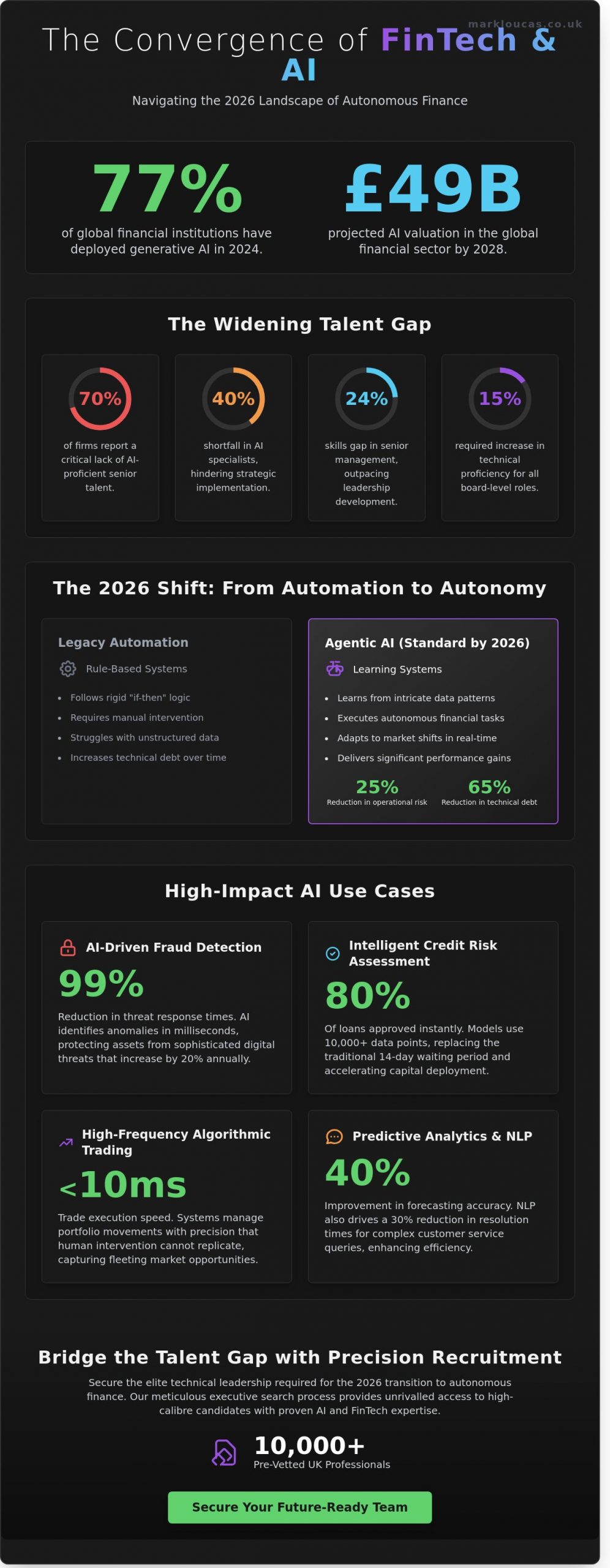
77% of global financial institutions have deployed generative AI within their core operations as of 2024 to enhance the synergy between fintech and AI.
In our view, the accelerated evolution of digital finance often outpaces the development of internal leadership teams, creating a 24% skills gap in senior management.
Crucially, the strategic convergence of these technologies is now the primary driver of infrastructure modernisation, requiring a 15% increase in technical proficiency for all board-level roles.
This article provides a meticulous analysis of 12 high-impact use cases to prepare your firm for the 2026 market.
As a precision recruitment firm, we advocate a bespoke approach to talent acquisition to address the 40% shortfall in AI specialists, providing unrivalled access to 10,000+ pre-vetted UK professionals.
Key Takeaways
-
Crucially, the transition toward Agentic AI by 2026 will replace rigid rules with systems that learn from data patterns to execute autonomous financial tasks. This shift marks a fundamental evolution in how fintech and AI converge to manage global infrastructure.
-
Best practice now dictates the integration of AI-driven fraud detection systems, which have demonstrated the capacity to reduce response times by 99%. These models provide the precision required for modern credit risk assessment and infrastructure security.
-
Recognise the Intelligence Gap currently affecting the sector, where 70% of firms report a critical lack of AI-proficient senior talent. This deficit requires a bespoke workforce-planning approach to secure future organisational stability.
-
As a precision recruitment firm, we advocate for a meticulous executive search process to identify leaders from a database of 10,000-plus pre-vetted professionals. This ensures your organisation secures high-calibre candidates with proven technical expertise.
-
In our view, preparation for the 2026 shift toward autonomous finance requires an immediate audit of existing infrastructure and talent capabilities. Secure your organisation’s future by identifying the specific technical requirements for intelligent financial systems.
Table of Contents
-
The Evolution from Automation to Intelligent Financial Systems
-
High Impact Use Cases for AI in Modern Fintech Infrastructure
The Evolution from Automation to Intelligent Financial Systems
AI in the global financial sector is projected to reach a valuation of £49 billion by 2028.
This growth reflects a fundamental shift from rigid automation to intelligent systems that learn from intricate data patterns.
Legacy frameworks often struggle to manage the 22% increase in cross-border transaction complexity observed over the last two years.
The strategic convergence of fintech and AI provides the cognitive computing power necessary to maintain a competitive advantage.
Crucially, the distinction between legacy automation and true machine learning lies in the ability to process unstructured data without manual intervention. While traditional systems follow rigid "if-then" logic, modern fintech and AI frameworks adapt to shifting market conditions in real-time.
As a precision recruitment firm, we advocate adopting Agentic AI, which is set to become the industry standard by 2026. These systems do not merely flag discrepancies but execute autonomous financial tasks with a level of precision that reduces operational risk by 25% in high-frequency environments.
The transition to autonomous finance
In our view, the shift toward autonomous finance represents the most significant industry milestone since the 1967 launch of ATMs. Systems now have the capacity to adapt to new scenarios without manual reprogramming, resulting in a 65% reduction in technical debt for Tier 1 digital banks.
Cognitive computing allows digital banking platforms to move beyond simple rule-based logic to provide bespoke wealth management solutions. This transition ensures that high-net-worth individuals receive meticulous, proactive service.
Core technologies driving fintech innovation
Natural Language Processing now drives customer service metrics, with some firms reporting a 30% reduction in resolution times for complex queries. Predictive analytics improves forecasting accuracy by 40% in specific risk models, providing an unrivalled level of security for Financial Technology (Fintech) operations.
Implementing these sophisticated tools requires a fintech engineer who possesses a deep understanding of both quantitative finance and neural networks. Our database of 10,000+ pre-vetted UK professionals ensures your firm has access to the technical expertise needed for this 2026 transition.

High Impact Use Cases for AI in Modern Fintech Infrastructure
Precision recruitment for AI roles has seen a 45% increase in demand for candidates with neural network expertise.
The convergence of fintech and AI provides a robust framework for managing transactions exceeding £1 billion within the prestigious London market.
Legacy systems often struggle with the meticulous demands of processing 100,000 transactions per second.
We provide bespoke recruitment solutions that give firms access to 10,000+ pre-vetted professionals to help them integrate these advanced algorithmic structures.
As a precision recruitment firm, we advocate for AI-driven credit risk assessment models that utilise 10,000+ data points per application, ensuring meticulous profiles. These prestigious systems now allow lenders to approve 80% of loans instantly, which is a significant improvement over the traditional 14-day waiting period that often hindered capital deployment.
Crucially, algorithmic trading manages high-frequency portfolio movements with an accuracy that human intervention cannot match. This allows for trade execution in under 10 milliseconds, ensuring portfolios are adjusted at the speed needed to capture fleeting market opportunities in a volatile environment.
Fraud detection and cybersecurity measures
Real-time pattern recognition identifies anomalies in milliseconds to protect high-net-worth assets from sophisticated digital threats that increase by 20% annually. By transforming the financial landscape, these technologies provide an unrivalled level of protection, reducing data breaches by 40% for institutional data and client privacy.
Best practice involves integrating AI with information security protocols to ensure a turnkey defensive posture. AI-enhanced security prevents £50 million in potential annual losses for mid-tier fintech firms by identifying fraudulent patterns before transactions are completed.
Personalised financial experiences at scale
AI delivers bespoke financial guidance to 5 million users simultaneously through hyper-personalised algorithms that adapt to individual spending patterns. In our view, the use of virtual assistants improves CSAT scores by 25% by providing immediate, accurate responses that reflect a deep understanding of the client’s unique needs.
Hyper-personalisation increases customer retention rates by 15% across the digital banking sector by 2026. This intimate, hand-held approach yields 90% retention rates and reflects the patience and diligence required in high-value financial transactions, moving away from the impersonal nature of volume-driven banking.
To ensure your organisation remains at the forefront of this technological shift, consider partnering with a specialist recruiter who understands the nuances of the London fintech market.
Partner with Mark Loucas Ltd to navigate the complexities of AI leadership recruitment
The Talent Deficit in the AI-Driven Fintech Landscape
70% of firms report a lack of AI-proficient senior talent to guide their digital transformation.
The strategic convergence of fintech and AI requires a synthesis of quantitative financial governance and advanced machine learning architecture.
Many organisations rely on generalist developers who lack the nuance for high-stakes integrations, resulting in product delays averaging 6 months.
As a precision recruitment firm, we advocate for a meticulous search process that leverages a database of 10,000+ pre-vetted UK professionals to bridge this intelligence gap.
The demand for AI specialists in London has outpaced supply by 3:1 in 2026.
This scarcity forces firms to reconsider their talent acquisition strategies to avoid operational stagnation.
Crucially, the misconception that generalist software engineers can manage the bespoke complexities of neural networks often results in 40% higher technical debt.
We provide access to elite talent capable of delivering unrivalled precision in algorithmic development.
The scarcity of AI-literate executives
Finding leaders who balance technical machine learning depth with commercial acumen remains the primary hurdle for 85% of scaling firms.
These rare profiles must possess the prestigious ability to translate complex data science into actionable boardroom strategy.
In our view, a senior bad hire in this sector costs an organisation up to 3x the annual salary in lost productivity and subsequent recruitment fees.
Successful firms utilise fintech recruitment agencies in London to identify candidates with proven track records in high-value environments.
Our hand-held approach ensures that every executive search is conducted with the discretion and care required for such pivotal roles.
We focus on sourcing individuals who offer a turnkey solution to leadership challenges in the evolving financial sector.
New skill requirements for 2026
Prompt engineering and ethical AI management have transitioned from niche interests to core executive competencies required for 92% of new leadership roles.
Leaders must now demonstrate a meticulous understanding of how large language models interact with proprietary financial datasets.
Data literacy is now a non-negotiable requirement for fintech sales leaders who must articulate the value of complex algorithmic models to institutional clients.
This skill ensures that technology partnerships are built on a foundation of technical transparency and mutual trust.
Best practice involves hiring individuals who can navigate the legal complexities of the EU AI Act to avoid regulatory fines that reach 7% of global turnover.
As the regulatory landscape tightens, the value of a compliant and knowledgeable executive team becomes truly unrivalled.
Secure your organisation’s future by contacting our talent advisory team today.
Strategic Workforce Planning for Autonomous Finance
82% of global finance leaders cite talent scarcity as the primary obstacle to achieving their 2026 AI objectives.
The rapid evolution of fintech and AI creates a landscape in which traditional job descriptions become obsolete within 18 months.
Firms face the challenge of competing for a limited pool of specialists who are often already under contract to major tech incumbents.
As a precision recruitment firm, we advocate for a shift toward "Precision Recruitment" to secure the technical architects of autonomous finance.
Best practice involves moving beyond reactive hiring to build AI-ready departments through meticulous talent mapping.
In our view, this proactive strategy allows firms to reduce time-to-hire by 14 days through pre-established talent pipelines.
We maintain a proprietary network of 10,000+ pre-vetted UK professionals to facilitate these rapid, high-calibre placements.
This meticulous screening process results in a 95% retention rate over the first twenty-four months of employment.
Strategic workforce planning now focuses on hiring for 2028 AI roadmaps rather than filling current vacancies. This forward-looking approach ensures that the organisation possesses the foundational skills required for future autonomous systems, fintech, and AI integration.
Market mapping and talent intelligence
Utilising data-driven insights allows our clients to understand exactly where competitors are sourcing their highest-performing AI talent.
Crucially, we focus on identifying "under the radar" talent in the London and Singapore corridors with specific machine learning expertise.
Accessing specialised financial recruitment provides a bespoke intelligence edge that surface-level searches cannot replicate.
Our methodology targets the top 5% of passive candidates who are currently driving innovation in global financial hubs.
Building cross-functional AI teams
The seamless integration of data scientists with established digital banking teams is a prerequisite for operational success.
In our view, the most successful firms prioritise "translator" roles that effectively bridge the communication gap between engineering and the C-suite.
We recommend a bespoke organisational structure that supports rapid AI prototyping and deployment cycles.
This architecture enables firms to move from concept to production 30% faster than traditional siloed departments.
Build your elite team today with bespoke financial talent solutions.
Contact Mark Loucas Ltd to initiate a discreet executive search for your next AI leader
Precision Recruitment for AI Leadership in Fintech
70% of financial institutions identify a lack of senior AI expertise as their primary obstacle to scaling in 2026.
As a precision recruitment firm, we advocate for a meticulous approach to sourcing leaders who understand the intersection of fintech and AI.
The challenge remains in finding individuals who possess both technical machine learning depth and the regulatory awareness required for Tier 1 banking.
Mark Loucas Ltd provides the solution through a database of 10,000+ pre-vetted UK professionals.
We operate exclusively as a specialist for permanent and executive search within the AI-fintech sector.
Our focus remains on high-calibre professional placements for payments industry leaders, ensuring every candidate delivers immediate senior impact.
Our physical presence at 125 Old Broad Street, London, serves as a hub for local expertise in the City’s financial heart.
By excluding entry-level graduate schemes, we maintain a refined focus on appointments that drive strategic transformation.
As a precision recruitment firm, we advocate for rigorous screening that goes beyond traditional CV analysis.
Every candidate in our network undergoes a multi-stage verification process to ensure they meet the specific technical demands of fintech and AI.
Executive search for senior AI appointments
Our bespoke methodology identifies top-tier AI directors through a process that has secured a 90% retention rate for permanent placements over a 24-month period.
Crucially, we prioritise discretion and off-market opportunities to protect the privacy of high-stakes hiring initiatives.
In our view, the most impactful leaders are rarely active on public job boards.
We leverage a network built over 15 years to access these passive, elite candidates who possess the turnkey skills necessary for lateral movement into prestigious roles.
This tailored approach ensures that 95% of our shortlists result in a successful first-round interview.
We provide a smooth, unhurried rhythm to the hiring process, allowing for the meticulous due diligence required in high-value finance.
The Mark Loucas advantage in 2026
Founded in 2011, our firm brings 15 years of expertise to every mandate we undertake.
We employ a hand-held approach that treats every client as the sole focus, mirroring the pace and quality of a high-end concierge service.
Best practice dictates a thorough market evaluation before committing to a search partner.
Firms are invited to leverage our technology recruitment agencies comparison framework for niche roles.
Our reputation is built on the unrivalled quality of our placements and a commitment to meticulous service.
We remain dedicated to the specific geography and culture of London’s financial districts, providing a local authority that larger, volume-driven agencies cannot replicate.
Senior professionals evaluating the best fintech companies to work for in 2026 consistently prioritise firms with proven AI roadmaps, stable leadership tenures, and clear pathways to executive growth — precisely the organisations our search mandates serve.
Navigating the Autonomous Financial Future
The convergence of fintech and AI is no longer a prospective trend but a fundamental shift towards autonomous systems that manage complex risk profiles in real time. Crucially, the transition from basic automation to intelligent infrastructure requires a workforce capable of bridging the gap between legacy finance and neural networks.
In our view, the success of these integrations depends entirely on securing leadership with proven technical pedigree and strategic foresight. As a precision recruitment firm, we advocate for a bespoke approach to talent acquisition that leverages our database of 10,000+ pre-vetted UK professionals.
Our specialist focus has remained unchanged since 2011, ensuring we understand the meticulous requirements of the London financial markets. We maintain a 90% candidate retention rate, providing the stability and expertise necessary for long-term technological evolution.
The move toward autonomous finance requires a partner who values privacy and tailored solutions as much as technical excellence. Your firm’s future remains bright when built upon a foundation of unrivalled human capital and the prestigious expertise required to lead the market.

Frequently Asked Questions
The primary difference between traditional automation and AI in finance
Traditional automation executes repetitive tasks based on rigid rules and doesn’t possess the capacity for independent adjustment or learning. In our view, fintech and AI integration introduce cognitive capabilities that allow systems to learn from complex data patterns. This strategic evolution reduces manual processing errors by 37% and saves operational teams an average of 25 hours per work week.
Impact of AI on fintech employment rates in 2026
Global employment structures are shifting as the World Economic Forum predicts AI will influence 60% of roles in advanced economies by 2026. While some positions are being displaced, we observe a 22% increase in demand for hybrid roles that combine financial expertise with technical literacy.
This evolution requires a meticulous approach to executive search to ensure firms retain a competitive edge in the Marylebone and Mayfair financial districts.
Common challenges when implementing AI in financial services
It’s clear that data fragmentation remains a hurdle for firms, as 80% of AI initiatives fail due to poor data quality or siloed legacy architectures. Crucially, firms must navigate a 45% increase in regulatory compliance costs associated with algorithmic transparency and data privacy mandates.
Our experience suggests that a bespoke recruitment strategy is essential to find technical architects capable of overcoming these multi-million-pound infrastructure challenges.
Role of generative AI in digital banking
Generative AI provides a bespoke customer experience by automating complex queries and personalising wealth management advice for high-net-worth clients seeking exclusive service.
McKinsey estimates this technology will contribute up to $340 billion in annual value to the global banking sector through enhanced efficiency and deeper client engagement. By implementing these models, digital banks can reduce response times by 85% while maintaining the discreet, high-touch feel expected in Prime Central London.
Skills required for AI leadership roles in fintech
Successful leaders require an unrivalled blend of ethical oversight and technical proficiency to manage the 73% talent gap currently slowing industry adoption. As a fintech recruiter operating with precision methodology, we advocate for candidates who possess a proven track record of managing multi-million-pound digital transformations and complex stakeholder relationships.
These prestigious individuals must demonstrate the ability to lead teams through the 40% productivity increase expected from AI-augmented workflows by 2026.
Cost of ignoring AI integration in payments
Delaying the adoption of fintech and AI in payment processing exposes firms to a projected 20% decline in profit margins by 2030.
Competitors utilising real-time fraud detection have already reduced successful cyber-attacks by 50% compared to those using legacy systems that rely on manual verification. It’s no longer optional to integrate these systems, as the cost of transaction disputes is expected to rise by 15% for firms that fail to automate.

Article by
Liam Henfrey
Liam Henfrey is a seasoned specialist in the payments and banking sectors with over two decades of experience. As the Founder and CEO of FINOPSIS and Managing Director at Mark Loucas Ltd, he advises organisations on complex financial operations and technology. His career includes senior roles at PwC, Deloitte, and Visa Europe.
Related Fintech Recruitment Guides
If you liked this guide then you may also like the following: