


Confidential Recruitment for Senior Roles in Modern Financial Services
How do financial institutions execute business-critical leadership transitions without alerting competitors, unsettling key stakeholders, or sparking unwanted market speculation? If you have ever guided an organisation through a sensitive handover, you know that an open job posting often risks destabilising internal team morale and exposing commercially delicate strategic pivots before they take shape. Public visibility creates an unnecessary vulnerability when navigating high-stakes appointments. Conducting confidential recruitment for senior roles offers an essential alternative, allowing modern financial institutions to safeguard institutional equity whilst quietly identifying transformative leaders who operate entirely beyond public channels.
You will discover how discreet executive search safeguards institutional value whilst securing transformative senior leadership who would never risk their current standing by applying publicly. We examine the tailored search protocols, robust non-disclosure frameworks, and calibrated market mapping methods that allow regulated institutions across London, Dubai, and international hubs to maintain uninterrupted operational continuity, protect enterprise reputation, and secure elite executive talent.
Key Takeaways
- Explore how conducting confidential recruitment for senior roles protects institutional equity, prevents competitor talent raids, and maintains internal team stability.
- Understand the multi-stage protocols, blind candidate profiling, and non-disclosure frameworks that guarantee client anonymity until mutual alignment is established.
- Compare the distinct commercial risks of open hiring campaigns against the privacy, control, and precision delivered by retained executive search.
- Learn how to balance discreet headhunting with statutory regulatory obligations across key financial jurisdictions, including the DIFC and international financial hubs.
- Identify the core criteria for selecting a boutique executive search partner equipped with deep market mapping capability and refined industry discretion.
Organisations planning high-stakes leadership transitions across the financial technology sector can contact our executive advisory team to discuss tailored talent strategies.
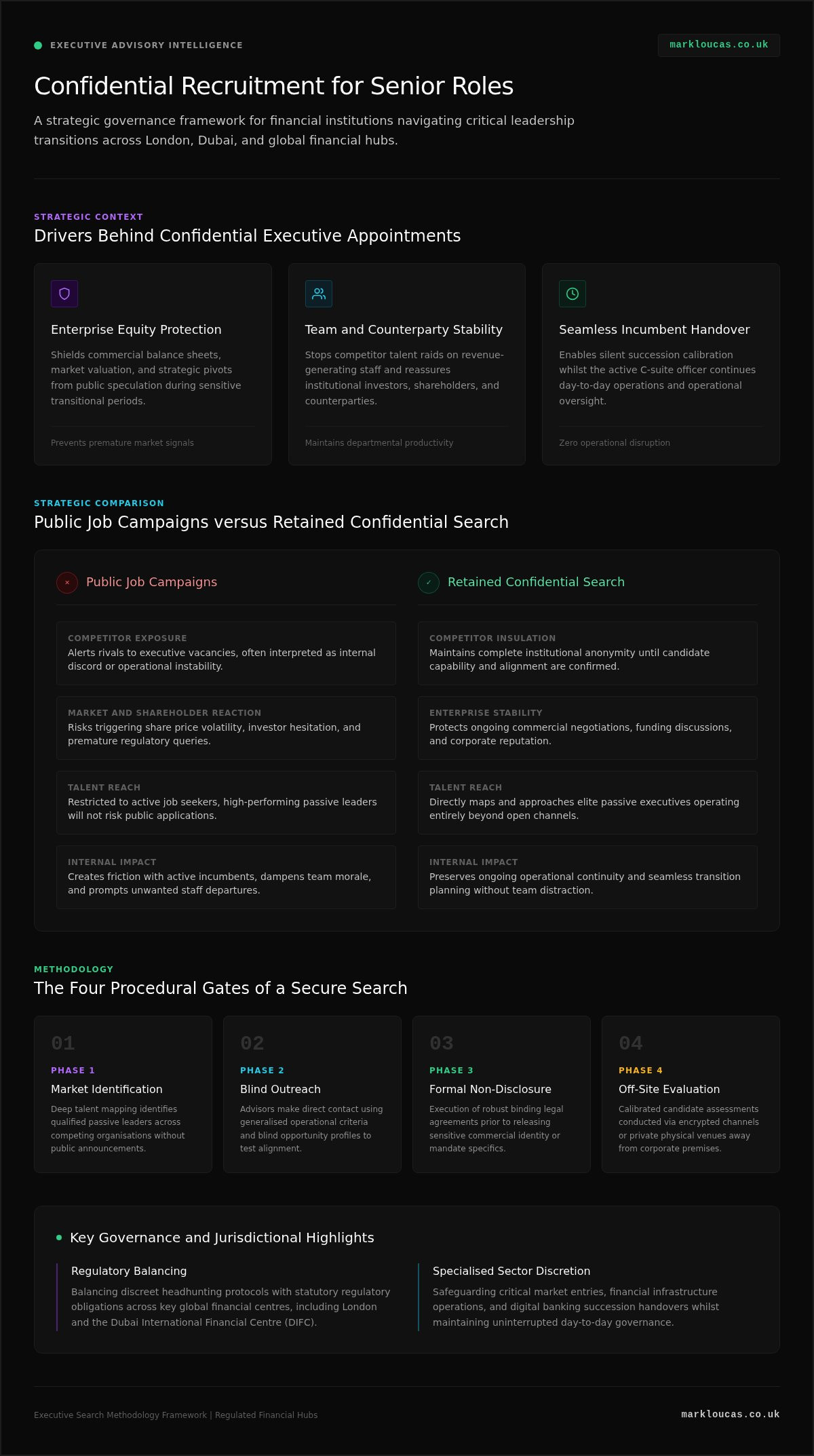
Strategic Drivers Behind Confidential Recruitment for Senior Roles
Operating within modern financial hubs such as the Dubai International Financial Centre (DIFC) or the City of London requires exceptional discretion. When a board decides to adjust its executive committee, public exposure introduces acute operational vulnerabilities. Choosing confidential recruitment for senior roles is rarely just about privacy. It is an intentional governance strategy designed to insulate business equity, reassure market counterparties, and preserve commercial focus while mission-critical changes occur.
Publicly advertising an executive vacancy alerts competitors immediately. Rival institutions frequently interpret an open executive advert as a sign of internal discord, seizing the opening to poach revenue-generating teams or solicit vulnerable enterprise clients. Beyond competitor opportunism, open job postings often unsettle institutional shareholders, triggering unwanted volatility in share prices and destabilising live funding discussions.
Protecting Enterprise Value and Investor Confidence
Public knowledge of leadership changes can disrupt delicate commercial negotiations. When a payments firm plans market entry into the UAE or prepares for a strategic restructuring, announcing an open leadership search signals operational gaps prematurely. Investors require continuity. By engaging a trusted partner for retained executive search, boards manage candidate outreach quietly under strict non-disclosure terms, shielding corporate balance sheets and preserving brand stability.
Uncontrolled market rumours can also prompt early inquiries from regulatory authorities before internal handover strategies are fully formulated. A discreet appointment protects critical commercial initiatives, ensuring that institutional accounts and capital commitments remain secure throughout the entire vetting period.
Managing Incumbent Transitions and Internal Sensitivities
The diplomatic challenge peaks when boards must replace an active C-suite officer before they depart. Announcing a vacancy publicly creates friction, dampens departmental productivity, and prompts key team members to consider external moves. Confidential recruitment for senior roles enables a board to calibrate succession quietly while the current executive continues delivering day-to-day results.
Specialised sectors like financial infrastructure require seamless governance during leadership handovers. When executing succession plans for technology leaders across digital banking recruitment initiatives, discretion ensures the outgoing executive maintains operational oversight until a suitable successor is secured, fully vetted, and ready to assume the mandate.
To implement an impenetrable search methodology for your board, connect with our senior recruitment partners to review bespoke headhunting frameworks.
The Anatomy of a Secure Executive Search Process
Executing confidential recruitment for senior roles requires a structured operational framework that prioritises absolute security at every stage. Elite candidates rarely engage with generic invitations. To capture the attention of high-performing leaders, search advisors deploy a phased architecture that protects client anonymity whilst rigorously testing functional capability.
This process moves methodically through distinct procedural gates:
- Phase 1: Market Identification. Deep talent mapping identifies qualified passive leaders across competing firms.
- Phase 2: Blind Outreach. Advisors make direct contact using generalised operational criteria.
- Phase 3: Formal Non-Disclosure. Execution of binding legal agreements prior to releasing sensitive commercial information.
- Phase 4: Off-Site Evaluation. Calibrated assessments conducted via encrypted channels or private physical venues.
Blind Talent Profiling and Initial Approach
Initial engagements rely on meticulously drafted blind opportunity profiles. These documents articulate enterprise scale, governance challenges, and remit complexity without divulging proprietary names, product lines, or exact geographic headquarters. When approaching candidates for specialised mandates, such as payments industry recruitment programmes, advisors gauge interest based entirely on technical remit, mandate scope, and compensation benchmarks.
Advisors evaluate career track records without revealing why the transition has arisen. This insulated barrier ensures competitors remain oblivious to your search activities.
Graduated Disclosure and Binding Legal Safeguards
True confidentiality hinges on graduated disclosure. An organisation’s identity remains completely concealed until a candidate has passed functional screening and executed a bespoke Non-Disclosure Agreement (NDA). In jurisdictions like the UAE, these agreements include strict clauses covering DIFC data privacy requirements and trade secret protections.
Once legal safeguards are executed, interviews take place outside corporate offices. Advisors arrange neutral suites within private clubs or deploy secure, single-use video links with restricted access permissions. Boards testing functional expertise in technical infrastructure can evaluate candidates through anonymised case scenarios, ensuring trade secrets remain protected.
Organisations looking to refine their talent strategies can reach out to our boutique advisory practice for guidance on confidential executive mapping.
To protect your organisation from unwanted exposure during critical appointments, speak with our executive recruitment specialists to discuss a confidential search strategy.
Public Job Campaigns versus Retained Confidential Executive Search
Public job portals serve an operational purpose for broad hiring, but they present significant risks for senior governance positions. Advertising an executive vacancy openly exposes institutional strategy whilst restricting the candidate pool almost entirely to active job seekers. In contrast, confidential recruitment for senior roles via an exclusive retained mandate delivers discretion, precise targeting, and absolute narrative control.
Evaluating these two models highlights distinct strategic differences:
- Candidate Reach. Public adverts capture individuals currently seeking an exit, whereas retained headhunting maps and engages proven market leaders who aren’t looking at job boards.
- Commercial Security. Open listings reveal internal changes to competitors, while confidential search keeps sensitive restructuring completely private.
- Reputational Control. An open advert lingering for months signals hiring difficulties, whereas discreet appointments protect corporate prestige until contracts are finalised.
Talent Quality and the Passive Candidate Reality
Tier-one leaders rarely monitor open employment platforms. The executives capable of guiding modern institutions through shifting regulatory pressures and technological changes are already delivering strong outcomes elsewhere. Confidential recruitment for senior roles creates an environment where these passive figures can engage safely. It protects their standing, allowing them to explore conversations without risking their deferred compensation, commercial standing, or current board trust.
Brand Reputation and Strategic Advantage
A prolonged public executive vacancy signals vulnerability to both competitors and clients. When market participants observe an open leadership seat, doubts arise regarding the firm’s strategic focus and operational stability. By partnering with specialised financial recruitment experts, institutions ensure their leadership transitions happen smoothly out of view. Rather than inviting external speculation, the firm manages every transition on its own terms, presenting a steady and confident profile to the market.
For expert advice on balancing multi-jurisdictional compliance with private executive search, contact the specialist team at Mark Loucas Ltd to plan your cross-border appointment.
Navigating Confidential Hiring Across Regulated Global Jurisdictions
Executing confidential recruitment for senior roles becomes significantly more complex when managing operations across multiple regulatory environments. Financial institutions based in the UAE, London, or Singapore must balance complete commercial privacy with strict statutory compliance obligations. Search mandates cannot compromise governance rules simply to stay quiet.
Managing discreet hiring across borders demands careful coordination across several regulatory considerations:
- Pre-Notification Timelines. Knowing exactly when statutory authorities must be notified of a pending key appointment.
- Mandatory Conduct Checks. Completing thorough lookback evaluations without revealing the hiring institution’s identity prematurely.
- Cross-Border Data Protocols. Ensuring candidate vetting complies with the DIFC Data Protection Law, UK GDPR, and European regulations.
Regulatory Alignment and Senior Function Authorisations
Regulators hold boards accountable for the probity of their key leadership. Mandates requiring fitness and propriety assessments need careful structuring so due diligence occurs smoothly under non-disclosure terms. Background checks, disciplinary history evaluations, and compliance audits must be built directly into the early vetting stages.
When seeking critical governance figures, finding the right interview questions for a compliance expert helps search partners verify regulatory capability before the institution submits formal applications to bodies such as the Dubai Financial Services Authority or the Financial Conduct Authority.
Cross-Border Discretion in Major Financial Centres
Different financial centres present distinct privacy dynamics. In the Dubai International Financial Centre, the close-knit nature of the financial community means executive movements rarely stay hidden without deliberate protections. Sourcing talent from London or Singapore for senior positions in the UAE requires structured handling of international relocations, deferred compensation buyout structures, and local residency onboarding.
Boutique advisory practices maintain confidential talent pools across Europe, Asia, and the Middle East, allowing institutions to conduct cross-border appointments smoothly. Using confidential recruitment for senior roles across international markets ensures hiring institutions stay ahead of regulatory demands whilst protecting their commercial interests.
If your institution is preparing to appoint executive leaders across regulated jurisdictions, arrange a consultation with our advisory team to discuss compliant, confidential search options.
When you are ready to evaluate specialist advisory partners for sensitive leadership mandates, speak with our senior team at Mark Loucas to arrange a private discussion.
Selecting the Right Partner for Discreet Executive Appointments
Selecting an executive search partner for confidential recruitment for senior roles requires evaluating operational security, technical fluency, and relationship depth. Large, volume-driven corporate agencies frequently handle executive mandates as routine transactions, passing sensitive briefs across junior research teams. In high-stakes transitions, this broad exposure significantly increases the risk of market leaks. A boutique advisory model provides tight governance, ensuring experienced partners manage every candidate dialogue and legal disclosure personally.
Essential Criteria for Assessing Executive Search Partners
When vetting prospective executive search partners, boards should examine practical capabilities rather than accepting generic claims of confidentiality:
- Direct Network Access. Look for established, long-standing relationships with high-performing passive executives who don’t engage with corporate recruiters.
- Technical Fluency. Ensure the advisor understands core payments architecture, digital ledger systems, and regulatory capital requirements.
- Data Governance. Confirm the firm uses strict information firewalls, encrypted communication channels, and enforceable non-disclosure frameworks.
- Dedicated Senior Attention. Verify that the seasoned partner taking the brief is the exact individual conducting candidate outreach.
Mark Loucas Ltd brings dedicated boutique advisory to confidential recruitment for senior roles across financial centres including London, Dubai, and Singapore. Founded in 2011, the firm uses proprietary market mapping rather than public advertisements, helping boards secure transformative talent across fintech banking technology ecosystems whilst maintaining absolute institutional privacy.
Initiating a Confidential Search Mandate
A successful confidential search begins with a discreet briefing session between board members and lead advisors. This dialogue defines strict communication boundaries, agrees targeted competitor protocols, and refines the blind opportunity brief before reaching out to prospective talent. Codifying these boundaries at inception ensures your commercial strategy stays protected while advisors engage premier candidates across the international market.
To protect your institutional equity and execute discreet appointments, discuss your confidential senior hiring mandate with Mark Loucas Ltd today.
Safeguarding Institutional Equity Through Discreet Leadership Appointments
Leadership transitions in regulated financial centres require absolute composure. Protecting sensitive commercial strategies, keeping internal teams focused, and meeting multi-jurisdictional compliance standards all depend on maintaining strict privacy. Implementing confidential recruitment for senior roles shields your organisation from unhelpful market speculation whilst directly engaging proven, passive executives who don’t explore public job boards.
Established in 2011, Mark Loucas Ltd operates as a trusted boutique advisor managing discreet appointments across London and the UAE. With specialist sector intelligence spanning payments infrastructure, digital banking, and compliance, our team delivers the refined governance and market reach your board expects. When you’re ready to secure transformative leadership with complete peace of mind, connect with our executive search team to begin your private consultation.
Frequently Asked Questions
Why is confidential recruitment necessary for senior roles?
Confidential recruitment for senior roles protects an organisation from market destabilisation, competitor speculation, and internal employee unrest during pivotal leadership changes. Announcing a chief executive departure prematurely can disrupt shareholder confidence and weaken commercial partnerships across critical markets like Dubai. Discretion safeguards sensitive strategic shifts, including market entries or restructuring plans. It lets boards assess exceptional passive talent quietly, ensuring business continuity remains uninterrupted throughout the entire succession cycle.

Article by
Liam Henfrey
Liam Henfrey is a seasoned specialist in the payments and banking sectors with over two decades of experience. As the Founder and CEO of FINOPSIS and Managing Director at Mark Loucas Ltd, he advises organisations on complex financial operations and technology. His career includes senior roles at PwC, Deloitte, and Visa Europe.
Related Fintech Recruitment Guides
If you liked this guide then you may also like the following: