


Merchant acquiring recruitment and how to hire the right payments talent
The most familiar job title may point you towards the wrong candidate. In merchant acquiring recruitment, a commercial lead, operations specialist and payments technology expert may all work in acquiring, but each brings different skills and responsibilities.
That distinction matters when a hiring brief spans merchant relationships, payment operations, risk or technical delivery. A broad job title can conceal the specialist experience your business needs, so start by defining the work rather than choosing a title first.
This guide sets out a practical way to shape a role around business needs, identify relevant expertise and compare recruitment approaches. It also explains when specialist payments recruitment, market mapping or talent advisory may help clarify a search. The aim is a focused hiring conversation and a considered appointment based on what the role must deliver.
Key Takeaways
- Start with the business outcome the hire must support, then define the responsibilities and expertise needed to achieve it.
- Set merchant acquiring recruitment criteria around the role’s actual remit, rather than relying on a job title alone.
- Compare internal hiring, direct advertising and specialist recruitment using consistent criteria, including market understanding and search method.
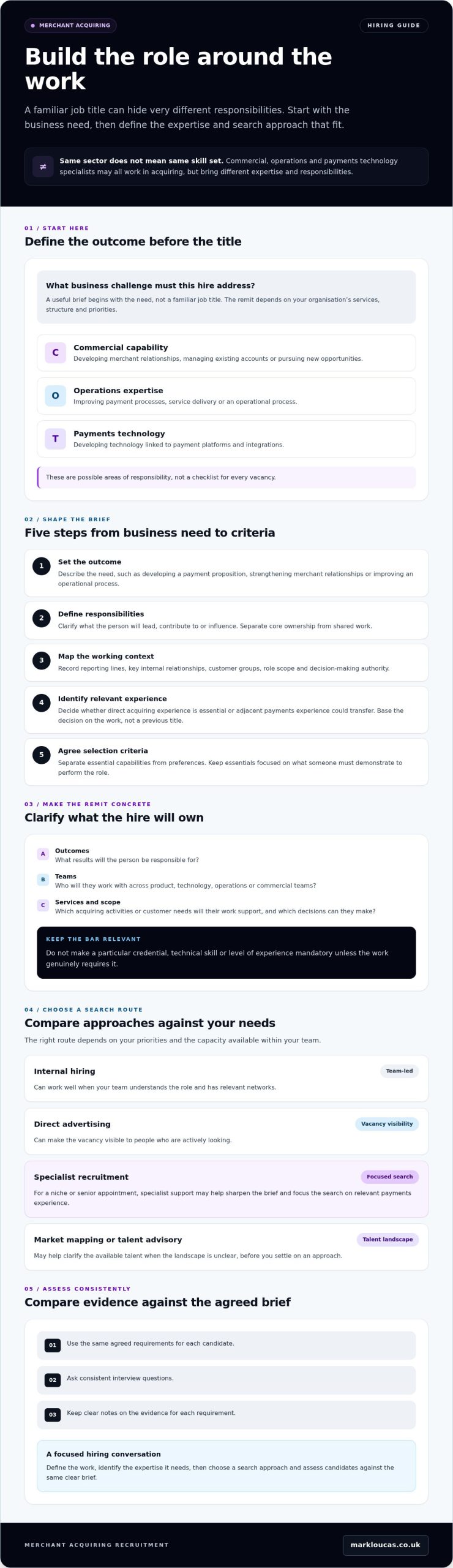
- Assess candidates against agreed requirements with consistent interview questions and clear notes on the evidence.
- Consider market mapping or talent advisory if you need a clearer view of the available talent before choosing how to proceed.
For a considered discussion about a payments or fintech hire in the UAE, you can contact Mark Loucas Ltd.
What merchant acquiring recruitment needs to solve for employers
Merchant acquiring recruitment is the process of identifying and appointing people whose expertise meets an employer’s needs in merchant payments. A useful brief begins with the business challenge, not a familiar job title. An employer seeking to develop merchant relationships may need commercial capability, while another improving payment operations or developing technology may need a different profile.
An acquiring bank plays a role in processing card payments for merchants and managing associated risks. The Acquiring bank overview provides a neutral introduction to this function. In practice, employers’ services and internal structures vary, so responsibilities attached to acquiring roles can vary too.
This guide is for employers shaping a hire, rather than job seekers looking for vacancies. Its focus is how to define the work, identify the expertise to seek and choose an appropriate search approach.
What merchant acquiring expertise can cover
Depending on the organisation’s priorities, the remit may include merchant acquisition or account development, payment processes and service delivery, payment propositions, or technology linked to platforms and integrations. These are possible areas of responsibility, not a checklist for every vacancy.
To make the remit concrete, specify the outcomes the hire will own, the teams they will work with and the services their work supports. For example, if the role is expected to develop merchant relationships, clarify whether it will manage existing accounts, pursue new opportunities or contribute to both. Avoid making a particular credential, technical skill or level of experience mandatory unless the work genuinely requires it.
When a specialist search may make sense
Internal hiring can work well when your team understands the role and has relevant networks. Direct advertising can make the vacancy visible to people actively looking. For a niche or senior appointment, specialist support may help sharpen the brief and focus the search on relevant payments experience. The right route depends on your priorities and the capacity available within your team.
If the talent landscape is unclear, market mapping or talent advisory can help inform the search before you settle on an approach. Mark Loucas Ltd provides payments industry recruitment as part of its payments and fintech specialisms. First define the role and required expertise, then consider whether specialist input would help you reach or assess relevant candidates.
For a focused discussion about defining a payments hire, speak with a specialist recruitment adviser.
How to define the right merchant acquiring role and capability profile
A strong hiring brief starts with the contribution the person must make, then sets out the experience and skills needed to deliver it. This keeps merchant acquiring recruitment tied to your organisation’s priorities instead of relying on a generic job description.
Turn the business need into a clear brief
Before settling on a title, agree what the role will own, who it will report to and how it will work with other teams. Consider which acquiring activities or customer needs the hire will support. The right remit depends on your services, structure and plans, not assumptions about a particular operating model.
Use this sequence to turn the business need into selection criteria:
- Set the outcome. Describe the business need the hire will address, such as developing a payment proposition, strengthening merchant relationships or improving an operational process.
- Define responsibilities. Clarify what the person will lead, contribute to or influence. Separate core ownership from work shared with product, technology, operations or commercial teams.
- Map the working context. Record reporting lines, key internal relationships, customer groups and the role’s scope. Be clear about which decisions the person can make.
- Identify relevant experience. Decide whether direct acquiring experience is essential or whether experience in an adjacent payments role could transfer. Base that decision on the work, not the candidate’s previous title.
- Agree selection criteria. Divide requirements into essential capabilities and preferences. Keep the essential list focused on what someone must demonstrate to perform the role.
For wider context, Spencer Stuart’s discussion of talent trends shaping the payments industry can help hiring teams consider how talent needs relate to business direction. Use such insight to inform the brief, not to add requirements the vacancy does not need.
Set criteria that reveal relevant expertise
Translate each essential requirement into evidence you can explore consistently. Ask candidates to describe relevant work, the decisions they made and how they collaborated with others. A role focused on merchant relationships, for instance, may call for evidence of managing commercial discussions. A product or technology remit may require examples of delivery with relevant teams.
Distinguish direct acquiring experience from adjacent payments experience, then decide where each is acceptable. If the role crosses functions or the talent landscape is unclear, a specialist financial recruitment perspective may help you explore relevant backgrounds. Keep the final criteria specific, observable and linked to the responsibilities agreed in the brief.
Once the brief and criteria are clear, you can discuss a focused recruitment approach with a specialist partner.
If you are weighing up hiring routes for a payments role, you can discuss your recruitment needs with a specialist.
How to compare merchant acquiring recruitment approaches
There is no single route that suits every vacancy. Internal hiring, direct advertising and specialist recruitment each have different strengths. Compare them against the role you have defined, the time and expertise your team can commit, and the candidate market you need to reach.
A simple comparison can keep the decision grounded. Assess each option against the same four points:
- Market understanding. Internal teams know the organisation, but consider whether they also understand the relevant acquiring and payments backgrounds. Ask a recruiter to explain their sector knowledge with clear examples.
- Search method. Consider whether the route relies on internal networks, responses to an advert or a more targeted search. Match the method to how clearly you can identify suitable candidates.
- Communication. Agree how progress, feedback and changes to the brief will be shared, and who will manage those conversations.
- Assessment approach. Check how candidates will be considered against the agreed criteria. Your team should have a consistent basis for comparing evidence, whichever route you choose.
Internal hiring can be effective when the team has relevant networks and capacity to manage the search. Advertising can make a role visible to active job seekers, though it depends on a clear brief and a suitable audience. Specialist support may be useful for a niche or senior appointment, particularly if the organisation needs a clearer view of the talent landscape.
Questions to ask a potential recruitment partner
A recruiter should offer more than a stream of applications. Ask how they would clarify the remit, which candidate backgrounds they would explore and why. Find out how they will share progress, gather feedback and respond if your priorities change. Request evidence of their payments and fintech specialism, such as the types of roles they understand, rather than relying on a broad claim.
Agree at the outset what useful progress looks like. It could include a clearer candidate profile, relevant market insight or candidates whose experience can be assessed against your criteria. Market mapping and talent advisory may help when the available talent or transferable backgrounds are not yet clear.
When adjacent payments expertise is relevant
Some roles span connected functions, so a candidate’s experience may be relevant even if their previous title was not specifically in acquiring. For a role focused on payment platforms and delivery, for example, DevOps recruitment for payments may be a useful adjacent area to consider. Judge each background against the responsibilities, not the label. A specialist partner should be able to explain both the fit and its limits.
If you are refining how to assess payments candidates, discuss your hiring requirements with a specialist.
How to assess candidates for merchant acquiring roles
A considered assessment compares each candidate with the same agreed role criteria. In merchant acquiring recruitment, this matters because similar job titles can conceal different responsibilities. Look for clear evidence of what a candidate personally delivered, how they made decisions and how their experience relates to the vacancy.
Explore experience without relying on job titles
Ask candidates to explain the work behind their previous titles. Questions should invite specific examples, not rehearsed descriptions of a team’s overall achievements. You might ask:
- Which acquiring or payments responsibilities did you personally own?
- What was the business or customer need, and what part did you play in addressing it?
- How did you weigh competing priorities or stakeholder needs?
- What changed during the work, and how did you respond?
Probe gently when an answer is broad. Ask what the candidate decided, what they contributed and what they would do differently. Someone with experience in a neighbouring payments function may still demonstrate relevant judgement or collaboration. Assess that evidence against the remit rather than treating a different job title as either an automatic match or a reason to rule them out.
Keep the hiring process focused and fair
Before interviews begin, agree who will meet candidates, what each stage will assess and who is responsible for gathering feedback. Give every candidate a clear explanation of the role, the people they will meet and the type of discussion involved. A consistent structure supports a more considered comparison.
Use a simple scoring record linked to the essential criteria in the brief. For each area, note the evidence heard, anything that needs clarification and the reason for the assessment. Separate demonstrated capability from preference or personal impression. If interviewers disagree, return to the examples and criteria rather than relying on instinct alone.
A scenario discussion can help when it reflects a real part of the vacancy. For a role responsible for resolving a payment operations issue, ask how the candidate would establish the facts, involve relevant colleagues and weigh possible responses. Keep the scenario proportionate to the actual remit, and assess the reasoning rather than expecting one fixed answer.
No interview question or assessment method can guarantee a successful appointment. A structured process instead helps the hiring team make its reasoning visible, compare relevant evidence and identify areas to explore further before reaching a decision.
For support with a focused payments search, start a conversation about your hiring needs.
If you are considering support with a payments hire, you can share your recruitment brief with Mark Loucas Ltd.
Choosing a merchant acquiring recruitment partner and taking the next step
The right route follows from the work you need done, the capability already within your team and the candidate market you need to reach. Merchant acquiring recruitment is not a choice between one universally best method and the rest. It is about choosing an approach that fits this vacancy.
An internal search can suit a team with relevant networks and enough capacity to manage outreach, interviews and follow-up. Direct advertising can reach people actively looking, particularly when the remit and criteria are clear. Specialist support may be worth considering for a niche or senior appointment, or when the team needs a clearer view of relevant backgrounds. Ask a potential partner how they will add value beyond passing on applications and keep the search aligned with your agreed criteria.
Match the recruitment model to the hiring need
First decide whether the need is for a permanent appointment, a senior leader or temporary support. These are different hiring requirements. Mark Loucas Ltd offers permanent fintech recruitment, executive search, and contract and interim solutions for fintech providers. Its market mapping and talent advisory services may also inform a search when an employer needs a clearer view of the talent landscape before settling on a route.
If your acquiring remit overlaps with digital banking, such as a role supporting connected banking and payment services, digital banking recruitment may be relevant alongside payments expertise. Keep the appointment type and required experience tied to the responsibilities, rather than selecting a service by title alone.
Prepare for a focused recruitment conversation
A concise brief gives a potential partner a useful starting point. Share:
- The role’s purpose, main responsibilities and reporting relationships
- Essential criteria, alongside skills or experience that are preferences
- The location and any practical requirements for the appointment
- Who will make decisions and how candidate feedback will be agreed
- What success in the role should look like, and what useful search updates mean to your team
Be open about what is settled and what still needs discussion. A specialist adviser can then understand the hiring need and explore whether permanent recruitment, executive search, interim support or market mapping is the most suitable starting point. The decision remains yours, informed by the brief and the evidence you need.
To discuss your requirements and consider a suitable next step, get in touch with Mark Loucas Ltd.
To discuss your hiring priorities, speak with Mark Loucas Ltd.
Move towards a confident payments hire
Effective merchant acquiring recruitment starts with a clear account of what the business needs the hire to deliver. Define the role around its responsibilities, separate essential capabilities from preferences, then assess candidates consistently against evidence rather than job titles alone.
The right hiring route depends on the vacancy and the expertise available within your team. Internal search and direct advertising may suit some roles, while specialist support can be considered for niche or senior appointments, or when you need a clearer view of the talent landscape.
Mark Loucas Ltd is an independent specialist consultancy founded in 2011, focused on recruitment and advisory services across fintech, payments and digital banking. If you have established the role and want to discuss a considered next step, discuss your merchant acquiring hiring needs with Mark Loucas Ltd.
A focused brief is a strong starting point. Clear priorities and a thoughtful assessment process can help you make a well-founded appointment.
Frequently Asked Questions
What does merchant acquiring recruitment involve?
Merchant acquiring recruitment helps employers identify and appoint people whose experience fits their acquiring related business needs. A role might focus on commercial relationships, operations, product or technology, depending on the organisation and vacancy. A sound search starts with the responsibilities and outcomes, then sets criteria for relevant experience. This keeps the process focused on what the candidate can contribute, rather than relying on a job title alone.
Which skills should employers look for in merchant acquiring candidates?
Look for skills that match the role’s actual responsibilities. A commercial position may call for relationship building, negotiation and clear communication, while an operational role may need sound judgement, analysis and the ability to work across teams. Product or technology vacancies may require experience relevant to the services being developed or delivered. Treat these as possible capabilities, not a universal checklist, and distinguish essential requirements from preferences.
How can I assess a merchant acquiring candidate’s experience?
Ask candidates to describe their own contribution to relevant work, the decisions they made and how they handled competing needs or changing priorities. Use consistent questions tied to the agreed role criteria, then record the evidence and any points that need clarification. Consider adjacent payments experience where it could transfer to the remit. Compare demonstrated responsibilities and outcomes, rather than assuming matching job titles mean matching expertise.
Should I use a specialist recruiter for merchant acquiring roles?
A specialist recruiter may be useful when the role is niche or senior, or when your team needs a clearer view of relevant talent. Internal hiring can suit organisations with sector knowledge, useful networks and time to manage the search. Direct advertising can reach people actively looking for a role. Compare each option against the vacancy, your team’s capacity and the recruiter’s evidence of relevant payments and fintech knowledge.
What should I ask a merchant acquiring recruitment agency?
Ask how the agency would clarify the remit and identify candidate backgrounds that fit your criteria. Explore how it would communicate progress, gather feedback and respond if the brief changes. Request clear evidence of its payments and fintech specialism, rather than relying on general claims. Agree what information you will receive and how candidates will be considered against the role. These questions help you judge whether the proposed approach suits your hiring need.
Can a payments recruiter help with adjacent fintech roles?
Potentially, if the adjacent role fits the recruiter’s stated specialisms and the candidate experience required. Payments work can sit alongside fintech and digital banking responsibilities, but related titles do not automatically mean the same expertise. Explain the remit and ask how relevant backgrounds would be identified. Mark Loucas Ltd’s stated focus includes payments, fintech and digital banking recruitment, with market mapping and talent advisory also available.
How do I write a clear merchant acquiring job brief?
Start with the business need and the outcomes the hire should support. Set out the role’s responsibilities, reporting relationships, scope and key working relationships. Then list essential capabilities separately from preferences, and clarify whether direct acquiring experience is required or adjacent payments experience may be suitable. Include the UAE location and explain who will make the hiring decision. A focused brief gives candidates and recruiters a clearer basis for discussion.

Article by
Liam Henfrey
Liam Henfrey is a seasoned specialist in the payments and banking sectors with over two decades of experience. As the Founder and CEO of FINOPSIS and Managing Director at Mark Loucas Ltd, he advises organisations on complex financial operations and technology. His career includes senior roles at PwC, Deloitte, and Visa Europe.
Related Fintech Recruitment Guides
If you liked this guide then you may also like the following: