


How to hire your first chief technology officer for your fintech firm in 2026
The most technically gifted developer in your network might be the very person who stalls your firm’s growth. In a 2026 landscape defined by agentic AI and the stringent requirements of Executive Order 14405, the ability to write elegant code is secondary to the capacity for strategic leadership. You likely recognise the immense pressure of this decision, as a single misstep in executive recruitment can derail your technical roadmap and alienate your investors. It’s a high-stakes endeavour that requires a level of precision often missing from standard recruitment processes.
Finding the right balance between a hands-on architect and a boardroom-ready strategist is a delicate task, particularly when competing for elite talent against the vast resources of global digital banks. This article details exactly how to hire your first chief technology officer by providing a curated framework for identification and evaluation. We will examine the essential archetypes of technology leadership and offer a precise roadmap to secure a partner who possesses the quiet confidence to scale your payments infrastructure whilst maintaining rigorous regulatory standards. You will gain the clarity needed to distinguish between a builder and a visionary, ensuring your first major appointment is one of enduring distinction.
Key Takeaways
- Recognise the CTO as the essential connective tissue between your commercial objectives and technical execution to ensure seamless organisational growth.
- Distinguish between the outward facing strategy of a CTO and the internal focus of a VP of Engineering to avoid a common and costly hiring error.
- Understand how to hire your first chief technology officer with the domain expertise required to master 2026 regulatory standards and payments infrastructure.
- Utilise a sophisticated search and interview framework that combines market mapping with multidisciplinary evaluation to identify world class leaders.
- Master the nuances of crafting competitive executive offers and bespoke onboarding plans that secure the commitment of the industry’s most sought after talent.
For organisations seeking bespoke guidance on executive leadership and technical strategy, we invite you to contact us for a confidential consultation.
Understanding the impact of your first chief technology officer hire
The appointment of a Chief Technology Officer represents a defining moment in the life cycle of a fintech firm. This leader acts as the essential connective tissue between your commercial aspirations and the technical execution required to achieve them. They don’t merely oversee a team of engineers; they translate the board’s vision into a resilient, scalable architectural roadmap. In a 2026 market where fintech app usage has surged to 78% of consumers, the technical foundation must be impeccable. A strategic CTO ensures that every line of code serves a business purpose, transforming technology from a cost centre into a primary driver of value.
Transitioning from a founder led technical roadmap to an executive led strategy is a significant shift that demands a high degree of professional maturity. Founders often possess the initial vision, yet they may lack the specific expertise required to navigate the complexities of Executive Order 14405 or the rapid growth of real-time payment networks. A world class technology leader builds immense investor confidence during funding rounds by demonstrating a mastery of these regulatory and infrastructure challenges. They provide the quiet confidence that your firm’s technical assets are managed with meticulous care and foresight, ensuring the organisation is prepared for the scrutiny of institutional backers.
When is the right time to appoint a technology leader
Recognising the ceiling of founder led management is vital for sustained growth. You’ve reached this point when your technical team is consistently prioritising short term fixes over long term architectural integrity. If your current payments or banking infrastructure is struggling to handle the 28% increase in transaction volumes seen across modern networks, it’s time to consider how to hire your first chief technology officer. This hire is necessary when the complexity of your product requires a dedicated executive eye to manage technical debt and plan for a future that includes agentic AI and tokenised assets.
The long term value of a strategic technology hire
An elite CTO serves as a powerful magnet for high calibre engineering talent. In an environment where digital banks compete fiercely for the same limited pool of experts, the presence of a respected leader is often the deciding factor for candidates. Beyond recruitment, this individual drives innovation by identifying emerging opportunities in stablecoins and settlement infrastructure before they become mainstream. By building a technical foundation that supports future market expansion, they ensure your firm remains agile and competitive. Engaging with fintech banking technology recruiters can help you identify a leader who possesses the rare combination of technical brilliance and commercial acumen needed to secure your firm’s long term distinction.
If you require a tailored approach to identifying the right technical leader for your specific growth stage, you may reach out to our executive search team for a private discussion.
Distinguishing between a chief technology officer and a vice president of engineering
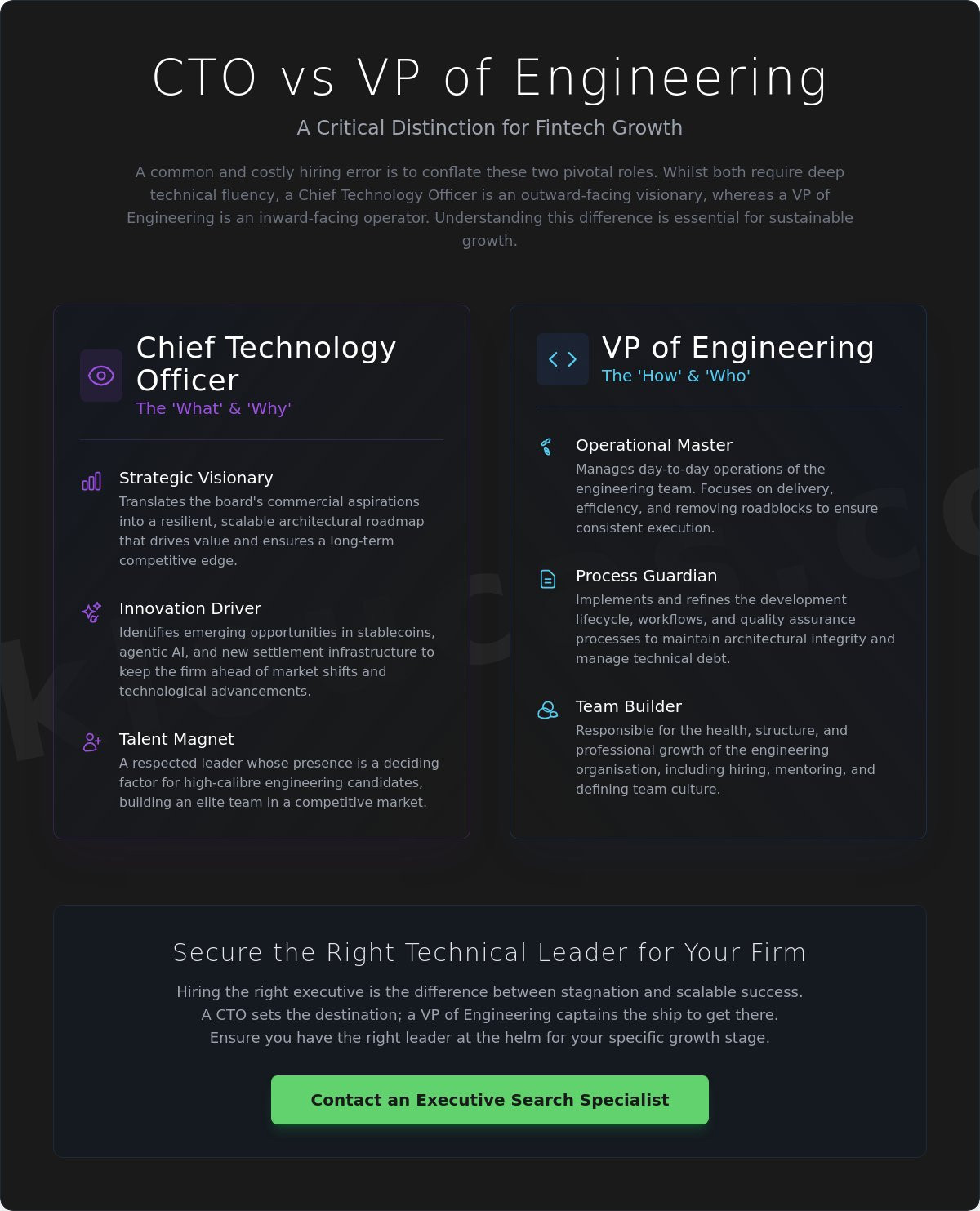
The distinction between a Chief Technology Officer and a Vice President of Engineering is often blurred in the early stages of a firm’s development. However, conflating these roles is a high stakes error that can lead to significant operational friction. Whilst both roles require deep technical fluency, their primary objectives are fundamentally different. A CTO is an outward facing visionary, whereas a VP of Engineering is an inward facing operator. Understanding this difference is critical when determining how to hire your first chief technology officer, as the person you appoint will define your technical culture for years to come.
Many firms mistakenly hire a VP of Engineering when their true requirement is a strategic leader. This usually happens when the board focuses too heavily on immediate delivery and the need for someone to manage the day to day engineering tasks. In a fintech banking technology environment, a VP might keep the trains running on time, but they may lack the expertise to navigate the regulatory shifts that define the 2026 landscape. They are masters of the “how”, whilst the CTO must own the “why” and the “what next”.
The strategic profile of a chief technology officer
A CTO is responsible for the long term technical vision and its alignment with commercial goals. They spend their time evaluating market trends, such as the adoption of agentic AI, and acting as a technical evangelist for the firm. This role carries the weight of the technology budget and is measured by the return on investment of technical assets. They are the technical face of the company, providing the quiet confidence required to reassure investors and high value clients. To truly hire a CTO who can command this level of respect, you must look for a leader who values architectural integrity over short term convenience.
The operational focus of a vice president of engineering
The VP of Engineering is the master of execution. Their focus is on team productivity, code quality, and the continuous optimisation of the development lifecycle. They mentor engineering leads and ensure that the delivery process is both efficient and sustainable. Whilst the CTO decides which mountain to climb, the VP ensures the team has the tools and the discipline to reach the summit. They are evaluated on velocity, bug rates, and team retention.
In smaller organisations, these roles often overlap within a single individual. However, once a firm scales beyond approximately eight to ten engineers, the divergence becomes necessary. Performance metrics for a CTO include strategic alignment and innovation adoption, whereas a VP remains focused on the granular details of delivery. If you are uncertain which profile suits your current trajectory, our advisory services can provide the clarity needed to make a definitive choice.
To ensure your executive search identifies a leader with the precise domain expertise your organisation requires, please get in touch with our specialist advisors for a confidential discussion.
Identifying the essential fintech competencies for a modern tech leader
In the discerning world of financial technology, a generalist approach to leadership is often insufficient for sustained success. When considering how to hire your first chief technology officer, one must look beyond basic engineering management to find a leader who possesses essential fintech competencies that bridge the gap between innovation and institutional stability. This individual must possess an intimate understanding of the payments industry, where the margin for error is non existent and the technical demands are uniquely rigorous. They don’t just build software; they architect trust.
A modern tech leader in 2026 must be as comfortable discussing ISO 20022 messaging standards as they are overseeing a complex cloud migration. They recognise that technical excellence is hollow without a foundation of data security and resilience. For any fintech firm, trust is the primary currency. Therefore, the CTO must ensure that technical systems are not only performant but also impregnable against the sophisticated AI powered threats that characterise the current era. It is a role that requires a meticulous attention to detail and a commitment to craftsmanship that mirrors the expectations of a high end concierge service.
Navigating the regulatory and compliance landscape
The regulatory environment has become significantly more intricate following the May 2026 Executive Order on fintech innovation. Your technology leader must ensure that all systems meet stringent FCA or global standards by design rather than as an afterthought. They act as the primary guardian of data privacy and the architect of financial crime prevention systems. This requires a nuanced understanding of how technology and compliance intersect, particularly within the context of open banking and real-time data sharing. They provide the quiet confidence that your firm’s interests are being managed with expert care.
Technical expertise in payments and digital banking
Expertise in high volume transaction processing is a non negotiable requirement. A world class leader understands the necessity of low latency systems and the complexities of legacy system integration within a cloud native financial architecture. They must be prepared to stay ahead of trends in decentralised finance and digital currencies, ensuring your technical foundation supports future expansion. If your firm is scaling its footprint, finding a leader through specialised digital banking recruitment ensures you secure a partner who values architectural integrity above all else. They are never in a rush, reflecting the patience and diligence required for high value transactions.
To secure a leader who possesses the rare combination of technical vision and commercial discipline, we invite you to discuss your requirements with our executive search specialists.
Designing a rigorous executive search and interview framework
The process of identifying a world class technology leader is an exercise in meticulous curation. Traditional methods often fail because the most desirable candidates are rarely actively seeking a change; they are typically engrossed in scaling the most prestigious platforms in the sector. When considering how to hire your first chief technology officer, you must adopt a proactive, multi stage approach that prioritises architectural craftsmanship over mere availability. This begins with a deep understanding of your firm’s specific technical debt and commercial trajectory, allowing for a search that is as precise as it is expansive.
A balanced interview panel is essential to evaluate a candidate’s multifaceted nature. It should include technical experts to vet architectural depth and business leaders to assess commercial alignment. This multidisciplinary perspective prevents the high stakes bad hire that often occurs when a candidate’s technical brilliance masks a lack of leadership maturity. By involving diverse voices, you ensure the individual possesses the quiet confidence required to command respect across the entire organisation, from the engineering floor to the boardroom.
Sourcing high calibre candidates through executive search
Senior technology appointments require a level of discretion that standard job boards cannot provide. Elite talent in the fintech sector resides within niche, private networks where reputation is the primary currency. By leveraging fintech banking technology recruiters, a firm can access passive prospects who would only be receptive to a truly distinguished opportunity. This tailored approach ensures that the shortlist is comprised only of those with a proven record of strategic foresight and technical excellence.
The executive interview process
The core of the evaluation should be a technical strategy case study rather than a simple coding exercise. Ask the candidate to present their vision for a scalable infrastructure that complies with modern standards like ISO 20022. This reveals their ability to translate complex technology into business value. You are looking for technical vision over hands on implementation; the ability to lead a team through a technical crisis is far more valuable than the ability to debug a single line of code. Testing for commercial acumen ensures they are aligned with your long term growth goals.
Final selection must be underpinned by thorough reference checks that go beyond verifying employment dates. These involve speaking with former peers and subordinates to understand the candidate’s true leadership behaviour and cultural fit. If you are ready to begin a bespoke search for your next technical leader, our fintech executive search team is available to provide the expert care your organisation deserves.
To ensure your final offer reflects the prestige of your firm and the calibre of the talent you seek, we invite you to speak with our advisors for bespoke guidance on executive compensation.
Navigating the final offer and onboarding phase for executive talent
The final stages of the recruitment journey are as critical as the initial search. Once you have determined how to hire your first chief technology officer, the transition from candidate to partner must be handled with the same level of curated excellence that defined the evaluation process. This phase is about more than just a signature on a contract; it’s about the meticulous alignment of expectations and the establishment of a foundation for long term success. A sophisticated approach to the final offer ensures that your chosen leader feels both valued and empowered from their first day in the boardroom.
In the 2026 fintech landscape, securing elite talent requires a nuanced understanding of market benchmarks. For growth stage firms, base salaries typically range from $200,000 to $300,000, whilst total compensation packages, including equity and bonuses, often reach between $280,000 and $550,000. For larger enterprise organisations, base salaries can rise to $400,000. These figures reflect the high stakes of the role and the technical complexity of modern payments infrastructure. By offering a package that recognises this expertise, you project the quiet confidence of an organisation that values craftsmanship and strategic foresight.
Crafting a compelling executive offer
A compelling offer balances financial reward with the autonomy and technical challenge that top tier leaders crave. Whilst the base salary is a vital anchor of reliability, the inclusion of performance based incentives and meaningful equity is what truly aligns a CTO with your firm’s growth. Negotiation should be a collaborative dialogue rather than a high pressure tactic. It’s an opportunity to demonstrate your commitment to a personalised approach, ensuring that non financial motivators, such as the ability to shape a technical vision from the ground up, are clearly addressed.
Ensuring a successful transition and integration
Successful onboarding is a deliberate process that continues long after the contract is signed. It involves setting clear performance milestones for the first six months and establishing direct communication channels between the new leader and the board. Your CTO must be given the resources to execute their vision and the space to build rapport with the existing engineering team. Continued support from a partner specialising in fintech banking technology recruiters can be invaluable during this period, providing a bridge between the firm’s history and its new technical future. This unhurried integration ensures that your first major technology appointment remains a hallmark of your organisation’s distinction.
If you require bespoke support in identifying a technology leader who possesses both technical brilliance and commercial maturity, you may reach out to our specialist advisors for a private consultation.
Securing your firm’s technical future
Appointing a world class technology leader is the most significant investment you’ll make in your organisation’s long term resilience. By distinguishing between operational delivery and strategic vision, you ensure that your technical roadmap is built upon a foundation of architectural integrity and regulatory foresight. Understanding how to hire your first chief technology officer is the essential catalyst for moving beyond founder led limitations and achieving true institutional scale within the global payments landscape.
Success requires a search process that’s as meticulous as the systems your new leader will oversee. Our firm provides specialist expertise in the global fintech and payments sectors, supported by a proven track record in high level permanent and executive placements. We maintain a deep network of niche technology specialists and senior leaders, ensuring your interests are managed with expert care and total discretion. To secure a leader who can transform your technical vision into reality, please contact our executive search consultants for a confidential discussion. Your firm’s next chapter of innovation begins with a single, distinguished appointment.
Frequently Asked Questions
What is the difference between a CTO and a Lead Developer
A Lead Developer is primarily focused on the technical delivery of specific features and the day to day mentoring of a development team. In contrast, a CTO is an executive leader responsible for the overarching technical vision and its alignment with your firm’s commercial strategy. Whilst a Lead Developer manages the code, the CTO manages the technical roadmap and ensures it supports long term business objectives.
How much should I expect to pay for a first time CTO in the UK fintech market
In the 2026 UK market, a first time CTO at a growth stage firm typically commands a base salary between £160,000 and £240,000. This is usually supplemented by a significant equity stake and performance based bonuses. These figures reflect the premium paid for leaders who can navigate the complexities of modern financial regulations and high volume payments infrastructure.
Should my first CTO be a hands on coder or a pure strategist
Your first technology leader should ideally be a strategic architect who retains the ability to step into the code when necessary. In a scaling fintech firm, a leader who is entirely removed from implementation may struggle to understand granular technical blockers. However, they must possess the professional maturity to prioritise high level strategy over daily coding tasks as the organisation grows.
How long does a typical executive search for a CTO take
A comprehensive executive search for a technology leader usually requires between twelve and sixteen weeks to complete. This unhurried pace allows for meticulous market mapping and the identification of passive talent who are not visible on traditional job boards. It ensures that every candidate is thoroughly vetted for both technical brilliance and cultural alignment before a final selection is made.
Do I need a CTO if I already have a strong VP of Engineering
You likely require a CTO if your organisation needs a technical visionary to represent the firm to investors or to navigate complex regulatory shifts. Whilst a VP of Engineering is a master of internal delivery and team productivity, they often lack the outward facing strategic focus of a CTO. The two roles are complementary and often diverge as a firm scales beyond its initial growth phase.
What are the biggest mistakes founders make when hiring their first CTO
The most frequent error when determining how to hire your first chief technology officer is overvaluing technical execution at the expense of strategic leadership. Founders often hire the best coder they know, only to find that person lacks the commercial acumen to sit on an executive board. Another common mistake is failing to provide a clear technical mandate, which can lead to friction between the new leader and the founding team.
How do I evaluate a CTO candidate if I am not technical myself
Focus your evaluation on the candidate’s ability to translate complex technical concepts into clear business value. A world class leader should be able to explain their architectural choices in a way that resonates with non technical stakeholders. You should also involve a specialised recruitment partner or a trusted technical advisor to conduct a rigorous assessment of their architectural depth and security expertise.
Can an interim CTO be a viable solution before making a permanent hire
An interim CTO is a highly effective solution for firms that require immediate leadership whilst conducting a patient search for a permanent executive. This approach provides the necessary technical oversight for funding rounds or major product launches without the pressure of making a hurried long term commitment. It allows you to maintain technical momentum whilst ensuring your permanent hire is a perfect match for your firm’s future.

Article by
Liam Henfrey
Liam Henfrey is an experienced specialist in the payments and banking sectors with over two decades of experience. As the Founder and CEO of FINOPSIS and Managing Director at Mark Loucas Ltd, he advises organisations on complex financial operations and technology. His career includes senior roles at PwC, Deloitte, and Visa Europe.
Related Fintech Recruitment Guides
If you liked this guide then you may also like the following: