


Fintech Hiring Challenges in 2026 and Strategic Solutions for Growth
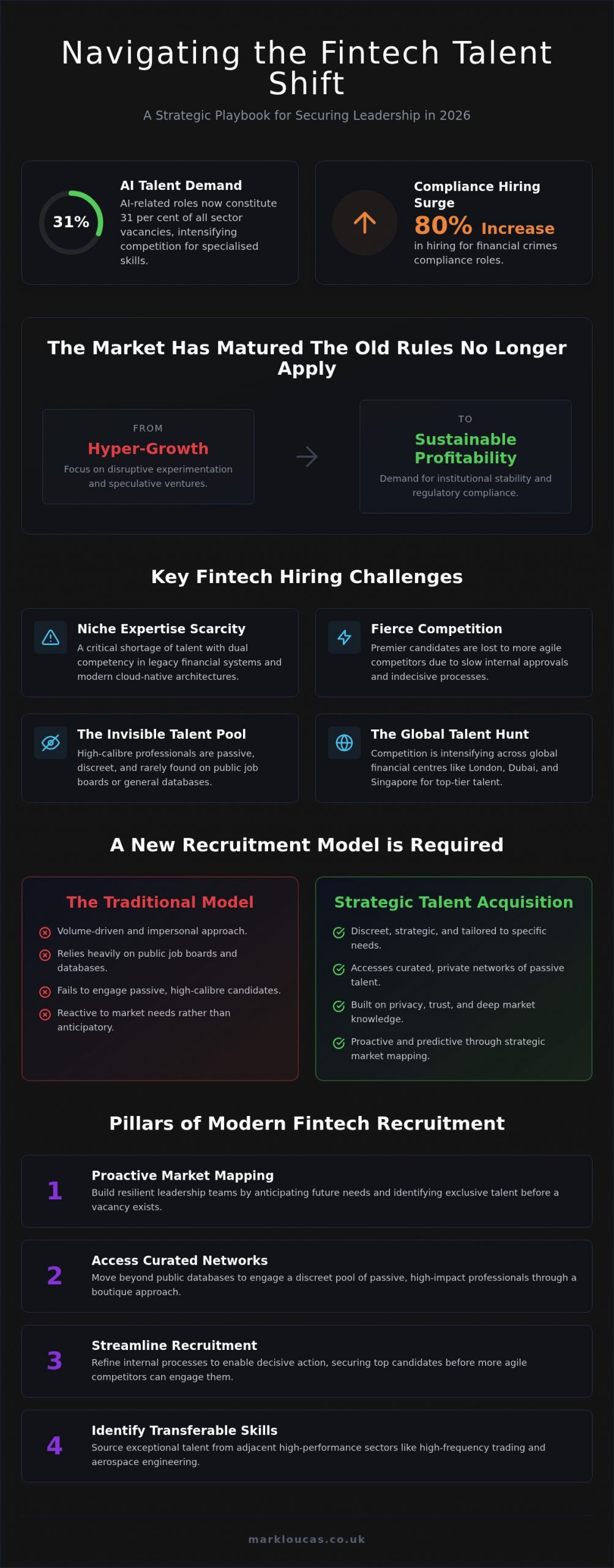
With AI-related roles now constituting 31 per cent of all sector vacancies, the competition for specialised talent has reached an unprecedented level of intensity. You’ve likely felt the frustration of losing a premier candidate to a more agile competitor whilst navigating your own internal approvals, or perhaps you’ve struggled to find the specific expertise required for high-stakes payments infrastructure. These fintech hiring challenges aren’t merely obstacles. They are a signal that the traditional recruitment model has been superseded by a need for more discreet, strategic acquisition.
We understand that building a resilient leadership team requires more than just a broad search; it demands a sophisticated approach to the talent landscape. This article will show you how to navigate the complexities of the payments and digital banking sectors to reduce your time-to-hire for critical senior roles. By accessing a curated pool of passive talent and refining your recruitment process, you’ll be better positioned to secure the specialists needed for the 2026 regulatory environment. From the implications of the California Digital Financial Assets Law to the 80 per cent increase in financial crimes compliance hiring, we provide the insights necessary to ensure your firm remains at the forefront of innovation.
Key Takeaways
- Learn why the shift toward sustainable growth in 2026 necessitates a more sophisticated approach to identifying leaders with both technical and commercial acumen.
- Understand how to navigate contemporary fintech hiring challenges by sourcing specialists who possess a deep expertise in both legacy infrastructure and emerging payments ecosystems.
- Discover how to streamline your recruitment process to avoid the indecision that often results in losing high-calibre candidates to more agile competitors.
- Explore the benefits of proactive market mapping to build resilient leadership teams and secure access to exclusive talent within prestigious global financial centres.
- Recognise the value of partnering with a discreet boutique consultancy that provides tailored solutions and maintains the highest standards of privacy for your firm.
To discuss how these market shifts impact your specific leadership requirements and to explore our tailored search solutions, please reach out to our team via our contact page.
The Evolving Landscape of Fintech Talent Acquisition in 2026
The transition from hyper-growth to sustainable profitability has fundamentally altered the DNA of successful leadership within the sector. As we progress through 2026, the demand for individuals who possess a rare blend of technical precision and commercial foresight has never been more acute. This shift reflects a broader maturation of Financial technology (fintech), where the focus has moved from disruptive experimentation to the rigorous demands of institutional stability and regulatory compliance. These fintech hiring challenges are compounded by a candidate pool that now prioritises long-term viability over the speculative allure of early-stage ventures. Organisations must now navigate a landscape where the most desirable talent seeks a partnership that offers both innovation and a secure foundation.
Identifying the Global Talent Shortage in Payments Infrastructure
The quest for excellence in payments industry recruitment has become a global pursuit, with competition intensifying across the prestigious financial centres of London, Dubai, and Singapore. Traditional, volume-driven recruitment methods often fail to resonate with the discreet, high-calibre professionals who manage high-stakes infrastructure. These individuals are rarely found on public job boards. Reaching them requires a more nuanced, boutique approach that values privacy and understands the intricacies of the global payments ecosystem. We find that the most successful firms are those that move away from impersonal databases in favour of curated talent networks.
The Impact of Rapid Technological Shifts on Resource Planning
Technological maturity, particularly the seamless integration of AI and machine learning, has redefined the expectations for senior leadership. It’s no longer sufficient for a Chief Technology Officer to merely oversee development; they must now act as strategic architects of a future-proof ecosystem. This evolution necessitates a more sophisticated approach to resource planning that anticipates shifts before they become disruptions. The 2026 market is defined by a critical deficit where the supply of veteran architects capable of bridging legacy core banking with decentralised AI protocols remains substantially below institutional demand. Strategic foresight and a commitment to meticulous talent advisory are the only ways to bridge this gap whilst maintaining a competitive edge amongst an increasingly sophisticated field of global players.
To discuss your specific requirements for senior leadership or niche technical roles, please reach out via our contact page.
Navigating the Scarcity of Niche Technical Expertise
The industry is currently facing a critical shortage of professionals who possess a deep, dual-competency in both legacy financial systems and modern cloud-native architectures. This scarcity is a primary driver of contemporary fintech hiring challenges. Finding a leader who can navigate the intricacies of decades-old core banking software whilst simultaneously implementing cutting-edge decentralised protocols requires more than a simple database search. It demands an advisor who understands that the ideal candidate often resides in a high-pressure environment where their skills are being utilised in ways a standard CV might not immediately reveal. These individuals are the quiet architects of stability in a volatile market.
Identifying such talent requires looking beneath the surface of traditional career trajectories. A specialist in payments industry recruitment knows how to isolate transferable skills from adjacent sectors such as high-frequency trading or aerospace engineering. These fields often share the same requirements for low-latency, mission-critical performance that define the modern payments ecosystem. It’s about finding the rare individual who thrives on the precision required for high-stakes infrastructure.
Sourcing Specialists for ISO 20022 and Modern Banking Systems
The global migration to ISO 20022 has intensified the need for specialists who can manage complex messaging standards without compromising operational stability. We see a significant demand for professionals capable of handling RTGS payment consulting and implementation. These roles are pivotal. They bridge the gap between technical execution and the stringent demands of regulatory compliance. Finding candidates with this specific pedigree is essential for maintaining the integrity of your financial infrastructure whilst ensuring future scalability.
Why Generalist Recruiters Struggle with Complex Fintech Roles
Generalist agencies often lack the industry-specific vocabulary and the intimate networks required to place niche talent. The risk of a bad hire increases substantially when a recruiter cannot discern the subtle technical nuances between digital banking and traditional finance. Partnering with a dedicated fintech recruiter ensures that your firm is presented to the most qualified, passive candidates who value privacy and excellence. This level of expert care is vital for securing the rare talent that larger, volume-driven entities often overlook. If you are ready to refine your search for these elusive specialists, you may wish to start a confidential conversation with our advisory team.
To refine your internal selection criteria and ensure your process attracts the industry’s most discerning leaders, you may find it beneficial to speak with our specialist advisors regarding your current recruitment strategy.
Balancing Efficiency with the Perfectionism Complex in Recruitment
The pursuit of the flawless candidate often becomes a paradox within the sector, mirroring the meticulous search for a rare architectural masterpiece where every detail must be perfectly aligned. Whilst the desire for absolute technical and cultural harmony is understandable, a rigid adherence to the perfectionism complex can inadvertently exacerbate fintech hiring challenges. Indecision at the final stage frequently results in the loss of high-calibre talent who, feeling undervalued by a lack of momentum, may choose to accept a swifter offer from a more decisive competitor. Streamlining this journey is not about lowering standards. It is about respecting the professional capital of the individuals you seek to attract.
The Risks of Overly Protracted Interview Processes
Protracted interview cycles are the primary cause of candidate attrition in 2026. When a process exceeds four stages without a clear timeline, recruitment fatigue sets in, diminishing the enthusiasm of even the most committed professional. This delay provides an opening for agile competitors to intervene, much like a private opportunity being snatched up by a more decisive buyer. To maintain engagement, consider a structure that balances depth with brevity. This approach ensures that your firm remains the preferred choice for those who value efficiency as much as excellence.
- Consolidate technical assessments to avoid repetitive questioning across different panels.
- Ensure every stakeholder is briefed on the specific competencies they are responsible for evaluating.
- Define a definitive closing date for the decision to provide candidates with a sense of security and clarity.
Strategies to Reduce Candidate Burnout and Ghosting
In an era increasingly dominated by impersonal, AI-driven screening, the human touch remains a hallmark of an elite recruitment experience. Implementing consistent feedback loops ensures that candidates feel their time has been valued, regardless of the final outcome. This transparency builds a foundation of trust that extends beyond the immediate vacancy, fostering a network of goodwill that can yield future opportunities. By prioritising the candidate’s experience, you demonstrate a level of professional care that is rare in the broader market, ensuring that your firm is perceived as a sanctuary of excellence rather than a volume-driven entity. A refined and respectful interview structure acts as a powerful signal of your organisational culture, significantly enhancing your employer brand amongst the industry’s most sought-after specialists.
To discover how our bespoke market mapping can secure the leadership your firm requires, please reach out to our boutique advisory team for a private consultation.
Building Agile Leadership Teams through Strategic Market Mapping
In the current climate, traditional recruitment methods often feel like a blunt instrument. Reactive hiring, where a firm only begins its search once a vacancy is public, is a significant contributor to fintech hiring challenges. It limits the pool to those actively seeking change, often overlooking the most accomplished individuals who are quietly excelling in their current roles. Strategic market mapping transforms this dynamic. It provides a panoramic view of the talent landscape within specific prestigious districts, allowing for a more calculated and discreet approach to acquisition. This methodology ensures that you’re not merely choosing from the available, but selecting from the exceptional.
By utilising data-driven intelligence, organisations can make informed decisions that go beyond a candidate’s technical history. This involves identifying high-performing leaders who may not be actively searching but possess the architectural vision required for senior appointments. It’s about understanding the subtle shifts in the market and knowing exactly where the expertise resides amongst the competition before a need becomes critical. This unhurried, meticulous approach mirrors the patience required in high-value transactions, ensuring every move is deliberate and strategic.
Utilising Intelligence to Identify Passive Executive Talent
The art of the discreet approach is central to successful fintech executive search. Elite professionals are often motivated by the promise of a unique challenge or a more refined organisational culture rather than mere compensation. Talent advisory plays a vital role here. It allows us to understand these private motivations and present opportunities that resonate on a deeper, more individualised level. This ensures that the next generation of C-suite leadership is not only technically proficient but also strategically aligned with your long-term vision whilst maintaining the utmost privacy.
Developing a Robust Talent Pipeline for Future Growth
Securing a resilient future requires building relationships long before a formal vacancy arises. For critical roles such as the Chief Compliance Officer or CTO, a reactive search is a risk few can afford. Market intelligence allows for precise forecasting, identifying potential resource needs based on emerging industry trends like the 2026 regulatory shifts. By maintaining a steady pulse of engagement with top-tier talent, firms can ensure they are never in a rush when a key leadership transition occurs.
- Identify emerging talent in niche geographical hubs before they are headhunted.
- Monitor the movement of key leaders within competitor organisations to anticipate market shifts.
- Assess the availability of specialists for high-stakes infrastructure roles to ensure operational continuity.
To ensure your leadership team is prepared for these future demands, you may request a tailored market intelligence report from our specialist consultants.
To discuss how a tailored search strategy can secure the niche expertise your organisation requires, please consult with our specialist advisors for a confidential discussion.
Partnering with a Boutique Consultancy for Exclusive Talent Access
As we have explored, the most pressing fintech hiring challenges in 2026 cannot be resolved through the impersonal, volume-driven methods favoured by large corporate entities. When the requirement is for a leader capable of navigating complex regulatory shifts or managing high-stakes payments infrastructure, the value of a boutique consultancy becomes clear. We operate as a discreet extension of your own leadership team, providing a level of personalised service that ensures every interaction is handled with expert care. This approach prioritises quality over quantity, offering a refined experience that mirrors the high-end standards of the clients we serve.
Working with a highly connected advisor provides access to a private network of non-public opportunities that are simply unavailable through traditional channels. These elite professionals, often residing in prestigious global financial hubs, value their privacy and respond only to a curated, respectful approach. By fostering a partnership built on mutual trust and deep industry knowledge, we move beyond the transactional nature of recruitment to provide long-term strategic value. This ensures that your interests are managed with the diligence and patience required for high-value appointments.
The Value of Discreet and Tailored Recruitment Solutions
Senior appointments within the digital banking and payments sectors require a heightened level of confidentiality to protect both the firm’s reputation and the candidate’s professional standing. Our commitment to curated excellence means we do not merely match skills to a job description; we ensure a meticulous strategic fit for your organisation’s unique culture. Mark Loucas Ltd takes the time to understand the granular details of your history and vision, ensuring that every placement acts as a catalyst for sustainable growth and stability.
Moving Beyond Traditional Hiring Methods with Mark Loucas
We combine deep local authority with a truly global reach to solve the most complex hiring challenges across the UK, UAE, and Asia. Our comprehensive suite of specialised financial recruitment services is designed for fintech providers who refuse to settle for the average. Whether you require a permanent executive search or a strategic talent advisory, our team provides the tailored solutions necessary to build a resilient leadership team. To begin a consultation for your next critical senior appointment, you are invited to connect with our boutique team to explore how we can support your strategic objectives.
To explore how our bespoke talent advisory can help you build a resilient and elite leadership team, please visit our contact page to arrange a confidential consultation.
Securing Your Leadership Legacy in a Competitive Era
Success in the coming years rests on the ability to identify niche specialists who can bridge the gap between legacy systems and the next generation of digital banking. By prioritising the candidate experience and utilising data-driven market mapping, your organisation can effectively overcome the most persistent fintech hiring challenges whilst securing the industry’s most sought-after leaders. This transition from reactive search to proactive talent acquisition is the hallmark of a resilient and forward-thinking firm.
Since 2011, Mark Loucas Ltd has remained exclusively focused on the global fintech and digital banking sectors. We specialise in high-stakes payments infrastructure and executive search, providing the strategic talent advisory required to build elite leadership teams through a discreet and highly connected network. Our approach is one of quiet excellence and meticulous attention to detail, ensuring that every placement is a harmonious fit for your firm’s unique culture.
We invite you to contact our expert team to discuss your fintech hiring strategy and discover how our specialised solutions can support your long-term growth. We look forward to helping you secure the talent that will define your future success.
Frequently Asked Questions
What are the biggest fintech hiring challenges in 2026?
The most significant fintech hiring challenges in 2026 revolve around the scarcity of specialists who understand complex payments infrastructure and the global shift toward ISO 20022 standards. Firms often struggle to find candidates who possess both technical excellence and the cultural agility required to navigate the evolving digital banking sector. This shortage is exacerbated by a competitive landscape where elite talent’s increasingly selective about the institutions they choose to join.
How can fintech companies attract top talent amongst fierce competition?
Attracting top talent requires a shift from volume-driven recruitment to a strategy of curated excellence and refined service. Candidates at this level value privacy and tailored opportunities, so firms must project a sense of quiet confidence and exclusivity whilst highlighting their long-term vision for innovation. By offering a bespoke experience that mirrors a high-end concierge service, organisations can distinguish themselves from the impersonal approach of larger, less specialised competitors.
Why is the interview process for fintech roles becoming longer?
Interview processes are extending because firms now demand meticulous attention to detail and deeper regulatory alignment before making a final commitment. This unhurried approach ensures that every new hire fits the precise architectural and cultural needs of the organisation, reflecting the patience required for high-value transactions. Whilst this deliberate pace might seem slow, it’s a safeguard to ensure that the candidate’s expertise is perfectly aligned with the firm’s strategic goals.
What is market mapping and how does it help in recruitment?
Market mapping is a strategic exercise that involves identifying and analysing the talent landscape within specific prestigious districts and global hubs. It helps firms uncover private, non-public opportunities by providing a granular view of the competitor landscape and the specific expertise available in the current market. This intelligence allows leaders to make informed decisions based on real-time data, ensuring they can secure the most distinguished professionals before they even consider entering the open market.
How does ISO 20022 impact the demand for fintech specialists?
The transition to ISO 20022 has created an unprecedented demand for specialists who can manage the architectural complexities of modern financial messaging. This global standard requires a rare level of craftsmanship in data handling, making it essential for firms to secure professionals who have a proven history in payments infrastructure. As the deadline for migration approaches, the competition for these niche experts intensifies, requiring a sophisticated approach to identify and attract those with the necessary technical mastery.
Should I use a specialist fintech recruitment agency for executive search?
Engaging a specialist fintech recruitment agency for executive search ensures your interests are managed with expert care by a knowledgeable local insider. Boutique firms offer a discreet service that generalist agencies can’t match, providing access to an elite network of leaders who aren’t visible on public job boards. This tailored approach focuses on quality over quantity, ensuring that every candidate presented has been meticulously vetted for their ability to lead in high-stakes financial environments.
How can we reduce candidate ghosting in the payments industry?
Reducing candidate ghosting in the payments industry relies on moving away from impersonal, high-pressure tactics in favour of an intimate, personalised approach. By maintaining a steady and reassuring pulse throughout the recruitment journey, you ensure the candidate feels like the sole focus of your attention, which builds genuine loyalty. Clear communication and a commitment to transparency help to establish a relationship of mutual respect, making it far less likely that a professional will withdraw without notice.
What is the role of a boutique recruitment consultancy in the digital banking sector?
A boutique recruitment consultancy acts as a discreet advisor in the digital banking sector, offering the kind of individualised attention that large corporate entities often lack. They provide a bridge to rare talent through deep local authority and a commitment to understanding the specific culture of premium urban centres like London or Dubai. These consultants don’t focus on volume-driven metrics, providing instead a refined service that prioritises the long-term success of both the client and the candidate.

Article by
Liam Henfrey
Liam Henfrey is a seasoned specialist in the payments and banking sectors with over two decades of experience. As the Founder and CEO of FINOPSIS and Managing Director at Mark Loucas Ltd, he advises organisations on complex financial operations and technology. His career includes senior roles at PwC, Deloitte, and Visa Europe.
Related Fintech Recruitment Guides
If you liked this guide then you may also like the following: