


The Strategic Role of a Fintech Engineer in the 2026 Financial Landscape
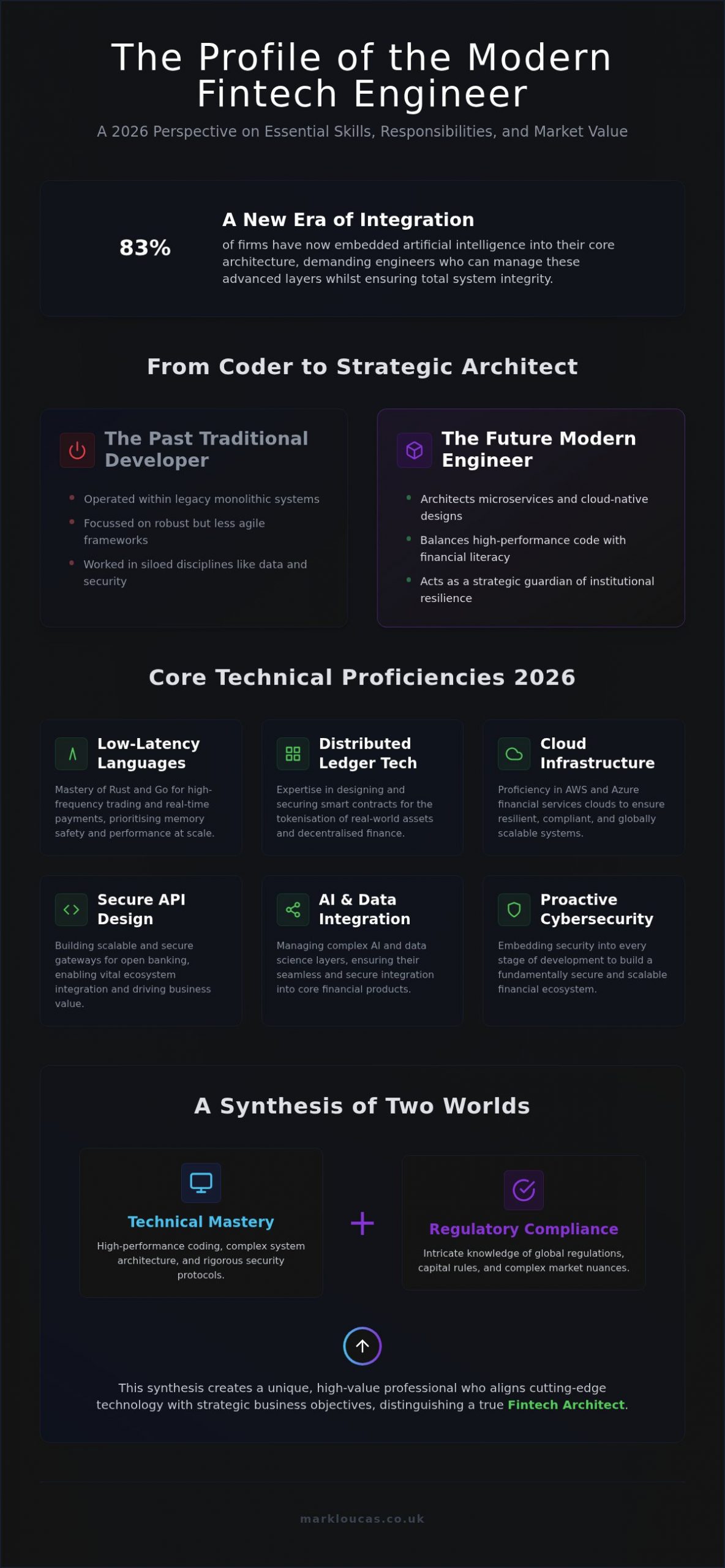
With 83 per cent of firms now embedding artificial intelligence into their core architecture, the role of the fintech engineer has transcended mere programming to become one of strategic guardianship. You have likely noticed that the generalist tech market feels increasingly crowded, whilst the demand for those who truly understand the nuances of the Bank Secrecy Act or the latest Federal Reserve capital rules remains unmet. It’s a challenging environment where finding a role that matches your senior expertise requires more than just a polished CV; it demands a deep alignment with the industry’s evolving maturation.
You’ll discover the essential skills and strategic responsibilities that command the highest market value in this complex global economy. We’ll examine the 2026 technical requirements, provide insight into current salary benchmarks for elite talent, and identify the career moves that distinguish a true architect from a standard developer. This guide offers a clear path through the intricate regulatory landscape and towards the most exclusive opportunities in the sector.
Key Takeaways
- Understand why the modern fintech engineer must now balance high performance coding with an intricate knowledge of global financial regulations.
- Identify the technical mastery needed for 2026, focusing on low latency languages like Rust and the security of smart contracts.
- Learn how to navigate the complex engineering challenges of global payment rail integration and legacy system migration.
- Explore the 2026 salary benchmarks and the evolving demand for interim specialists in the executive search market.
- Discover the benefits of partnering with a boutique consultancy to find high calibre talent for sensitive technical roles.
For those seeking to secure high-calibre talent to lead their technical vision, we invite you to connect with our consultants for a discreet and professional discussion regarding your requirements.
Defining the Modern Fintech Engineer
The contemporary fintech engineer represents a bespoke class of specialised software professional, one who designs and maintains the intricate technology that underpins our global financial services. This role requires a unique and highly sought-after blend of high-performance coding and deep financial literacy, a combination that is as rare as the high-stakes environments in which they operate. In 2026, the focus has shifted decisively towards decentralised finance and real-time processing, necessitating a level of technical sophistication that far exceeds the requirements of previous decades. Whilst the elegant aesthetics of a front-end interface remain a vital component of client engagement, the modern engineer focuses their mastery on the high-stakes back-end architecture where institutional resilience is forged.
This professional is not merely a coder but a strategic architect who understands the gravity of the data they handle. They operate at the intersection of complex mathematics and software craftsmanship, ensuring that every line of code contributes to a secure and scalable ecosystem. In an era where 83 per cent of firms have integrated artificial intelligence into core products, the ability to manage these advanced layers whilst maintaining system integrity is what defines the elite tier of the profession.
The Evolution of Financial Technology Roles
Traditional banking development often relied on legacy monolithic systems, which were robust but lacked the agility required for contemporary, fast-moving markets. The shift towards microservices and cloud-native designs has fundamentally redefined the engineering landscape, allowing for the rapid innovation that characterises Financial Technology (Fintech) today. This evolution has expanded the role to encompass disciplines once considered separate, such as data science and cybersecurity. Modern engineers must now be as proficient in managing distributed ledger technology as they are in traditional database management, reflecting the holistic nature of 2026’s financial ecosystems.
The Strategic Importance of the Role
Engineers are the silent architects of business value, driving success through transaction speed and unwavering system reliability. By meticulously managing technical architecture, they reduce operational risk and safeguard the interests of a discerning clientele in a world where real-time settlement is the expected standard. Following the implementation of Executive Order 14405 in mid-2026, which integrated innovation into regulatory frameworks, these professionals have become even more critical. They act as the indispensable bridge between complex regulatory requirements and the precise technical execution of a firm’s strategic objectives, ensuring that innovation never comes at the cost of compliance.
To secure the highly specialised technical expertise required for these high-stakes environments, you are invited to discuss your requirements with our boutique advisory team.
Core Technical Skills and Domain Expertise
The modern fintech engineer must possess a technical repertoire that is both broad and exceptionally deep. It’s no longer sufficient to be a generalist. The market demands specialists who can navigate the intricacies of low latency languages such as Rust or Go. These tools are favoured for their memory safety and performance in high-frequency trading and real-time payment environments. Mastery of these languages allows for the creation of systems that handle immense throughput without the unreliability of older, more encumbered frameworks. It’s about precision at scale.
Beyond traditional coding, a profound understanding of distributed ledger technology (DLT) is essential. As tokenisation of real-world assets becomes a standard practice, engineers are expected to design and secure smart contracts that manage significant capital. This expertise must be paired with a sophisticated command of cloud infrastructure. Specifically, proficiency in AWS and Azure financial services clouds is required to ensure that systems remain resilient and compliant with the latest global standards. These platforms offer specialised tools that help firms meet the technology-neutral capital rules clarified by regulators in early 2026.
Effective API design has also become a cornerstone of the role. In an era of open banking, the ability to build secure, scalable gateways for ecosystem integration is a primary driver of business value. If you are looking to build a team with these specific capabilities, our specialised recruitment experts can provide the market intelligence you need to find the right fit.
High Performance Development and Architecture
Mastering concurrency and asynchronous programming is now a non-negotiable requirement. Financial systems operate in a world where “five nines” availability is the only acceptable benchmark. This level of reliability ensures that services remain accessible during periods of extreme market volatility. The distinction between development and operations has blurred significantly. DevOps is now a core engineering skill, ensuring that continuous integration and deployment are handled with the same meticulous care as the code itself. It’s a holistic approach to system health.
Regulatory Compliance and Security as Code
Security isn’t a final check; it’s integrated directly into the development lifecycle as security as code. This involves embedding KYC and AML protocols into the very fabric of the software. A zero trust architecture is fundamental to modern digital banking, ensuring that every request is verified regardless of its origin. Engineers must also balance the need for data privacy with the requirement for system transparency. This allows for seamless regulatory audits without compromising client confidentiality or the firm’s integrity.
If you are looking to secure the elite technical talent necessary to navigate these structural shifts, our team is available to discuss your recruitment strategy in total confidence.
Engineering Challenges within Payments and Digital Banking
The financial environment in 2026 demands far more than basic technical proficiency. A modern fintech engineer must navigate the intricate web of global payment rails whilst ensuring that every transaction remains both swift and secure. This requires a meticulous approach to integration, particularly as the industry moves away from traditional batch processing towards the real-time settlement standards that are now universally expected by a discerning global clientele. Digital payments have solidified their position as the largest segment of the market, accounting for over 41 per cent of the total share, which places an immense responsibility on the architects of these systems.
Managing technical debt is perhaps the most delicate task facing any senior technical leader today. Many established institutions are currently engaged in the complex process of migrating from legacy banking cores to more agile, cloud-native architectures. This transition must be handled with the precision of a master craftsman; it is essential to ensure that existing services remain uninterrupted whilst new, hyper-scalable features are deployed. It is a continuous balance of maintaining institutional stability and fostering the rapid innovation required to remain competitive in a crowded market.
Latency is no longer merely a technical metric; it’s a fundamental measure of trust. In the cross-border landscape, achieving sub-second processing speeds is essential for maintaining a competitive edge and satisfying regulatory expectations. This involves optimising every layer of the technical stack, from the network protocols to the application logic, ensuring that capital moves with the same fluidity as information. For the fintech engineer, the challenge lies in balancing this rapid feature deployment with the unwavering stability required for financial trust.
Architecting for ISO 20022 and Real Time Payments
The global shift to ISO 20022 has introduced a level of data richness previously unseen in payment messaging. For the engineering team, this means managing larger and more complex payloads without sacrificing system performance. Synchronising these settlements across diverse jurisdictions requires a deep understanding of local regulatory nuances and technical standards. Our expertise in RTGS payment consulting helps firms identify the rare talent capable of architecting these sophisticated, data-rich systems with absolute precision.
Scalability in Neo Banking Environments
Market volatility can cause massive and unpredictable spikes in user traffic that test the limits of even the most robust systems. Handling these surges requires advanced strategies for database partitioning and horizontal scaling to ensure that the user experience remains seamless. It’s about building systems that expand gracefully under pressure rather than failing at the moment they are needed most. Finding professionals who understand these specific pressures is a significant challenge, which is where our focus on digital banking recruitment provides a distinct advantage for firms seeking to scale their operations with quiet confidence.
For those seeking to navigate the complexities of senior career moves or to secure elite talent for their leadership team, we invite you to contact our executive search specialists for a tailored and confidential consultation.
Career Progression and Market Benchmarks
The journey of a fintech engineer has matured into a prestigious path that rewards both technical mastery and commercial foresight. Whilst the early stages of a career focus on the elegance of code and system architecture, the transition to senior leadership requires a shift in perspective. We’re seeing an unprecedented demand for interim and contract engineering specialists who can step into high-stakes environments to lead specific, time-sensitive migrations or infrastructure overhauls. This flexibility allows firms to access elite skills for critical projects without the long-term commitment of a permanent hire, reflecting the unhurried and precise nature of modern talent acquisition.
Transitioning from a generalist tech background into the upper echelons of financial technology is a deliberate and rewarding process. It requires more than just learning a new language; it demands an immersion in the regulatory and operational nuances that define the sector. Aspiring leaders must demonstrate an understanding of how code interacts with the Bank Secrecy Act or the latest Federal Reserve capital rules. Those who successfully bridge this gap often find themselves in high-level executive roles where they shape the very future of digital finance. It’s a move from being a builder to becoming an architect of economic stability.
From Senior Engineer to Strategic Leadership
Ascending to the C-suite as a technical professional requires a refined sense of commercial acumen. It’s about understanding how technical decisions impact the bottom line and institutional risk. Our work in fintech executive search reveals that the most successful candidates are those who balance their architectural brilliance with a commitment to mentorship and team development. These leaders don’t just build systems; they build the cultures that sustain them. If you’re ready to explore your next strategic move, you can reach out to our boutique advisors for a private discussion.
Understanding the 2026 Compensation Landscape
The compensation for elite talent reflects the rarity of their skills. As of June 2026, the median salary for engineers at fintech companies has reached $198,000, whilst those in the 90th percentile can expect to earn up to $285,000. These figures are often complemented by sophisticated equity packages and performance bonuses that align the engineer’s interests with the firm’s long-term success. We see a significant premium placed on niche expertise, particularly within DevOps recruitment, where the ability to automate compliance and security is highly valued. Remote and hybrid models continue to influence these benchmarks, allowing global hubs to attract the finest talent regardless of geography.
To ensure your technical leadership is sourced with the meticulous care it deserves, we invite you to engage with our boutique consultancy for a tailored recruitment solution.
Partnering with Specialists for Engineering Talent
Generic recruitment agencies often treat the search for technical talent as a volume-driven exercise, an approach that inevitably fails to capture the architectural nuances required for a senior fintech engineer. In high-stakes environments, the cost of a sub-optimal hire extends far beyond the immediate financial impact; it can compromise system integrity and damage institutional reputation. A boutique approach prioritises curated excellence over sheer quantity, utilising sophisticated market mapping to identify the top 5 per cent of talent who possess the rare blend of coding mastery and deep financial literacy. This level of industry intelligence is the only reliable method to mitigate risk in a landscape defined by rapid maturation and increasingly complex global regulations.
By focusing on the granular details of a candidate’s history and technical craftsmanship, a specialist advisor ensures that every hire is a strategic asset. This process is unhurried and steady, reflecting the patience required for high-value transactions. It’s about finding the individual who doesn’t just fill a gap but elevates the entire technical vision of the firm. In an era where 74 per cent of public fintechs are now profitable, the demand for this calibre of talent has never been more competitive or more critical to sustained success.
The Value of Niche Recruitment Expertise
Accessing the most accomplished professionals in premium urban centres requires a level of connectivity that transcends traditional methods. Many of the most senior engineers are passive candidates who are not actively seeking new roles through public channels. Leading fintech recruitment agencies london provide the necessary bridge to these individuals, offering a level of technical vetting that generalist firms simply cannot replicate. By partnering with experts in specialised financial recruitment, organisations ensure that every candidate has been assessed for their ability to navigate the specific challenges of ISO 20022 migration and the security requirements of modern digital banking.
Accessing the Hidden Talent Market
The most prestigious and influential engineering roles are rarely found in the public domain. Discretion is the hallmark of executive-level moves, where privacy is valued as highly as the opportunity itself. Mark Loucas Ltd facilitates these exclusive connections globally, acting as a quiet, highly connected advisor for both institutions and candidates. This personalised approach ensures that the focus remains entirely on the unique needs of the client, mirroring the unhurried pace of a high-end concierge service. It’s a bespoke search for the initiated, delivering results with a sincerity that elevates the recruitment process to a core brand identity.
For those who require a sophisticated approach to talent acquisition or career management, we invite you to connect with our boutique advisors for a private consultation.
Architecting Your Future in Global Finance
The transition from a traditional developer to a strategic fintech engineer represents a significant shift in the global financial hierarchy. Success in 2026 requires more than technical mastery; it demands a profound understanding of the regulatory frameworks and high-stakes infrastructure that maintain institutional trust. Those who can bridge the gap between complex code and compliance requirements are no longer just builders; they are the essential guardians of our economic stability.
Since 2011, Mark Loucas Ltd has operated at the heart of this evolution, providing discreet access to non-public opportunities through our global executive search capabilities. Our expertise in payments and digital banking infrastructure ensures that both firms and professionals are matched with the precision and care their interests deserve. If you are looking to secure elite engineering talent or advance your own career in this sector, please contact our specialist team to discuss your requirements. The journey towards strategic leadership is a rewarding one, and we are here to ensure your transition is managed with the utmost care and expertise.
Frequently Asked Questions
What is the average salary for a fintech engineer in London in 2026?
In 2026, a senior fintech engineer in London typically commands a salary between £110,000 and £160,000. These figures reflect the intense competition for talent within the Square Mile and the prestigious districts of Mayfair and Canary Wharf. Compensation often includes substantial performance bonuses and equity options that significantly elevate the total package for those who possess rare, niche expertise. Niche talent remains paramount.
Do I need a finance degree to become a fintech engineer?
You don’t necessarily need a finance degree to excel in this specialised field. Whilst a background in mathematics or economics is certainly beneficial, most elite firms prioritise a deep understanding of software architecture and distributed systems. Leading institutions value the ability to bridge the gap between complex code and financial logic, favouring hands on experience over a specific university degree title. Practical expertise is the ultimate currency.
Which programming languages are most in demand for fintech in 2026?
Rust, Python, and Go remain the most sought after programming languages for a fintech engineer in the current 2026 market. Rust is favoured for its safety and performance in high frequency trading environments, whilst Python continues to dominate the data science and machine learning sectors. Proficiency in these languages demonstrates a commitment to building the modern, secure, and scalable financial infrastructure that clients expect. These tools define the modern era.
What is the difference between a software engineer and a fintech engineer?
The primary distinction lies in the domain specific knowledge required to navigate the intricacies of global markets and complex regulatory frameworks. A standard software engineer focuses on general application logic, but a specialist in this sector must master low latency processing, cryptographic security, and stringent financial compliance. It’s a role that demands a rare blend of technical brilliance and deep sector intelligence to succeed. Precision is non negotiable.
How has AI changed the role of engineers in the financial sector?
AI has shifted the role of the engineer from manual coding to the orchestration of intelligent, autonomous systems. Professionals now spend more time designing sophisticated models that predict market shifts and automate risk management processes with precision. This evolution has made the role more strategic, requiring a nuanced understanding of how generative AI integrates with the legacy financial cores of established institutions. Strategy now guides the code.
Is fintech engineering a stable career choice during economic uncertainty?
Fintech engineering remains a remarkably stable career choice because financial institutions rely on robust technology to navigate volatile markets safely. During periods of economic shift, firms often increase their investment in automation and digital efficiency to protect their margins and enhance service delivery. This constant need for technical refinement ensures that skilled professionals remain in high demand, providing a secure path amidst broader uncertainty. Stability is built on technical excellence.
What technical certifications are most valued by fintech recruiters?
Recruiters highly value certifications that demonstrate expertise in cloud security and blockchain architecture, such as AWS Certified Solutions Architect or the Certified Blockchain Developer credential. These qualifications provide a tangible signal of proficiency in the technologies that underpin modern digital banking and secure transaction processing. Holding these certifications often opens doors to exclusive, non-public opportunities within the most prestigious London recruitment circles. Distinction is earned through verified skill.
Can I work as a remote fintech engineer for a London based firm?
Many London based firms offer flexible or fully remote arrangements for talented engineers, though some preference remains for occasional presence in the City. The rise of decentralised teams allows professionals to contribute to high stakes projects from anywhere in the UK or abroad with ease. However, maintaining a connection to the central London hub often provides better access to the most discreet and senior career opportunities. Proximity to the centre still carries weight.

Article by
Liam Henfrey
Liam Henfrey is a seasoned specialist in the payments and banking sectors with over two decades of experience. As the Founder and CEO of FINOPSIS and Managing Director at Mark Loucas Ltd, he advises organisations on complex financial operations and technology. His career includes senior roles at PwC, Deloitte, and Visa Europe.
Related Fintech Recruitment Guides
If you liked this guide then you may also like the following: