


The Strategic Role of the Chief Technology Officer in the 2026 Fintech Landscape
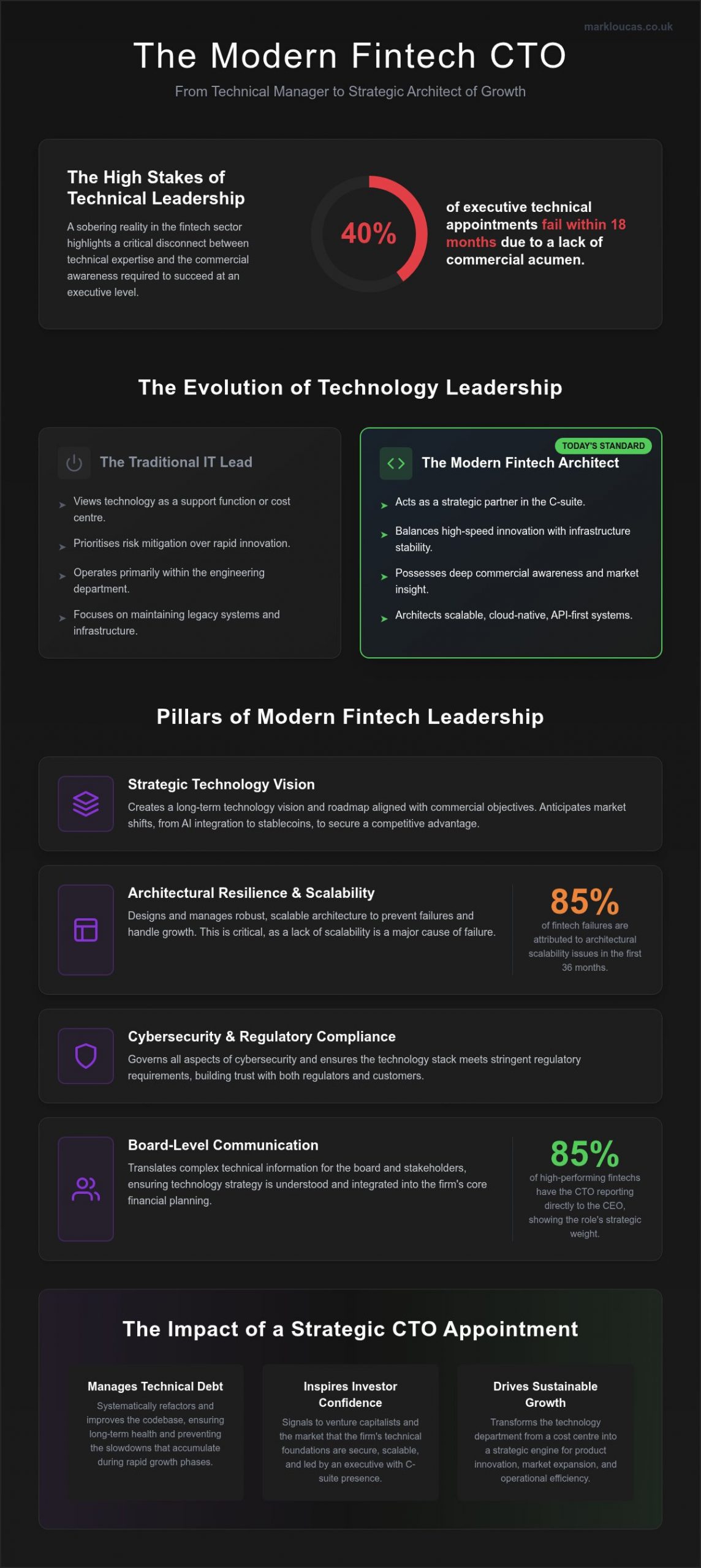
Did you know that 40 per cent of executive technical appointments in the fintech sector fail within 18 months because of a lack of commercial acumen? It’s a sobering reality for many founders who find themselves caught between the urgent need for deep engineering expertise and the demand for sharp business strategy. You likely recognise the difficulty of finding a leader who can navigate the complexities of legacy banking systems whilst simultaneously building the agile, scalable architectures of tomorrow. The role of the chief technology officer has shifted from a purely technical mandate to a position of profound strategic importance.
We understand that the stakes are exceptionally high when securing leadership for payments infrastructure. This guide provides a clear framework for the value a modern technical leader brings to your board. You’ll discover the specific skills required to meet 2026 market demands, from regulatory credibility to architectural resilience. We’ll examine how the right appointment transforms technology from a cost centre into a sophisticated engine for sustainable growth. By the end, you’ll have the confidence to initiate an executive search that aligns with your long term vision.
Key Takeaways
- Recognise how the chief technology officer has evolved into a strategic architect who balances engineering excellence with complex regulatory requirements.
- Learn to align a long term technology vision with your commercial goals to ensure payments infrastructure remains stable whilst driving growth.
- Identify the non negotiable technical foundations and commercial acumen needed to navigate the 2026 fintech landscape successfully.
- Understand the clear distinctions between CTO and CIO roles to build an executive team that supports both innovation and internal operations.
- Gain confidence in your executive search process by identifying the specific expertise required to bridge the gap between legacy banking and modern engineering.
Before we explore the technical intricacies of the sector, you may wish to speak with our specialist consultants regarding your executive needs.
Defining the Chief Technology Officer in a Fintech Context
In the sophisticated environment of 2026, the chief technology officer serves as the primary architect of a firm’s digital destiny. No longer confined to the server room, this individual operates at the intersection of complex engineering and high-level commercial strategy. Within fintech, the role is defined by the ability to transform abstract code into market-moving products that redefine how value is exchanged. They are the essential bridge between the technical nuances of the engineering team and the strategic ambitions of the boardroom, ensuring that every line of code serves a clear business purpose.
This leadership is particularly vital in the sectors of digital banking and payments innovation. Here, the CTO must balance the pursuit of cutting-edge features with the absolute necessity of infrastructure stability. It’s a delicate dance of maintaining reliability whilst pushing the boundaries of what’s possible in real-time financial transactions. Their focus remains on building resilient systems that can withstand the scrutiny of both regulators and a discerning global clientele. The role has shifted fundamentally from managing hardware to architecting the very future of finance.
The Evolution of Technology Leadership in Finance
Traditional banking structures often viewed technology as a support function, managed by leaders who prioritised risk mitigation over rapid innovation. Modern fintech has inverted this model. The contemporary technology head champions cloud-native infrastructures and API-first strategies that allow for unparalleled agility. In the 2026 market, a successful leader must possess a deep commercial awareness. They understand that technical decisions aren’t made in a vacuum; they are the levers that drive market share and operational efficiency in an increasingly crowded landscape.
Why Every Growing Fintech Needs a Dedicated CTO
As a startup matures, the requirements of its technical leadership undergo a fundamental shift. A founding engineer who excelled at building the initial prototype may lack the executive presence needed for the C-suite. Transitioning to a dedicated chief technology officer allows the organisation to manage the technical debt that inevitably accumulates during periods of rapid scaling. This leader provides the technical maturity required when engaging with sophisticated investors. Whether securing venture capital or preparing for a prestigious exit, having a strategic technologist at the helm signals to the market that the firm’s foundations are both secure and scalable.
If you are currently seeking tailored talent advisory to refine your leadership team, we invite you to visit our contact page.
Key Responsibilities of the Technology Leader
The modern fintech landscape requires a leader who can translate complex technical requirements into a coherent business strategy. A primary duty of the chief technology officer involves the creation of a long term technology vision that remains meticulously aligned with the broader commercial objectives. This leadership extends to product and platform development, where the ability to innovate whilst maintaining rigorous security standards is paramount; often, this involves overseeing collaborations with specialised engineering firms like Lightning Kite to deliver high-calibre mobile and web applications. Since 85 per cent of fintech failures are attributed to architectural scalability issues within the first 36 months, the CTO’s role in managing cybersecurity and regulatory compliance is no longer secondary. It is a fundamental pillar of corporate governance. Effective stakeholder communication and board level reporting ensure that technical progress is transparent and understood by those steering the firm’s financial future. Indeed, 85 per cent of high performing fintech organisations now have the CTO reporting directly to the CEO, reflecting the strategic weight of the position.
Strategic Technology Vision and Roadmap Planning
Anticipating technological shifts is a core competency for any executive in this space. The CTO must look beyond immediate requirements to identify trends that offer a genuine competitive advantage, such as the integration of AI for risk monitoring or the adoption of stablecoins. This requires a sophisticated balance between high speed innovation and the absolute stability of payments infrastructure. Resource allocation and budget management are handled with a precision that ensures every pound invested in the stack delivers measurable value to the customer and the shareholder alike. For those looking to secure such expertise, our team provides bespoke executive search solutions tailored to your specific infrastructure needs.
Engineering Culture and Team Architecture
Building a high performing engineering team requires more than just hiring talented developers. It involves architecting a culture that prioritises continuous improvement and a security first mindset. The chief technology officer designs the team structure to support rapid deployment whilst ensuring that legacy knowledge is preserved. Sourcing these rare individuals often requires the assistance of specialised fintech banking technology recruiters who understand the unique pressures of the digital banking sector. This ensures the engineering team is not only technically proficient but also commercially aligned with the firm’s long term vision.
To discuss specific candidate profiles and how they might integrate into your unique organisational structure, we recommend you contact our executive search team for a private consultation.
Essential Skills and Expertise for Modern Success
A chief technology officer in the current market requires a rigorous foundation in system architecture and software engineering to maintain the integrity of high volume financial platforms. However, technical brilliance is merely the entry requirement. The 2026 landscape demands a deep business acumen, where the leader understands how every technical decision impacts the bottom line and the eventual return on investment for shareholders. They act as a vital translator, stripping away layers of complex technical jargon to present clear, actionable insights to non technical stakeholders. This ensures that the technology strategy is never siloed but remains a core driver of the firm’s commercial success.
The foresight to navigate emerging trends is equally essential. Whether it is the integration of machine learning for fraud detection or the adoption of blockchain for cross border settlements, the CTO must identify which innovations offer genuine value and which are merely distractions. This requires a balanced perspective that values long term stability over short term hype cycles. Success in this role is measured not just by the elegance of the code, but by the resilience and profitability of the platform it supports.
Technical Proficiency in Payments and Digital Banking
Specialised knowledge in RTGS payment consulting and the complexities of ISO 20022 migration has become a non negotiable requirement for leaders in the payments space. The ability to manage the delicate integration of legacy banking systems with modern, cloud native SaaS platforms is what distinguishes a true expert from a generalist. This expertise ensures that the firm can transition to more agile infrastructures without compromising the reliability of existing services. Rigorous adherence to global data security standards remains the cornerstone of trust in the 2026 fintech ecosystem.
Soft Skills and Executive Presence
Beyond the technical stack, the role demands high levels of emotional intelligence to lead and inspire diverse engineering teams across different geographies. A successful executive must possess the gravitas to influence fellow C-suite members, ensuring that technology investments are viewed as strategic assets rather than mere overheads. This requires a discreet and professional demeanour, which is essential for those who operate at the highest levels of the financial sector. They must manage sensitive internal transitions and external partnerships with a quiet confidence, reflecting the meticulous attention to detail required in high value transactions. Leading through influence rather than just authority allows the CTO to foster a culture of excellence that attracts and retains the finest technical talent available.
Our executive search solutions cover all C-suite technology roles, ensuring that your leadership structure is both balanced and future proof.
Understanding the Difference Between CTO and CIO Roles
Confusion between these two executive titles often arises in lean, high growth environments where responsibilities naturally overlap. Whilst they may appear interchangeable to the uninitiated, their primary objectives are distinct and essential for a mature fintech organisation. The chief technology officer focuses on the technology that drives the product and generates revenue, acting as the visionary for what the customer experiences. Conversely, the Chief Information Officer manages the internal systems and data security that keep the organisation running smoothly. In the early stages of a firm’s development, a single individual often covers both functions, but as the business scales towards 2026 standards, this dual mandate becomes increasingly difficult to sustain.
External Innovation versus Internal Infrastructure
The CTO’s gaze is directed outward, driving revenue through product innovation and sophisticated, customer facing solutions. They are the architects of the user interface and the underlying payment rails that define the firm’s market position. In contrast, the CIO prioritises internal efficiency, selecting the employee tools and infrastructure that ensure operational stability. This leader focuses on the internal network and the data management systems that support the staff. These two roles must maintain a collaborative relationship, particularly regarding end to end security, to ensure that the firm’s internal protocols are as robust as its external offerings.
Choosing the Right Role for Your Organisation
Prioritising which role to hire first depends entirely on the current lifecycle of your business. A startup primarily focused on building a market moving product will naturally prioritise a chief technology officer to lead their engineering efforts. As the organisation matures and internal complexity grows, the need for a dedicated CIO becomes paramount to protect the firm’s assets and optimise internal workflows. Utilising a specialised fintech executive search can help you identify which specific leadership profile your firm requires at this juncture. The Chief Operating Officer often plays a vital role in supporting these technology functions by ensuring they remain grounded in the firm’s broader operational reality.
If you are ready to refine your C-suite structure with precision, we invite you to request a talent advisory consultation to discuss your specific requirements.
For those seeking a tailored approach to leadership acquisition, we invite you to get in touch with Mark Loucas for bespoke talent advisory.
Strategic Appointment of Executive Technology Talent
Securing a chief technology officer who possesses both the technical depth and the commercial maturity required for the 2026 market is an intricate challenge. The global demand for these rare individuals has created a landscape where the most suitable candidates are often not actively seeking new opportunities. This necessitates a move away from the volume driven methods of generalist agencies. A boutique consultancy offers the discretion and depth required to engage with elite talent who value privacy above all else. Success in this sector requires a rigorous vetting process that goes beyond a standard interview. It assesses a candidate’s ability to navigate the specific regulatory pressures of the payments industry whilst maintaining infrastructure stability.
Market mapping and intelligence are indispensable tools in this pursuit. By identifying passive talent within prestigious districts and global hubs, an organisation can build a pipeline of leaders who are already proven in similar high stakes environments. This proactive approach ensures that when a vacancy arises, the search is targeted and efficient. It allows for a deeper understanding of the candidate’s history and their reputation amongst the initiated. Partnering with a specialist ensures that every detail is managed with expert care.
The Executive Search Process for Fintech Leaders
A successful search begins with a meticulously crafted brief that captures the grand vision of the firm. This process moves through several distinct stages, from initial market mapping to the final appointment. Cultural alignment is as critical as technical proficiency. A leader must share the firm’s values to drive long term success. We utilise our specialised financial recruitment networks to access non public opportunities that are often invisible to the broader market. This ensures a level of exclusivity that generalist firms simply cannot replicate.
Navigating the Competitive Global Talent Landscape
The competition for leadership is particularly fierce in established centres such as London, Dubai, and Singapore. Understanding regional nuances and salary benchmarks is vital for any organisation looking to attract top tier talent. In London, for example, base salaries for a fintech CTO typically range from £180,000 to £275,000. These are often supplemented by significant equity stakes of 0.5 per cent to 2.0 per cent. Market intelligence provides the clarity needed to navigate these expectations with confidence. Ultimately, the successful appointment of a chief technology officer acts as a catalyst for growth, securing the firm’s infrastructure and its place at the forefront of the digital banking revolution.
To ensure your leadership team is equipped for the challenges of the coming years, we invite you to contact our specialist consultants for a private discussion.
Architecting the Future of Global Fintech
The transition from a purely technical lead to a strategic growth architect is now complete. We have explored how a chief technology officer must balance the agility of modern engineering with the absolute stability required for payments infrastructure. This role is no longer about managing servers but about navigating complex regulatory landscapes whilst driving commercial value. By understanding the distinct nuances between internal operations and external innovation, your organisation can build a leadership structure that is both resilient and forward-looking.
Finding an executive who possesses this rare blend of technical brilliance and commercial acumen requires a partner with deep local authority. With over a decade of specialised experience in fintech recruitment, Mark Loucas Ltd provides the discreet and personalised executive search solutions your firm deserves. Our expertise in the global payments and digital banking sectors ensures that your interests are managed with meticulous care. We invite you to secure your next technology leader with Mark Loucas Ltd today. The right appointment will define your place in the future of finance.
Frequently Asked Questions
What is the typical salary for a Chief Technology Officer in 2026?
In 2026, the base salary for a chief technology officer in London typically ranges from £180,000 to £275,000. Total compensation packages often include equity stakes between 0.5 per cent and 2.0 per cent for those joining early stage firms. These figures reflect the high demand for individuals who can bridge the gap between engineering and board level strategy. Packages in other global hubs like Dubai or Singapore are similarly competitive, reflecting the niche expertise required.
Does a CTO need to have a computer science degree?
Whilst a computer science degree provides a rigorous foundation in architectural principles, it is not an absolute requirement for every technical leader. Many successful executives possess degrees in mathematics, physics, or engineering, or have built their expertise through decades of hands-on experience. However, a deep understanding of software engineering and system design remains non negotiable. In the sophisticated 2026 fintech landscape, a candidate’s proven track record of delivering scalable products often carries more weight than their formal education.
How many years of experience are required to become a CTO?
Most organisations seek a chief technology officer with at least 10 to 15 years of experience in the technology sector. This usually includes a significant period in leadership roles where they have managed diverse teams and complex budgets. In the payments industry, specific experience with legacy system integration and modern API first strategies is highly valued. It’s not just about the number of years, but the quality of the challenges they have successfully navigated during their career.
Is the CTO role different in a startup compared to an enterprise?
The role varies significantly depending on the organisation’s maturity. In a startup, the CTO is often a hands-on builder who writes code and defines the initial architecture. In an enterprise, the focus shifts towards governance, regulatory credibility, and managing large scale technical debt. Whilst the startup leader prioritises speed and innovation, the enterprise executive focuses on sustainability and operational efficiency. Both must remain commercially aligned, but their daily tasks reflect different stages of the business lifecycle.
Can a CTO also be a founder of the company?
It is very common for a chief technology officer to be a co-founder, especially in firms where the core product is a technical innovation. These individuals often possess the original vision for the platform and drive the initial development. As the company scales, a founding CTO must decide whether they wish to remain in a strategic leadership role or return to a more hands-on engineering position. This transition requires a significant shift in focus from building code to building a business.
What is the difference between a CTO and a VP of Engineering?
The distinction lies in the focus of their leadership. A CTO is primarily concerned with the long term technology vision and how it supports the firm’s commercial goals. In contrast, a VP of Engineering focuses on the execution of that vision, managing the daily operations of the engineering team and ensuring projects are delivered on time. The CTO looks outward at market trends and innovation, whilst the VP of Engineering looks inward at team health and process efficiency.
How does a CTO manage regulatory compliance in fintech?
What are the most important interview questions for a CTO candidate?
Effective interview questions should probe both technical depth and commercial acumen. You might ask how they have managed architectural scalability issues or how they align technical roadmaps with business growth targets. Inquiring about their experience with specific regulations, such as the Money Laundering Regulations 2026, provides insight into their regulatory credibility. Finally, asking how they have influenced other members of the C-suite on significant technology investments reveals their executive presence and ability to drive strategic change.

Article by
Liam Henfrey
Liam Henfrey is a seasoned specialist in the payments and banking sectors with over two decades of experience. As the Founder and CEO of FINOPSIS and Managing Director at Mark Loucas Ltd, he advises organisations on complex financial operations and technology. His career includes senior roles at PwC, Deloitte, and Visa Europe.
Related Fintech Recruitment Guides
If you liked this guide then you may also like the following: