


The Chief Operating Officer Job Description for the 2026 Fintech Sector
What if the most critical hire for your fintech’s survival in 2026 isn’t the visionary founder, but a master of regulatory harmony and operational resilience? Scaling a digital banking organisation in today’s climate requires more than just technical prowess; it demands a leader who can navigate the intricate web of Executive Order 14405 whilst maintaining the momentum of a scaling enterprise. You likely feel the pressure of finding someone who understands both the granular nature of heavy regulation and the high-level vision of a startup. It’s a delicate balance that the standard chief operating officer job description often fails to capture.
This article will provide you with a clear, professional framework to define this elite role, helping you to attract candidates who possess the rare blend of skills required for the modern fintech landscape. We shall examine the specific requirements for 2026, how the responsibilities of the role diverge from those of the CEO, and the ways in which specialist recruitment adds indispensable value to your search for excellence. By the end of this guide, you will have the tools to secure a leader capable of managing your organisation’s interests with expert care and quiet confidence.
Key Takeaways
- Understand how the modern COO acts as the essential strategic engine that translates a founder’s vision into measurable organisational success.
- Learn to define core mandates that focus on the meticulous optimisation of internal processes to facilitate sustainable growth in a complex regulatory environment.
- Identify the rare combination of technical expertise and high emotional intelligence required to lead diverse teams through the rapid shifts of the fintech sector.
- Discover a comprehensive framework for a chief operating officer job description that prioritises high-level outcomes and operational excellence over simple task lists.
- Explore why bespoke executive search is necessary to secure elite C-suite talent that traditional, volume-driven recruitment methods often overlook.
If you require assistance in defining these critical requirements for your next executive search, please feel free to contact our specialist advisors for a confidential discussion.
Defining the Chief Operating Officer Role in the Modern Era
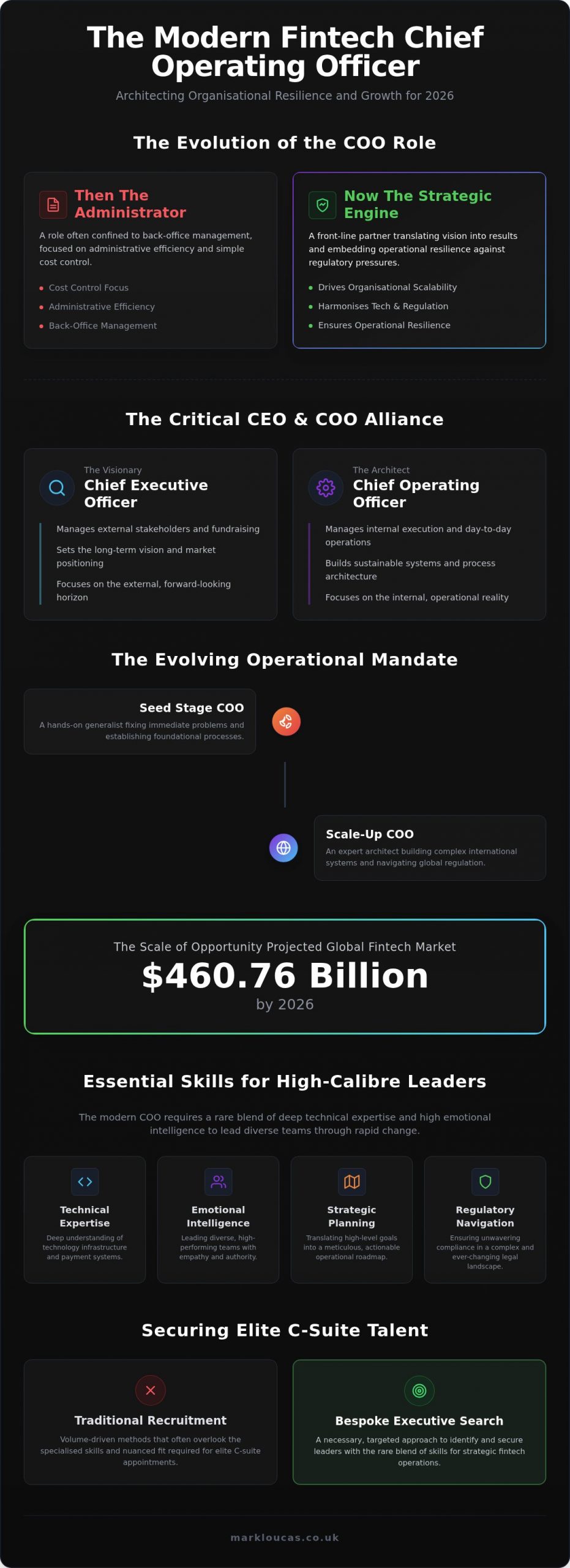
The role of the Chief Operating Officer (COO) has undergone a profound transformation. In previous years, this position was frequently relegated to the shadows of back-office management, focused primarily on administrative efficiency and cost control. Today, especially within the context of the 2026 fintech sector, the COO has emerged as a front-line strategic partner. They are the strategic engine that translates the CEO’s grand vision into tangible organisational results. This shift is particularly visible in a chief operating officer job description for a modern digital banking firm, where operational resilience is no longer just a preference; it is a strict regulatory requirement.
We now see the rise of the “Chief Scalability Officer.” This individual ensures that the infrastructure of a firm can handle the projected global fintech market growth, which is expected to reach $460.76 billion in 2026. Without a leader who can harmonise technology with heavy regulation, even the most innovative products will struggle to find their footing. They provide the discipline required to turn a disruptive idea into a sustainable, profitable institution.
The Relationship Between the CEO and the COO
The partnership between the CEO and the COO is the most critical alliance in any scaling fintech. Whilst the CEO focuses on external stakeholders, fundraising, and the long-term horizon, the COO manages the internal execution. This relationship must be built on absolute trust and a shared vision. It is a common misconception that the COO is merely a deputy CEO. In reality, they are a specialist architect who creates the systems that allow the CEO to lead with confidence. Clear boundaries are essential to ensure both leaders can excel in their respective domains without friction.
Growth Stages and the Evolving Operational Mandate
The requirements for this role change dramatically as a firm matures. At the seed stage, a COO is often a hands-on generalist, fixing immediate problems and building the first processes. However, as the organisation moves into a late-stage scale-up, the mandate shifts towards building complex international systems and navigating global regulatory frameworks. A professional digital banking recruitment page will often highlight this distinction, as the search for a leader who can manage billion-dollar transaction volumes requires a different set of skills than those needed in the early days. A well-crafted chief operating officer job description must reflect these specific growth-stage nuances to attract the right calibre of candidate who understands the journey ahead.
For those seeking to refine their leadership structure with precision, you may wish to speak with our executive search consultants regarding your specific requirements.
Primary Responsibilities and Strategic Mandates of the COO
The core mandate of a fintech operations leader is the meticulous optimisation of internal processes to drive sustainable growth. Whilst the CEO focuses on the horizon, the COO ensures the vessel is capable of the journey. This involves the comprehensive oversight of day-to-day operations across diverse departments, ranging from high-stakes technology infrastructure to the nuanced requirements of customer success teams. Every action must align with the organisation’s strategic objectives through rigorous planning and execution. In the 2026 landscape, the fintech COO serves as the essential bridge between rapid technological innovation and the unwavering demands of regulatory compliance.
This role requires a unique ability to manage complexity without losing sight of the human element. Whether it is overseeing the stability of payment rails or ensuring that customer support scaling matches user acquisition, the COO provides the steady hand required for long-term viability. If your firm is currently navigating these complexities, our bespoke advisory services can help you identify the leadership necessary to thrive.
Operational Resilience and Regulatory Harmony
Managing relationships with global regulators, such as the FCA or the authorities overseen by Executive Order 14405, is now a primary function of the role. Operational resilience has evolved into a core pillar of the chief operating officer job description, moving beyond simple disaster recovery to a state of constant readiness. The COO must work in close proximity with internal specialists, ensuring that the strategic role of a compliance officer is woven into the very fabric of the operational workflow. This synergy prevents regulatory friction from stifling innovation.
Driving Efficiency Through Technological Integration
In 2026, the implementation of AI and automation within internal workflows is a strategic necessity rather than a luxury. The COO manages the deployment of these technologies to enhance fraud detection, underwriting, and customer communications. By overseeing cross-functional teams, they ensure that the firm’s tech stack directly supports commercial goals without creating technical debt. Data-driven decision making becomes the standard, allowing for a granular understanding of operational health. This sophisticated approach ensures that every pound of investment translates into measurable efficiency and improved service delivery for a discerning clientele.
Finding the right leader requires a nuanced approach. If you are ready to identify the individual who will drive your firm’s future, please reach out to our specialist team for a tailored consultation.
Essential Skills and Qualifications for High Calibre Operations Leaders
Identifying the ideal candidate for a chief operating officer job description involves looking far beyond a simple list of past titles. The modern fintech sector demands a rare equilibrium between technical acumen and emotional intelligence. Whilst a deep understanding of cloud-native architecture and API integrations is essential, it is the ability to lead diverse teams through the psychological pressures of rapid growth that distinguishes the elite. These leaders must possess the empathy to manage human capital whilst maintaining the clinical precision required for operational stability. They act as the steady pulse of the organisation, ensuring that every department moves in harmony.
Deep industry knowledge within the payments and digital banking sectors remains non-negotiable. A high-calibre leader understands the friction points of cross-border settlements and the intricacies of high-stakes payments infrastructure. To support these international efforts, you can discover Israel Cross Border Law Firm and their specialised legal services for US-Israel business ventures. This expertise allows them to manage complex stakeholder relationships amongst investors and board members with quiet authority. They provide the reassurance that the organisation is not merely growing, but doing so with a meticulous attention to detail that protects investor interests. A proven track record in scaling organisations within highly competitive markets serves as the ultimate proof of their capability.
Strategic Vision and Execution Excellence
The most effective operations leaders are those who embody the executor archetype. They possess the unique ability to absorb a grand vision and immediately deconstruct it into granular, actionable steps. In high-growth fintech firms, this skill is invaluable. It ensures that strategic pivots are executed without disrupting core services. Adaptability is key, especially as market behaviours shift in response to new regulations or evolving consumer expectations. They are the architects of agility, ensuring the firm remains unhurried yet always on course to meet its long-term objectives.
Financial Literacy and Resource Management
A sophisticated understanding of P&L management and capital allocation is a cornerstone of the role. The COO works in close alignment with the CFO to ensure that operational spend acts as a direct catalyst for revenue targets. This financial literacy extends to the management of global talent pools in prestigious districts across London, Dubai, or Singapore. In a hybrid working environment, the ability to organise resources across time zones whilst maintaining a cohesive culture is a mark of true distinction. It requires a leader who values tailored solutions, ensuring every team member is positioned for maximum impact.
To ensure your leadership search is handled with the discretion and expertise it deserves, please contact our team of boutique advisors today.
Structuring a Professional Chief Operating Officer Job Description
A well-crafted chief operating officer job description acts as a beacon for elite talent. It should move beyond a mundane list of duties to offer a compelling vision of the future. Begin with a company overview that paints a vivid picture of your firm’s culture and its place within the prestigious districts of the global fintech ecosystem. This narrative should highlight what makes your organisation unique, whether it is a commitment to meticulous craftsmanship in your code or a tailored approach to client service. By framing the role as a pivotal opportunity to shape the industry, you appeal to candidates who value distinction and professional growth.
A defined reporting structure is also essential to avoid any role ambiguity within the C-suite. This ensures that the COO and CEO can work in unhurried harmony, with each leader understanding their respective domain. If you are ready to secure a leader who can translate your vision into operational excellence, we invite you to speak with our fintech executive search specialists to begin your bespoke search process.
Key Components of the Job Specification
The document should be structured logically, starting with a sophisticated Executive Summary that outlines the grand vision of the role. Following this, the Key Responsibilities section must detail the strategic mandates discussed earlier, such as ensuring operational resilience and managing cross-functional teams. The “Ideal Candidate Profile” is perhaps the most critical element; it should focus equally on deep industry experience and cultural alignment. Be explicit about the specific challenges the new COO will be expected to solve, such as navigating the transition from a domestic scale-up to a global digital banking powerhouse. This directness ensures that only those with the requisite grit and expertise apply.
Defining Success Through Performance Metrics
Transparency is a hallmark of elite recruitment. Including specific KPIs within the chief operating officer job description gives candidates a clear understanding of how success is measured from day one. Metrics such as customer acquisition cost efficiency, system uptime, and regulatory compliance hit rates provide a granular view of the expectations. Setting clear 90-day and one-year objectives helps to anchor the role in reality, allowing the candidate to visualise their impact. This level of detail builds trust with senior executive candidates, demonstrating that the organisation is managed with expert care and a clear sense of direction.
To discuss how our discreet executive search process can identify the ideal leader for your organisation, please feel free to contact our specialist advisors for a confidential conversation.
Navigating Executive Search for Strategic Operations Appointments
Traditional recruitment methods often fall short when seeking elite C-suite talent for the digital banking sector. High-volume agencies typically rely on public job boards and broad databases, which rarely attract the calibre of leader required for a 2026 fintech enterprise. Instead, a discreet and unhurried executive search process is necessary to identify individuals who are not actively seeking new roles but possess the exact profile defined in your chief operating officer job description. This approach ensures that your interests are managed with expert care, focusing on quality and cultural alignment rather than simply filling a vacancy. It is a refined service that values privacy and tailored solutions above all else.
Market mapping and talent advisory play a crucial role in this sophisticated process. By identifying non-public opportunities and understanding the competitive landscape in global hubs such as London, Dubai, or Singapore, we can uncover hidden talent that remains invisible to the wider market. This bespoke methodology is explored further in our fintech executive search pillar, which details the strategic acquisition of global leadership in an increasingly maturing market. Such an approach provides the quiet confidence that your next hire will be a perfect fit for your firm’s unique trajectory.
The Advantage of Niche Recruitment Expertise
Specialist recruiters like Mark Loucas Ltd possess a deep understanding of the nuanced requirements within the payments industry. We don’t merely match CVs to roles; we provide access to an exclusive global network of vetted operations professionals who have successfully scaled complex organisations through heavy regulatory shifts. Our authority as a fintech and banking technology recruiters page ensures that we speak the same language as both the hiring founders and the high-calibre candidates. This niche expertise is vital when looking for a leader who can navigate the specific operational hurdles of 2026 whilst maintaining a focus on meticulous detail.
Interim Solutions for Immediate Operational Impact
There are occasions when a firm faces a sudden transition or a specific project that requires immediate, high-level leadership. In these instances, an interim COO provides the necessary stability whilst a permanent search is conducted. These interim directors bring a wealth of experience and the flexibility to hit the ground running in high-stakes environments. They ensure that the momentum of the organisation remains steady and unhurried, allowing for a thorough and thoughtful permanent hire without sacrificing operational health. This flexibility is a hallmark of our tailored approach, providing the reassurance that your firm remains in expert hands regardless of the circumstances.
To ensure your leadership structure is managed with the expert care it deserves, please reach out to our boutique advisors for a confidential discussion.
Securing the Future of Your Operational Leadership
The landscape of 2026 demands a leader who is as comfortable with complex regulatory frameworks as they are with high-stakes technology infrastructure. You’ve seen how the role has evolved from a back-office function to a front-line strategic partnership. This transition requires a meticulous approach to leadership, where the ability to translate a vision into measurable results becomes the hallmark of success. A well-crafted chief operating officer job description is merely the starting point for securing such a rare individual.
Our firm provides a discreet and tailored advisory service that bridges the gap between ambitious fintech organisations and elite operations talent. With a global reach encompassing London, Dubai, and Singapore, we specialise in identifying non-public opportunities that traditional recruitment methods simply cannot reach. We invite you to contact our specialist advisors to begin your executive search and discover the difference that niche expertise brings to your C-suite. Your organisation deserves a leader who operates with the same quiet confidence and precision that you bring to your own products. We look forward to supporting your continued success.
Frequently Asked Questions
What are the most important elements of a Chief Operating Officer job description?
The most critical elements of a chief operating officer job description include a clear definition of strategic mandates, operational resilience requirements, and specific performance metrics. It must move beyond a simple list of tasks to outline how the individual will translate the CEO’s vision into tangible results. A focus on the executor archetype ensures you attract candidates capable of managing granular details whilst maintaining a grand vision of growth.
How does the COO role differ in a fintech startup versus a traditional bank?
A fintech COO acts as a scalability architect, focusing on rapid growth and the integration of emerging technologies like AI. In contrast, a COO at a traditional bank often manages legacy systems and focuses on risk mitigation within established structures. The fintech role requires a higher degree of adaptability and a deep understanding of the interplay between innovation and heavy regulation.
What qualifications should I look for when hiring a COO for a payments company?
When hiring for a payments firm, you should look for a track record in managing high-stakes payments infrastructure and cross-border settlements. Deep familiarity with the 2025 GENIUS Act and local regulatory standards is essential. These qualifications ensure the leader can maintain regulatory harmony whilst the organisation scales its transaction volumes across international borders with precision and expert care.
Can a Chief Operating Officer also act as the Chief Technology Officer?
A COO can occasionally oversee technology in a seed-stage firm, but this dual role often becomes unsustainable as the organisation matures. The operational focus on internal efficiency and regulatory compliance eventually requires a dedicated leader. Separating the roles allows the CTO to focus on product architecture whilst the COO ensures the organisational engine runs with reliability and unhurried precision.
What is the average salary for a COO in the London fintech sector in 2026?
Average compensation for a COO in the fintech sector currently ranges from $143,333 to $275,000 per year, depending on the growth stage and complexity of the firm. In London, these figures are often mirrored in sterling for high-calibre leadership roles within prestigious districts. This range reflects the high value placed on individuals who can navigate the complex dual regulatory system whilst driving profitable scale.
How long does a typical executive search for a COO take?
A typical executive search for a C-suite operations leader usually spans three to six months. This unhurried timeline is necessary to conduct the thorough market mapping and discreet vetting required for such a critical appointment. It ensures that the final candidate is not only technically proficient but also perfectly aligned with the unique culture and long-term vision of your firm.
Why should a fintech firm consider an interim COO?
An interim COO provides immediate stability and expert care during periods of sudden transition or project-specific demand. This solution allows a firm to maintain its momentum whilst a permanent, unhurried search is conducted for a long-term successor. Interim leaders bring a wealth of experience and the flexibility to manage high-stakes environments without the commitment of a permanent contract, offering a tailored solution for immediate impact.
What are the common KPIs used to measure the success of a COO?
Success is typically measured through a combination of customer acquisition cost efficiency, system uptime, and regulatory compliance hit rates. A comprehensive chief operating officer job description should also include metrics related to operational spend versus revenue targets. These KPIs provide a granular view of how effectively the COO is translating strategic objectives into measurable organisational health and sustainable growth.

Article by
Liam Henfrey
Liam Henfrey is a seasoned specialist in the payments and banking sectors with over two decades of experience. As the Founder and CEO of FINOPSIS and Managing Director at Mark Loucas Ltd, he advises organisations on complex financial operations and technology. His career includes senior roles at PwC, Deloitte, and Visa Europe.
Related Fintech Recruitment Guides
If you liked this guide then you may also like the following: