


Competitor Salary Benchmarking for Fintech Teams in 2026
What if the salary figure you’re using to attract a fintech specialist reflects a different role, seniority level or market altogether? Competitor salary benchmarking can offer useful direction, but a broad job title or public salary range rarely tells the whole story. In the UAE, where fintech roles can combine financial expertise with specialist technical skills, those differences matter.
It’s understandable to look for a clear number when hiring or reviewing pay. The challenge is that salary surveys, online databases and recruitment intelligence each have limits. Unverified assumptions can lead to unrealistic offers or pay decisions. A credible comparison starts with roles that genuinely match in scope, experience, location and total rewards.
This guide explains how to build a more defensible, like-for-like view of relevant competitor pay. You’ll learn how to assess data sources, account for niche fintech positions and use findings to inform hiring, retention and workforce planning. It also explains how specialist market mapping can add context beyond broad averages, while keeping decisions grounded in transparent checks.
Key Takeaways
- Set the market, comparison period and hiring decision before collecting salary figures, so the evidence answers a clear question.
- Use competitor salary benchmarking to compare equivalent roles by responsibilities, seniority, location and total rewards, not title alone.
- Assess each data source for coverage, recency and method, and record what it cannot confirm.
- Present findings as a supported range, noting source dates, confidence limits and gaps before making pay decisions.
- Use specialist market mapping to explore fintech talent pools and role overlap where broad salary sources leave important questions unanswered.
For tailored insight on fintech talent and hiring markets, you can speak with Mark Loucas Ltd.
What competitor salary benchmarking reveals and where it can mislead
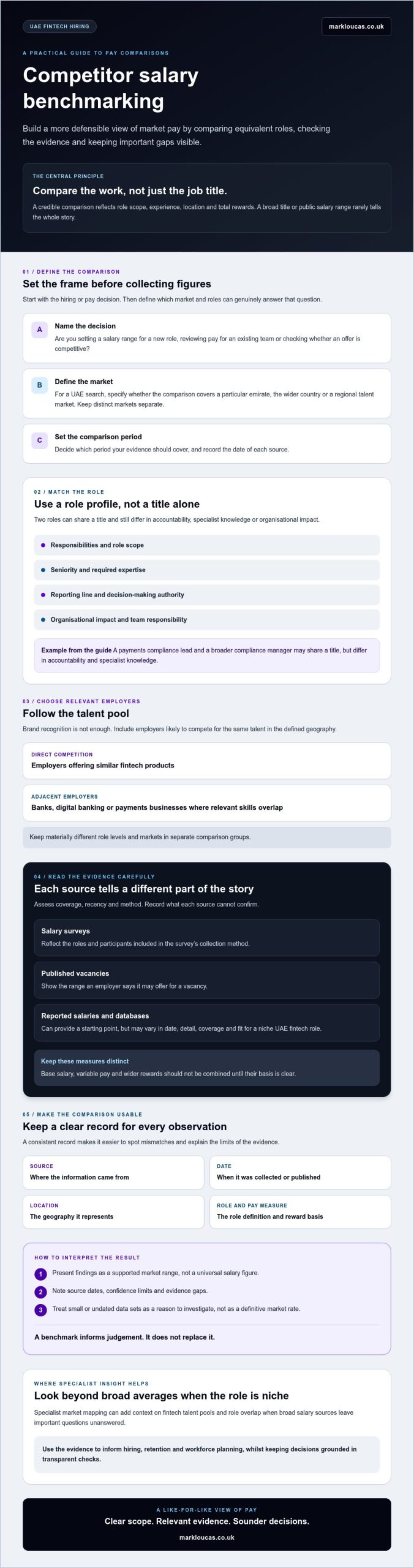
Competitor salary benchmarking is the structured comparison of pay for equivalent roles at employers competing for talent in a defined market. It can indicate a credible market range, but it cannot prove what every employer pays or what a specific candidate will accept.
The value comes from making a fair comparison, not collecting the largest possible set of figures. A broad occupational average or one advertised salary may offer a reference point, but neither is a benchmark on its own. The principle is similar to process benchmarking: comparisons are useful when the measures and context are clear.
What counts as a genuine competitor comparison
Start with the talent pool and hiring market, rather than brand recognition. A direct competitor may offer similar fintech products, whilst an adjacent employer, such as a bank or payments provider, may also compete for the same specialist skills. In the UAE, define the location carefully. Specify whether the comparison covers a particular emirate, the wider country or a regional talent market.
Then match role scope, seniority, reporting line, decision-making authority and required expertise. A payments compliance lead and a broader compliance manager may share a title, but differ in accountability and specialist knowledge. Specify whether the comparison concerns base salary, variable pay or wider rewards, and keep those measures separate until their basis is clear.
Why a headline salary can give the wrong impression
Titles are an imperfect guide. One senior product role might own strategy and team decisions, whilst another focuses on delivery within a defined remit. Without checking responsibilities and organisational context, the figures can look comparable when the roles are not.
Data sources also describe different things. An advertised range shows what an employer says it may offer for a vacancy. A salary survey reflects the roles and participants included in its collection method. Reported salaries may capture individual experiences, but can vary in date, detail and coverage. A database search by position and country can be a useful starting point, yet broad categories may not represent a niche fintech role in the UAE.
Record the source, date, location, role definition and pay measure for each observation. Treat a small or undated set as an indication to investigate, not a definitive market rate. A benchmark informs a decision, but does not replace judgement about the role, candidate and employer’s own pay structure.
If you’re weighing a specialist hiring or talent question, you can discuss the market context with Mark Loucas Ltd.
How to conduct competitor salary benchmarking step by step
A useful benchmark begins with a decision, not a spreadsheet. Are you setting a salary range for a new UAE role, reviewing pay for an existing team or checking whether an offer is competitive? A clear objective will shape which employers, roles and evidence belong in the comparison.
Consistent role definitions make salary comparisons more meaningful because they help ensure each figure relates to similar work, seniority and responsibility.
- Set the decision and market. Define the question you need to answer, the geography relevant to hiring and the period your evidence should cover. For a UAE search, decide whether you’re assessing a specific emirate, the country as a whole or a wider talent market. Keep distinct markets separate.
- Write a role profile. Record the role’s responsibilities, required expertise, seniority, reporting line and organisational impact. A fintech title alone may not distinguish a hands-on technical specialist from a leader setting strategy or managing a team.
- Select the competitor group. Include employers likely to compete for the same talent in the defined geography. Consider direct fintech competitors and adjacent employers, such as digital banking or payments businesses, where relevant skills overlap. Keep materially different role levels or markets in separate groups.
- Choose and collect evidence. Review relevant salary surveys, published vacancies and available market intelligence. Guidance from the U.S. Chamber of Commerce on how to conduct a salary competitive analysis can inform the research process, but its material should not be treated as UAE salary data.
- Log each observation consistently. Record the source, collection date, geography, role and seniority, and whether the figure is stated or estimated. Note whether it represents base salary, variable pay or another reward. Keep bonuses, equity and benefits distinct rather than combining unlike measures into one figure.
- Compare and document limitations. Check that each observation fits the role profile and comparison group. Flag gaps such as unclear responsibilities, limited coverage, old data or an unspecified pay component. Summarise what the evidence supports, what remains uncertain and how those limits affect the decision.
This gives competitor salary benchmarking a clear audit trail, rather than leaving a decision to rest on an isolated figure. If a specialist fintech role is difficult to match, raise a tailored market or talent question with Mark Loucas Ltd as one source of context alongside transparent data checks.
For a tailored discussion about fintech talent and market context, you can contact Mark Loucas Ltd.
How to compare salary data sources and assess their reliability
Reliable competitor salary benchmarking depends on the quality and fit of the evidence, not simply how many figures you collect. Assess every source against three questions: does it cover the right roles and UAE locations, is it current enough for your decision, and can you understand how the figures were gathered?
Reported salary data reflects pay recorded from respondents or other observations, whilst an advertised salary range shows what an employer states it may offer for a vacancy, not what a successful candidate ultimately receives.
| Source | What it can indicate | What it cannot confirm alone |
|---|---|---|
| Salary surveys | Pay patterns within the survey’s stated sample and role categories | Whether respondents match a niche fintech role or the relevant UAE hiring market |
| Salary databases | Directional comparisons by job title and location, depending on their data | That a broad title reflects the role’s actual scope, seniority or pay components |
| Vacancy adverts | The range an employer publishes for a particular opening | The final agreed salary or whether the range remains current |
| Recruiter intelligence | Market context from relevant hiring activity and candidate conversations | A representative salary dataset unless its coverage and method are clearly established |
What to check in a salary survey or database
Read beyond the headline figure. Check the publication date, geographic coverage, role taxonomy, respondent profile and stated methodology. Look for sample context and confirm whether the data refers to base salary, variable pay or total rewards. A source that does not represent fintech-specific responsibilities or the UAE locations you’re assessing should be marked as limited, not treated as a direct match.
More sources do not automatically create stronger evidence. Several databases may rely on similar self-reported profiles, while different sources may group unlike roles under the same title. Benchmarking competitive pay levels also involves considering how evidence is analysed and applied, rather than relying on a headline number.
How to handle adverts and recruiter intelligence
For each advert, record when you viewed it, the named location, role scope and whether the range is stated clearly. Treat recruiter insight as context, then ask what roles, employers, geography and period it covers. Specialist intelligence can help explain talent overlap in fintech, payments or digital banking, but its basis should be transparent.
Keep source notes beside each observation. That makes gaps visible and helps decision-makers judge how much weight each figure deserves.
For a tailored discussion about fintech hiring and talent markets, speak with Mark Loucas Ltd.
How to turn competitor salary benchmarks into sound pay decisions
A benchmark should inform a pay decision, not make it automatically. The right response depends on the role’s responsibilities, the strength of the evidence and your organisation’s hiring and retention aims. Matching or exceeding a competitor’s figure without that context can create inconsistency without solving the underlying recruitment challenge.
Build a decision-ready benchmark summary
Bring the evidence together in a concise record that decision-makers can review and revisit. Include:
- Role definition, including responsibilities, seniority and required expertise
- Comparator employers and the geography covered, such as Dubai or the wider UAE
- Source names and collection dates
- Pay components, with base salary, variable pay and benefits clearly distinguished
- Evidence quality, including gaps, assumptions and any unresolved differences
Separate stronger, well-matched evidence from directional signals, such as a broad job category or an advert with limited role detail. Present a reasonable range where the evidence supports one, and explain its limits. If the data is sparse or inconsistent, say so rather than implying a level of precision it cannot support. Describe confidence in plain terms, such as stronger, indicative or weak evidence, and record the reasons.
Set out the recommendation as conditional. For example, a range may be appropriate if the role scope remains as defined and the hiring market is unchanged. Record why the chosen position within the range fits the role requirements, internal pay structure and recruitment objective. This gives leaders a consistent basis for review if the assumptions change.
Use the findings in hiring and workforce planning
External evidence is one input. Consider it alongside the expertise the role requires, the level of impact expected and how the proposed pay relates to comparable roles inside your organisation. A higher external range may point to a recruitment or retention risk, but it does not automatically justify changing every related salary. Review the specific role and the reasons behind any gap.
Use the findings to shape realistic hiring parameters and identify roles where retention may need closer attention. Revisit the comparison if responsibilities, seniority or hiring geography change. Expansion into a new market can alter the relevant talent pool, so the original comparator group may no longer fit. Talent intelligence for financial services can help test whether a hiring plan reflects the skills actually available in the market before those assumptions are built into pay decisions.
To discuss a fintech hiring or market question, contact Mark Loucas Ltd.
To discuss a fintech talent or market question, contact Mark Loucas Ltd.
When specialist market mapping can strengthen salary benchmarking
General salary sources can be useful for an initial view, yet may leave gaps when a fintech role combines responsibilities that sit across familiar job categories. Market mapping can add context by helping identify relevant employers and talent pools. It does not, by itself, provide a guaranteed salary dataset or confirm what an employer pays.
Where fintech role comparisons need more context
Consider a payments role that calls for both technical expertise and an understanding of payment operations. A broad technology title may group it with roles that have different accountabilities. In digital banking, a position focused on a particular platform or product area may also differ from a general banking technology role, even if the job titles appear similar.
For competitor salary benchmarking, the important question is whether employers draw on the same pool of people for work with comparable scope. Specialist capabilities, decision-making responsibility and the organisation’s needs can all affect that comparison. Mark Loucas Ltd focuses on fintech, payments and digital banking, with payments industry recruitment expertise providing relevant sector context. Its market mapping and intelligence services may help frame which employers and talent pools merit closer review, alongside transparent checks of salary evidence.
Use that context to refine the comparison, not to treat a list of employers as proof of a pay rate. If a role crosses sectors or locations, record which talent markets are included and why. Keep evidence gaps visible, particularly where public sources do not describe specialist responsibilities.
How to prepare for a market intelligence discussion
A focused discussion starts with a clear question. Prepare the role brief and note its responsibilities, required expertise, seniority and expected organisational impact. Then set out the target geography, the employers you believe may compete for the talent, and the hiring decision the research needs to inform.
Bring the salary sources already reviewed, including their dates and any limitations. Mark what remains uncertain, such as whether the figures relate to the right role level or include variable pay. For digital banking roles, digital banking recruitment offers related specialist context.
Mark Loucas Ltd provides market mapping, market intelligence and talent advisory, which may offer an additional perspective on a hard-to-compare role. Treat specialist input as one part of the evidence, not a substitute for checking source coverage, definitions and pay components. The result should be a clearer research question and a more considered view of the available evidence.
Discuss your fintech talent market with the team.
Make your next pay decision with confidence
Sound competitor salary benchmarking starts with clear role definitions, relevant employers and evidence checked for coverage, recency and limitations. Use the findings to inform a decision, not as an automatic instruction to match or exceed another employer’s offer. Record the reasoning so it can be reviewed if the role or hiring market changes.
For specialist fintech roles, market mapping can add context about relevant employers and talent pools alongside careful checks of salary data. Mark Loucas Ltd focuses on fintech, payments and digital banking, with market mapping, intelligence and talent advisory among its services. The consultancy was founded in 2011.
A clear question and a considered evidence base can help you make pay decisions with greater confidence.
Frequently Asked Questions
What is competitor salary benchmarking?
Competitor salary benchmarking compares pay for equivalent roles at employers competing for talent in a defined market. It helps employers assess external pay evidence alongside their own role requirements and pay structure. A useful comparison accounts for responsibilities, seniority, location and pay components. It isn’t a single advertised salary or broad occupational average, and it can’t confirm what every competitor pays or what a particular candidate will accept.
How do you benchmark competitor salaries?
Start by defining the hiring decision, target geography, comparison period and role. Set out the responsibilities, expertise and seniority, then select employers that compete for similar talent. Gather relevant surveys, databases, vacancy adverts and market intelligence. Record each source, date, location, role level and pay component, and note whether figures are stated or estimated. Compare only evidence that fits, then document limitations and assumptions.
Which sources are best for competitor salary data?
No single source is best for every role or market. Salary surveys and databases can show broader patterns, whilst vacancy adverts indicate the range an employer publishes for a specific opening. Recruiter intelligence may add context about hiring activity and talent overlap. Assess each source for date, geography, role definitions, sample and method. For UAE fintech roles, mark evidence as limited if it doesn’t represent the relevant location or specialist responsibilities.
How often should competitor salary benchmarking be updated?
There’s no universal review interval that suits every employer or role. Refresh the evidence when a hiring decision is being made and revisit it if the role scope, seniority, hiring geography or talent market changes. Check source dates before relying on existing figures, as an older observation may not reflect the market relevant to a current vacancy. Record when the comparison was reviewed and which assumptions still apply.
Can salary benchmarking include bonuses and benefits?
Yes. A benchmark can include variable pay and wider rewards, but each component should be identified and compared on a like-for-like basis. Keep base salary distinct from bonuses, equity and benefits unless the source clearly explains how it combines them. Check whether a figure is an amount offered, reported or estimated. This helps prevent a total rewards package from being mistaken for a base salary comparison.
How can I benchmark salaries for specialist fintech roles?
Define the role through its responsibilities, specialist expertise, seniority and organisational impact, rather than relying on its title alone. Identify employers in the UAE that may compete for the same talent, including relevant fintech, payments and digital banking organisations. Where general data leaves gaps, market mapping can help clarify employers and talent pools. Mark Loucas Ltd provides market mapping, intelligence and talent advisory, which may add context alongside checked salary evidence.
Is salary benchmarking the same as a salary survey?
No. A salary survey is one possible source of pay information, based on its respondents, role categories, geography and methodology. Salary benchmarking is the broader comparison process. It can draw on surveys alongside databases, vacancy adverts and market intelligence, then assess how well each source matches the role and market. A survey result is not automatically a direct competitor benchmark, particularly when specialist roles or local coverage are limited.
Contact Mark Loucas Ltd to discuss your fintech hiring and talent market needs.

Article by
Liam Henfrey
Liam Henfrey is a seasoned specialist in the payments and banking sectors with over two decades of experience. As the Founder and CEO of FINOPSIS and Managing Director at Mark Loucas Ltd, he advises organisations on complex financial operations and technology. His career includes senior roles at PwC, Deloitte, and Visa Europe.
Related Fintech Recruitment Guides
If you liked this guide then you may also like the following: