


Controller in Finance Definition Role and Responsibilities in 2026
In the high-stakes environment of 2026 fintech, the financial controller is no longer merely a guardian of the ledger; they’re the architect of corporate integrity. You’ve likely noticed the lines blurring between the CFO and the controller, particularly within fast-paced payments firms where data moves at the speed of light. It’s a common frustration to feel uncertain about where one mandate ends and the other begins, especially when attempting to clarify the controller finance definition role responsibilities within an increasingly digital arena.
This guide provides a comprehensive breakdown to help you master the complexities of this essential position. We’ll clarify the strategic importance of the function and provide a practical checklist of the skills required to excel. By the end of this article, you’ll have a transparent view of the career progression available within the world’s most prestigious financial centres. We’ll ensure you’re equipped to manage your professional journey with the quiet confidence that comes from expert knowledge.
Key Takeaways
- Understand the precise controller finance definition role responsibilities as the primary guardian of accounting integrity within sophisticated fintech organisations.
- Master the essential daily functions and the month-end close process required to produce the meticulous financial reports that underpin corporate transparency.
- Identify the rare combination of technical accounting mastery and commercial acumen necessary to excel in high-growth payments environments.
- Clarify the distinct boundaries between the controller and the CFO to ensure a seamless partnership that protects and enhances organisational value.
- Discover the strategic career milestones and diverse experiences required to ascend to a senior controllership position within premium financial hubs.
To discover how our executive search team identifies the leaders who will define your firm’s financial future, please visit our contact page for an introductory conversation.
Defining the modern financial controller
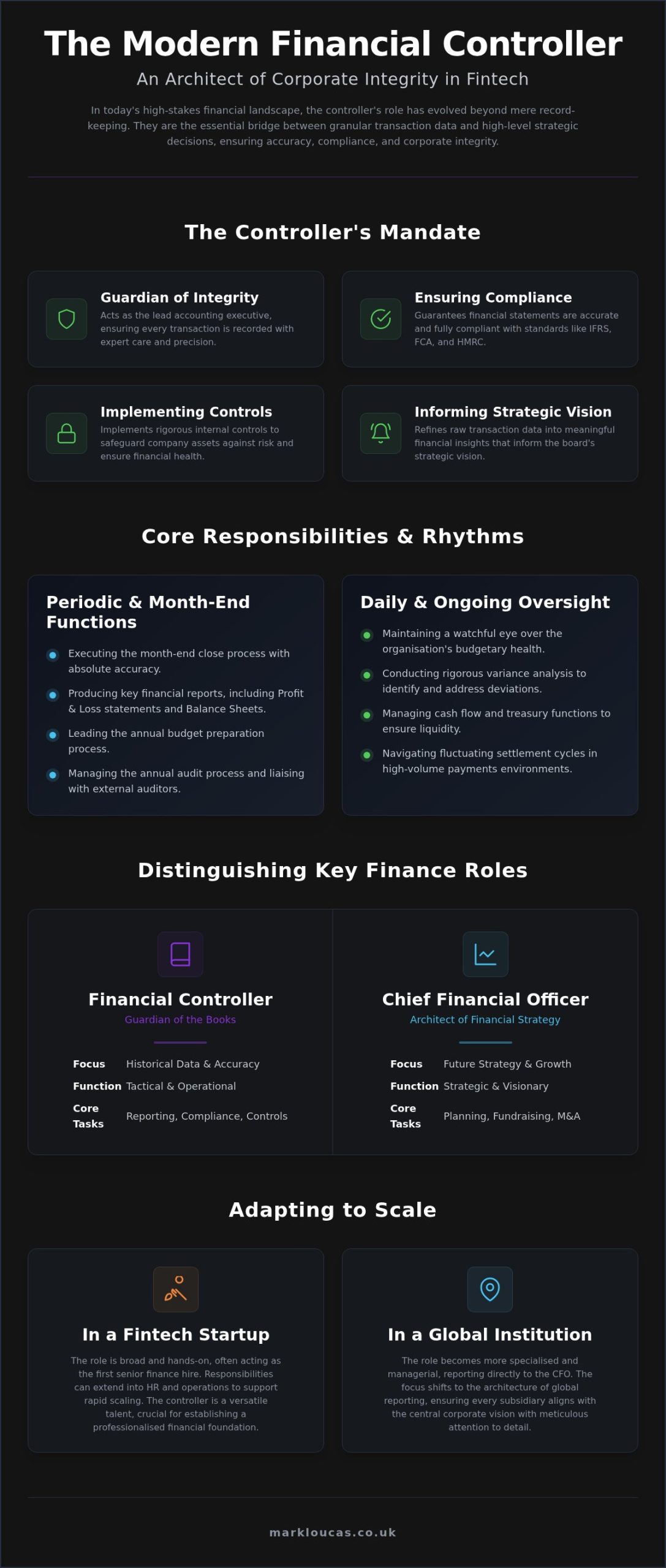
The modern financial controller acts as the lead accounting executive. This position demands absolute precision and an unwavering commitment to the integrity of an organisation’s financial data. A precise controller finance definition role responsibilities begins with the understanding that this individual is the primary guardian of accounting excellence, ensuring every transaction is recorded with expert care. Whilst they’ve traditionally been viewed as the “guardian of the books”, their influence now extends far beyond mere record-keeping. In the modern environment, they provide the transparency required for sustainable growth; they act as a bridge between granular ledger entries and high-level strategic decisions. For many scaling fintech firms, this position represents the first senior finance hire. It marks a transition from basic bookkeeping to professionalised financial management that reflects a commitment to curated excellence.
The primary purpose of the controllership
The controller ensures every financial statement produced is not only accurate but also fully compliant with international standards such as IFRS. This involves a sophisticated transition where raw transaction data is refined into meaningful financial insights that inform the board’s vision. By implementing rigorous internal controls, the controller safeguards company assets against risk, ensuring the organisation’s financial health remains robust. It’s a role defined by craftsmanship and a deep understanding of the subtle nuances within complex financial systems. This meticulous attention to detail ensures that the message remains clear despite the descriptive richness of the underlying data. Their work provides the quiet confidence that a discerning board requires to manage high-value transactions effectively.
How the role differs by company size
In a bespoke fintech startup, the controller’s influence is often broad and hands-on, sometimes extending to HR or operational duties to ensure the business scales effectively. These professionals are frequently sourced through payments industry recruitment specialists who understand the need for versatile talent with a refined skill set. Conversely, within a global banking institution, the role becomes more specialised and managerial. In these large-scale enterprises, the controller typically reports directly to the CFO. They focus on the refined architecture of global reporting and ensure every subsidiary aligns with the central corporate vision with meticulous attention to detail. This hierarchy allows for a steady, reassuring pulse within the finance function, mirroring the pace of a high-end concierge service.
If you wish to discuss how a bespoke recruitment strategy can elevate your finance function, please reach out to our team through our contact page for a private consultation.
Core responsibilities and daily functions
The daily rhythm of the controllership is one of unhurried precision and deep focus. At the heart of the controller finance definition role responsibilities lies the month-end close process, a critical period where the lead accounting executive ensures every transaction is reconciled with absolute accuracy. This isn’t merely an administrative exercise; it’s the process of distilling raw transaction data into a clear, vivid picture of organisational performance. These professionals produce the financial reports that act as anchors of reliability for the board, ensuring that strategic decisions are based on the firmest possible ground.
Beyond the monthly reporting cycle, the controller maintains a watchful eye over the firm’s budgetary health. They lead the budget preparation process and conduct rigorous variance analysis to identify and address any deviations from the plan. In the fast-moving payments sector, this role takes on added complexity. The controller must manage cash flow and treasury functions whilst navigating fluctuating settlement cycles and high-volume transaction flows, ensuring that the business remains liquid and resilient. This requires a level of commercial acumen that allows the controller to act as a discreet, highly connected advisor to the executive team.
Financial reporting and regulatory compliance
The production of profit and loss statements and balance sheets is a task that demands technical mastery and an eye for quality. Within the United Kingdom, the controller ensures that the organisation adheres to FCA regulations and HMRC requirements with meticulous attention to detail. During the annual audit, they take the lead in coordinating with external auditors. This relationship is managed with a professional directness that ensures the audit is completed smoothly, reflecting a commitment to transparency and curated excellence.
Internal controls and risk management
A sophisticated controller designs internal policies that act as a discreet shield against fraud and financial error. In high-growth fintech environments where transaction volumes are immense, they monitor operational risk with a knowledgeable, insider’s perspective. This includes the rigorous oversight of accounts payable and receivable functions to maintain a steady pulse of liquidity amongst complex operational demands. If your organisation requires this level of expert care, our specialised financial recruitment advisors can help you navigate the search for elite talent who value privacy and tailored solutions.
To secure a leader with the precise blend of technical mastery and commercial foresight your organisation demands, please reach out to our experts via our contact page.
Essential skills and professional qualifications
The landscape of 2026 demands a professional whose capabilities transcend traditional bookkeeping. To truly master the controller finance definition role responsibilities, an individual must possess a rare synthesis of technical mastery and sharp commercial acumen. It’s no longer a back-office function; it is a position of curated excellence that requires an unhurried, steady pulse in the face of complex market shifts. Elite candidates often refine their career trajectory through specialised financial recruitment channels, where the subtle nuances of high-end fintech and digital banking are deeply understood. Mastery of cloud-based ERP systems, such as NetSuite or Oracle, has become a baseline expectation for those managing the intricate architecture of modern finance, providing the necessary visibility for high-value decision-making.
Technical expertise and certifications
Within the United Kingdom, prestigious qualifications like the ACA, ACCA, or CIMA are the hallmarks of a professional who has been initiated into the highest standards of the craft. They’re generally considered non-negotiable for senior appointments within the most prestigious financial districts. For global fintech organisations, a controller must navigate the layered complexities of international accounting standards with effortless precision and expert care. As the payments industry matures, the growing need for data analytics skills is paramount. Interpreting large, non-public datasets requires a level of craftsmanship that ensures granular details always align with the grand vision of sustainable growth, allowing the business to move logically from vision to granular history.
Soft skills for effective leadership
Leadership in the controllership is defined by the ability to act as a discreet advisor who can translate complex financial narratives into clear insights for diverse stakeholders. This requires communication skills that are both sophisticated and approachable. Meticulous attention to detail and a sincere commitment to integrity act as anchors of reliability for the entire organisation. A successful controller leads their team with a quiet confidence, eschewing volume-driven management in favour of a tailored, personalised approach that suggests each department is their sole focus. They drive process improvements with the patience and diligence required for high-value transactions, whilst ensuring all financial outcomes are delivered with a sense of refined service.
To discuss how our specialised search team can help you secure the elite leadership required for your firm’s success, please visit our contact page for a private conversation.
Distinguishing the controller from the CFO and other roles
The boundaries of senior finance leadership often appear opaque to those outside the inner circle. Understanding the nuances of the controller finance definition role responsibilities is essential for any organisation aiming for curated excellence. Whilst the controller and the Chief Financial Officer (CFO) are distinct, they must work in a seamless partnership to ensure the firm’s long-term prosperity. This relationship is built on a foundation of mutual respect and shared objectives; the tactical oversight of the former empowers the strategic vision of the latter. For firms seeking to build such a high-calibre leadership team, our expertise in fintech executive search provides a discreet gateway to the industry’s most sought-after talent.
Controller versus Chief Financial Officer
The CFO acts as the outward-facing strategist of the organisation. They focus on the grand vision of capital structure, long-term investment, and investor relations. In contrast, the controller is the inward-facing manager who ensures the historical accuracy of every ledger entry and the robustness of internal processes. The controller acts as the anchor of reliability; they provide the granular, verified data upon which the CFO bases their most critical strategic decisions. Without the controller’s meticulous attention to detail, the CFO’s vision would lack the necessary foundation of truth. It’s a relationship that mirrors the harmony of a well-orchestrated concierge service, where every detail is managed with expert care to maintain a steady, reassuring pulse within the corporate treasury.
The difference between a controller and a comptroller
Confusion occasionally arises regarding the term comptroller, particularly within international contexts or amongst those transitioning from the public sector. This title is more frequently encountered in government departments and non-profit organisations, where it denotes a similar focus on financial oversight and stewardship. Whilst the two terms are often pronounced identically, they possess different etymological roots and cultural connotations. In the private fintech arena, particularly within the premium urban centres of London or Dubai, financial controller remains the standard title for the lead accounting executive. It’s a role that demands the same level of craftsmanship and distinction, regardless of the specific nomenclature used. Choosing the right title ensures clarity within the corporate hierarchy and reflects a commitment to professional directness that high-end firms value above all else.
If you are looking to appoint a leader who bridges the gap between accounting integrity and strategic vision, we invite you to contact us today for a tailored consultation.
To align your career trajectory with the industry’s most exclusive opportunities, we invite you to explore our contact page to begin a bespoke partnership with our executive search team.
Navigating the career path to financial controllership
The journey to the summit of the finance function is rarely linear. It demands a relentless commitment to professional growth and a sophisticated understanding of the controller finance definition role responsibilities within a rapidly shifting market. Unlike traditional corporate environments where progression can feel volume-driven and impersonal, the fintech sector rewards those who approach their career with a sense of craftsmanship and distinction. Identifying the right opportunities often requires the insight of fintech banking technology recruiters who possess the local authority and global reach to navigate private, non-public executive searches for high-calibre talent.
Educational requirements and experience
A degree in accounting or finance remains the essential foundation for any aspiring controller. Many elite professionals begin their journey within a “Big Four” audit firm, where they are initiated into the rigours of international standards and meticulous financial reporting. This experience provides the architectural detail required to manage complex financial ecosystems with expert care. This background allows a professional to move logically from the grand vision of a firm’s strategy to the granular details of its history. Whilst traditional paths suggest five to ten years of progressive experience before reaching this level, the accelerated nature of scaling fintechs often creates unique opportunities for high-calibre talent to ascend more rapidly. It is a path that frequently mirrors the strategic role of a compliance officer, another senior trajectory that values integrity and unhurried diligence.
The evolving role within the fintech sector
By 2026, the controllership has been transformed by the steady pulse of technological innovation. AI and automation are no longer future concepts; they are essential tools that free the controller from manual reconciliations, allowing them to focus on providing tailored financial insights that suggest the client is the sole focus of their attention. Aspirants must develop a knowledgeable insider’s understanding of blockchain and real-time payment rails to remain relevant in global financial centres. Staying informed on related sectors, such as the latest trends in insurtech, ensures a well-rounded perspective that is highly valued in premium urban markets. This continuous evolution ensures that the controller remains an anchor of reliability in a world that values privacy and expert care above all else.
If you require a bespoke approach to identifying the leaders who will safeguard your firm’s financial integrity, our contact page provides a direct path to our expert advisors.
Securing the future of your finance function
The evolution of the financial controller in 2026 demonstrates an architectural shift towards strategic influence within the fintech sector. A precise controller finance definition role responsibilities serves as the essential foundation for accounting integrity and corporate transparency. By synthesising technical mastery with the commercial foresight demanded by the global payments industry, these professionals serve as vital partners to the CFO. Since 2011, Mark Loucas Ltd has specialised in this niche, offering curated excellence in senior finance and executive search to connect high-calibre talent with prestigious leaders. Our deep understanding of digital banking ensures your interests are managed with unhurried diligence and refined service. We invite you to contact Mark Loucas Ltd today for expert fintech recruitment and executive search solutions. Building an elite finance team starts with a single, discreet conversation.
Frequently Asked Questions
Is a financial controller an executive position?
A financial controller often occupies a senior management tier, though within the bespoke structures of elite fintech firms, the role frequently ascends to executive status. They act as the primary architect of financial reporting and internal controls. This position requires a meticulous eye for detail and a steady hand, ensuring every fiscal nuance is captured with absolute precision and quiet confidence.
Can a financial controller become a CFO?
Transitioning from a controller to a Chief Financial Officer is a natural progression for those who possess both technical mastery and strategic foresight. It’s a journey that demands vision. Whilst the controller focuses on the historical accuracy of accounts, the CFO role looks ahead. Many successful leaders in the London fintech scene have made this transition by demonstrating an ability to navigate complex market landscapes.
Does a financial controller need to be a CPA or ACA?
Most prestigious organisations require their financial controllers to hold a formal qualification such as ACA, ACCA, or CIMA. These credentials serve as a hallmark of excellence and professional rigour. In the competitive spheres of Mayfair or the City, such certifications reassure stakeholders that the individual possesses the refined expertise necessary to manage intricate financial frameworks with unwavering accuracy and discretion at all times.
What is the average salary for a financial controller in the UK?
Compensation for this pivotal role varies based on the complexity of the organisation and its geographical setting. In the United Kingdom, a financial controller can typically expect a salary ranging from £70,000 to over £120,000 per annum. Those operating within the high stakes environments of London often command the upper end of this spectrum, reflecting the specialised nature of their contributions to the firm’s success.
For high-calibre professionals within this salary bracket, ensuring personal assets are protected is paramount; you may wish to explore mortgage and protection advice matching to secure your financial future with the same diligence you apply to the corporate ledger.
Is a financial controller higher than a finance manager?
A financial controller typically holds a more senior position than a finance manager, overseeing the broader accounting function with a focus on compliance and reporting. Whilst a finance manager handles day to day operations, the controller ensures the entire financial architecture remains robust. This hierarchy allows for a more balanced approach to fiscal management, where the controller provides the final layer of expert verification.
What tools do financial controllers use most often?
Modern controllers rely on a sophisticated suite of tools to maintain the highest standards of financial clarity. Enterprise Resource Planning systems such as NetSuite or SAP are essential for managing complex data sets across global operations. These are often complemented by advanced analytical software and bespoke reporting platforms, allowing the controller to deliver precise insights that support the firm’s most delicate and high value decisions.
What is the difference between a controller and an auditor?
The distinction lies in their perspective and relationship to the organisation. A financial controller is an internal steward, dedicated to the daily integrity and precision of the company’s fiscal records. In contrast, an auditor provides an external, independent review to ensure that these records meet specific regulatory standards. One builds the financial narrative, whilst the other verifies its absolute authenticity and compliance with diligence.
How has the role of the controller changed with the rise of fintech?
The emergence of fintech has transformed the controller finance definition role responsibilities into a more dynamic and tech-enabled discipline. Controllers now leverage real-time data and automated workflows to provide immediate visibility into financial health. This shift allows them to move beyond traditional record-keeping, becoming strategic partners who navigate the fast-paced digital landscape—often with the support of specialised crypto accounting firms like block3finance.com—with the same meticulous care once reserved for manual ledgers and static reports.

Article by
Liam Henfrey
Liam Henfrey is a seasoned specialist in the payments and banking sectors with over two decades of experience. As the Founder and CEO of FINOPSIS and Managing Director at Mark Loucas Ltd, he advises organisations on complex financial operations and technology. His career includes senior roles at PwC, Deloitte, and Visa Europe.
Related Fintech Recruitment Guides
If you liked this guide then you may also like the following: