


Mastering Executive Interview Questions for Fintech Leadership in 2026
By mid 2026, the global fintech sector has evolved into a landscape where operational profitability and regulatory rigour are valued as highly as disruptive innovation. In this refined environment, the standard executive interview questions fintech leaders once navigated have been replaced by a far more sophisticated form of board level scrutiny. It is no longer sufficient to merely understand the underlying technology; one must now articulate how that technology integrates with the UK’s modernised payments framework and the expanding reach of Open Finance.
You likely recognise the immense pressure of balancing aggressive growth targets with the meticulous requirements of the FCA’s latest roadmap. This guide provides a curated framework for navigating these high stakes interactions with the quiet confidence and expert precision that elite roles demand. We shall examine the complex regulatory queries and technological challenges you will face, ensuring you can demonstrate your strategic value to even the most discerning selection committees. From the nuances of PSD3 compliance to the integration of artificial intelligence, you will gain the clarity required to lead with distinction and secure your place at the centre of the industry’s future.
Key Takeaways
- Understand the transition from market disruption to systemic importance and how this shift redefined leadership expectations for 2026.
- Prepare for high level executive interview questions fintech boards utilise to evaluate the delicate balance between rapid scaling and regulatory rigour.
- Identify the specific cultural markers and scale up behaviours that distinguish successful fintech leaders from traditional corporate banking executives.
- Implement a structured five step preparation framework to navigate board level scrutiny regarding the UK payments modernisation package and Open Finance.
- Discover the strategic advantages of engaging with boutique search specialists to access exclusive and private leadership mandates globally.
If you are looking for expert guidance regarding your next leadership hire, please contact us to discuss how we can support your search.
The Evolution of Fintech Executive Leadership in 2026
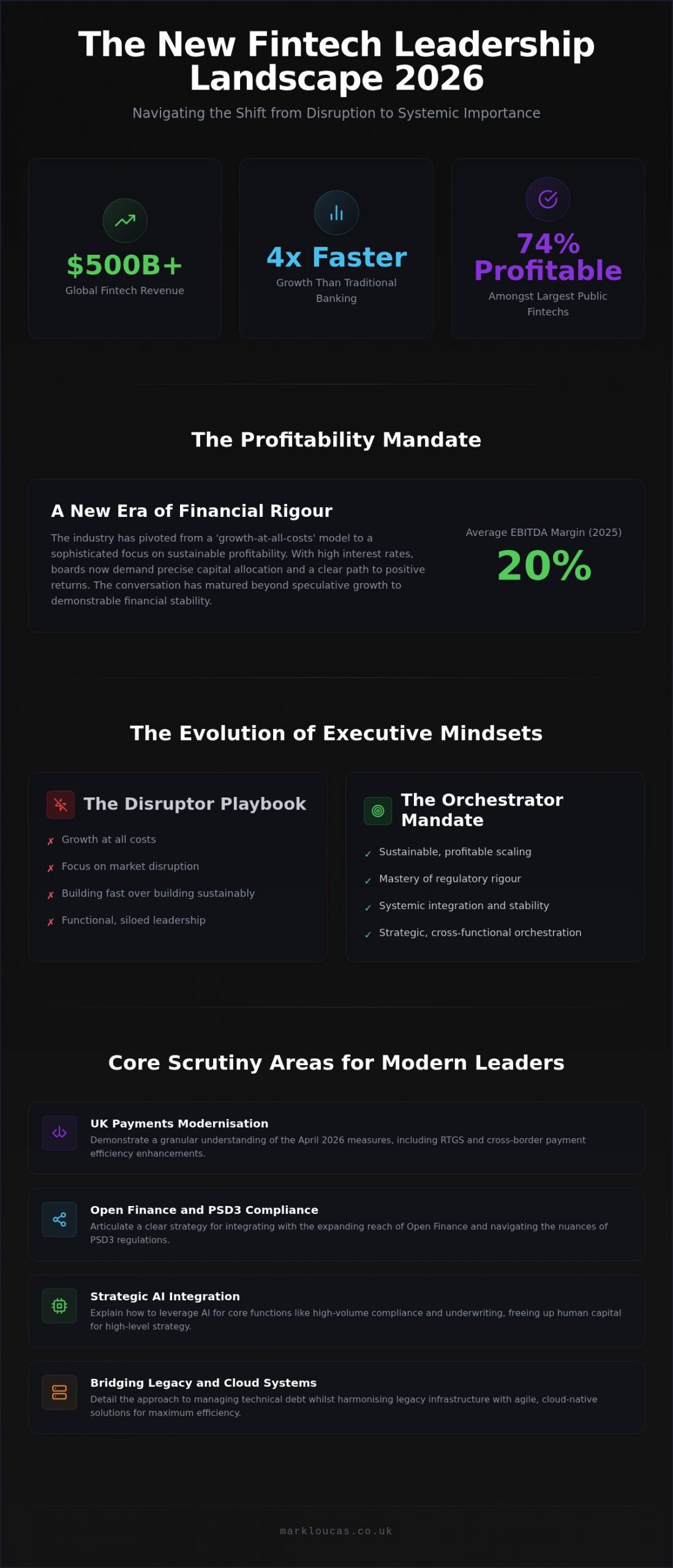
The narrative of fintech has shifted significantly. We’ve moved beyond the era of simple market disruption into a period of systemic importance within the global payments landscape. By mid 2026, the sector has matured, with global revenues surpassing half a trillion dollars and growing four times faster than traditional banking. This maturity means that the executive interview questions fintech boards now pose are designed to probe stability as much as innovation. Leaders must now demonstrate how they can orchestrate growth whilst maintaining the rigorous standards expected of a Tier 1 financial institution.
Top tier firms now demand a convergence of traditional banking stability and agile technological execution. The executive role has transitioned from a functional lead into a strategic orchestrator. It is no longer sufficient to manage a department; one must harmonise complex regulatory requirements with rapid, consumer driven product cycles. This shift is particularly evident in digital banking recruitment, where the focus has moved towards candidates who can bridge the gap between legacy reliability and the speed of modern payments infrastructure.
Navigating Complexity in Digital Banking
The Strategic Importance of Specialised Knowledge
Generalist recruiters often overlook the subtle nuances that define high level fintech roles. Success in this elite space requires more than a standard CV review. It demands the precision of market mapping to identify discreet leadership opportunities that often remain non public. Transitioning from traditional finance to a tech first mindset is a delicate process that requires meticulous attention to detail. It requires an advisor who understands the specific geography of premium urban centres and the cultural signatures of the world’s most prestigious fintech districts, ensuring that every placement is a perfect architectural fit for the organisation’s future.
For those seeking tailored advice on their leadership journey, please refer to our bespoke search services.
Strategic Questions for C Suite and VP Candidates
The shift towards profitability in 2026 has fundamentally altered the nature of executive interview questions fintech candidates encounter. With 74% of the largest public fintech companies now profitable, the conversation has moved away from growth at all costs. Boards now demand a sophisticated approach to capital allocation, particularly in the current high interest rate environment where every pound must yield a demonstrable return. The narrative has matured beyond the speculative growth of previous years, with average EBITDA margins rising to 20% in 2025.
A candidate’s ability to manage technical debt whilst simultaneously driving innovation is a key differentiator. It’s no longer enough to build fast; one must build sustainably. This requires a leader who can articulate the strategic acquisition of talent through fintech executive search to ensure the foundation remains as robust as the facade. In a high interest rate environment, the philosophy regarding capital allocation must be precise. Candidates should be prepared to discuss how they would protect the firm’s balance sheet whilst funding necessary technological advancements.
Vision and Scale Up Strategy
The relationship between the Chief Risk Officer and the Product Head should be one of collaborative tension, where compliance acts as a catalyst for secure innovation rather than a barrier. Ensuring board level transparency regarding cybersecurity and data privacy risks involves translating complex technical threats into strategic business impacts. Leaders hiring for these roles should consider the compliance expert interview questions used to vet those who will safeguard the firm’s reputation.
If you require a more tailored approach to identifying your next leadership challenge, please reach out to our consultants for a private discussion.
Candidates who are considering their next move within the global payments ecosystem are invited to reach out for a confidential discussion regarding their market positioning.
Assessing Cultural Alignment and Scale Up Behaviour
Transitioning from a legacy institution to a tech first environment requires a profound shift in mindset. Whilst traditional corporate banking often rewards risk mitigation and hierarchical stability, the fintech sector in 2026 demands a blend of agility and systemic responsibility. Boards are looking for leaders who can navigate the ambiguity of a Series B or C growth phase. At this stage, structures are often being built whilst the engine is running at full speed. The executive interview questions fintech firms prioritise during these sessions focus on behavioural adaptability rather than just technical prowess.
Success in a scale up environment depends on the ability to influence stakeholders across both technology and finance silos. This requires a bilingual capability. You must translate technical debt into balance sheet risk and product roadmaps into revenue forecasts. Understanding the cultural context of the strategic role of a compliance officer is vital. It demonstrates that you view governance as a core cultural pillar rather than a secondary function. This alignment is what separates a functional lead from a true strategic orchestrator.
Leadership Style in High Pressure Environments
Maintaining team morale during periods of intense regulatory scrutiny or market volatility is a hallmark of elite leadership. In 2026, the introduction of the UK’s modernised payments framework has increased the pressure on executive committees. Transparent communication is essential. You must be able to manage up to a board that may have varying levels of technical literacy. Explaining the implications of the FCA’s Open Finance roadmap in plain, commercial terms is a skill that ensures long term board level support during turbulent periods. Boards often use specific executive interview questions fintech leaders must answer to prove they can handle these unique pressures.
Championing Innovation whilst Maintaining Rigour
Fostering a culture of experimentation without compromising financial security is a delicate act. You need to evaluate a candidate’s history of pivoting strategy in response to market intelligence. This isn’t about changing course on a whim. It’s about data driven agility. As AI now accounts for over 36% of the global fintech market share, the leader’s role in promoting ethical AI and data usage has become a significant cultural marker. Experimentation should be encouraged, but it must always be anchored by the meticulous attention to detail that protects the firm’s reputation and capital.
Organisations looking to secure elite leadership are invited to partner with us to refine their executive hiring process and gain access to non public talent pools.
Advanced Preparation for High Stakes Leadership Interviews
Preparing for the rigorous executive interview questions fintech boards utilise in 2026 demands a level of diligence that mirrors the high value of the role itself. Success isn’t found in rehearsed answers but in a deep, analytical understanding of the firm’s specific ecosystem. We recommend a five step framework to ensure absolute readiness. This involves analysing the latest regulatory modernisation measures, mapping the competitive landscape, assessing the firm’s technological architecture, scrutinising their path to profitability, and profiling the individual board members you’ll meet. This level of granular detail allows you to enter the room with the quiet confidence of a knowledgeable insider.
Your preparation should culminate in a list of high value questions to ask the board or the CEO. These shouldn’t be generic. They should probe the firm’s long term commitment to innovation and its resilience against market volatility. Our fintech banking technology recruiters often observe that the most successful candidates are those who treat the interview as a strategic consultation rather than a standard assessment. By demonstrating that you’ve already begun to solve their most complex problems, you establish immediate authority.
Market Intelligence as a Competitive Edge
Utilising market mapping provides a distinct competitive advantage. It allows you to understand where a firm sits amongst its peers, particularly in prestigious districts like London’s Square Mile or the DIFC. By identifying the specific resource gaps the board is seeking to solve, you can position yourself as the precise solution to their architectural challenges. Candidates who have researched the specific career trajectories and previous successful exits of their interviewers are far more likely to build immediate rapport. This insight enables you to tailor your communication style to match the board’s specific priorities and technical literacy.
Mastering the Narrative of Success
Your narrative of success must be bespoke. It should connect your past achievements directly to the hiring firm’s current hurdles. When discussing failures or strategic pivots, focus on resilience and the resulting strategic learning. Quantify your impact through metrics that resonate with founders and investors, such as EBITDA margin improvements or successful RTGS migrations. Crafting a compelling vision for the firm’s future under your leadership requires a blend of grand ambition and granular operational detail. This demonstrates that you aren’t just a functional lead, but a strategic orchestrator capable of delivering long term value.
If you wish to discuss how our market mapping can provide your firm with a strategic advantage, please contact our specialist consultants for a private discussion.
Please contact our specialist consultants to discuss your permanent or interim needs.
Strategic Talent Acquisition through Executive Search
In an industry where the stakes are exceptionally high, the transition from volume driven recruitment to a curated search model is essential. Mark Loucas Ltd operates as a discreet boutique advisor, focusing on those non public opportunities that the wider market rarely sees. By utilising sophisticated market mapping and intelligence, we identify niche specialists who possess the rare combination of technical agility and financial rigour. The specific executive interview questions fintech boards utilise are often refined through our market intelligence, ensuring that every candidate is tested on their ability to deliver strategic value within a complex regulatory environment. This bespoke approach ensures that the selection process is as meticulous as the leadership it seeks to secure.
Partnering with a Niche Consultant
Navigating the executive interview questions fintech firms pose requires a partner who understands the granular details of the role. High stakes leadership appointments require more than a generalist’s touch. Specialist fintech recruiters are vital because they understand the subtle cultural signatures of premium urban centres from London and Dubai to Singapore. Our approach is intentionally unhurried, reflecting the patience and diligence required in high value transactions. We manage elite career transitions with a level of discretion that protects the interests of both the individual and the organisation. By accessing a global network of payments and digital banking professionals, we ensure that our clients are presented with a selection of candidates who represent the pinnacle of craftsmanship in their field.
Beyond Traditional Hiring
Modern leadership needs often extend beyond permanent roles. Interim directors play a crucial role in solving project specific challenges, such as navigating the complexity of RTGS migrations or implementing the FCA’s latest Open Finance roadmap. This flexible approach allows firms to close resource gaps with expert precision whilst maintaining their long term strategic vision. Our commitment to specialised financial recruitment ensures a seamless fit between executive ambition and organisational goals. We view our role as one of talent advisory and strategic workforce planning, where the focus remains on curated excellence and the meticulous attention to detail that defines elite fintech leadership. Every search is treated as a unique architectural project, where the aim is to build a leadership team that is both resilient and innovative.
If you would like to explore how our boutique approach can assist your search for elite talent, please reach out to our team for a private consultation.
Securing Your Future in the Global Payments Landscape
The transition towards systemic importance in the fintech sector requires a leadership style that balances technological agility with deep financial rigour. As the industry moves beyond speculative growth, the executive interview questions fintech candidates must answer have become a test of their ability to orchestrate long term value within a sophisticated regulatory landscape. By aligning your strategic vision with the modernised payments framework and focusing on cultural synergy, you can navigate these high stakes interactions with expert precision and the quiet confidence that elite roles demand.
Mark Loucas Ltd has provided specialist fintech executive search since 2011, offering a boutique advisory service for elite professional placements across London, the UAE, and Singapore. Our expertise in global payments and digital banking infrastructure allows us to manage your interests with expert care and meticulous attention to detail. For a discreet and expert approach to your next leadership appointment, please visit our contact page. With the right preparation and a strategic partner, you can step into your next role with absolute clarity and secure your place at the centre of the industry’s future.
Frequently Asked Questions
How do executive interview questions in fintech differ from traditional banking roles?
Executive interview questions fintech candidates encounter typically focus on agility and technological fluency rather than the rigid stability found in traditional banking. Whilst legacy institutions value risk mitigation and long term preservation, fintech firms seek leaders who can navigate rapid scaling and iterative development. You should expect inquiries about your ability to lead through disruption and your comfort with the evolving digital architectures that define the modern financial landscape.
What are the most common C suite interview questions in the fintech sector?
Common C suite inquiries often focus on the intersection of sustainable growth and unit economics within a volatile market. Boards frequently ask how a leader intends to cultivate a high performance culture whilst maintaining the lean operational efficiency required for profitability. You might also be asked to detail your experience with international expansion and how you manage the delicate balance between aggressive innovation and rigorous capital discipline.
How should an executive discuss regulatory challenges during a high stakes interview?
Discussing regulation requires a perspective that views compliance as a strategic advantage rather than a mere operational hurdle. You should highlight your experience in building transparent relationships with global regulators whilst ensuring that your product remains competitive. Demonstrating a proactive approach to evolving frameworks, such as open banking or crypto assets, shows that you possess the foresight to protect the firm’s reputation and long term viability.
What is the best way to demonstrate a growth mindset for a fintech scale up?
Demonstrating a growth mindset involves sharing specific instances where you successfully pivoted a strategy based on market data or internal learnings. Scale ups value leaders who are comfortable with ambiguity and possess the humility to learn from setbacks. Highlighting your commitment to continuous personal development and your ability to empower teams to experiment safely will reassure the board that you’re suited for their dynamic and unhurriedly evolving environment.
How can I prepare for a fintech technical interview as a non technical leader?
Non technical leaders should prepare by focusing on the strategic implications of technology rather than the underlying code. You must understand how the firm’s architecture supports its commercial goals and be able to discuss data privacy, security, and system scalability with confidence. Being able to articulate the trade offs between different technological paths demonstrates that you can lead technical teams even if you aren’t a developer yourself.
What strategic questions should a fintech executive ask the board during an interview?
You should ask the board about their long term vision for the firm’s exit strategy and the specific metrics they use to define success. Inquiring about the level of board involvement in daily operations and their appetite for risk provides valuable insight into the corporate culture. These questions demonstrate your strategic depth and your desire to ensure that your leadership style aligns perfectly with the expectations of the initiated investors.
How does market mapping influence the executive search process in fintech?
Market mapping allows search firms to identify and engage with high calibre talent who may not be actively seeking new opportunities. This process provides a comprehensive overview of the competitive landscape, ensuring that the board has access to the most distinguished professionals in the sector. By utilising detailed market intelligence, a boutique advisor can facilitate a more precise and tailored match between an executive and a fintech firm seeking exceptional leadership.
What is the significance of RTGS and payments expertise in 2026 leadership roles?
Expertise in Real Time Gross Settlement systems and global payments infrastructure is essential as the industry moves towards universal ISO 20022 standards by 2026. Leaders who understand the nuances of instant liquidity and cross border settlement will be uniquely positioned to drive innovation in digital banking. This technical knowledge ensures that the firm remains at the forefront of the financial revolution whilst maintaining the highest levels of operational reliability and meticulous detail.

Article by
Liam Henfrey
Liam Henfrey is a seasoned specialist in the payments and banking sectors with over two decades of experience. As the Founder and CEO of FINOPSIS and Managing Director at Mark Loucas Ltd, he advises organisations on complex financial operations and technology. His career includes senior roles at PwC, Deloitte, and Visa Europe.
Related Fintech Recruitment Guides
If you liked this guide then you may also like the following: