


Succession Planning for C-Level Roles in the Fintech Sector
What would happen to your fintech firm if your Chief Executive Officer stepped down tomorrow without a clear replacement in sight? In the high-stakes environment of UAE digital banking, the sudden departure of a key leader often triggers a wave of uncertainty amongst investors and regulators. It is a reality that many boards find unsettling, particularly when the weight of the entire organisation rests on a few individuals. Mastering succession planning for c-level roles is no longer a luxury, it is a fundamental necessity for maintaining a competitive edge and satisfying the rigorous standards of the Central Bank of the UAE.
Mark Loucas Ltd provides a sophisticated framework through this guide to help you identify and groom future leaders with precision and care. You will learn how to reduce the risk of business disruption and enhance investor trust through demonstrated long-term stability. We will examine how discreet market mapping and talent advisory can transform your leadership pipeline into a source of enduring resilience, ensuring your organisation remains prepared for any transition.
Key Takeaways
- Understand how to transition from reactive hiring to a proactive strategy that secures the long term stability of your fintech organisation.
- Learn the precise methods for identifying high potential individuals amongst your senior management team to build a robust internal leadership pipeline.
- Discover how external market mapping provides a vital benchmark, ensuring your succession planning for c-level roles meets the highest industry standards.
- Gain a structured, step by step framework for formalising executive transitions that minimises business disruption and satisfies regulatory requirements.
- Recognise the critical moments when engaging a specialist search partner is essential to securing elite leadership for your firm’s future.
If you are looking to secure your organisation’s future leadership, you can reach out to our team at Mark Loucas through our contact page for a private consultation.
The Strategic Necessity of Executive Continuity in Modern Fintech
In the fast paced ecosystem of the United Arab Emirates, succession planning is far more than a simple contingency arrangement. It is a proactive, meticulous strategy designed to identify and develop the next generation of leaders before a vacancy even arises. For fintech firms operating within the Dubai International Financial Centre or the Abu Dhabi Global Market, the risks associated with leadership gaps are magnified by intense regulatory scrutiny. The Central Bank of the UAE expects a high level of governance. A lack of executive continuity can lead to compliance delays or even licensing concerns.
Beyond regulation, the departure of a Chief Executive or Chief Financial Officer can send ripples through the investor community. In high growth startups, where valuations are often tied to the perceived brilliance of the founding team, executive turnover can lead to a sharp decline in confidence. Maintaining momentum is critical whilst competing in the sophisticated payments landscape of the Middle East. Any pause in innovation due to a leadership vacuum allows competitors to seize market share rapidly. A well executed strategy for succession planning for c-level roles ensures that the firm’s trajectory remains stable during periods of transition.
Defining Succession Planning for High Stakes Environments
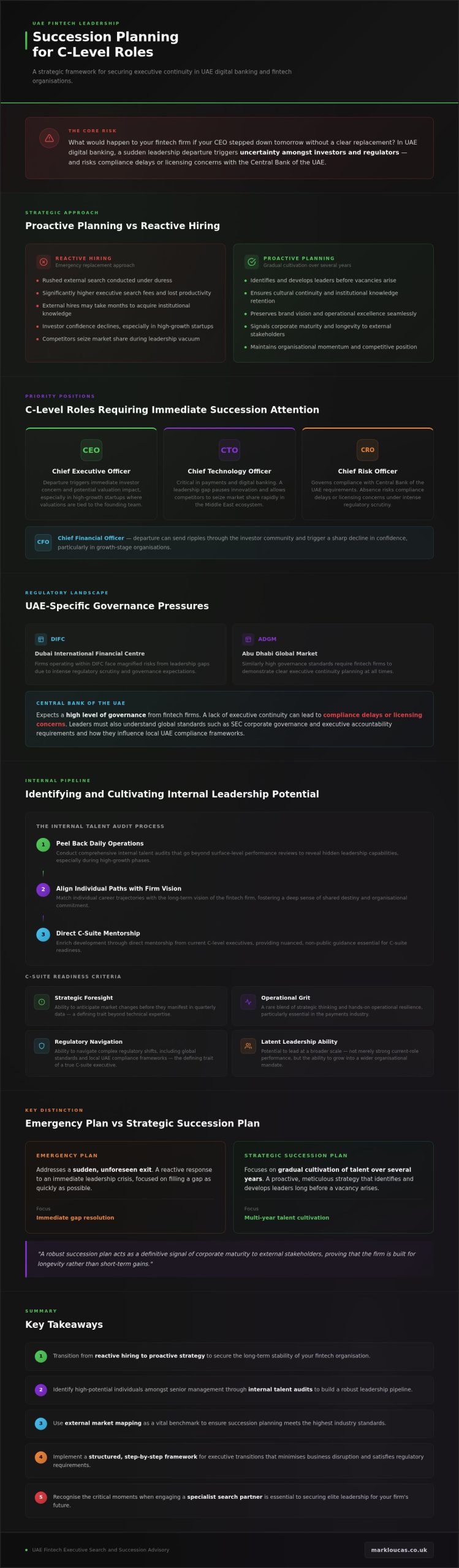
Succession planning for c-level roles is distinct from mere emergency replacement. Whilst an emergency plan addresses a sudden, unforeseen exit, a long term strategic plan focuses on the gradual cultivation of talent over several years. Key roles requiring immediate attention include the CEO, CTO, and Chief Risk Officer. A robust plan acts as a definitive signal of corporate maturity to external stakeholders, proving that the firm is built for longevity rather than short term gains. It shows that the board has considered the future with the same diligence it applies to its current balance sheet.
Why Proactive Planning Outperforms Reactive Hiring
The financial implications of reactive hiring are often overlooked. A rushed external search, conducted under duress, can cost significantly more in terms of executive search fees and lost productivity than a planned internal transition. Proactive planning ensures cultural continuity and the retention of vital institutional knowledge that external hires may take months to acquire. For those in digital banking recruitment, the strategic value of continuity lies in the seamless preservation of the brand’s vision and operational excellence. It allows an organisation to evolve without losing the core values that defined its early success.
To ensure your leadership pipeline remains robust, we invite you to discuss your executive needs with our specialist advisors for a private consultation.
Identifying and Cultivating Internal Leadership Potential
Identifying potential within the existing ranks requires a disciplined, almost architectural approach. It is not merely about rewarding performance in a current role. Instead, boards must look for individuals who possess the latent ability to lead at a broader scale. Comprehensive internal talent audits are essential tools here. These audits peel back the layers of daily operations to reveal hidden leadership capabilities that might otherwise go unnoticed in the rush of high growth phases. By aligning individual career paths with the long term vision of the fintech firm, organisations can foster a deep sense of shared destiny. This process is often enriched by direct mentorship from current C-level executives, who provide the nuanced, non-public guidance necessary for success in succession planning for c-level roles.
Criteria for Assessing Future C Suite Readiness
Assessing readiness involves looking far beyond technical prowess. In the payments industry, leaders must possess a rare blend of strategic foresight and operational grit. Whilst technical expertise is the foundation, the ability to navigate complex regulatory shifts is what defines a C-suite executive. This includes understanding global standards, such as SEC corporate governance and executive accountability requirements, and how they influence local UAE compliance frameworks. Leaders must be able to anticipate market changes before they manifest in the quarterly data. Strategic thinking in this context means the ability to pivot an entire organisation’s focus whilst maintaining the trust of both employees and shareholders.
Cultivating Leadership Competencies within Fintech Teams
Once potential is identified, tailored development programmes must be implemented with meticulous attention to detail. These programmes should not be generic or volume driven. They must address the specific gaps in a candidate’s profile, whether that is financial literacy or the soft skills required for executive influence. Cross-functional experience is particularly valuable in the fintech sector. Moving a senior technologist into a commercial role for a period can provide the general management perspective required for a CEO position. This holistic approach to payments industry recruitment ensures that internal candidates are as prepared as any external peer. However, there are times when fintech executive search becomes necessary to fill specific gaps that internal talent simply cannot meet. If you are unsure where your talent gaps lie, our talent advisory team can assist in evaluating your current bench strength with complete discretion.
If you wish to benchmark your internal leadership against the global market, you can speak with our specialist advisors to arrange a discreet consultation.
The Role of External Market Mapping in Benchmarking Talent
Market mapping is the cornerstone of a sophisticated succession strategy. It allows a board to step outside the internal echo chamber and view their talent through the lens of the global marketplace. In the competitive fintech centres of Dubai and Abu Dhabi, understanding the calibre of leadership in rival firms is essential. This process involves a meticulous analysis of the external talent pool, often revealing non-public opportunities that are not visible through traditional channels. A discreet approach is paramount. When exploring the external landscape, maintaining the privacy of both the organisation and the potential candidates ensures that market sensitive information remains protected. Reliability is the goal.
The Value of External Benchmarking against Internal Candidates
Boards have a fiduciary duty to ensure that internal successors are truly world class. It’s often easy to overestimate a familiar face. External data provides a necessary reality check. By utilising fintech talent advisory services, organisations gain access to objective intelligence that validates or, in some cases, challenges internal perceptions. This data driven insight ensures that the final choice for a C-level role is based on merit and market standing rather than tenure alone. It is a process that demands patience and diligence.
Utilising Talent Intelligence to Uncover Niche Expertise
The fintech sector requires a unique breed of leader. They must possess the gravitas of legacy banking whilst mastering the agility of modern payments infrastructure. These individuals are rare. Talent intelligence allows firms to identify rising stars within competing fintech providers who may not be actively seeking a move. This level of granular detail is vital for succession planning for c-level roles, as it provides a safety net of external options. Ultimately, a comprehensive talent map acts as a safeguard. It significantly reduces the risk of a bad hire by ensuring every candidate is measured against a rigorous, global benchmark. For institutions that must protect their strategic direction throughout this process, confidential recruitment for senior roles provides the essential framework to identify transformative leaders without exposing commercially sensitive decisions to the wider market.
If you require expert guidance to formalise your leadership strategy, please contact our boutique advisory team for a confidential discussion.
Implementing a Structured Framework for Executive Transitions
Establishing a framework for leadership change is an exercise in meticulous preparation. It’s not enough to have a list of names. The board must be fundamentally aligned on the vision for the firm’s future. This alignment ensures that when a transition occurs, the choice of successor reflects where the organisation is going, not just where it has been. For fintech firms in the UAE, this often means balancing rapid innovation with the stability required by local financial authorities. A well documented framework provides a clear roadmap, reducing the emotional and operational friction that often accompanies high level changes. Regular reviews are essential. The payments market moves with such velocity that a plan created eighteen months ago may already be obsolete. Keeping the strategy relevant requires a steady, unhurried pulse of assessment.
Steps to Formalise an Executive Transition Strategy
Managing Stakeholder Expectations and Board Communications
Communication is perhaps the most sensitive aspect of any transition strategy. Reassuring investors that leadership changes are being managed with expert care is paramount for maintaining share price and market confidence. The board plays a central role here, acting as the ultimate guarantor of stability. Transparency with key stakeholders is necessary, yet it must be balanced with a strict level of privacy to protect the interests of all parties involved. By demonstrating a structured approach, the firm signals to the market that it’s a mature, resilient entity. To begin building your bespoke transition framework, reach out to our consultants for tailored advice. Our expertise in fintech banking technology recruiters ensures your board has the intelligence needed to make informed, long term decisions.
To ensure your leadership transition is managed with the highest level of expertise and discretion, we invite you to speak with our expert advisors for a private consultation.
Partnering with Specialists to Secure Long Term Leadership
There comes a critical juncture where internal development must be augmented by elite external intelligence. Engaging a niche partner who understands the intricate nuances of payments infrastructure is not a sign of a deficit in internal development, but rather a profound commitment to corporate excellence. These specialists provide a comprehensive solution for leadership continuity, bridging the gap between current capabilities and the ambitious requirements of the future. Succession planning for c-level roles often reaches a phase where the internal bench requires a rigorous benchmark against the global elite to ensure the firm remains truly competitive. A tailored approach ensures that the transition is not just a replacement, but an evolution that secures the firm’s legacy.
When to Engage a Specialist Executive Search Partner
There are specific scenarios where engaging a specialist executive search partner becomes a strategic necessity. This is most evident when internal talent is not yet prepared to assume the full weight of C-suite responsibilities, or when a specific, rare skill set is required to navigate new technological frontiers. In the United Arab Emirates, where the fintech sector is maturing at an exceptional pace, the need for external expertise is frequently driven by the desire to enter new geographical markets with confidence. This is where digital banking recruitment acts as a vital growth lever. A specialist advisor can identify leaders who possess the rare combination of local regulatory fluency and global technical standards, ensuring your organisation is led by those who truly understand the regional culture.
The Mark Loucas Approach to Discreet Leadership Continuity
The Mark Loucas approach is defined by a philosophy of quiet confidence and refined service. We recognise that at the most senior levels of the fintech industry, discretion is the most valuable currency an organisation possesses. Our methodology is deeply personal, shunning the impersonal, volume-driven nature of large corporate entities in favour of a curated experience that feels both elite and approachable. We focus exclusively on high calibre professional placements, ensuring that every candidate we present has been vetted with meticulous attention to detail. This bespoke service ensures that your leadership pipeline is not just filled, but meticulously crafted to support your long term vision. It is essential to partner with a boutique advisor who values your privacy and strategic goals with the same sincerity that you do. For firms where regulatory accountability is paramount, engaging a dedicated head of compliance search firm with deep fintech expertise can be a defining governance decision that protects your licence and reputation.
To explore how our tailored solutions can support your executive continuity, please reach out to our specialist advisors for a confidential discussion.
Securing the Future of Fintech Leadership
The journey from a reactive hire to a resilient, board-led transition requires both patience and precision. By integrating internal cultivation with external market intelligence, your organisation can move beyond the fear of key person dependency. A structured approach ensures that when the time for change arrives, the transition is seamless and investor confidence remains unshaken. With over a decade of specialised fintech executive search experience, Mark Loucas provides the deep expertise in payments and digital banking required to navigate these high stakes shifts.
Our discreet and tailored approach to global leadership acquisition allows you to benchmark your talent with complete privacy. It’s time to secure your leadership continuity with our expert talent advisory services and ensure your firm’s legacy is protected. Effective succession planning for c-level roles is the ultimate hallmark of a mature and enduring fintech enterprise. Your organisation’s most significant chapters are yet to be written, and with the right leadership in place, they’ll be defined by continued innovation and stability.

Article by
Liam Henfrey
Liam Henfrey is a seasoned specialist in the payments and banking sectors with over two decades of experience. As the Founder and CEO of FINOPSIS and Managing Director at Mark Loucas Ltd, he advises organisations on complex financial operations and technology. His career includes senior roles at PwC, Deloitte, and Visa Europe.
Related Fintech Recruitment Guides
If you liked this guide then you may also like the following: