


How to Build a World-Class Fintech Team
What if the best first hire for your fintech business isn’t a developer? Knowing how to build a world-class fintech team means looking beyond job titles to the capabilities that will manage risk, deliver your product and support growth. In the UAE, where fintech businesses may be building across payments, digital banking and other specialist areas, the right mix depends on your priorities and stage of development.
It’s understandable to feel unsure about which expertise to bring in first. A team needs deep specialist knowledge, but people also need to work well across functions. As priorities shift, a hiring plan that once made sense may need to change.
This guide connects team design to business goals, helps you identify capability gaps and sets out ways to prioritise hiring. You’ll explore how skills in risk, cybersecurity, data science and software development can support different needs, and when permanent, executive, contract or interim hiring may fit your plan. The aim is a team that can collaborate effectively today and adapt as your fintech business develops.
Key Takeaways
- Build your team around the capabilities your strategy needs, rather than headcount or prestigious job titles.
- Map product, customer, operational and technical priorities to decide which expertise is essential now and what can wait.
- Compare current strengths with near-term needs to distinguish genuine capability gaps from temporary workload or unclear ownership.
- Turn your plan into clear role scopes, decision ownership and a considered assessment process, then review hiring outcomes.
- Building a world-class fintech team may call for specialist recruitment to reach passive candidates for hard-to-fill roles.
Discuss your fintech team priorities with Mark Loucas Ltd.
What makes a fintech team world-class
A world-class fintech team brings together the capabilities needed to deliver the business strategy, earn trust and adapt as requirements change. It isn’t defined by headcount, prestigious employers or technical credentials alone. Those qualities matter when they support the work the organisation needs to do.
A useful test is whether the team can move a product or service forward while meeting its operational, customer and technology requirements. Look at how expertise works together, not simply how many specialists are on the team. An engineer, for example, can contribute more effectively when they explain technical trade-offs to product and business colleagues and understand how those choices affect customers.
Start with the business model and stage
The right capability mix depends on what the business provides, its stage of development and what it must deliver next. A start-up may need people to establish core technology and test a product proposition. A scale-up may need to strengthen delivery, security and operational processes as activity grows. An established financial institution may focus on integrating new services with existing systems and ways of working.
The business model matters too. A payments business may prioritise payment infrastructure, risk and service reliability. A digital banking team may need expertise across software, data, cybersecurity and customer-facing product development. Mark Loucas Ltd provides specialist recruitment for digital banking roles that support this kind of environment.
These needs change over time. Review the team when entering a new phase, changing a product or taking on new operational demands. This helps distinguish capabilities needed for the next stage from those that were useful earlier but are no longer the immediate priority.
Balance specialist depth with team contribution
Fintech work often calls for deep expertise in areas such as software development, data science, cybersecurity, payments or risk. Technical ability alone, however, won’t make a team effective. People also need sound judgement, clear communication and the ability to work with colleagues whose priorities and knowledge differ from their own.
Consider how a product decision moves through the organisation. Product teams explain customer and commercial goals; technology specialists make system implications clear; business and operational colleagues identify practical requirements. When people share information and understand who owns each decision, specialist knowledge is more likely to lead to useful outcomes.
There’s no universal ideal candidate. Define role fit around the work, the team’s current strengths and the decisions the person will need to make. A specialist who thrives in a small, fast-changing team may bring a different contribution from someone suited to a more structured environment. The aim is not to hire identical profiles, but to balance expertise and working styles.
That is the foundation of how to build a world-class fintech team: make each hire serve a clear business need and consider how their skills will complement the people already in place. Quality comes from purposeful capability, shared responsibility and the capacity to adjust as the organisation evolves.
Discuss your fintech team priorities with Mark Loucas Ltd.
Which capabilities a fintech team needs
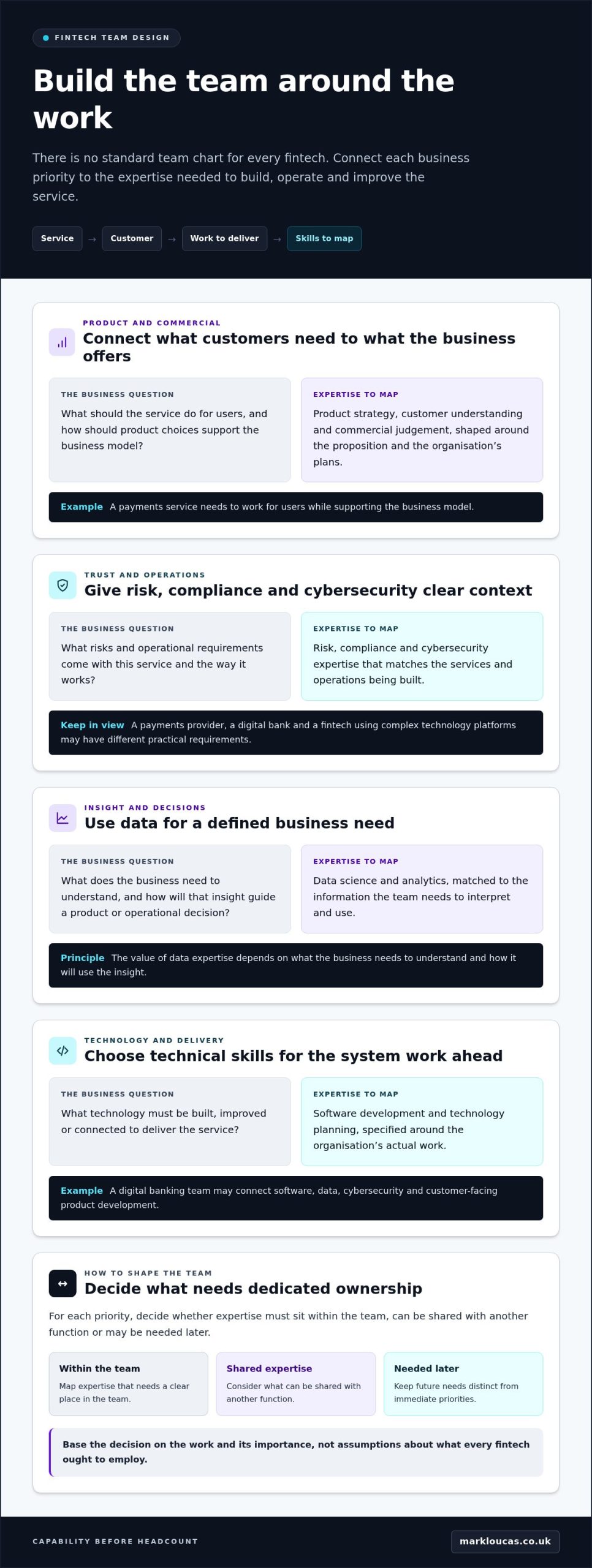
There’s no standard team chart that suits every fintech. The capabilities to bring together depend on the service, its customers and the work required to deliver it reliably. Start with business priorities, then map the skills needed to build, operate and improve the product. This keeps hiring connected to delivery rather than a generic list of fintech roles.
For each priority, decide what expertise must sit within the team, what can be shared with another function and what may be needed later. A smaller business might draw on shared technology or risk expertise while establishing its offer. As needs grow, it may require dedicated ownership of particular capabilities. Base the decision on the work and its importance, not assumptions about what every fintech ought to employ.
Connect product and commercial expertise
Product strategy, customer understanding and commercial judgement are closely linked. A team shaping a payments service needs to understand how it works for users and how product choices support the business model. A digital banking team may need a different blend, connecting customer needs with product design, technology and the practical demands of operating a bank. The specific mix depends on the proposition and the organisation’s plans.
For a new digital bank, begin by setting out what it intends to offer and which capabilities are needed to design, build and run that proposition. Digital banking recruitment covers specialist roles that can support different parts of this work, but the hiring plan should still follow the bank’s priorities.
Plan for risk, data and technology
Consider risk, compliance and cybersecurity in relation to the services and operations the business is building. A payments provider, a digital bank and a fintech using complex technology platforms may have different practical requirements. Define the work that needs clear ownership, then identify the relevant expertise rather than hiring to broad labels alone.
Data science and analytics can help teams draw insight from information to guide product or operational decisions. Their value depends on what the business needs to understand and how it will use that insight. Technology planning should be just as specific: software development may be central to building a product, while expertise in core banking platforms may matter more to an organisation working with those systems.
A useful capability map can group needs under product and commercial work, risk and control, data and technology, and day-to-day operations. For each area, record the outcome it supports, who owns it and whether the capability is needed now, can be shared or belongs to a later stage. This makes gaps easier to see without treating every gap as an immediate vacancy.
In short, how to build a world-class fintech team starts with the business model and traces delivery needs to the capabilities that can meet them. If specialist hiring is part of that plan, discuss your fintech team’s recruitment priorities.
Discuss your fintech team priorities with Mark Loucas Ltd.
How to assess capability gaps and team fit
A capability gap is the difference between what your team can currently deliver and what the business needs to achieve next. Identify it by comparing the skills and ownership already in place with near-term requirements, rather than starting with a list of roles you think a fintech should have.
Begin with specific work, such as a product launch, a new operational need or a planned improvement to an existing service. For each task, ask what expertise is required, who currently provides it and whether that coverage is sufficient. A delivery delay may point to a missing skill, but it could also reflect unclear decision-making, competing priorities or a temporary rise in workload. Confirm the cause before deciding to hire.
A simple comparison can make the picture easier to discuss. Use one row for each capability that matters to the work ahead, then record:
- Capability: the expertise or responsibility needed.
- Current coverage: who provides it and whether ownership is clear.
- Business importance: how it affects delivery, risk management or planned growth.
- Hiring priority: whether to recruit now, develop existing skills, share the work or revisit it later.
This isn’t a scoring exercise. It’s a way to make assumptions visible, compare needs and agree on a proportionate response.
Prioritise gaps by business impact
Rank gaps by their effect on your organisation’s goals. Ask which unmet capability could delay delivery, leave important work without an owner or limit a planned next step. Separate that from expertise that would be valuable but can be developed over time. A sector trend may prompt a useful question, but it shouldn’t dictate your hiring plan without a clear connection to your business.
Also consider whether the gap is lasting or temporary. A sustained need may support a permanent role; a defined short-term requirement may call for a different workforce solution. Match the response to the nature and timing of the work.
Assess expertise and working relationships
Assess candidates against the actual demands of the role. Look for relevant evidence, such as work on comparable systems, products or problems, then explore how they approached decisions and what they learned. A practical discussion of a realistic work scenario can reveal more than credentials alone.
Explore how the candidate explains specialist issues to colleagues outside their field, handles differing views and shares responsibility across teams. Define fit as the contribution someone can make, not whether they resemble the existing team. This keeps assessment focused and helps create a team with complementary strengths.
Used thoughtfully, this process makes building a world-class fintech team a clearer decision: identify the business need, establish whether it is a genuine gap and choose a response that fits. For support with specialist hiring priorities, discuss your fintech recruitment needs.
Discuss your fintech hiring plan with Mark Loucas Ltd.
How to turn a fintech hiring plan into action
A hiring plan turns capability priorities into decisions about roles, timing and recruitment routes. Keep it tied to the outcomes the business needs, with clear ownership at each stage. This helps stakeholders agree what they are hiring for before candidate conversations begin, and gives the team a sound basis for reviewing whether each appointment has helped.
- Agree the business priority. Define the product, operational or growth outcome the hire will support. Make the need specific, such as delivering a defined technology change or strengthening a specialist function.
- Set the role scope. Describe the outcomes, responsibilities and essential expertise required. Separate must-have experience from skills that can be developed, and clarify how the role will work with other teams.
- Assign decision ownership. Agree who leads the search, who assesses specialist capability and who makes the final decision. Align stakeholders on the role brief and evaluation criteria before meeting candidates.
- Choose the hiring route. Match the approach to the role, its urgency and the likely duration of the need. Set an assessment process that tests candidates against the actual work.
- Review the outcome. After the appointment, assess whether the hire has addressed the capability need and supported the intended business outcome. Use what you learn to refine future role briefs and priorities.
Set a clear role brief and hiring process
A precise brief makes a search more focused. Explain what the person will deliver, the decisions they will own and the expertise needed to do the work. For a specialist technology role, assess relevant experience and problem-solving against the systems and responsibilities involved, rather than relying on a broad list of desirable credentials.
Keep interviews purposeful. Give each stakeholder a defined area to assess, and use consistent criteria so candidates are considered on relevant evidence. A realistic discussion of a work-related challenge can show how someone approaches decisions and communicates with colleagues beyond their specialism.
Choose a hiring route that fits the need
Permanent recruitment can be arranged on a contingent, exclusive or retained search basis. Contingent recruitment is offered on a no win, no fee basis. Exclusive recruitment makes the consultancy the sole external recruitment partner, while retained search is designed for senior or confidential roles. The right option depends on the role and search approach required.
For a defined project or temporary capacity need, contract and interim recruitment can provide a flexible route. Managed recruitment services may suit project-based hiring or broader recruitment operations. These services can include budgeting, forecasting, invoicing, payroll and time-card management.
Connect workforce planning to capability gaps, business priorities and the organisation’s stage. Fintech talent advisory and market mapping can help shape that wider view, so recruitment supports a considered plan rather than a succession of isolated vacancies.
A clear process makes building a world-class fintech team more achievable, from agreeing the need through to reviewing the result. Discuss your fintech hiring plan with Mark Loucas Ltd.
Talk through your specialist recruitment needs with Mark Loucas Ltd.
How specialist fintech recruitment supports team building
Recruitment is most effective when it follows a clear workforce plan. Mark Loucas Ltd is a specialist consultancy for fintech and digital banking recruitment, supporting organisations as they identify the expertise needed to deliver business priorities. Its work spans payments, risk, digital banking, cybersecurity, data science, software development and core banking platforms.
Specialist searches can require more than advertising a vacancy. Mark Loucas provides access to passive candidates, including the top 5% of London fintech professionals, bringing experienced people into consideration who may not be actively looking for a new role. This is particularly relevant when a business needs specific expertise or is hiring for a senior position.
Match recruitment support to the hiring requirement
For a defined, longer-term capability need, permanent recruitment can help identify candidates whose expertise fits the role and the organisation’s plans. Executive search suits senior appointments where the brief calls for a focused search. Permanent recruitment can be contingent, exclusive or retained, depending on the search requirement.
Contract and interim solutions can suit project-specific work or a temporary resource gap. For a broader programme of hiring or recruitment operations, managed recruitment services may be appropriate. Support can include budgeting, forecasting, invoicing, payroll and time-card management, alongside compliant EOR/AOR payroll solutions.
Match the recruitment route to the need. A permanent appointment may make sense where a capability is central to ongoing delivery, while interim expertise may suit a defined period of change. Managed recruitment services can support organisations coordinating a wider hiring programme, including project-based recruitment and on-site recruitment manager placement.
Bring market insight into the next hiring decision
Market mapping gives an organisation a clearer view of the specialist talent landscape, helping it understand where relevant expertise sits and shape realistic search priorities. Combined with talent advisory, this insight can inform workforce planning before a vacancy is opened, as well as decisions about role scope and hiring sequence.
Mark Loucas Ltd has offices in London, Singapore, Cyprus and Dubai, with dedicated service teams in the UK and Slovakia. This brings an international perspective alongside knowledge of specific talent markets, supporting searches shaped around the organisation’s location and needs.
Building a strong fintech team is a considered process, from identifying capability priorities to choosing the right recruitment approach. To discuss a hiring plan shaped around your organisation’s requirements, speak with the Mark Loucas Ltd team.
Discuss your next fintech hiring decision with Mark Loucas Ltd.
Make your next hiring decision count
Turn a business priority into a clear decision about the capability that will move it forward. Choose an upcoming objective, identify what is needed to deliver it and decide whether the answer is a new appointment, a different allocation of responsibility or a change to the plan. A focused decision gives your team a practical starting point for building with intent.
Mark Loucas Ltd has supported fintech and digital banking recruitment since 2007, with testimonials from Mastercard, Visa Europe and Euronet Worldwide. This experience can inform a tailored conversation about your organisation’s hiring priorities and the specialist expertise you need to bring in.
If you’re ready to consider how to build a world-class fintech team around your next stage of growth, discuss your fintech team priorities with Mark Loucas Ltd. A thoughtful first step can help you move forward with greater clarity and confidence.
Frequently Asked Questions
How do you build a fintech team from scratch?
Start by defining the service you’ll provide and the customer problem it must solve. Then map the work required to deliver it, from product decisions to technical build and ongoing operations. For example, decide which parts of a payment journey your business will own and who will be accountable for each. This gives you a practical basis for building a world-class fintech team without hiring for roles before their purpose is clear.
Which roles should a fintech hire first?
Hire first for the capability that removes the most important constraint on your immediate plans. If product development is waiting on technical decisions, that may point to a different priority than a launch delayed by unclear operational ownership. Ask leaders to identify the work that cannot progress, what expertise it needs and whether an existing team member can reasonably take it on. Let delivery priorities, not a standard fintech hiring order, determine the answer.
What skills does a fintech team need?
A fintech may need a combination of product, payments, risk, compliance, cybersecurity, data and software expertise, but not every business needs all of these as dedicated roles. A small payments team, for example, may need payments knowledge close to product and technology decisions, with other specialist input brought in where required. Communication and sound judgement help people connect their expertise to customer and operational needs rather than working in isolation.
How do you assess fintech candidates beyond technical skills?
Use a role-related scenario to see how a candidate would approach a realistic challenge, such as explaining a technical trade-off to a non-technical stakeholder. Ask what information they would seek, how they would weigh competing needs and how they would communicate their recommendation. Pair this discussion with evidence of relevant experience and agreed assessment criteria. This helps you consider judgement and collaboration alongside the technical skills the role requires.
When should a fintech use contract or interim staff?
Contract or interim support can suit a business that needs experienced expertise for a defined project or temporary resource gap. Before hiring, set out the expected deliverable, the work’s timeframe and how the specialist will work with the permanent team. Also agree who will own decisions and hand over knowledge when the assignment ends. These details help distinguish a time-limited requirement from a capability the organisation needs to retain long term.
How can a fintech retain a strong team?
Support retention by making expectations clear and creating regular opportunities to discuss workload, development and changes in priorities. For example, a manager can review whether responsibilities still match an employee’s skills as a product or team evolves. Recognise useful contributions and consider where people can develop their expertise. These steps can help create a constructive working environment, although retention depends on the organisation and each person’s circumstances.
What does a fintech recruitment consultancy do?
A fintech recruitment consultancy helps organisations find specialist professionals through services such as permanent recruitment, executive search, contract and interim solutions, market mapping and talent advisory. Mark Loucas works across fintech and digital banking. An organisation planning a senior appointment may use executive search, while market mapping can inform its understanding of relevant talent before a role is opened. The support can be shaped around the hiring requirement.
To discuss how to build a world-class fintech team around your organisation’s priorities, contact Mark Loucas Ltd.

Article by
Liam Henfrey
Liam Henfrey is a seasoned specialist in the payments and banking sectors with over two decades of experience. As the Founder and CEO of FINOPSIS and Managing Director at Mark Loucas Ltd, he advises organisations on complex financial operations and technology. His career includes senior roles at PwC, Deloitte, and Visa Europe.
Related Fintech Recruitment Guides
If you liked this guide then you may also like the following: