


Why is it so hard to hire fintech engineers in the 2026 market
Whilst the global fintech market is projected to reach an impressive $460.76 billion this year, a staggering 71% of companies within the finance and insurance sectors report that they simply cannot find the talent they need to grow. You have likely felt the frustration of watching a promising candidate vanish at the final stage, perhaps lured away by an aggressive counter-offer from a traditional banking giant. This persistent difficulty often leaves leadership teams asking why is it so hard to hire fintech engineers when the industry is seemingly at its peak. It’s a challenge that requires a deeper look at the evolving expectations of the current market.
We understand that the search for elite engineering talent is no longer a simple recruitment exercise but a pursuit of rare craftsmanship. You require individuals who possess a unique blend of modern technical agility and a sophisticated understanding of complex regulatory frameworks. In this article, you will discover the structural and economic reasons why these professionals remain so elusive. We shall also provide a clear perspective on how to approach this competitive landscape to secure the specialised expertise your organisation deserves.
Key Takeaways
- Understand why the intersection of high-frequency performance and data integrity creates a specialised skill set that standard developers often lack.
- Discover how to address the legacy technology trap and attract elite engineers who are typically deterred by outdated systems.
- Gain insight into the economic factors and global competition explaining why is it so hard to hire fintech engineers in the current landscape.
- Learn why traditional recruitment and automated filtering fail to identify the high-potential candidates your organisation requires.
- Explore the benefits of moving toward a bespoke executive search model to secure the most exclusive technical talent.
If you are looking for guidance on building your technical team, you may reach out to our consultants for a private discussion.
The unique complexity of the fintech engineering skill set
The current market presents a paradox where the abundance of software developers does not translate into a wealth of suitable candidates for the financial sector. Understanding why is it so hard to hire fintech engineers requires an appreciation for the delicate balance between rapid innovation and absolute reliability. Unlike other sectors where a ‘move fast and break things’ culture might be tolerated, the financial world demands a level of precision that is rarely found in the generalist pool. The stakes are simply too high for anything less than perfection, and in many instances, the margin for error is non-existent.
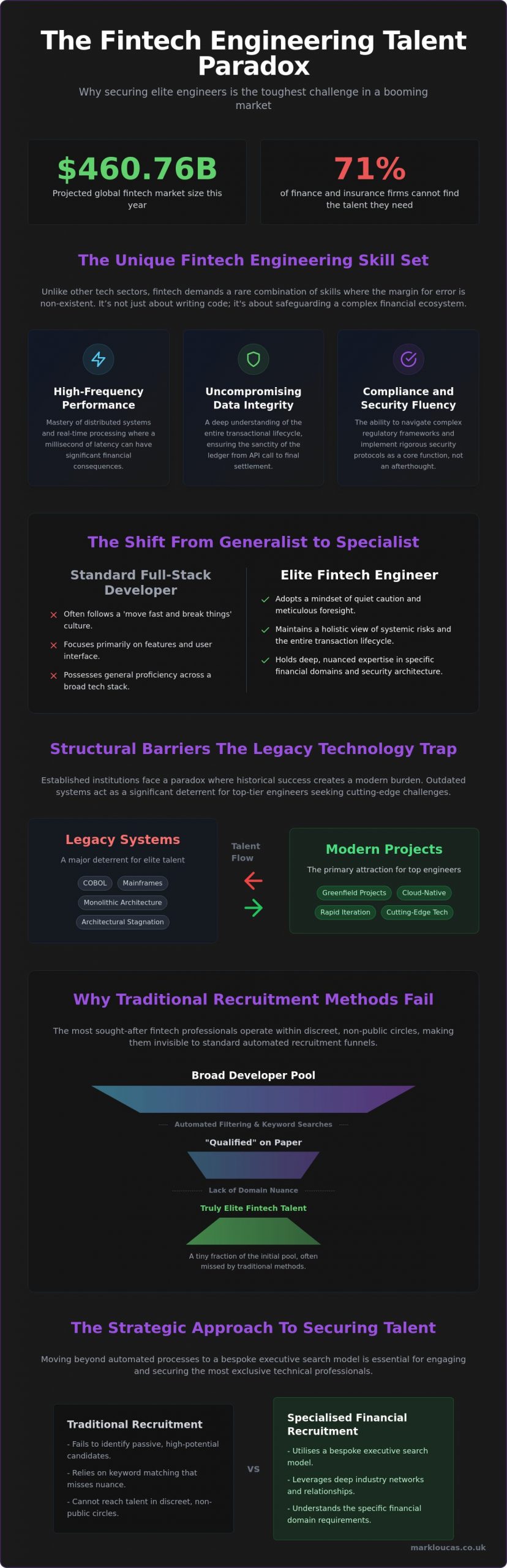
An elite fintech engineer must navigate the intersection of high-frequency performance and uncompromising data integrity. They operate in a space where a millisecond of latency can have significant fiscal consequences, yet they must maintain the rigorous security protocols that define what fintech is today. This ‘triple threat’ of advanced technical ability, financial acumen, and compliance fluency creates a talent pool that is exceptionally small. It’s not merely about writing code; it’s about understanding the systemic risks inherent in every line. A standard developer might focus on the user interface, but a fintech specialist considers the entire transactional lifecycle, from the initial API call to the final clearing and settlement process. This holistic view is essential for maintaining the trust that underpins the entire financial ecosystem.
Defining the fintech engineering profile in 2026
The profile of a successful candidate has evolved into something far more intricate than a standard technical specification. Mastery of distributed systems and real-time processing is now the baseline requirement. However, the true distinction lies in an innate understanding of regulatory frameworks and the ability to translate technical risks for non-technical stakeholders. These individuals act as guardians of the platform, ensuring that every deployment respects the sanctity of the ledger whilst delivering the agility that digital banking demands. They must be comfortable working within the constraints of strict security architectures, often finding elegant solutions where others see only obstacles.
The shift from generalist to specialist requirements
Standard full-stack developers often struggle when transitioned into the high-stakes environment of payments. The mindset required is fundamentally different; it is one of quiet caution and meticulous foresight. This is precisely why specialised financial recruitment has become indispensable for firms seeking to scale. The definition of a ‘qualified’ engineer has narrowed significantly over the last three years, moving away from general proficiency towards a deep, nuanced expertise in specific financial domains. This specialisation is a primary reason why is it so hard to hire fintech engineers, particularly as these rare professionals often operate within discreet, non-public circles that traditional methods fail to reach.
To discuss your specific talent requirements in confidence, you may connect with our boutique advisory team for personalised assistance.
Structural barriers and the legacy technology trap
Many established financial institutions find themselves caught in a cycle where their historical success becomes a modern burden. The presence of legacy COBOL or mainframe systems, whilst reliable, acts as a significant deterrent for elite technical talent who seek the cutting edge. When candidates weigh their options, the prospect of maintaining decades-old codebases often pales in comparison to the allure of greenfield projects. This architectural stagnation is a central reason why is it so hard to hire fintech engineers who are accustomed to the rapid iteration cycles of the pure-tech world.
Bridging the gap between these monolithic structures and modern, cloud-native environments requires a rare temperament. It’s not just about finding someone who can code; it’s about finding an engineer willing to act as a translator between two eras of computing. The challenge is compounded by the necessity of maintaining 24/7 availability. Migrating a core banking system whilst it’s processing thousands of transactions per second is akin to changing an aircraft engine mid-flight. This level of technical debt is no longer just an IT issue; it’s a profound recruitment liability that can tarnish an employer’s brand amongst the technical elite.
The deterrent of technical debt
High-calibre engineers often prioritise working with modern languages such as Rust or Go, viewing them as essential for their long-term career capital. When a fintech firm is perceived as ‘stodgy’ due to its reliance on legacy stacks, it loses its competitive edge. To counter this, savvy leaders must position these transformation projects as significant engineering milestones. It’s about framing the work as a strategic challenge that requires the highest level of craftsmanship to solve, rather than a mundane maintenance task.
Navigating the infrastructure divide
Finding individuals who can manage DevOps recruitment within a strictly regulated environment is an arduous task. These roles require a delicate balance between the desire for innovation and the absolute need for stability. Selling a digital transformation project to top-tier candidates involves highlighting the unique complexity of the environment. You aren’t just building another app; you’re re-engineering the foundations of global finance. This narrative of curated excellence is often the only way to overcome the structural barriers that make people wonder why is it so hard to hire fintech engineers in today’s market. If your firm is currently navigating these complexities, speaking with a boutique advisor can offer the clarity needed to attract the right talent.
If you are seeking to understand the current market value of technical leadership, our advisors are available to provide a bespoke consultation regarding your recruitment strategy.
The competitive landscape and salary inflation in 2026
As the global fintech market expands towards its projected valuation of $460.76 billion, the competition for elite engineering talent has reached an unprecedented level of intensity. The presence of global digital banking giants has fundamentally altered local talent availability, as these organisations often possess the treasury to offer compensation packages that far exceed traditional benchmarks. This aggressive pursuit of excellence explains why is it so hard to hire fintech engineers within premium urban centres. It’s no longer a matter of simply matching a salary; it’s about competing with global entities that view talent as their primary competitive advantage.
One of the most significant factors driving demand in 2026 is the mandatory migration to ISO 20022 standards. This technical mandate has created a temporary but intense spike in demand for engineers who specialise in real-time gross settlement systems. With the 90th percentile of compensation for these roles reaching $285,000, the financial pressure on mid-sized firms is considerable. Simultaneously, we’re seeing the rise of the silent counter-offer. These are discreet, highly lucrative proposals made by a candidate’s current employer the moment they signal an intent to leave. Such disruptions often occur in the final stages of the hiring process, leaving firms with unfilled roles and wasted resources. It’s a reminder that salary, whilst important, is no longer the sole motivator for the most sought-after professionals.
Market dynamics in the digital banking sector
The influence of neobanks has shifted candidate expectations toward a culture of rapid progression and substantial equity. Modern digital banking recruitment now requires a more nuanced approach that includes bespoke lifestyle benefits and the promise of meaningful impact. For many elite engineers, the opportunity to shape the future of finance is as compelling as the financial reward itself. They seek environments that mirror the agility of a startup whilst maintaining the stability of a seasoned institution.
The 2026 technical mandates driving demand
To ensure your recruitment strategy is as refined as your technical requirements, we invite you to discuss your talent objectives with our specialists in a private setting.
Why traditional recruitment methods fail for niche fintech roles
Generalist recruitment agencies often operate on a model of high volume, a strategy that is fundamentally incompatible with the precision required for high-stakes financial technology. When a recruiter lacks the technical depth to vet for distributed systems or real-time processing, they inevitably present candidates who look proficient on paper but lack the necessary depth. This mismatch is a primary reason why is it so hard to hire fintech engineers; the vetting process often misses the subtle markers of a risk-averse, high-performance mindset. Without a deep understanding of the regulatory context, traditional methods simply cannot distinguish between a talented coder and a true fintech artisan.
Automated keyword filtering has also become a significant hurdle for many organisations. These systems are designed to find exact matches, often overlooking brilliant engineers from adjacent sectors like high-frequency trading or aerospace who possess the perfect transferable skills for fintech. Furthermore, the most exceptional talent is rarely active on public job boards. They are “invisible” professionals, managed by discreet advisors and moved through private, non-public networks. If your firm relies on standard adverts, you’re likely only seeing a fraction of the available talent pool, most of whom are already being aggressively pursued by your competitors. This reliance on public channels is a significant factor in why is it so hard to hire fintech engineers today.
The limitations of internal talent acquisition
Internal teams, whilst dedicated, often lack the breadth of external market mapping and intelligence necessary to uncover hidden opportunities. Without a constant presence in specific technical communities, your reach is limited to those already looking for a change. Successful hiring in this elite bracket requires a level of industry-specific networking that transcends a simple job posting. It’s about building long-term relationships with the quiet achievers who aren’t yet on the open market.
The cost of a generic hiring process
A slow, bureaucratic interview process is the quickest way to lose a top-tier candidate. High-calibre professionals expect a journey that mirrors the efficiency of the systems they build. If your technical tests are generic and don’t reflect the high-stakes reality of fintech, you risk alienating the very people you wish to attract. Refinement is essential. You must articulate a unique value proposition that resonates with someone who values craftsmanship, discretion, and the opportunity to solve genuinely complex problems. To refine your approach and secure the professionals your organisation needs, you can consult with our boutique team for a tailored recruitment solution.
If you wish to explore how a tailored talent strategy can transform your engineering department, you may contact our boutique advisory team for a private consultation.
Strategic approaches to securing elite engineering talent
The quest for senior technical leadership requires a shift from high-volume tactics to a more refined executive search methodology. When considering why is it so hard to hire fintech engineers at the highest level, one must recognise that these individuals are often deeply embedded in critical projects. They aren’t browsing job boards; they’re being managed by trusted advisors. A transactional approach rarely succeeds here. Instead, a long-term talent advisory partnership provides the steady, unhurried pulse needed to navigate high-value transactions. This relationship allows for a granular understanding of your firm’s history and future vision, ensuring every candidate is a precise fit for your unique culture. Excellence is found in the details.
Leveraging specialised recruitment networks
Partnering with fintech and banking technology recruiters provides access to non-public opportunities and passive candidates. These networks are built on years of discreet, high-level engagement within prestigious financial districts. By utilising talent advisory services, you can refine your employer brand to speak directly to the technical elite. It’s about projecting a persona of curated excellence that attracts those who value privacy and tailored solutions. You must be seen as an insider who understands the nuances of the craft.
Implementing a bespoke recruitment strategy
Transitioning from reactive hiring to proactive talent mapping is essential. This involves a grand vision of your future needs, underpinned by the patience and diligence required to find rare talent. Every senior engineering candidate deserves individualised attention, mirroring the pace of a high-end concierge service. By positioning your firm as a centre of excellence for innovation, you signal to the initiated that you are a place where craftsmanship is truly valued. This strategic shift is the ultimate answer to why is it so hard to hire fintech engineers; it’s because the best talent requires a level of engagement that only a bespoke approach can provide. Reliability is earned through meticulous attention.
If you would like to discuss your specific technical requirements, you can contact us for a discreet consultation regarding your recruitment strategy.
Securing your technical future in a restricted market
The intersection of regulatory fluency and technical craftsmanship makes the 2026 market particularly challenging for firms seeking to scale. We have explored how legacy debt and aggressive global competition explain why is it so hard to hire fintech engineers who can truly transform an organisation. Moving beyond transactional methods toward a bespoke talent advisory model is no longer optional; it’s essential for leadership teams who value long-term stability and innovation. This refined approach ensures that you’re not merely filling a seat, but securing a strategic asset.
As a specialist recruitment consultancy founded in 2011, we maintain an exclusive focus on the global fintech and digital banking sectors. Our expertise in executive search and niche specialist placements ensures that your interests are managed with meticulous attention. If you require a more tailored approach to your technical hiring, you may wish to contact our specialist team for a confidential discussion regarding your requirements. We look forward to helping you secure the elite talent your vision requires.
Frequently Asked Questions
Why do fintech companies require previous financial services experience
Previous experience is essential because it ensures immediate regulatory fluency and a deep understanding of data integrity. Fintech firms operate under strict compliance frameworks where a misunderstanding of financial logic can lead to significant penalties. Hiring someone who already understands the sanctity of the ledger ensures the platform remains stable whilst navigating complex transactional requirements. This background reduces the risk of costly errors during the onboarding phase.
How much more do fintech engineers earn compared to general software engineers
Elite fintech engineers often command a significant premium, with the 90th percentile of earners reaching $285,000 as of June 2026. This reflects the rare combination of technical mastery, financial acumen, and regulatory knowledge. The scarcity of these professionals is a primary reason why is it so hard to hire fintech engineers without offering a compensation package that reflects their specialised value in a competitive market.
What are the most in-demand programming languages for fintech in 2026
Rust and Go have become the preferred choices for modern, high-performance financial systems due to their memory safety and concurrency features. Whilst Java remains a staple for many legacy banking cores, the shift toward real-time processing and distributed ledgers has made proficiency in low-latency languages a critical requirement. Engineers who can bridge the gap between these modern stacks and established financial infrastructure are particularly sought after.
Can a software engineer from a different industry transition into fintech
Yes, engineers from high-stakes backgrounds like aerospace or medical technology often possess the meticulous mindset needed for financial systems. These professionals are accustomed to environments where precision is non-negotiable. However, the learning curve regarding financial logic and compliance is steep. Success depends on a candidate’s ability to demonstrate a disciplined approach to data integrity and a willingness to master complex regulatory requirements quickly.
How long does it typically take to hire a senior fintech engineer
A thorough search for a senior technical professional typically spans eight to twelve weeks. This timeframe reflects the need for discreet networking and rigorous vetting to ensure a precise cultural and technical fit. Rushing this process often leads to candidate attrition or a mismatch in expectations, which is another reason why is it so hard to hire fintech engineers in such an exclusive and fast-moving landscape.
What is the impact of remote work on fintech engineering recruitment
Remote work has expanded the talent pool whilst simultaneously intensifying global competition for the best engineers. Whilst firms can now access talent in prestigious districts across the globe, they must also compete with digital banking giants offering premium salaries regardless of location. This shift has made market mapping and intelligence essential for identifying high-calibre talent before they are lured away by international competitors.
Why is the interview process for fintech roles so rigorous
The rigour is necessary to verify a candidate’s ability to handle high-stakes environments where errors have immediate fiscal consequences. Beyond technical tests, firms must assess a candidate’s understanding of security protocols and their ability to communicate complex risks to stakeholders. This exhaustive vetting ensures that only those with a truly risk-aware mindset are trusted with the core financial infrastructure of the organisation.
How can a recruitment agency help with niche payments roles
A boutique agency provides access to private, non-public talent pools that are often invisible to internal teams. Through sophisticated executive search and market mapping, these specialists identify high-calibre professionals who are not actively seeking new roles. This curated approach ensures that your firm is presented to elite talent with the discretion and sincerity that a high-end, personalised service demands.

Article by
Liam Henfrey
Liam Henfrey is a seasoned specialist in the payments and banking sectors with over two decades of experience. As the Founder and CEO of FINOPSIS and Managing Director at Mark Loucas Ltd, he advises organisations on complex financial operations and technology. His career includes senior roles at PwC, Deloitte, and Visa Europe.
Related Fintech Recruitment Guides
If you liked this guide then you may also like the following: