


Creating a Business Case for a Retained Search in the 2026 Fintech Sector
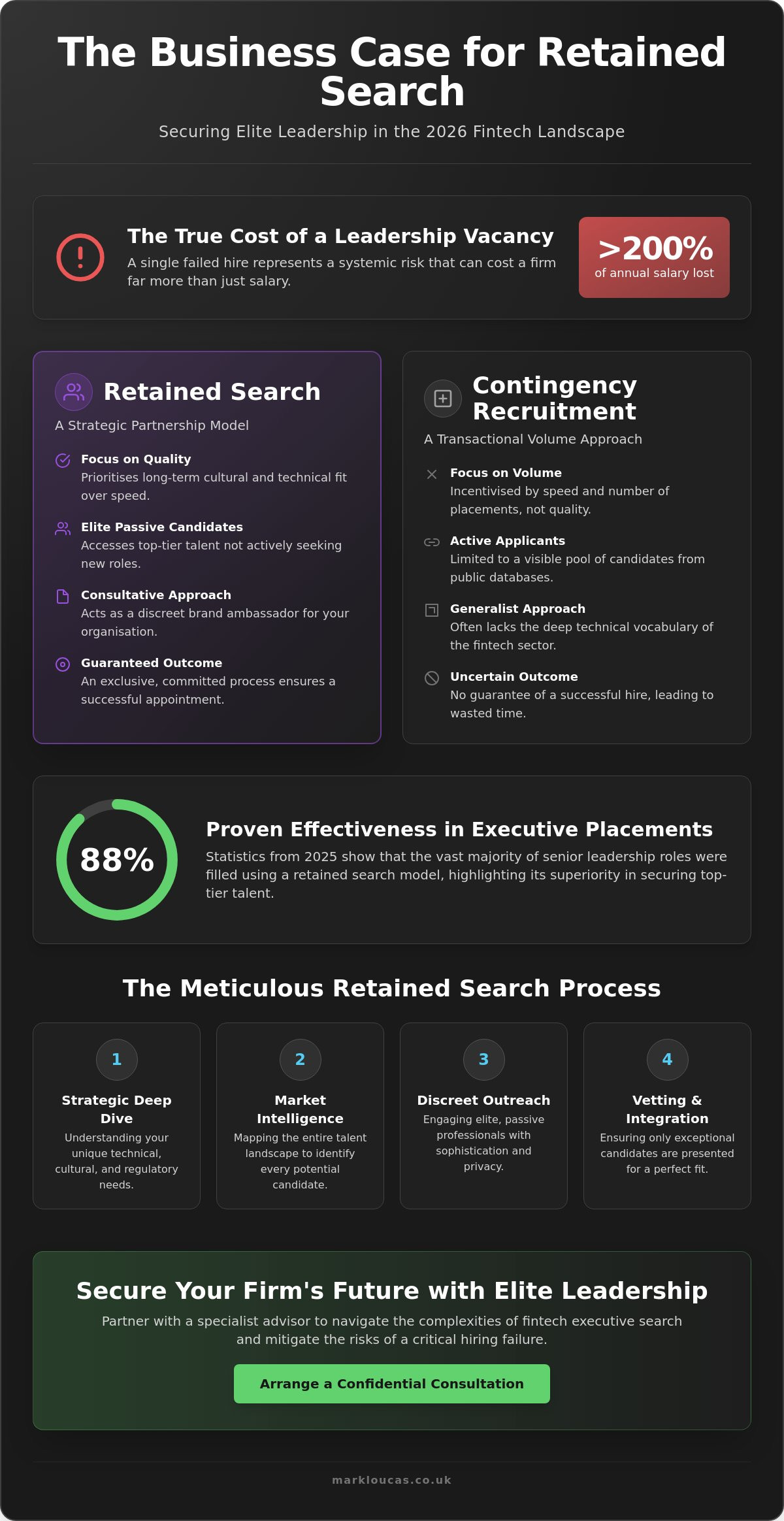
In the high-stakes environment of 2026 fintech, a single leadership vacancy is no longer just an empty seat. It represents a systemic risk that can cost a firm over 200 per cent of the annual salary in lost innovation and cultural erosion. You likely feel the immense pressure to secure a transformative leader whilst fearing the catastrophic impact of a hire that fails to align with your complex regulatory architecture. It is understandably frustrating to sift through the uninspiring candidates provided by volume-driven agencies that simply do not understand the nuances of digital banking. Developing a robust business case for a retained search is the only way to move beyond these limitations and secure the rare talent your firm requires.
This article provides the essential framework you need to justify this strategic investment to your board by highlighting the clear path to elite, passive talent. We will explore how this meticulous and exclusive approach guarantees a successful appointment whilst protecting your organisation from the significant financial burdens of recruitment failure. By the end of this guide, you will have a clear structure to present a solution that prioritises precision, privacy, and long-term stability for your executive team.
Key Takeaways
- Understand why a dedicated partnership model is essential for navigating the rapid pace of innovation within the 2026 fintech landscape.
- Learn how to access the top tier of passive candidates through meticulous market mapping that looks far beyond traditional databases.
- Build a compelling business case for a retained search by contrasting quality-driven incentive structures with the volume-led approach of contingency firms.
- Quantify the true cost of leadership vacancies and mitigate the substantial financial risks associated with a critical hiring failure in a regulated sector.
- Discover the advantages of partnering with a discreet boutique advisor who possesses a deep personal network within the payments and digital banking sectors.
If you are looking to secure the elite leadership required for your next phase of growth, please visit the Mark Loucas contact page to arrange a confidential consultation with our specialist advisors.
The Strategic Necessity of Retained Search for Critical Fintech Appointments
Fintech is not merely finance with a digital veneer; it is a distinct ecosystem where the pace of technological change often outstrips traditional banking structures. In this environment, a standard recruitment approach is frequently insufficient. A retained search is far more than a simple hiring exercise. It is a dedicated partnership where the consultant acts as a seamless extension of your brand, representing your interests with the same level of care and discretion as your own executive team. Unlike high-volume agencies, a boutique advisor invests the time to understand the granular details of your payments infrastructure or specific regulatory challenges. This depth is fundamental when building a business case for a retained search, as it ensures that the market perceives your firm as an elite destination for talent.
Building a compelling business case for a retained search requires a shift in perspective from viewing recruitment as a simple cost to seeing it as a strategic insurance policy. Traditional finance roles often rely on established credentials and historical performance. However, fintech leadership requires individuals who can navigate the intersection of legacy systems and decentralised finance whilst managing rapid innovation. Contingency models, which reward speed and volume, often fail to capture this nuance. They are transactional by nature. In contrast, a retained mandate is deeply consultative, focusing on the quality of fit and the long-term success of the appointment. By utilising established Executive Search Models, firms can ensure a rigorous methodology that mitigates the risk of a misaligned hire.
Defining the Retained Search Model for Senior Stakeholders
A retained search involves an exclusive agreement where a boutique advisor is fully committed to a successful outcome. This process is structured into meticulous phases, starting with exhaustive research and market mapping to identify every potential candidate within a specific niche. It is specifically designed for high-stakes roles where the cost of a hiring failure, which can exceed 200 per cent of an annual salary, far outweighs the initial investment. This model provides a level of certainty that volume-driven methods simply cannot match.
Why Generalist Recruitment Fails in the Fintech Landscape
Generalist agencies frequently lack the technical vocabulary needed to vet senior digital banking engineers or compliance heads. High-calibre professionals in the payments industry rarely respond to generic, automated outreach. They expect a sophisticated, tailored approach from an insider who understands their specific technical environment. An expert search firm provides a vital layer of vetting, protecting the valuable time of the executive board whilst ensuring only the most exceptional candidates are presented for final consideration.
To discuss how our bespoke research methodologies can identify the ideal leadership for your firm, please reach out to our team at the Mark Loucas contact page.
Beyond the Database whilst Leveraging Market Intelligence
In the rarefied world of fintech leadership, the most exceptional individuals are rarely found on a public database. They are almost universally passive candidates, deeply entrenched in high-impact roles and not actively seeking a change. Relying on active applicants often results in a pool of candidates who lack the specific technical or cultural alignment required for a high-stakes appointment. This is where the business case for a retained search becomes undeniably clear. It moves beyond the visible market to identify those who are truly elite, using a methodology that values depth over breadth. Statistics from 2025 indicate that 88 per cent of executive placements were made using a retained search model, highlighting its effectiveness in securing top-tier talent.
A sophisticated search partner provides more than just a list of names. They deliver a comprehensive understanding of the talent ecosystem through Market Mapping & Intelligence. This data-driven approach ensures that every viable candidate within a specific niche is identified, regardless of their current job-seeking status. It’s about precision. It’s about ensuring your firm has access to the 1 per cent of talent capable of navigating the complexities of 2026 digital banking. This intelligence transforms the hiring process from a reactive task into a strategic advantage.
The Power of Comprehensive Market Mapping
Market mapping provides a complete visual representation of the talent landscape across global hubs and prestigious districts, such as the City of London or the thriving technology centres of the North. By visualising team structures and reporting lines within competitor organisations, you gain a strategic advantage that goes beyond simple recruitment. This process ensures that no potential candidate is overlooked simply because they haven’t updated a public profile. Beyond the immediate vacancy, this intelligence serves as a foundation for future succession planning, allowing your firm to remain agile. This intelligence serves as a core pillar of the business case for a retained search, transforming a simple hire into a long-term strategic asset.
Strategic Talent Advisory and Competitive Intelligence
A retained partner acts as a discreet advisor, providing granular insights into competitor salary benchmarks and benefit structures. Understanding how your brand is perceived amongst the most sought-after leaders in regions like Canary Wharf allows you to position your offer with absolute confidence. This intelligence helps to refine the job description, ensuring it resonates with the modern fintech leader who prioritises both innovation and regulatory integrity. To refine your executive attraction strategy, you might consult with a specialist advisor who understands the nuances of your specific vertical.
To ensure your next senior appointment is managed with the discretion and personal attention it requires, we invite you to contact us through the Mark Loucas contact page to begin a confidential dialogue.
Comparing Contingency and Retained Models for Senior Leadership
The choice between contingency and retained models is often the most significant decision in an executive hiring strategy. Whilst contingency recruitment serves a purpose for mid-level roles, it often falters when applied to the upper echelons of fintech leadership. Establishing a compelling business case for a retained search requires an understanding of how these differing models impact your brand’s standing in the market. In a contingency arrangement, the recruiter is only remunerated if they are the first to present the successful candidate. This inevitably creates a race for speed over substance. The priority becomes flooding your inbox with CVs before a competitor does, a tactic that rarely uncovers elite talent.
This transactional approach is frequently at odds with the meticulous care required to protect the long-term integrity of your executive team. In contrast, a retained search advisor is paid to navigate the complexities of the market until the right person is found. This exclusive commitment transforms the relationship into a true partnership. The consultant acts as your brand ambassador, ensuring that your firm’s reputation remains untarnished by the aggressive, uncoordinated outreach often associated with multi-agency contingency searches. It provides a level of curated excellence that volume-driven models simply cannot replicate.
Incentives and Alignment of Interests
In a contingency model, the recruiter’s loyalty is divided amongst multiple clients and dozens of active roles. If a candidate proves difficult to engage, the recruiter is incentivised to move on to an easier “win” elsewhere. Conversely, the business case for a retained search rests on the total alignment of interests. The advisor is committed to a successful outcome regardless of the time required for an exhaustive search. This alignment ensures the consultant is acting as a true advocate for the client, providing a bespoke service that feels both elite and approachable.
The Rigour of Candidate Assessment and Referencing
The depth of assessment in a retained mandate is incomparable to the standard CV submission. It involves a sophisticated evaluation of technical prowess, cultural alignment, and strategic vision. For instance, when vetting a senior compliance officer, the process must go beyond surface-level qualifications to explore their ability to architect regulatory frameworks. You can find examples of this depth in our guide on the best interview questions to ask your compliance expert candidate. Referencing in a retained process is equally exhaustive. It moves beyond the provided list of names to include discreet, off-the-record market checks within prestigious financial districts. This level of due diligence ensures that when a candidate is finally presented, they have been vetted with a level of craftsmanship that contingency models simply cannot provide.
To protect your organisation from the substantial financial risks associated with a critical hiring failure, we invite you to speak with our specialist consultants for a private discussion.
Quantifying the Financial Impact and Risk Mitigation
The decision to invest in an exclusive appointment often rests on a meticulous calculation of risk versus return. When constructing a business case for a retained search, it is vital to acknowledge that the fee is not merely a cost but a strategic insurance policy for your firm’s future. Current industry data for 2026 suggests that the cost of a bad executive hire can range from 200 per cent to 213 per cent of their annual salary. For a senior leader, this financial burden can easily exceed £200,000, a figure that does not even account for the intangible damage to firm culture or investor confidence. By opting for a model with a 95 per cent success rate, you are effectively buying out the significant failure risk inherent in contingency methods, which often see fill rates as low as 20 per cent.
Viewing the search fee as an investment in long-term stability allows the board to see beyond the immediate transaction. In the high-growth fintech sector, where global funding reached $44.7 billion in the first half of 2025, the pressure to deploy capital effectively is immense. A retained partner ensures that your leadership team is composed of the rare 1 per cent of talent capable of navigating this complex landscape. This precision protects your digital banking platform from the stagnation that follows a mediocre appointment.
Calculating the Real Cost of an Executive Vacancy
Every day a senior role remains open represents a tangible loss in strategic momentum and decisive leadership. Beyond the missed revenue opportunities, a prolonged vacancy places an undue burden on the existing executive team, often leading to increased turnover amongst high-performing subordinates who feel the lack of direction. A simple calculation reveals that the cost of a six-month vacancy often dwarfs the fee of a retained search. By securing a leader quickly and effectively, you maintain the unhurried, steady pulse of growth that characterises the most successful fintech firms in premium urban centres.
Mitigating Regulatory and Operational Risk
In the highly regulated fintech environment, a bad hire in a compliance or technology role can lead to catastrophic regulatory fines and operational paralysis. For instance, the projected cost of a single bad hire in an AI leadership role has reached $1.2 million in lost innovation and subsequent recruitment costs. Utilising specialised financial recruitment provides a vital layer of security, ensuring that every candidate possesses the niche expertise required to manage cross-jurisdictional regulatory architecture. To ensure your next appointment meets these exacting standards, you may contact our boutique advisors for a tailored talent solution.
To secure a leadership partner who understands the intricate demands of the digital banking landscape, we invite you to visit the Mark Loucas contact page for a confidential discussion regarding your requirements.
Partnering with a Specialist Advisor for Executive Appointments
In the refined world of fintech executive search, the choice of partner is as consequential as the appointment itself. Establishing a compelling business case for a retained search involves recognising the immense value of an advisor who moves with unhurried precision and quiet confidence. Unlike the impersonal, volume-driven nature of large corporate entities, a boutique firm provides a level of curated excellence that feels both elite and approachable. This is particularly vital in the payments industry, where the talent pool is small and the stakes for every senior appointment are incredibly high. A specialist advisor does not merely search a database; they leverage a collection of deeply nurtured, private relationships built over years of dedicated service.
This intimate, personalised approach ensures that your firm’s interests are managed with expert care. The boutique advisor acts as a knowledgeable local insider, representing your brand in prestigious financial districts with a sincerity that elevates the recruitment process. They understand that every interaction with a potential candidate is a reflection of your firm’s culture. By choosing a partner who values privacy and tailored solutions, you ensure that the search process remains discreet whilst attracting the rare talent capable of driving innovation. This level of individualised attention is a core component of the business case for a retained search, as it guarantees that the grand vision of your organisation is communicated with absolute accuracy.
The Boutique Advantage in Fintech Recruitment
Boutique firms offer a bespoke service that large agencies simply cannot replicate at scale. One of the most significant advantages is that the senior consultant you speak with at the outset is the same individual who will be performing the search and vetting every candidate. There is no delegation to junior staff. This continuity ensures that the subtle nuances of your requirement are never lost in translation. It allows for a sophisticated, unhurried pace that mirrors the high-end concierge service expected by elite fintech leaders. This meticulous attention to detail is what ultimately secures the most sought-after individuals in the market.
Securing the Future of Your Fintech Organisation
Choosing the right search partner is a critical decision for any board or leadership team aiming for long-term stability. A successful appointment delivers more than just a new employee; it delivers a strategic asset that can transform your firm’s trajectory. To explore how this model secures global leadership, you may wish to read our pillar article on fintech executive search. Ultimately, the investment in a retained mandate provides the certainty and rigour required to navigate the complexities of 2026 with confidence.
Securing Your Leadership Legacy in the 2026 Fintech Market
Navigating the intricate complexities of the modern financial landscape requires more than just a standard recruitment strategy; it demands a partnership rooted in precision and mutual trust. By moving beyond the transactional nature of volume-driven agencies, you ensure that your firm is represented with the quiet confidence and exclusivity it deserves. The business case for a retained search is fundamentally built on this promise of curated excellence, transforming a high-stakes appointment from a source of potential risk into a definitive strategic triumph. Our specialist focus exclusively on the fintech and digital banking sectors ensures that your organisation has access to the private, non-public opportunities that define the top tier of leadership talent.
With over a decade of experience in high-stakes payments recruitment, we understand the meticulous attention to detail required to secure elite candidates. Our sophisticated market mapping and talent advisory services provide the granular intelligence needed to navigate the talent landscape with absolute certainty. We invite you to speak with our boutique advisors to discuss how a retained search can secure your next critical fintech leader. Your firm deserves the distinction and reliability that only a deeply personal, tailored approach can provide.
Frequently Asked Questions
What is the typical fee structure for a retained search in fintech
Standard retained fees generally fall between 25 per cent and 35 per cent of the successful candidate’s total first year compensation. This is typically structured into three equal instalments. An initial commencement fee is followed by a second payment upon the presentation of a vetted shortlist, and a final instalment is due when the appointment is confirmed. This phased approach ensures the search is adequately resourced and prioritised from the outset.
Why should I pay an upfront fee before a candidate is hired
The commencement fee secures the dedicated time and expertise required to perform an exhaustive search of the entire market. Unlike contingency models, where recruiters often work on multiple roles simultaneously, a retained advisor commits to your specific vacancy until it is successfully filled. This initial investment funds the meticulous market mapping and intelligence gathering that form a core part of the business case for a retained search.
How long does a retained search process usually take to complete
A comprehensive executive search in the fintech sector typically requires between eight and twelve weeks to reach a successful conclusion. This timeline allows for a thorough research phase, initial approaches to elite passive talent, and multiple stages of rigorous assessment. The unhurried pace ensures that every candidate is vetted against the highest standards of technical prowess and cultural alignment before being presented to your board.
Is retained search only suitable for C suite level appointments
Retained search is essential for any appointment where the cost of failure is high, regardless of the specific title. Whilst frequently used for C suite roles, it is equally effective for critical positions such as Heads of Compliance, Chief Data Officers, or lead engineers in payments. If the role requires a rare combination of skills or navigating complex regulatory architecture, a retained model is the most reliable approach.
What happens if the candidate hired through a retained search leaves early
Most boutique search firms provide a replacement guarantee to protect your organisation’s investment. If a candidate leaves within a specified period, often ranging from six to twelve months, the advisor will conduct a new search at no additional professional fee. This provision acts as a further layer of security, reinforcing the business case for a retained search as a robust risk mitigation strategy for your firm.
Can I still use my internal recruitment team whilst a retained search is active
The search is conducted on an exclusive basis to ensure a consistent and professional message is delivered to the market. However, internal candidates can certainly be included in the process. Your search partner will assess them with the same rigour and objectivity as external candidates. This provides an unbiased perspective that is invaluable to the board when making a high stakes appointment.
How does a retained advisor find candidates that other agencies cannot
Retained advisors identify candidates through deep market intelligence and a personal network of passive talent that is not visible on the open market. By using sophisticated market mapping, they engage with individuals who are currently performing at a high level elsewhere and are not actively seeking employment. This discreet approach allows for a more nuanced and exclusive conversation about your firm’s long term vision.
What is the difference between an engaged search and a fully retained search
An engaged search is often a hybrid model where a smaller upfront fee is paid, but the remaining balance is contingent upon a successful hire. A fully retained search is a more comprehensive commitment that guarantees an exhaustive research phase and a dedicated consultant. This model is generally preferred for high stakes appointments where a deep and thorough understanding of the entire talent landscape is mandatory.

Article by
Liam Henfrey
Liam Henfrey is a seasoned specialist in the payments and banking sectors with over two decades of experience. As the Founder and CEO of FINOPSIS and Managing Director at Mark Loucas Ltd, he advises organisations on complex financial operations and technology. His career includes senior roles at PwC, Deloitte, and Visa Europe.
Related Fintech Recruitment Guides
If you liked this guide then you may also like the following: