


Structuring a Product Team in a Digital Bank for 2026
What if the very compliance frameworks designed to protect your bank could actually become the catalyst for its most rapid product cycles? Many leaders find that structuring a product team in a digital bank often feels like an impossible choice between velocity and safety. You likely understand the quiet frustration of seeing a brilliant feature stalled by a rigid regulatory review, or the immense difficulty of finding senior talent who truly grasp the nuances of both the Digital Asset Banking Act of 2026 and modern agile rituals. It’s a friction that can hinder even the most ambitious institutions.
We believe that true distinction in the fintech sector is found in the meticulous integration of these two worlds. You’ll discover how to organise a high-performing product organisation that balances agile innovation with rigorous banking regulations. Our discussion explores the architecture of cross-functional squads, the framework for scaling into multiple tribes, and a refined strategy for hiring senior product leaders who possess the rare expertise your bank requires.
Key Takeaways
- Understand why replacing rigid departmental silos with mission aligned squads is the definitive step toward achieving true operational agility.
- Gain a blueprint for structuring a product team in a digital bank by harmonising the expertise of product managers, designers, and lead engineers.
- Compare established scaling frameworks to identify the most effective method for expanding your product organisation without compromising on communication or quality.
- Learn the techniques for integrating rigorous compliance requirements into agile sprints to maintain pace whilst meeting the highest regulatory standards.
- Define the strategic role of a modern Chief Product Officer in orchestrating a vision that bridges the gap between innovative technology and traditional banking stability.
If you are seeking to enhance your leadership team with professionals who understand the intersection of finance and technology, please contact our consultants for a confidential discussion.
The Foundations of Modern Product Organisations in Digital Banking
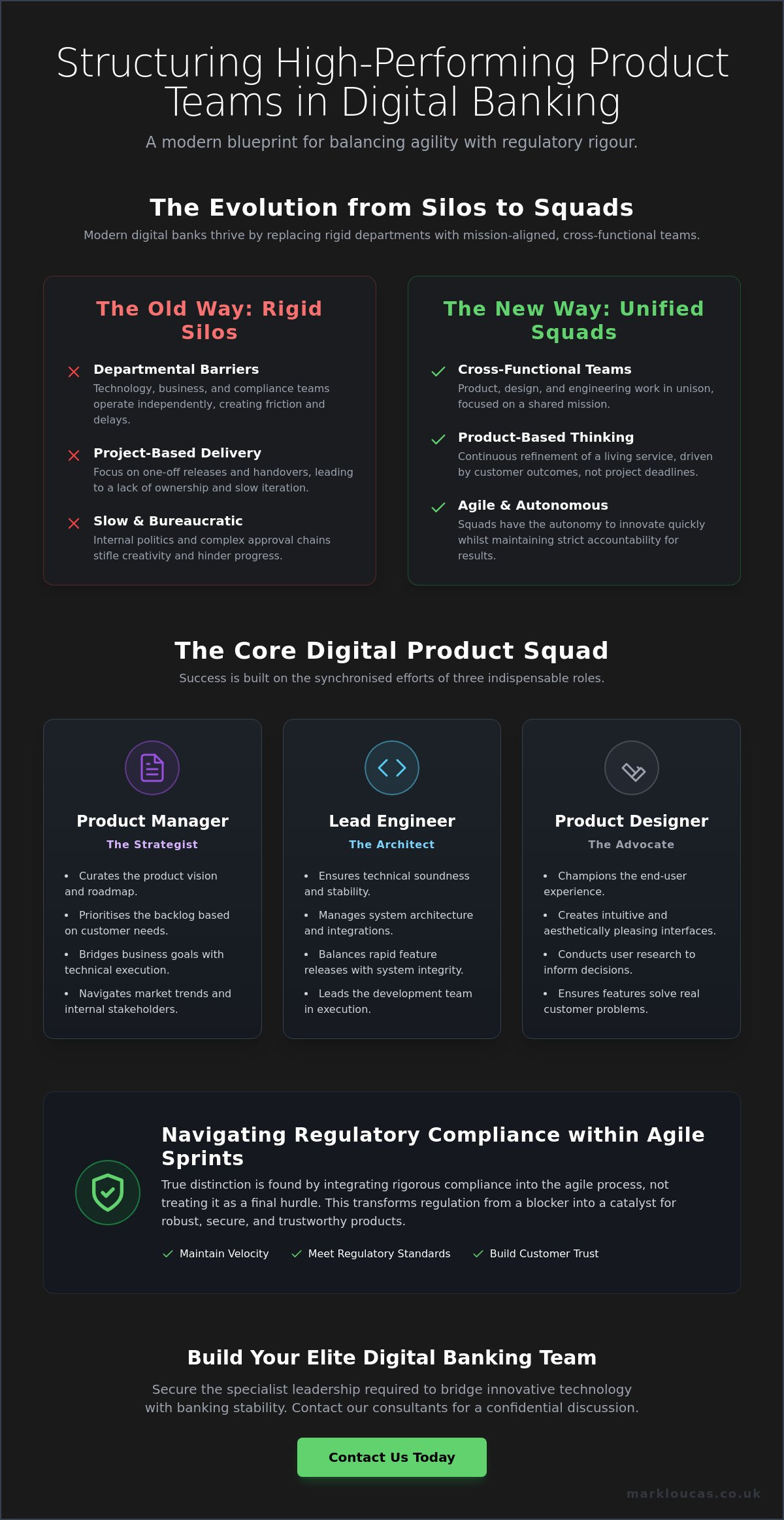
In the current era of financial services, the concept of a product team has evolved from a simple department into a sophisticated, cross-functional unit. When structuring a product team in a digital bank, the focus must shift away from isolated technical tasks toward specific customer outcomes. This requires a seamless blend of engineering, design, and product management, all working in unison to deliver a refined user experience. It’s no longer enough to simply build features; teams must solve problems that truly matter to the end user.
Traditional banking hierarchies often suffer from rigid silos that impede progress and stifle creativity. In a digital-first environment, these barriers are replaced by a unified product organisation. Whilst old-fashioned banks might separate the business from the technology department, modern leaders understand that the technology is the business. This shift ensures that every decision is filtered through the lens of customer value rather than internal bureaucracy. It’s a fundamental change in how a bank views its own identity and operational rhythm.
Mission alignment is the cornerstone of this evolution. Instead of building teams around technical layers like databases or front-end development, squads are organised around customer journeys, such as onboarding or lending. This transition from project-based delivery to product-based thinking is vital for the 2026 landscape. It moves away from one-off releases and toward the continuous refinement of a living service. This approach allows an organisation to remain agile whilst maintaining the stability required in a regulated sector.
Why Digital Banks Require a Unique Structural Approach
Digital banks operate in a high-stakes environment where real-time payments and core banking integrations are the standard. This complexity demands a structure that can balance rapid feature releases with absolute system stability. In the UK market, data analytics play a pivotal role, informing every iteration with precise insights into user behaviour. Leaders must ensure their teams are equipped to handle these technical demands without losing sight of the broader commercial goals of the institution.
Moving Beyond Traditional Hierarchy in Financial Services
Modern fintechs often favour flat structures over traditional tiered management. This allows squads the autonomy to drive innovation whilst maintaining strict accountability for their results. For many specialised providers, a boutique approach to team design is more effective than the volume-driven models of large corporate entities. Some organisations find success by adopting principles from the Scaled Agile Framework to manage complexity at scale. This flexibility is essential when structuring a product team in a digital bank that aims to disrupt the status quo.
If you are looking to refine your recruitment strategy for these pivotal positions, we invite you to discuss your specialised hiring needs with our expert consultants.
Defining Essential Roles for a High Performing Digital Product Squad
Success in the fintech space is rarely the result of a single brilliant mind. Instead, it arises from the synchronised efforts of a highly specialised squad. When structuring a product team in a digital bank, the core trio of a Product Manager, a Product Designer, and a Lead Engineer forms the indispensable foundation of every unit. These individuals must operate with a level of synergy that transcends traditional departmental boundaries, ensuring that every feature is technically sound, commercially viable, and aesthetically pleasing.
The Product Manager serves as the primary bridge between the bank’s overarching business goals and the granular details of technical execution. They are responsible for curating the product vision and prioritising the backlog, ensuring that the team’s efforts remain aligned with the most pressing customer needs. This requires a sophisticated understanding of market trends and a keen ability to navigate the internal politics of a financial institution. Without this central figure, even the most talented engineers can lose sight of the commercial objective.
Equally vital is the Product Designer, whose task is to create seamless user experiences for complex financial products. In an industry where trust is paramount, the interface must be both intuitive and reassuring. They work closely with the Lead Engineer, who must be as comfortable discussing cloud-native architecture as they are with the intricacies of core banking systems. When organising product teams, leaders often find that this trio’s effectiveness is the single greatest predictor of a product’s success.
The Critical Addition of Domain Specialists
Beyond the core trio, the inclusion of a Compliance Liaison directly within the squad is a transformative move for banks in 2026. This specialist ensures that regulatory requirements, such as those mandated by the Digital Asset Banking Act of 2026, are considered from the very first line of code. This prevents costly delays during the launch phase. Data Scientists are also essential for personalising banking services to meet individual user preferences. Leveraging data analytics recruitment to secure these specialists allows a bank to turn raw data into a bespoke customer experience that feels truly elite.
Supporting Roles that Enable Squad Autonomy
To maintain a high velocity, squads require supporting roles that remove operational friction. An Agile Coach provides the necessary guidance to ensure that processes remain lean and efficient, whilst Site Reliability Engineers focus on the absolute availability of the service. Investing in DevOps recruitment ensures that the technical infrastructure can support continuous deployment without compromising the security that customers expect. Finding the right individuals for these roles is a nuanced task. You might consider exploring our tailored recruitment solutions to identify the elite talent your institution deserves.
As your institution expands, the complexity of talent acquisition often necessitates a more bespoke approach. We encourage you to reach out to our advisors for expert talent advisory services tailored to your growth objectives.
Strategic Frameworks for Scaling Product Tribes across the Bank
Scaling a digital bank requires a transition from individual squads to a more cohesive ecosystem. The Spotify model of Squads and Tribes is often favoured for its emphasis on autonomy and cross-functional collaboration. In contrast, the Amazon Two Pizza Team approach prioritises smaller, highly focused units that can move with exceptional speed. When structuring a product team for success, many leaders find that a hybrid model often yields the best results, combining the cultural strengths of Spotify with the operational rigour of Amazon. This strategic choice is fundamental when structuring a product team in a digital bank that intends to lead the market in 2026.
Grouping teams by Product Line remains a traditional yet effective method, where squads focus on specific categories such as lending or savings. However, a more contemporary approach involves the User Journey model. Here, teams are organised around significant life events, such as buying a first home or planning for retirement. This ensures the customer experience remains the primary focus throughout the entire lifecycle. To maintain a consistent aesthetic and functional quality across these diverse tribes, a centralised Design System is indispensable. It acts as a single source of truth for the entire product organisation, ensuring that every interaction feels like part of a unified and elite brand experience.
When to Transition from Squads to Tribes
Identifying the moment to transition is a nuanced task. Usually, the signal is a noticeable breakdown in coordination or a slowdown in decision making within a single squad. A Head of Product is then required to oversee multiple squads within a tribe, ensuring that individual efforts contribute to the broader mission. During these periods of rapid change, the presence of an interim director can provide the necessary stability and expertise to navigate a restructure without losing momentum. This boutique approach to leadership ensures that the institution remains agile whilst it expands.
Maintaining Communication and Alignment at Scale
Chapters and Guilds serve as the connective tissue of the bank, allowing professionals like designers or engineers to share best practices whilst remaining embedded within their respective squads. Quarterly planning sessions are equally vital, as they align tribes with the overall bank strategy and ensure that resources are allocated to the highest impact areas. It is essential to establish clear KPIs that reflect both product health and regulatory safety. This dual focus ensures that the bank continues to innovate whilst adhering to the highest standards of financial conduct, a balance that is critical for long term distinction in the industry.
Securing professionals who can navigate the intricate web of financial regulation whilst maintaining an agile pace is a hallmark of an elite institution. If you require assistance in identifying such rare talent, please reach out to our specialist recruiters for a confidential consultation.
Navigating Regulatory Compliance within Agile Product Structures
There is a persistent misconception that agile methodology and banking regulations are fundamentally incompatible. In reality, a well-structured product organisation views compliance as a catalyst for quality rather than a hindrance to speed. By treating regulatory requirements as user stories from the outset, a bank can ensure that every feature is built with ‘Compliance by Design’ at its core. This proactive approach prevents the costly redesigns that often occur when legal reviews are treated as an afterthought. It’s about building integrity into the product’s DNA.
A critical component of structuring a product team in a digital bank is the early integration of the Chief Compliance Officer into the product roadmap process. Their involvement ensures that the strategic vision is tempered with regulatory foresight, allowing for a smoother path to market. To maintain velocity, teams employ automated testing and immutable audit trails that provide regulatory bodies with the transparency they require. These technical safeguards allow the squad to continue iterating at a pace that keeps them ahead of the competition whilst ensuring absolute adherence to the law.
Integrating Risk and Legal into the Product Lifecycle
We advocate for a ‘Shift Left’ approach where legal and risk reviews occur during the initial discovery phase rather than at the point of launch. Conducting ‘Pre-mortems’ allows the team to identify potential regulatory hurdles before development begins, saving valuable resources. When building these specialised units, using a tailored list of interview questions for compliance experts ensures you find individuals who possess the rare ability to work within agile rituals. This cultural fit is just as important as technical expertise.
Managing the Friction between Speed and Safety
Sandboxes allow for the testing of innovative financial features without compromising the integrity of the core ledger. Phased rollouts and feature flags further mitigate risk by allowing for controlled releases in a live banking environment. For institutions building the underlying infrastructure for 2026, engaging in RTGS payment consulting ensures that systems are robust enough to support high-value transactions securely. If you are ready to build a product team that masterfully balances innovation with integrity, contact our executive search team to begin your search for elite fintech leaders.
If you require bespoke guidance in identifying the individuals who will define your institution’s future, please contact our executive search team for a private consultation.
Securing Elite Leadership for Digital Banking Product Teams
Whilst the technical blueprint for structuring a product team in a digital bank provides the necessary framework, the success of the organisation ultimately rests upon the calibre of its leadership. The Chief Product Officer acts as the vital linchpin, translating the grand vision of the board into the granular realities of the engineering roadmap. This individual must possess a rare combination of technical literacy and deep financial acumen, ensuring that every innovation is both feasible and commercially sound. They aren’t merely managers; they are the architects of the customer’s digital relationship with the bank.
Hiring for high stakes payments infrastructure requires a level of niche expertise that generalist agencies often struggle to identify. It’s a field where a single error can have profound regulatory and reputational consequences. Consequently, digital banking recruitment at the executive level must be conducted with a meticulous attention to detail. We focus on identifying leaders who have a proven history of navigating these complexities with quiet confidence. Engaging a specialist partner for fintech executive search allows an institution to access a curated network of leaders who are often not visible through traditional channels.
The Search for the Modern Chief Product Officer
The modern CPO must be an exceptional communicator, capable of moving between a high level board presentation and a detailed technical sprint review with ease. They are the voice of the customer within the executive suite, advocating for a refined user experience at every turn. Through sophisticated market mapping, we often identify exceptional talent in adjacent sectors such as e-commerce or high frequency trading. These individuals bring fresh perspectives to the banking world, often providing the creative spark needed for true disruption.
Building a Culture of Excellence and Retaining Talent
Elite product professionals are drawn to institutions where they can have a tangible impact within a well organised environment. A thoughtfully designed team structure is, in itself, a powerful recruitment tool that signals a commitment to excellence. By investing in long term talent advisory and workforce planning, a bank ensures it has the leadership required for sustainable growth. This boutique approach to human capital is what separates the industry leaders from the followers, ensuring that structuring a product team in a digital bank leads to lasting distinction.
To ensure your institution is positioned at the forefront of financial innovation, please speak with our specialist consultants regarding your executive search requirements.
Defining the Future of Your Product Organisation
The path toward a truly distinguished digital bank in 2026 requires more than just technical adoption; it demands a fundamental shift in how you organise your most valuable asset, your people. By replacing traditional silos with mission aligned squads and treating compliance as a core design principle, you create an environment where innovation and safety coexist with ease. Structuring a product team in a digital bank is a meticulous process that, when executed with precision, allows your institution to scale with unhurried grace and absolute regulatory integrity.
Success in this high stakes landscape is ultimately defined by the calibre of the leaders you choose to appoint. Since 2011, Mark Loucas Ltd has operated as a specialist fintech recruitment consultancy, offering a boutique and deeply personalised approach to executive search and niche payments infrastructure roles. We combine a sophisticated global reach with the intimate service of a trusted advisor, ensuring your interests are managed with expert care. We invite you to partner with Mark Loucas Ltd for your next digital banking appointment and secure the talent that will define your future. Building an elite organisation is a journey of refinement, and the opportunities for those who lead with vision have never been greater.
Frequently Asked Questions
What is the ideal ratio of engineers to product managers in a digital bank
In a high performing digital bank, the ideal ratio typically sits between five to seven engineers per product manager. This balance fluctuates depending on the technical depth of the domain. For squads managing core banking infrastructure or complex payment rails, a lower ratio is often required to navigate the intricacies of the system. Conversely, front end consumer features can typically support a larger engineering presence under a single manager.
Should the product team report to the Chief Technology Officer
The most successful digital banks often have the Chief Product Officer reporting directly to the Chief Executive Officer rather than the CTO. When structuring a product team in a digital bank, this alignment ensures that strategy remains a core business driver. It creates a necessary balance between technical delivery and customer value. This structure prevents product development from being viewed merely as a subset of technical execution.
How do you integrate compliance into an agile squad without slowing them down
Integrating compliance requires a shift from a gatekeeper mentality to a collaborative partnership by shifting left in the lifecycle. By involving compliance specialists during the initial discovery and design phases, regulatory requirements are baked into the product from the start. This proactive approach eliminates the friction of last minute reviews. It allows the team to move through the build and deploy phases with unhurried confidence.
What are the common mistakes when structuring a new product team
A frequent error is building teams around technical layers, such as mobile or back end squads, rather than specific customer outcomes. This often results in heavy dependencies and a noticeable slowdown in delivery. Other common mistakes include failing to define clear boundaries of ownership or underestimating the need for a dedicated product designer. Without these elements, an institution risks building functional but ultimately unusable banking applications.
How does the squad model work for complex banking migrations
For high stakes projects like ISO 20022 migrations or core ledger updates, squads should be structured around specific technical milestones or system components. These units require a higher concentration of domain experts and senior engineers to manage the complexity. It is often beneficial to engage interim specialists who have successfully navigated similar migrations at other institutions. This provides the necessary expertise without requiring a long term permanent commitment from the bank.
Is the Spotify model actually suitable for regulated financial institutions
The Spotify model is an excellent starting point but requires significant adaptation for the regulated realities of the financial sector. Whilst the concepts of squads and tribes facilitate autonomy, the fail fast mentality must be tempered by a commitment to absolute financial accuracy. Structuring a product team in a digital bank using this model necessitates the inclusion of more robust risk management and audit functions than a typical technology firm would require.

Article by
Liam Henfrey
Liam Henfrey is a seasoned specialist in the payments and banking sectors with over two decades of experience. As the Founder and CEO of FINOPSIS and Managing Director at Mark Loucas Ltd, he advises organisations on complex financial operations and technology. His career includes senior roles at PwC, Deloitte, and Visa Europe.
Related Fintech Recruitment Guides
If you liked this guide then you may also like the following: