


Hiring for cultural fit in fintech to build high performance teams in 2026
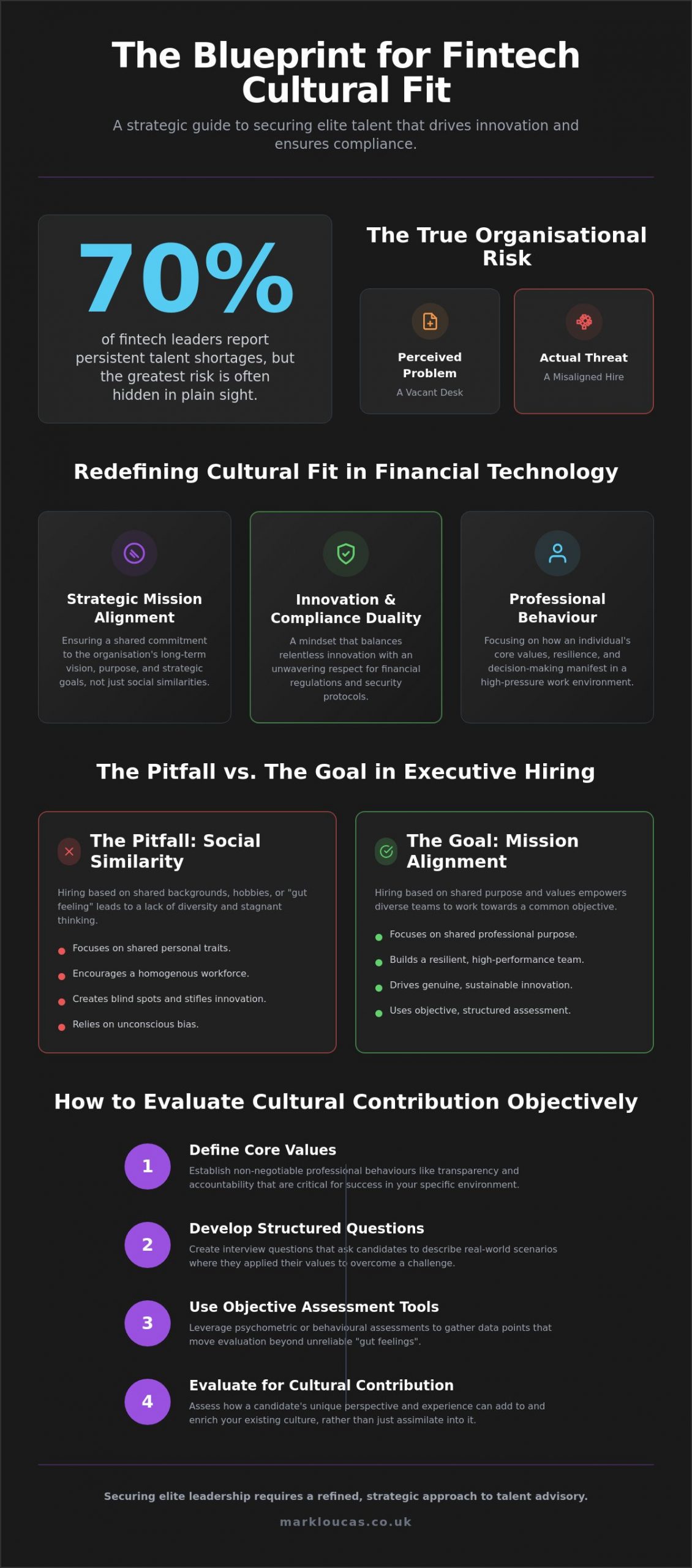
Nearly 70% of fintech leaders report persistent talent shortages in 2026, yet the most significant risk to your firm is often not a vacant desk, but a misaligned hire. You probably recognise the quiet exhaustion that follows a senior departure, particularly when a technically brilliant individual fails to navigate the delicate nuances of your organisation’s mission. It’s a common struggle during periods of rapid scaling, where the desire for speed often leads to the dilution of the very culture that sparked your initial success.
This article provides a refined approach to hiring for cultural fit in fintech, offering a blueprint to secure elite talent that mirrors your values without falling into the trap of unconscious bias. We will examine how to distinguish between social similarity and genuine mission alignment, whilst considering the impact of new regulations such as New York’s Senate Bill 3072. By the end of this piece, you’ll understand how to utilise objective assessment tools to build a resilient, high performance team that is prepared for the complexities of the modern financial landscape.
Key Takeaways
- Define cultural fit as a strategic alignment between an individual’s professional behaviour and your organisation’s mission, ensuring a shared commitment to both innovation and regulatory compliance.
- Recognise how core values such as transparency and accountability act as an essential internal compass for leaders making complex decisions within the payments and banking sectors.
- Distinguish between genuine mission alignment and simple social similarity to avoid the trap of creating a homogenous workforce that lacks the diversity required for true innovation.
- Master structured and objective assessment techniques when hiring for cultural fit in fintech to move beyond unreliable gut feelings and reveal how candidates apply their values in real world scenarios.
- Leverage the expertise of a specialist talent advisory to secure elite leadership through access to exclusive, non public opportunities and refined executive search methodologies.
If you are seeking to refine your leadership team with individuals who truly align with your organisation’s vision, please contact us to discuss your requirements with a specialist advisor.
Defining Cultural Fit in the High Stakes Fintech Sector
In the fast moving world of financial technology, the concept of cultural fit has evolved far beyond the superficial. It is no longer about who shares a similar background or a penchant for the same leisure activities. Instead, it represents the fundamental alignment between an individual’s professional behaviour and the organisation’s strategic mission. When hiring for cultural fit in fintech, the objective is to secure talent that possesses a shared commitment to relentless innovation whilst maintaining a strict, unwavering respect for financial regulations and compliance. This specific blend of an agile mindset and institutional responsibility defines the modern fintech professional.
True fit ensures that new hires can navigate the rapid pace of digital banking without compromising on the quality or security that clients expect. This is particularly vital in 2026, as firms face a more complex regulatory landscape following recent federal shifts toward streamlining innovation. A candidate who fits your culture will treat these regulations not as obstacles, but as the essential boundaries within which they can creatively solve problems. Without this mindset, a hire might prioritise speed over security, leading to the high turnover in senior roles that many firms currently experience.
The Difference Between Social Fit and Mission Alignment
Focusing on social fit, such as shared hobbies or educational backgrounds, often leads to stagnant thinking and a regrettable lack of diversity. Mission alignment, however, investigates whether a candidate shares the long term vision of the fintech provider. This distinction is why fintech recruitment agencies london place such emphasis on mission alignment when identifying senior leaders. For an executive to succeed, they must be motivated by the same future state as the founders, ensuring their decisions are consistently in the company’s best interest. It is about shared purpose, not shared personalities.
Why the Fintech Environment Requires a Unique Cultural Lens
The intersection of technology and finance creates a high pressure environment that differs significantly from traditional banking. Candidates must demonstrate a rare resilience to change whilst respecting the legacy of financial stability. Evaluating how a candidate handles the ambiguity of a growing startup versus a structured corporate environment is essential. When hiring for cultural fit in fintech, we look for individuals who can pivot their strategy in the morning and deliver a meticulous compliance report by the afternoon. This duality is the hallmark of a successful fintech culture.
If you wish to secure elite leadership that aligns with your organisation’s core values, please contact our specialist team for a private discussion regarding your requirements.
Why Values Alignment Drives Performance in Payments and Banking
Values serve as the silent, internal compass that guides every senior professional when they face complex decisions without direct oversight. In the high stakes environment of payments industry recruitment, values such as transparency and accountability are not merely aspirations; they are non negotiable requirements for maintaining the trust of both regulators and consumers. When a team operates within a unified moral framework, the inherent friction between engineering speed and compliance rigour dissipates, as both departments understand that security is a shared responsibility rather than a hurdle to be cleared. This alignment is a cornerstone of successfully hiring for cultural fit in fintech, ensuring that every hire strengthens the collective integrity of the firm.
Organisations that achieve high levels of values alignment benefit from a significant reduction in hiring costs over the long term. This economic advantage stems from increased employee retention, as individuals who feel a genuine connection to their company’s mission are far less likely to be swayed by external offers. By prioritising these shared principles, firms can build a stable foundation of talent that grows more effective with time. It’s a strategic investment in human capital that pays dividends through consistent performance and reduced disruption during periods of rapid growth.
Transparency and Accountability in Payments Infrastructure
Maintaining the integrity of global payments systems requires more than technical skill; it demands a deep personal alignment with the rigorous ethics of the modern financial world. Accountability is paramount when managing high value transactions and sensitive data, where a single lapse can have far reaching consequences for a brand’s reputation. Within our fintech executive search mandates, we look for leaders who don’t just follow rules, but who actively foster a culture of integrity that permeates every level of the organisation. This ensures that transparency is woven into the very fabric of the payments infrastructure.
The Strategic Advantage of a Cohesive Fintech Culture
A cohesive culture acts as a powerful magnet for elite talent who seek more than just a competitive salary in a crowded marketplace. When teams are aligned on a singular goal, product development cycles accelerate because the need for constant course correction and internal debate is minimised. This cultural clarity serves as a profound differentiator in the digital banking landscape, allowing firms to scale with precision whilst avoiding the pitfalls of cultural dilution. If you are looking to refine your approach to hiring for cultural fit in fintech, consulting with a specialist advisor can help you identify the precise profiles needed for your unique mission.
To ensure your executive search is conducted with the utmost discretion and a focus on genuine excellence, please get in touch with us to discuss your leadership needs.
Avoiding the Pitfalls of Social Similarity in Executive Hiring
The inherent danger of prioritising fit is that it can inadvertently lead to a homogenous workforce, where stagnant thinking replaces the vibrant innovation required for success. When organisations prioritise social similarity over strategic alignment, they often create an echo chamber that lacks the cognitive diversity essential for solving the complex problems of modern finance. Recruiters must possess the refined discernment to distinguish between a candidate who truly does not fit the mission and one who is simply different in their perspective or background. Elite recruitment focuses on identifying the most capable individuals regardless of their social circle or previous affiliations. True excellence knows no single mould.
In the high pressure world of digital banking, hiring for cultural fit in fintech must never become an excuse for exclusionary practices. It requires a sophisticated understanding of how diverse viewpoints can strengthen a team’s resilience. By focusing on the unique contributions an individual brings, firms can avoid the trap of hiring for social comfort. This ensures that the leadership remains sharp, objective, and prepared for the technical challenges of 2026. Innovation demands difference.
Moving from Cultural Fit to Cultural Contribution
Instead of merely seeking a candidate who fits the current mould, forward thinking firms look for cultural contribution. This approach identifies what a professional can bring that the team currently lacks, ensuring the organisation evolves rather than simply replicating its current state. Identifying candidates who challenge the status quo whilst remaining deeply aligned with core values requires a nuanced approach. It involves looking for individuals who offer fresh technical insights or diverse life experiences that can enhance the collective intelligence of the leadership team. Difference is a strategic asset.
Mitigating Unconscious Bias in the Recruitment Process
Standardising the interview process is a critical step in ensuring that every candidate is evaluated against the same objective criteria. By using diverse interview panels, firms can gain a broader perspective on a candidate’s potential, reducing the influence of individual prejudices. Data driven market mapping also plays a vital role, as it allows for the identification of diverse talent pools across the globe, moving beyond traditional networks. This methodical approach is essential when hiring for cultural fit in fintech, as it prioritises merit and mission alignment over superficial similarities. Such rigour ensures that your team remains elite and capable of managing the shifting landscape of 2026.
For a tailored assessment of your current talent acquisition strategy, please reach out to our boutique consultancy to discuss your specific requirements with an expert advisor.
How to Evaluate Cultural Contribution During the Interview Process
Subjectivity is the enemy of precision in executive search. To build a resilient team, your organisation must move beyond the unreliable nature of gut feeling toward a structured, objective assessment of professional behaviour. The interview process serves as a critical diagnostic tool, designed to reveal how a candidate applies their core values when faced with the high stakes scenarios typical of the financial sector. Every interaction should be meticulously documented, providing a transparent record that ensures all stakeholders remain aligned on the candidate’s potential impact. This level of rigour is essential when hiring for cultural fit in fintech, as it transforms the interview from a social exchange into a strategic evaluation of mission alignment.
Designing Behavioural Interview Questions for Fintech
Effective questioning should focus on revealing a candidate’s approach to problem solving and collaboration during periods of significant pressure. In 2026, this might involve probing their resilience when navigating the regulatory shifts introduced by Executive Order 14405 or how they balance technical debt with the need for rapid innovation. For those seeking technical leadership, it is helpful to integrate insights from our guide on the best interview questions to ask your compliance expert candidate. These queries are designed to expose whether a professional’s mindset truly mirrors the institutional responsibility required in modern finance. A candidate who can articulate a clear, value driven response to these challenges is far more likely to contribute positively to your firm’s long term stability.
A Five Step Framework for Assessing Values Alignment
To maintain consistency across your leadership search, we recommend a disciplined five step framework that prioritises objective data over personal preference.
- Define Core Behaviours. Clearly articulate the specific behaviours that demonstrate your organisation’s values in a professional setting.
- Standardise Scoring. Create a robust rubric to evaluate candidate responses consistently, ensuring every interviewer uses the same criteria.
- Evidence Based Interviews. Conduct behavioural interviews that require candidates to provide specific, verifiable examples of their past work and decision making.
- Targeted Reference Checks. Perform thorough reference checks that specifically investigate the candidate’s impact on team culture and their adherence to stated values.
- Collaborative Review. Review all findings as a team to determine if the candidate adds a necessary dimension to the existing organisational culture.
Implementing such a framework ensures that hiring for cultural fit in fintech remains a data driven exercise. If you are ready to secure your next elite hire, please discuss your leadership search with our specialist team today.
If you are seeking a partner who understands the intricate balance of technical prowess and mission alignment, please contact our specialist advisors to explore how we can support your growth through bespoke leadership solutions.
Securing Elite Leadership Through Strategic Talent Advisory
Building a world class fintech team requires a proactive and strategic approach to talent acquisition that transcends the traditional, reactive methods of the past. It’s about cultivating a pipeline of elite professionals who don’t just possess the required technical skills but who are also deeply aligned with your organisation’s long term mission. Specialist recruitment consultancies offer a significant advantage here, providing exclusive access to non public opportunities and elite talent pools that remain invisible to the broader market. When hiring for cultural fit in fintech at the executive level, a discreet and highly tailored approach is paramount to protecting the privacy of both the firm and the candidate whilst ensuring a precise match. This level of care reflects the patience and diligence required in high value transactions, a standard also championed by Omedia Paris when sculpting exceptional narratives for premium brands.
With approximately 26,000 global fintech job openings recorded in June 2026, the competition for elite talent has never been more intense. Strategic talent advisory helps organisations navigate this crowded landscape by moving beyond simple placement to long term workforce planning. This partnership allows firms to anticipate future leadership needs before they become critical vacancies, ensuring that the culture remains robust even during periods of rapid scaling. It is a sophisticated way to manage your human capital with the same expert care you apply to your financial assets.
For those who wish to apply this same level of strategic rigour to their digital presence, the marketing and automation expertise of Frank Novak provides a valuable framework for building a successful and scalable online business.
The Role of Specialist Fintech Banking Technology Recruiters
Generalist recruitment firms often lack the depth required to understand the technical and cultural nuances of the financial technology sector. In contrast, fintech banking technology recruiters act as trusted advisors who understand the subtle interplay between agile development and regulatory compliance. They possess the local authority and industry specific terminology needed to identify niche talent that others might overlook. By acting as a discreet bridge between the organisation and the candidate, these specialists ensure that every hire is a perfect match for both the role and the company’s unique ethos.
Long Term Workforce Planning and Market Intelligence
Market mapping provides a clear, panoramic view of the talent landscape, allowing firms to identify potential leaders years before a formal search begins. These intelligence services enable organisations to benchmark their internal culture and compensation structures against industry leaders, ensuring they remain an attractive destination for top tier talent. This is particularly vital in digital banking recruitment, where a deep understanding of the evolving technology sector is required to identify candidates with the hybrid skills necessary for 2026. This data driven approach ensures that hiring for cultural fit in fintech is a precise, calculated strategy rather than a matter of chance.
If you are ready to secure elite talent that aligns with your organisation’s long term vision, please contact us to speak with a specialist advisor today.
Cultivating a Legacy of Excellence in Financial Technology
In an era defined by rapid digital transformation, the success of your firm depends on moving beyond the limitations of social similarity. A disciplined approach to hiring for cultural fit in fintech ensures that your organisation remains both innovative and compliant, even whilst navigating the regulatory complexities of 2026. By prioritising mission alignment and cultural contribution, you secure a team capable of managing high stakes transactions with the precision and integrity that your clients expect. This strategic focus allows for a more resilient, high performance culture that thrives on technical challenge.
Since 2011, our specialist recruitment consultancy has maintained an exclusive focus on fintech, payments, and digital banking. We provide a global reach delivered through a boutique, personalised approach that treats every executive search with the expert care it deserves. If you are looking to secure elite leadership for your organisation, please visit our contact us page to discuss your requirements with a specialist advisor. We look forward to helping you build a team that defines the future of finance.
Frequently Asked Questions
What is the difference between cultural fit and cultural add in fintech
Cultural fit focuses on alignment with existing values and the strategic mission, whereas cultural add identifies what a candidate brings that the team currently lacks. In the fast moving fintech sector, cultural add is essential for preventing stagnant thinking and ensuring the organisation evolves. It allows firms to maintain their core mission whilst integrating fresh perspectives that drive technical innovation and resilience.
How can I measure cultural fit without being biased
Measuring fit objectively requires a shift from gut feelings to structured behavioural assessments and standardised scoring rubrics. By evaluating candidates against specific, pre-defined values and using diverse interview panels, you can mitigate unconscious bias. This methodical approach ensures that every individual is judged on their professional behaviour and mission alignment rather than superficial social similarities or shared backgrounds.
Why is cultural fit so important in the payments industry
The payments industry demands a unique blend of technical agility and a deep seated respect for regulatory compliance and security. A professional who fits this culture will naturally prioritise accountability and transparency when managing high value transactions. This alignment is vital for maintaining the trust of both global regulators and consumers in a high stakes financial environment where integrity is non negotiable.
Can cultural fit be taught or is it an inherent trait
While specific technical skills can be developed, core values and professional mindsets are generally inherent traits that are difficult to teach. When hiring for cultural fit in fintech, it is essential to identify individuals whose internal compass already aligns with your organisation’s strategic mission. It is far more effective to secure talent that shares your foundational principles than to attempt to reshape a misaligned senior hire.
What are the best interview questions to assess values in digital banking
The most effective questions focus on past behaviours in high pressure scenarios, such as managing technical debt or navigating significant regulatory changes. You might ask a candidate to describe a time they prioritised compliance over speed or how they handled a conflict between innovation and security. These behavioural queries reveal the candidate’s true priorities and their commitment to institutional responsibility within the digital banking sector.
How does a strong company culture impact fintech scaling
A robust and cohesive culture acts as a stabilising force that prevents dilution during periods of rapid growth and international expansion. It ensures that new hires remain aligned with the original mission, reducing the friction often found in cross functional teams. This cultural clarity allows firms to scale with precision, maintaining high performance levels whilst avoiding the high turnover often seen in senior leadership roles.
Is hiring for cultural fit legal under UK employment law
Hiring for cultural fit is legal in the UK provided that the criteria used are objective, non discriminatory, and directly related to the role’s requirements. It must not be used as a mask for discrimination against protected characteristics under the Equality Act 2010. By focusing on mission alignment and professional behaviours, firms can stay compliant whilst building a high performance leadership team that reflects their core values.
How can a recruitment agency help with cultural assessment
A specialist recruitment consultancy provides the market intelligence and objective distance needed to evaluate a candidate’s true alignment with your mission. They utilise sophisticated market mapping and behavioural assessment tools to identify elite talent that matches your unique technical and cultural needs. This expert guidance ensures that hiring for cultural fit in fintech is a discreet, tailored, and data driven process focused on long term growth.

Article by
Liam Henfrey
Liam Henfrey is a seasoned specialist in the payments and banking sectors with over two decades of experience. As the Founder and CEO of FINOPSIS and Managing Director at Mark Loucas Ltd, he advises organisations on complex financial operations and technology. His career includes senior roles at PwC, Deloitte, and Visa Europe.
Related Fintech Recruitment Guides
If you liked this guide then you may also like the following: