


Fintech Executive Interview Questions for Senior Leadership Roles in 2026
In 2026, the era of the “growth at all costs” fintech leader has officially ended, replaced by a mandate for institutional-grade governance and technical mastery. You likely recognise that the threshold for leadership has shifted significantly. It’s no longer enough to merely understand the market; you must now navigate the intricacies of the 2026 Executive Order on fintech innovation whilst managing the heavy weight of increased AML penalties. Securing a seat at the table requires more than just experience. It demands a command of the specific fintech executive interview questions that elite recruitment firms use to separate the visionaries from the traditionalists.
We understand the pressure of articulating a balance between rapid scaling and the rigorous demands of financial stability. This guide provides the definitive strategic frameworks and sophisticated insights you’ll need to master the most complex interview stages. We’ll explore the critical trends of 2026, from ISO 20022 migration to the tokenisation of real-world assets, ensuring your expertise aligns perfectly with the expectations of the world’s most prestigious fintech organisations.
Key Takeaways
- Prepare for the shift towards institutional-grade governance by learning how to balance rapid growth with the rigorous demands of 2026 regulatory frameworks.
- Refine your approach to fintech executive interview questions by mastering strategic frameworks that address the integration of digital assets and traditional banking systems.
- Understand the nuances of leading international expansion in premium markets such as Dubai or Singapore whilst navigating the transition from founder-led cultures.
- Develop the technical literacy needed to discuss complex infrastructure like RTGS and ISO 20022 migration as a strategic asset rather than a purely operational task.
- Learn how to leverage market mapping and elite advisory services to access exclusive, non-public leadership opportunities within the global payments sector.
If you wish to discuss your leadership trajectory with a discreet advisor, please contact our specialist team for a private consultation.
Navigating the Fintech Executive Interview in 2026
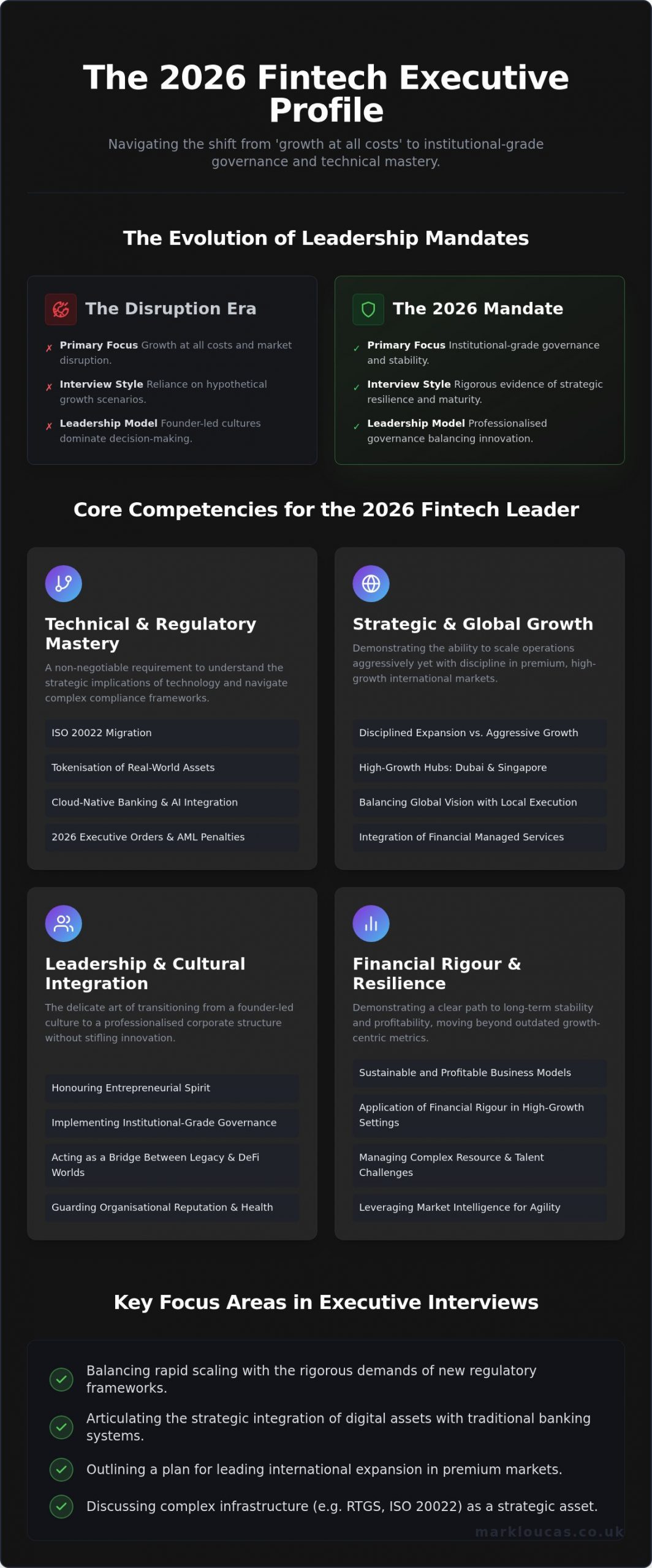
The threshold for excellence has been redefined. In 2026, the global fintech sector no longer rewards mere disruption; it seeks a rare synthesis of technological agility and institutional-grade stability. Leaders are expected to navigate the friction between legacy banking infrastructures and the burgeoning world of decentralised finance whilst maintaining absolute compliance. This shift has transformed the nature of fintech executive interview questions, moving away from hypothetical growth scenarios toward rigorous evidence of strategic resilience and operational maturity.
Successful candidates often frame their background as a bridge between two worlds. You must demonstrate a deep understanding of the fintech landscape, showing how you have applied financial rigour to high-growth environments. The executive search process itself reflects this new reality. It is a meticulous, unhurried journey that values privacy and tailored solutions over the volume-driven approaches of the past. Your ability to articulate this synthesis will be the anchor of your candidacy.
The Evolution of the Executive Profile
The 2026 mandate focuses on sustainable and profitable business models. The industry has moved beyond the “growth at all costs” mindset that dominated previous decades, favouring leaders who can demonstrate a path to long-term stability. Today, the most sought-after leaders are those who act as knowledgeable local insiders whilst possessing a truly global perspective. This is why the fintech executive search process now prioritises discreet, highly connected candidates who can influence diverse stakeholders across multiple jurisdictions. You are no longer just a manager; you are a guardian of the organisation’s reputation and financial health.
Identifying the Core Competencies for 2026
Technical literacy has become a non-negotiable requirement for senior roles. You don’t need to be writing the code, but you must understand the strategic implications of cloud-native banking and AI integration. Your ability to articulate how these technologies drive efficiency whilst managing risk is a common theme in modern fintech executive interview questions. Beyond the technology, strategic resilience is paramount. You must show how you manage complex resource challenges within the specialised financial recruitment landscape, ensuring your team remains agile despite shifting global economic conditions. This requires a nuanced understanding of talent advisory and market intelligence that goes far beyond traditional hiring practices.
To explore how our bespoke market intelligence can support your next international expansion, please get in touch with our boutique consultancy.
Strategic Questions for Scaling and Global Growth
Securing a senior leadership role in 2026 requires an ability to articulate growth that is both aggressive and disciplined. When addressing fintech executive interview questions, candidates must move beyond simple revenue targets. You’ll need to demonstrate how you intend to scale operations in high-growth hubs like Dubai or Singapore whilst maintaining the meticulous standards expected by global regulators. This often involves the strategic integration of financial managed services to ensure that operational efficiency doesn’t lag behind market expansion. The most sophisticated candidates balance the grand vision of a global product with the granular details of local market execution.
A significant challenge in 2026 is the transition from a founder-led culture to a professionalised corporate structure. Boards are looking for leaders who can honour the original entrepreneurial spirit whilst implementing the governance required for institutional trust. This shift requires a delicate touch. You must prove you can lead this evolution without stifling the creativity that made the firm successful. If you’re preparing for a high-stakes leadership transition, a private conversation with a specialist executive search advisor can help refine your strategic narrative.
Managing the Transition from Startup to Scaleup
Expect rigorous questioning regarding your methodology for implementing governance frameworks during periods of rapid growth. You must explain how you introduce necessary bureaucracy to protect the firm without slowing down the innovation cycle. Hiring remains a central theme. You’ll be asked how you identify and attract high-calibre professionals who thrive in a professionalised environment whilst retaining their agility. It’s about building a legacy of excellence that survives the initial scaling phase.
Balancing Innovation with Financial Stability
Justifying research and development spend on emerging technologies like AI to a conservative board is a core competency. The academic rigour found in NYU Stern’s MS in Fintech program highlights the necessity of this strategic balance. In 2026, the path to profitability is the primary metric for success. You must answer questions about burn rates with absolute precision, showing a clear roadmap to sustainable margins. Success in this area is often underpinned by digital banking recruitment strategies that prioritise long-term stability over short-term technical fixes.
If you are preparing for a senior leadership transition and require discreet advice on your strategic positioning, please reach out to our boutique advisory team for a private consultation.
Technical Proficiency and the Regulatory Landscape
In 2026, the technical literacy required for senior roles has transcended basic digital fluency. It’s no longer sufficient to speak in generalities about innovation. Instead, the most probing fintech executive interview questions now focus on your grasp of systemic infrastructure. You must demonstrate a sophisticated understanding of RTGS payment consulting and how modern settlement systems underpin global liquidity. This knowledge allows you to position technical decisions as core strategic drivers that enable market expansion rather than mere back-office concerns.
Cybersecurity has also evolved from a defensive technical hurdle into a powerful business enabler. In an era of heightened transparency, your ability to articulate a robust security posture can be the deciding factor in securing high-value partnerships. Navigating banking compliance across multiple jurisdictions requires more than just a checklist approach. It demands a leader who can maintain a steady, reassuring pulse whilst managing the granular details of varying regulatory expectations in London, Dubai, or Singapore. This architecture of reliability is what separates elite candidates from the rest of the field.
Addressing ISO 20022 and Global Payment Standards
The migration to rich data messaging represents a once-in-a-generation shift for the payments industry. When addressing this in an interview, you should move beyond the technical specifications to discuss the strategic potential of structured data. ISO 20022 isn’t merely a compliance exercise; it’s a foundation for building more intelligent, automated financial services. You might highlight how this standard allows for more precise fraud detection or how it streamlines the reconciliation process for corporate clients. Articulating the impact of real-time gross settlement on liquidity management shows you understand the steady, reassuring pulse required to manage high-value transactions in a 24/7 environment.
Resilience in High Stakes Compliance Environments
Leading a team through a significant regulatory audit requires a discreet and professional approach. It’s about fostering a culture where compliance is integrated into the very architecture of the product. By drawing on the best interview questions for compliance experts, you can demonstrate your ability to curate a team of insiders who value privacy and tailored solutions. Your narrative should reflect a brand of leadership that is never in a rush, suggesting the patience and diligence required to navigate the most complex regulatory landscapes across the globe. This projects a persona of reliability and expert care that elite recruitment firms value above all else.
To discuss how our tailored leadership advisory can refine your executive presence, please connect with our discreet consultants for a private conversation.
Leadership Qualities and Cultural Integration
The architecture of leadership in 2026 is defined by a rare synthesis of discretion and influence. It’s no longer sufficient to be the loudest voice in the room. Instead, elite recruitment firms are looking for candidates who can demonstrate quiet confidence whilst navigating the complex interpersonal dynamics of a global C-suite. When answering fintech executive interview questions, your ability to articulate a methodology for managing up is paramount. You must show how you build consensus amongst diverse stakeholders who may have conflicting priorities, from risk-averse board members to innovation-hungry investors. This requires a steady, reassuring pulse that projects reliability even during periods of significant market volatility.
Fostering a culture of excellence requires a commitment to privacy and tailored solutions that mirrors the unhurried pace of a high-end concierge service. This involves more than just setting performance targets. It requires a leader who values the granular details of organisational behaviour and understands the importance of craftsmanship in team building. You must be prepared to discuss how you cultivate diversity and inclusion not as a marketing exercise, but as a core strategic asset that drives better decision-making in high-stakes environments. Your narrative should reflect a persona that is deeply professional, understated, and focused on the long-term health of the institution.
Influencing Stakeholders and Board Members
Board-level influence in the payments sector often requires an understated and elite communication style. You might be asked to describe a time you successfully persuaded a board to pivot on a major strategic decision, perhaps regarding an international expansion or a significant regulatory challenge. The key is to demonstrate how you maintained professional decorum whilst delivering a definitive, evidence-based argument. Reliability acts as the anchor of these high-value transactions, and your ability to handle conflict amongst the C-suite with grace is a hallmark of senior leadership maturity.
Fostering Innovation whilst Maintaining Governance
Balancing the creative spark of your fintech and banking technology teams with the heavy weight of regulation is a delicate art. Many fintech executive interview questions will explore how you ensure that meticulous attention to detail is maintained at every level without stifling the agility that defines the sector. This involves identifying and retaining niche specialists who possess both technical brilliance and a deep respect for governance. If you are seeking to refine your leadership narrative for an elite role, please book a private session with our executive advisors to ensure your profile resonates with the expectations of the world’s most prestigious firms.
If you are ready to explore exclusive, non-public leadership opportunities within the global payments sector, please contact our specialist advisors for a confidential discussion.
Partnering with Specialist Consultants for Executive Success
The path to an elite leadership role in 2026 is rarely found through public channels. For the discerning executive, the volume-driven approach of large corporate recruitment entities often lacks the privacy and tailored solutions required for high-stakes career transitions. Partnering with a boutique advisor like Mark Loucas Ltd provides a signal of exclusivity to the initiated, offering access to private opportunities that never reach the open market. This intimate approach ensures that your interests are managed with expert care, allowing you to maintain the quiet confidence necessary when preparing for the most rigorous fintech executive interview questions.
A sophisticated digital banking recruiter acts as more than just an intermediary. They serve as a knowledgeable local insider, providing the architectural detail of a firm’s culture and history that is essential for a successful placement. By leveraging market mapping and intelligence, you gain a definitive understanding of your position within the competitive landscape. This strategic alignment ensures that every interaction with a potential board is underpinned by reliability and a deep understanding of the organisation’s grand vision.
The Value of Niche Market Intelligence
Success in senior leadership interviews often depends on the granular details of your preparation. Niche market intelligence allows you to anticipate specific board-level concerns, from regional regulatory shifts in Dubai to the cultural nuances of the London fintech district. By working with a consultancy that explicitly excludes entry-level roles, you benefit from a focus on high-calibre professional placements. This environment fosters the meticulous attention to detail required to answer fintech executive interview questions regarding systemic infrastructure and long-term profitability. Data-driven insights act as the anchor for your strategic narrative, ensuring you speak with the authority of a true industry insider.
Securing Exclusive Opportunities through Search Firms
Building a long-term relationship with a discreet executive search partner is a hallmark of the successful 2026 leader. This partnership moves at the smooth, unhurried pace of a high-end concierge service, reflecting the patience and diligence required in high-value transactions. It’s a journey that prioritises your long-term career trajectory over immediate placement, ensuring that every opportunity is a curated match for your unique expertise—a philosophy mirrored in personal spheres by luxury matchmaking services like Perfect Fit. As you prepare for the most prestigious roles in the sector, remember that the most significant opportunities are often those discussed behind closed doors. This commitment to individualised attention is what ultimately secures your place amongst the global fintech elite.
To discuss your next career move within the global payments landscape, please reach out to our specialist advisors for a private consultation.
Lead the Future of Global Financial Innovation
The landscape of 2026 demands a leader who can weave together the grand vision of digital innovation with the meticulous rigour of institutional governance. By mastering the strategic nuances behind modern fintech executive interview questions, you position yourself as a candidate who understands that technical infrastructure is a fundamental driver of business value rather than a mere operational hurdle. You now have the frameworks to articulate your influence at the board level and your ability to lead through complex regulatory shifts with quiet confidence. Success in this elite sector requires more than just technical skill. It requires a persona of reliability and a deep understanding of the global payments architecture.
At Mark Loucas Ltd, we specialise in the strategic acquisition of global leadership, offering a bespoke approach that prioritises your privacy and long-term trajectory. Our deep expertise in payments infrastructure and global market intelligence provides you with the non-public insights required to secure the most prestigious roles in London, Dubai, and Singapore. If you are seeking your next leadership challenge in the global fintech sector, we invite you to contact our executive search team for a discreet consultation. Your journey towards the pinnacle of fintech leadership deserves the dedicated attention of a specialist advisor. We look forward to supporting your continued success.
Frequently Asked Questions
How should I prepare for a fintech executive interview in 2026?
Preparation requires a deep dive into the 2026 regulatory environment, specifically the Executive Order on fintech innovation. You must align your previous successes with the industry’s shift toward institutional stability and profitability. Reviewing current market mapping data for your target region ensures you speak with local authority. It’s essential to practise articulating how you balance technological agility with the rigorous demands of global compliance, and you may also explore Credit-based fees for premium AI career tool usage to access sophisticated interview simulators.
What are the most common strategic questions for fintech leaders?
Expect fintech executive interview questions that probe your methodology for scaling across borders whilst maintaining operational efficiency. Boards frequently ask how you manage the transition from a founder-led culture to a professionalised corporate structure. You will also face queries regarding your strategy for capital allocation in high-interest environments and how you justify significant R&D spend on emerging technologies like artificial intelligence to conservative stakeholders.
How do I demonstrate technical literacy as a non-technical executive?
Focus on the strategic implications of technology rather than granular coding details. You should discuss how cloud-native banking or AI integration drives specific business outcomes, such as reduced operational risk or improved customer acquisition costs. Proving you understand the architecture of reliability, including cybersecurity as a business enabler, demonstrates that you possess the necessary technical vision to lead a sophisticated technology firm without being hands-on.
Why is knowledge of ISO 20022 important for fintech leadership roles?
ISO 20022 is the global standard for financial messaging that enables richer data exchange and improved interoperability. For leaders, this knowledge is critical because it underpins the future of cross-border payments and real-time settlement. Understanding this migration allows you to discuss how structured data can be leveraged for better fraud detection and more efficient liquidity management, which are top priorities for institutional partners in 2026.
How do I answer questions about scaling a fintech profitably?
Lead with a definitive roadmap to sustainable margins rather than just user growth. You must demonstrate an understanding of unit economics and how you intend to optimise burn rates whilst expanding into new territories like Dubai or Singapore. Discussing the use of financial managed services to streamline back-office operations shows you have a practical plan for achieving profitability without sacrificing the innovation that drives the firm’s value.
What is the role of an executive search firm in the fintech sector?
A boutique search firm acts as a discreet advisor, providing access to exclusive, non-public opportunities that aren’t visible to the wider market. They offer tailored solutions and market intelligence that help you understand your competitive position. Unlike volume-driven recruiters, a specialist consultancy focuses on high-calibre professional placements, ensuring that your unique leadership profile is presented to the most prestigious organisations with the necessary expert care.
How can I discuss my leadership style without sounding generic?
Avoid marketing clichés by using specific examples of how you have influenced a board or managed a C-suite conflict. Describe your methodology for building a high-performance culture that values meticulous attention to detail and privacy. By anchoring your leadership philosophy in the granular details of your past successes, you project a persona of quiet confidence and reliability that resonates with the sophisticated expectations found in fintech executive interview questions.
What questions should an executive ask the interviewer in a fintech firm?
Focus on the firm’s long-term architectural vision and its relationship with global regulators. Ask how the board balances the desire for rapid innovation with the necessity of institutional stability. Inquire about the organisation’s approach to ISO 20022 migration and how they use market intelligence to stay ahead of competitors. These queries show you are thinking like a strategic partner who is invested in the sustainable health of the business.

Article by
Liam Henfrey
Liam Henfrey is a seasoned specialist in the payments and banking sectors with over two decades of experience. As the Founder and CEO of FINOPSIS and Managing Director at Mark Loucas Ltd, he advises organisations on complex financial operations and technology. His career includes senior roles at PwC, Deloitte, and Visa Europe.
Related Fintech Recruitment Guides
If you liked this guide then you may also like the following: