


The Strategic Role of the Chief Revenue Officer in 2026
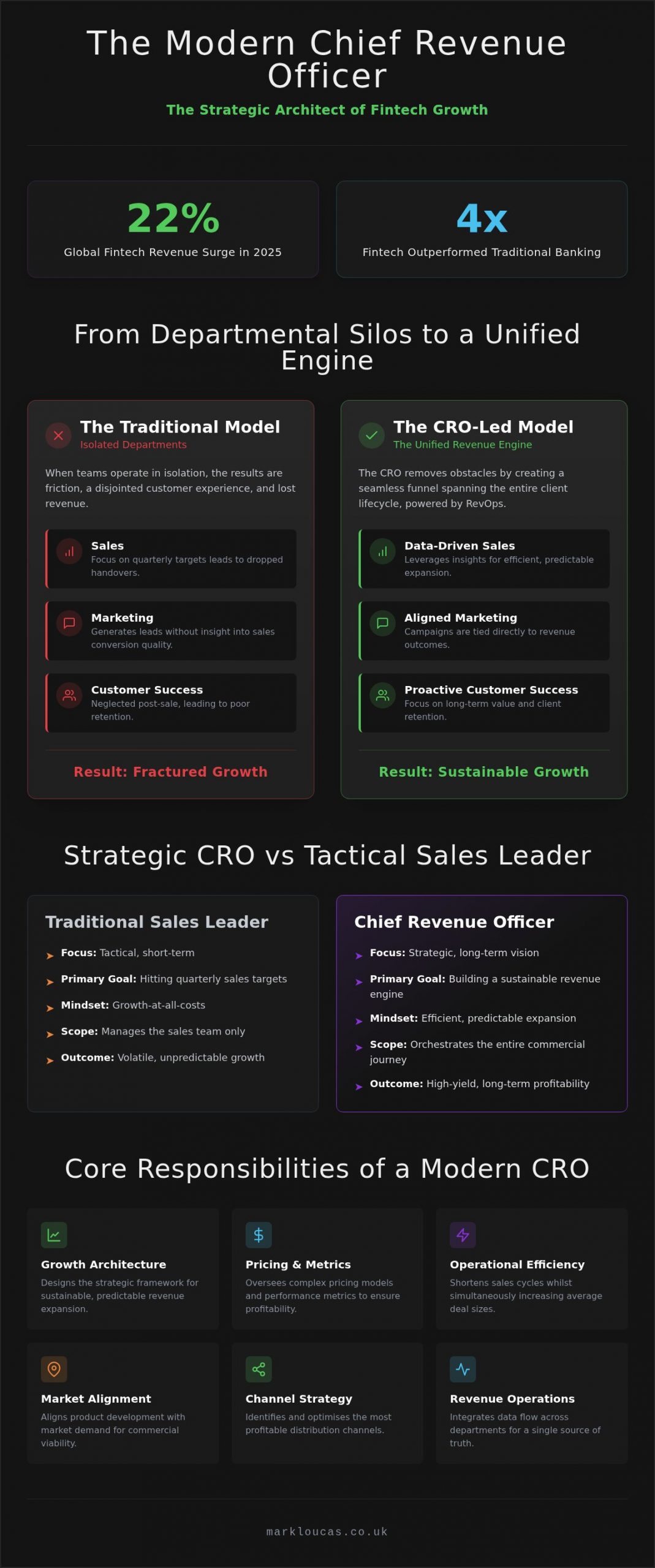
Whilst global fintech revenues surged by 22% in 2025, outperforming traditional banking four times over, why do so many institutions struggle with fractured growth? The answer often lies in the invisible walls separating sales, marketing, and customer success. You likely feel the weight of these departmental silos, which can hinder even the most innovative digital banking platforms from reaching their full potential. It is a common frustration amongst leaders, from the City to Silicon Valley, who find that the right chief revenue officer, one possessing both technical fintech knowledge and commercial scale experience, remains remarkably elusive.
This exploration reveals how the role serves as the strategic orchestrator of a unified revenue engine, particularly as we address the complexities of the 2026 regulatory environment. You will discover a clear framework for the position and the definitive return on investment that follows such an elite appointment. We also provide a refined strategy for sourcing the rare talent required to lead within the global fintech sector, ensuring your organisation secures a leader with the poise and expertise to manage high-value transactions with meticulous care.
Key Takeaways
- Understand how the chief revenue officer unifies fragmented departments into a single, cohesive engine designed for sustainable growth.
- Learn the essential distinctions between tactical sales leadership and the strategic, long-term vision required for modern revenue alignment.
- Identify the specific traits and technical expertise needed to lead high-growth payments firms through a complex regulatory landscape.
- Discover why specialised market mapping remains indispensable for identifying elite candidates within the private, non-public talent pool.
- Gain a clear framework for assessing the long-term value and return on investment when appointing senior revenue leaders to your board.
If you are looking for an expert advisor to help you find the right leader for your organisation, you can reach out to us at our contact page for a private consultation.
Defining the Chief Revenue Officer in the Modern Fintech Landscape
The role of the chief revenue officer has transitioned from a niche executive position into a cornerstone of the modern board. Whilst the foundational definition of a Chief Revenue Officer centres on the executive responsible for every process that generates revenue within an organisation, the 2026 landscape demands far more than administrative oversight. Precision is paramount. In this sophisticated environment, the CRO acts as the primary architect of sustainable growth in fintech, ensuring that every commercial lever is pulled with meticulous care. Traditional leadership models often relied on a head of sales to drive quarterly targets through sheer force of will. However, the current economy prioritises efficient, predictable expansion over the volatile growth-at-all-costs mindset of previous decades.
The Unification of Revenue Silos
When marketing, sales, and customer success operate in isolation, the result is almost always a disjointed customer experience and lost revenue. Silos are a relic of the past. These traditional barriers create friction, where leads are dropped or existing clients feel neglected once the initial contract is signed. The chief revenue officer removes these obstacles by creating a seamless funnel that spans the entire lifecycle of a client. By integrating Revenue Operations, or RevOps, the CRO ensures that data flows freely across the business. This unified structure transforms revenue generation from a series of disjointed events into a continuous, reliable process that supports long term retention; to achieve this, many organisations implement digital communication systems built by thepalmgroup.eu that are fully optimised for revenue growth.
Strategic Importance in the 2026 Digital Economy
The complexity of modern financial products requires a level of commercial sophistication that goes beyond simple transactional selling. As we navigate the intricacies of the 2026 digital economy, organisations must manage global market fluctuations whilst maintaining a competitive edge in fintech and banking technology. A seasoned CRO provides the strategic depth necessary to align product development with market demand. This ensures that innovations are both technically sound and commercially viable. Such expertise is vital for firms looking to secure their position amongst the elite providers in a crowded global marketplace. It is no longer enough to simply offer a product; one must curate a comprehensive revenue strategy that anticipates the needs of a discerning clientele.
To discuss your specific leadership requirements in confidence, please visit our contact page for a private consultation.
Core Responsibilities and the Evolution of Revenue Alignment
The modern chief revenue officer is the primary custodian of the board’s commercial ambitions. They do not merely manage sales teams; they curate the entire financial trajectory of the organisation with a focus on sustainable, high-yield growth. By overseeing complex pricing models and performance metrics, they ensure that every transaction contributes to long-term profitability. This involves a meticulous approach to payments industry recruitment, where identifying the right distribution channels and market opportunities is a matter of strategic survival. The strategic role of the CRO has evolved into a partnership with the CEO, acting as a reliable anchor for scaling operations without sacrificing the quality of service that discerning clients expect.
Efficiency is the hallmark of an elite revenue leader. They are tasked with driving operational improvements that shorten sales cycles whilst simultaneously increasing average deal sizes. This requires a granular understanding of the customer journey, from the first point of contact to the final signature. By refining these processes, the CRO ensures that the organisation remains agile and responsive in a competitive global market. They identify the most profitable distribution channels, ensuring that marketing spend is allocated with precision to the highest-yielding opportunities.
Data Driven Forecasting and Market Expansion
In 2026, guesswork has no place in the executive suite. Elite CROs utilise advanced analytics to predict growth patterns with startling accuracy, allowing for unhurried and logical decision-making. They oversee geographic expansion whilst maintaining revenue stability, often relying on deep market mapping and intelligence to identify non-public opportunities. This sophisticated approach to expansion reflects the patience and diligence required in high-value fintech transactions. It ensures that entering a new territory is a calculated move rather than a speculative gamble.
Optimising Customer Lifetime Value in Subscription Models
Acquisition is only half the battle in the contemporary fintech landscape. In the subscription-heavy payments sector, customer retention is the true engine of sustainability. The chief revenue officer ensures that customer satisfaction remains a core revenue driver, implementing bespoke strategies that reduce churn and increase expansion revenue. They focus on the granular details of the client relationship, ensuring that every touchpoint adds value and reinforces the brand’s reputation for excellence. This holistic view of the customer lifecycle allows the business to scale with confidence. If you are seeking a discreet partner to help you navigate these complex leadership challenges, our team offers tailored solutions for fintech boards to ensure your interests are managed with expert care.
If you require a discreet advisor to identify your next revenue leader, please reach out to us at our contact page for a confidential discussion.
Distinguishing the Chief Revenue Officer from Traditional Sales Leadership
The transition from a traditional Sales Director to a Chief revenue officer (CRO) represents a fundamental shift in executive scope. Whilst a Vice President of Sales is often consumed by the immediate pressure of quarterly quotas, the chief revenue officer operates with a broader, more unhurried perspective. They are not merely focused on hitting a number; they are the architects of the entire revenue ecosystem. This role demands a profound understanding of marketing and customer service that far exceeds the requirements of a traditional sales leader. It is a position of curated excellence, where the focus remains on the granular details of business growth rather than just the tactical execution of sales targets.
A CRO influences the very fabric of the organisation, often guiding product development and pricing strategy to ensure they align with market realities. They recognise that a product’s value is not just in its features, but in how it effectively solves a specific problem for a discerning clientele. By bridging the gap between what is built and what is sold, they ensure the company avoids the common pitfall of developing technology in a vacuum. This level of influence marks the definitive shift from a department head to a true C-suite executive who manages the organisation’s interests with expert care; to explore this transition further, you can learn more about Robin Lohmann and his philosophical approach to strategic sovereignty.
Beyond the Quota
Elite revenue leaders prioritise the long term health of the business over short term gains. They understand that unsustainable growth can lead to burnout and brand dilution. Instead, they balance immediate targets with strategic objectives that secure the company’s future amongst the elite providers in the fintech sector. This requires a level of patience and diligence often absent in high pressure sales environments. Their perspective is holistic, ensuring that the revenue engine remains robust and reliable throughout various market cycles; to achieve this, some organisations consult experts like Scott Lumley for leadership in business growth and turnaround.
Cross Functional Collaboration and Cultural Impact
The cultural impact of a chief revenue officer is significant. They foster a culture of shared responsibility, where every department understands its role in generating value. By collaborating closely with the CTO and COO, they ensure that technical innovations and operational processes are perfectly aligned with commercial goals. This directness ensures the brand’s market positioning remains clear and authoritative, reflecting the meticulous attention to detail that high value transactions require. Many organisations achieve this by partnering with BrandLume to unify their branding and digital marketing efforts. Such leadership shuns impersonal volume in favour of an intimate, tailored approach to market presence.
If you are seeking to secure a leader who embodies this rare combination of technical and commercial excellence, please visit our contact page for an initial consultation.
Identifying the Ideal Candidate for High Growth Payments Firms
Finding a chief revenue officer who can navigate the complexities of the 2026 payments landscape is an exercise in meticulous selection. It is not merely about finding a sales leader; it is about identifying a visionary who is equally comfortable with data analytics as they are with high-level board negotiations. The ideal candidate represents a refined blend of analytical rigour and charismatic leadership, capable of steering an organisation through the rapid shifts of the digital banking sector. This individual must possess a deep-seated understanding of how technical innovations translate into commercial value, ensuring that the firm remains both innovative and profitable. Such leaders are rare, often operating within private, non-public circles that require a discreet approach to uncover.
Essential Traits and Professional Background
A background in high-growth fintech or digital banking is essential, as it provides the necessary context for the unique challenges of the sector. The ability to remain cool under pressure during high-stakes board meetings is a trait that cannot be overstated. Elite candidates often have a proven track record in specialised financial recruitment and leadership, having successfully scaled operations and implemented sophisticated revenue technology in previous roles. They bring a sense of quiet confidence to the table, derived from years of managing complex, high-value transactions. Their experience allows them to organise revenue streams with a level of precision that ensures long term stability whilst others may be distracted by short term market noise.
Interviewing for Strategic Vision and Technical Literacy
When interviewing for this pivotal role, questions must go beyond surface-level achievements to uncover a candidate’s ability to align disparate departments. You might ask how they have previously unified marketing and customer success teams to create a single revenue engine. Assessing their understanding of complex payments infrastructure is also vital; a chief revenue officer must be technically literate enough to challenge and support the CTO. Finally, evaluate their approach to building and mentoring high-performing teams, as their influence will define the organisation’s internal culture and external market positioning. To ensure you find a candidate of this calibre, our fintech executive search experts are available to provide the discreet, tailored support your board requires to identify and secure elite revenue talent.
If you are ready to secure a leader who can define your organisation’s commercial future, please visit our contact page for a discreet consultation regarding your executive requirements.
Strategic Executive Search for Global Revenue Leaders
In the high-stakes environment of global payments infrastructure, generic recruitment methods consistently fall short of the mark. Finding a chief revenue officer who possesses both the technical literacy of a developer and the commercial acumen of a seasoned board member requires a level of niche expertise that volume-driven agencies simply cannot provide. Partnering with a specialist fintech executive search firm ensures that your organisation has access to a global network of proven leaders. Mark Loucas Ltd delivers tailored solutions for these critical senior appointments, moving beyond surface-level resumes to understand the architectural depth of a candidate’s experience. Precision is non-negotiable. This unhurried, meticulous approach is essential for securing individuals who can manage high-value transactions with the required poise and expertise.
Our firm shuns the impersonal nature of large corporate entities in favour of an intimate, personalised approach that suggests the client is the sole focus of our attention. We recognise that the most distinguished revenue leaders are rarely found on public job boards. Instead, they operate within elite circles where privacy is paramount. By acting as a discreet advisor, we bridge the gap between ambitious fintech boards and the rare talent capable of driving sustainable growth in the 2026 economy.
Navigating the Competitive Talent Market
The global fintech landscape is increasingly nuanced, requiring a sophisticated understanding of local market signatures and regulatory shifts. We utilise advanced market mapping to identify top-tier, non-public candidates who are not actively seeking new roles but possess the exact skills required to scale a digital banking platform. This personalised strategy is far superior to standard recruitment tactics. It allows us to find individuals who can align sales, marketing, and success whilst maintaining the steady, reassuring pulse of a maturing business. We look for those who have navigated the complexities of urban financial centres and emerged with a proven record of success.
Tailored Recruitment Solutions for Executive Appointments
Ensuring a perfect cultural fit is as vital as verifying technical credentials. A new chief revenue officer must align with your board’s vision whilst fostering a culture of shared responsibility across the entire organisation. We manage the search process with absolute discretion, protecting your brand’s reputation and the candidate’s privacy throughout. Managing the transition and onboarding of such a senior leader requires patience and diligence. Our firm provides the necessary support to ensure that the integration is seamless, allowing your new executive to focus immediately on building a predictable and scalable revenue engine that secures your position amongst the elite of the fintech sector.
If you are looking to secure elite leadership for your organisation, you should contact the team at Mark Loucas Ltd to discuss your requirements in a private setting.
Securing the Future of Fintech Revenue Leadership
The evolution of the chief revenue officer reflects a broader maturation within the global payments sector. This role now transcends traditional sales management to become the primary architect of a unified, sustainable revenue engine. By dissolving departmental silos and leveraging sophisticated market mapping, organisations can navigate the complexities of the 2026 economy with unhurried confidence. The transition from tactical quota hitting to holistic business growth is no longer a luxury; it is a strategic necessity for those who wish to remain amongst the elite providers of digital banking technology.
Founded in 2011, Mark Loucas Ltd remains a dedicated advisor for boards seeking to identify non-public talent through specialist fintech executive search and global market intelligence. Our boutique approach ensures your interests are managed with the meticulous care and discretion that high-value appointments demand. We invite you to reach out to our advisors to begin a tailored search for the leader who will define your organisation’s commercial legacy. With the right leadership in place, the path to sustainable growth becomes clear and attainable.
Frequently Asked Questions
What is the main difference between a CRO and a VP of Sales
A chief revenue officer manages the entire customer lifecycle, whilst a VP of Sales focuses primarily on new customer acquisition and meeting quarterly quotas. The CRO integrates sales, marketing, and customer success into a single, cohesive engine. This holistic approach ensures that revenue generation is sustainable and aligned with long term board objectives, rather than being limited to the tactical execution of sales targets.
When should a fintech startup hire its first Chief Revenue Officer
A fintech firm should consider this appointment when transitioning from initial market entry to a phase of rapid scaling, typically around Series B or C funding. This occurs amongst organisations looking to unify fragmented departments and prepare for complex global expansion. Hiring a leader with this level of commercial sophistication ensures that growth is managed with meticulous care, preventing the operational friction that often accompanies high value transactions.
What qualifications are typically required for a CRO role
Elite candidates usually possess a refined blend of technical literacy and commercial acumen, often with a proven track record in high growth fintech environments. Qualifications often include a deep understanding of payments infrastructure and the ability to implement sophisticated revenue technology. Most importantly, they must demonstrate the charismatic leadership and analytical rigour required to manage a diverse, multi functional revenue organisation with quiet confidence.
How does a CRO interact with the Chief Marketing Officer
The relationship is one of strategic collaboration, where the CRO ensures that marketing efforts are perfectly aligned with sales objectives and customer retention goals. They work together to refine the brand’s market positioning, ensuring that every campaign contributes directly to the health of the revenue ecosystem. This partnership shuns disjointed goals in favour of a tailored approach that prioritises the organisation’s long term interests and market authority.
What are the key performance indicators for a Chief Revenue Officer
Success is measured through a variety of metrics, including Annual Recurring Revenue growth, Customer Lifetime Value, and the efficiency of the sales cycle. Other vital indicators include the cost of customer acquisition and net revenue retention. These data points allow the chief revenue officer to forecast growth patterns with startling accuracy, providing the board with a reliable anchor for strategic decision making in a volatile global market.
Is a CRO responsible for customer success teams
Yes, in modern structures, the CRO frequently oversees customer success to ensure that retention remains a core driver of profitability. By integrating this function into the broader revenue strategy, the organisation can focus on reducing churn and increasing expansion revenue amongst existing clients. This holistic view ensures that every touchpoint in the customer journey is managed with the expert care required to maintain high value, long term relationships.
How much does a Chief Revenue Officer typically earn in the UK
Whilst compensation varies based on the scale of the organisation, the median salary for a chief revenue officer in the fintech sector is approximately $310,000. Typical ranges often fall between $260,000 and $370,000, excluding significant equity components that are standard for such senior appointments. These figures reflect the rarity and high value of the expertise required to lead revenue strategies in the complex 2026 payments landscape.
Can a CRO help with international market expansion
International expansion is a core responsibility, as the CRO identifies new distribution channels and geographic opportunities whilst maintaining revenue stability. They utilise deep market mapping and intelligence to navigate the nuances of global fintech environments, ensuring that expansion is a calculated move. This level of strategic oversight allows the organisation to scale its presence across prestigious districts and premium urban centres with unhurried diligence and expert care.

Article by
Liam Henfrey
Liam Henfrey is a seasoned specialist in the payments and banking sectors with over two decades of experience. As the Founder and CEO of FINOPSIS and Managing Director at Mark Loucas Ltd, he advises organisations on complex financial operations and technology. His career includes senior roles at PwC, Deloitte, and Visa Europe.
Related Fintech Recruitment Guides
If you liked this guide then you may also like the following: