


Interim director meaning and the strategic value of temporary executive leadership in 2026
What if the most significant risk to your fintech firm isn’t a market downturn, but the quiet erosion of momentum during a six month executive search? Whilst many boards view a leadership vacancy as a period of waiting, elite organisations recognise it as a critical window for transformation. Understanding the true interim director meaning goes far beyond finding a temporary placeholder; it involves securing a high calibre professional who arrives with a mandate for change. These individuals don’t merely keep the seat warm. They bring a level of refined expertise that turns a period of potential instability into a strategic advantage.
You’re likely familiar with the mounting pressure of maintaining growth and operational excellence, particularly whilst navigating the increasingly complex regulatory shifts that define the current financial climate. You’ll discover how these specialised leaders drive immediate impact and why they’ve become indispensable in the 2026 payments landscape. We’ll explore the strategic framework for identifying elite talent and the precise moments when an interim appointment is the most sophisticated choice for your firm’s future.
Key Takeaways
- Understand the fundamental interim director meaning as a catalyst for transformation rather than just a temporary replacement during executive transitions.
- Recognise why the rapid pace of the payments sector necessitates the immediate impact of specialised temporary leadership to maintain momentum.
- Evaluate the nuanced financial benefits of day rate appointments compared to the long term commitment of permanent executive recruitment.
- Identify the critical organisational triggers that require a discreet, highly connected advisor to secure niche executive expertise.
- Learn the precise framework for defining assignment outcomes to ensure your organisation secures the most distinguished talent available.
Finding the right leadership during a transition shouldn’t be left to chance. You can speak with our specialist advisors to learn how a bespoke interim appointment can protect your firm’s momentum and provide the stability your stakeholders expect.
The fundamental meaning of an interim director in the corporate world
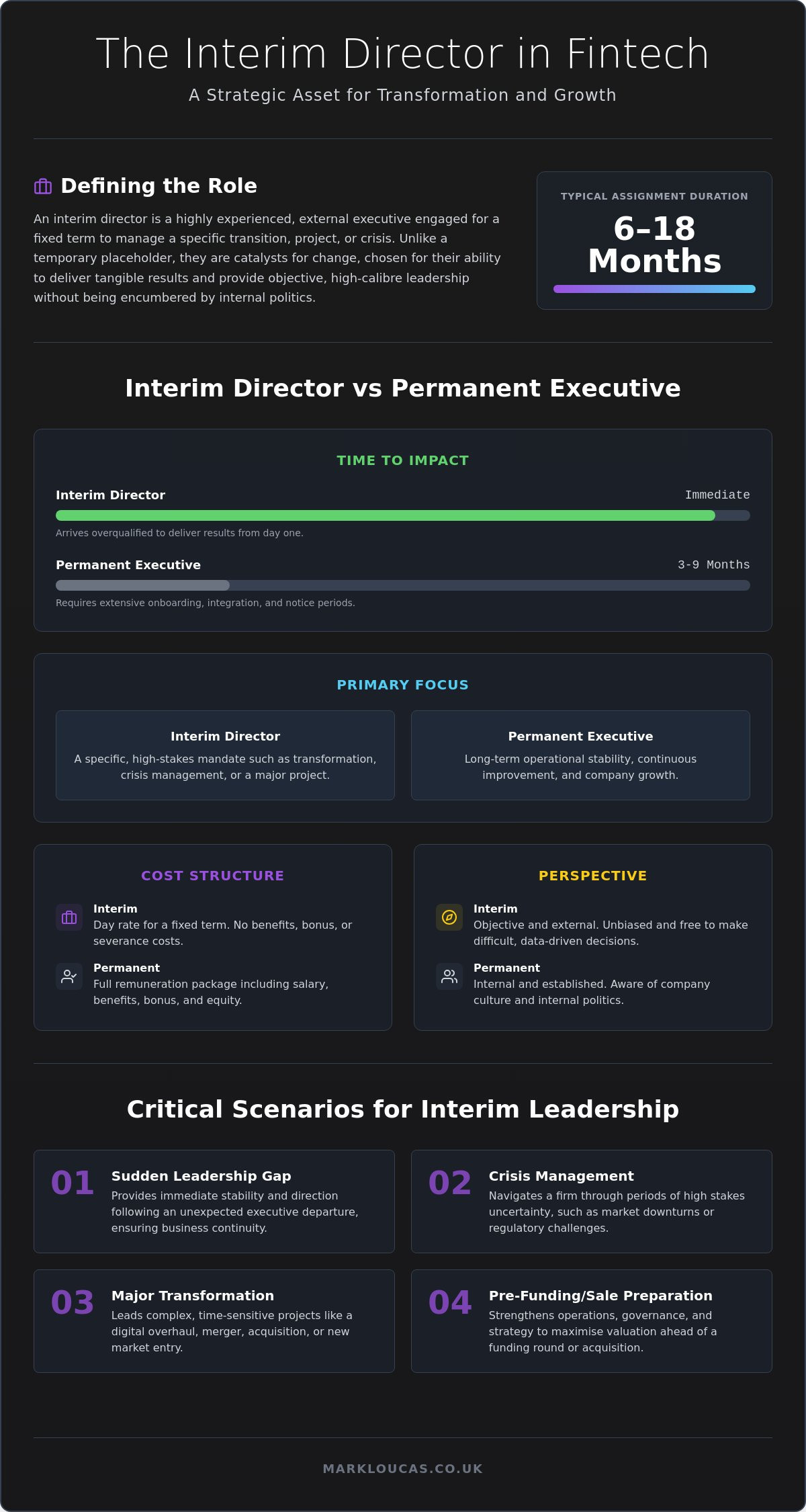
At its most basic level, the interim director meaning refers to a highly experienced executive who joins an organisation for a fixed period to manage a specific transition or crisis. Unlike an “acting” director, who is often an internal candidate stepping up to hold the fort whilst a permanent search is conducted, an interim is an external specialist. They are chosen specifically for their ability to deliver tangible results rather than simply maintaining the status quo. These professionals don’t just fill a gap; they provide a fresh, objective perspective that is unencumbered by internal politics. Most assignments typically range from six to eighteen months, which is a sufficient duration to implement meaningful change without the individual becoming a permanent fixture of the corporate hierarchy.
The practice of Interim management has evolved into a sophisticated strategic tool for boards. In the fast moving fintech sector, where delay can result in lost market share, these leaders act as catalysts for progress. They are often brought in when an organisation is at a crossroads, such as during a sudden departure of a founder or when a firm is preparing for a significant funding round. They provide the steady hand required to navigate these high stakes environments with quiet confidence.
Core responsibilities of an interim leader
An interim director’s primary duty is to stabilise the organisation. During a period of uncertainty, employees and investors alike look for a sign of reliability. These leaders provide that anchor. Beyond mere stabilisation, they often lead specific, high stakes projects that require a niche skill set. This might involve overseeing a complex merger or driving a wholesale digital transformation. They also play a vital role in mentoring existing staff. By the time they depart, they have often prepared the ground for a permanent successor, ensuring that the transition is seamless and that the progress made is sustainable for the long term.
The professional profile of an interim director
These individuals are typically overqualified for the roles they accept. This is a deliberate choice; they have reached a stage in their careers where they value the variety and challenge of project based work. Because they are overqualified, they can make an immediate impact without the need for extensive onboarding. They arrive with a proven track record, often having served as permanent C-level executives in prestigious districts or global firms. Our experience as fintech banking technology recruiters suggests that the most effective interims possess a rare blend of technical expertise and emotional intelligence, allowing them to integrate quickly into new cultures whilst delivering on rigorous commercial objectives.
If your firm requires a discreet partner to source elite talent during a leadership transition, contact our boutique advisory team for a confidential consultation regarding your strategic requirements.
Strategic advantages of appointing an interim director within fintech
The fintech sector operates at a pace that often leaves traditional recruitment cycles behind. Whilst a permanent hire might take six months to source and another three to clear notice periods, the market waits for no one. This is where the true strategic interim director meaning reveals itself. It is the ability to inject elite competence into an organisation exactly when it is required. These professionals bring a level of objectivity that is often missing from internal promotions. Because they are not focused on long term ladder climbing, they can make difficult, data driven decisions without fearing for their political future within the firm. They act as an “honest broker” in disputes between departments, ensuring that the firm’s strategic objectives remain the absolute priority.
For startups and scaling organisations, this model offers unparalleled flexibility. It allows them to access C-suite experience without the heavy cost and long term commitment of a full time contract. This is particularly vital when navigating complex infrastructure shifts or entering new jurisdictions where local expertise is paramount. If your organisation is facing a complex infrastructure shift, you might consider how tailored interim solutions could accelerate your progress and protect your commercial interests.
Rapid deployment and immediate impact
Speed is perhaps the most compelling argument for an interim appointment. When a key leader departs unexpectedly, the vacuum can stall critical projects and cause anxiety amongst investors. An interim can often be on-site within days, providing a safe pair of hands whilst the board conducts a thorough fintech executive search for a permanent successor. This agility ensures that momentum is maintained and that the organisation’s reputation for stability remains intact. They are prepared to hit the ground running, requiring minimal orientation to begin delivering value to the bottom line.
Specialised knowledge for fintech challenges
The complexities of 2026 require more than just general management skills. Many firms are currently grappling with ISO 20022 migrations or navigating the intricate requirements of the EU AI Act. An interim director often brings niche expertise that a generalist permanent hire might lack. They have navigated these scaling hurdles before, often multiple times across different jurisdictions. This experience is particularly valuable for the compliance officer function, where regulatory changes are constant. Understanding What is an Interim Executive helps boards realise that they are hiring a specific solution to a defined problem, which is why the interim director meaning is so closely tied to successful transformation. They provide the precise technical and leadership skills needed to bridge the gap between current operations and future growth.
To understand how a high calibre professional can bridge the leadership gap in your organisation, we invite you to speak with our specialist advisors regarding our bespoke executive solutions.
Comparing interim directors with permanent executive appointments
Whilst a permanent executive represents a multi year commitment to the firm’s culture and vision, an interim is a surgical appointment designed for a specific outcome. The true interim director meaning is found in this shift from long term potential to immediate, tangible execution. When you hire a permanent director, you’re investing in a relationship that may span a decade. This requires a slow, meticulous onboarding process to ensure cultural alignment. Conversely, an interim director arrives with a “plug and play” mindset. They don’t need six months to understand the landscape; they’re expected to deliver value within their first fortnight. This makes the risk profile of an interim considerably lower. If the fit isn’t perfect, the contract is flexible. A permanent hire who fails to integrate can cost a firm several times their annual salary in severance and lost productivity.
Cost structures also differ significantly. A permanent C-suite role involves a complex package of base salary, bonuses, private healthcare, pension contributions, and often significant equity. In 2026, the average private sector day rate for an interim manager in the UK has exceeded £1,000. Whilst this figure appears high at first glance, it is an all inclusive cost. There are no long term benefits, no social security burdens, and no expensive exit packages. You pay for the days worked and the results achieved. This transparency is particularly attractive to boards who need to justify executive spend during a transformation project or a period of restructuring.
Interim vs Permanent vs Consultant
It’s a common mistake to confuse interims with management consultants. A consultant’s role is typically to observe, analyse, and provide a report full of recommendations. They advise from the sidelines. An interim director, however, steps onto the field. They take full operational accountability and hold the “P and L” responsibility. They don’t just tell you how to fix a problem; they execute the solution themselves. This hands on nature makes them far more cost effective than a large consultancy firm, where you often pay for a pyramid of junior analysts led by a single partner.
The ROI of interim leadership
The return on investment for an interim director is measured by the successful delivery of a defined strategic milestone within a fixed timeframe. Beyond the immediate project goals, they prevent the “vacuum cost” of a leadership gap. This is the hidden financial drain caused by delayed decisions and lost momentum whilst a seat remains empty. They also facilitate a vital knowledge transfer. By the time they depart, your permanent team has been upskilled, ensuring that the excellence they introduced remains part of the firm’s DNA. Our financial managed services often highlight this legacy of improved internal capability as a primary benefit of the interim model.
If your organisation is currently facing a leadership transition or requires immediate expertise for a high stakes project, you can connect with our boutique advisors to discuss a tailored interim solution that protects your firm’s interests.
Critical scenarios that require the expertise of an interim director
The decision to engage a temporary executive often stems from a precise organisational trigger that demands more than just a placeholder. Whilst the general interim director meaning involves a fixed term appointment, the strategic application of this role is found in its ability to resolve high pressure dilemmas. One of the most common drivers is the gap between an executive’s departure and the arrival of a permanent successor. This period of interregnum is often fraught with risk, yet an elite interim professional turns this window into an opportunity for operational refinement and objective assessment.
Beyond simple gap filling, these leaders are frequently deployed as turnaround specialists. When a business unit is underperforming or a project has stalled, an external expert can diagnose systemic issues without being hindered by historical loyalties or internal politics. They are also indispensable during significant organisational restructuring or M&A activity. In these instances, the interim manages the complex logistics of integration or divestment, allowing the permanent C-suite to remain focused on the firm’s core commercial goals. Their mandate is clear: deliver the required outcome and leave the organisation in a stronger position than they found it.
To explore how strategic guidance can help your organisation overcome growth obstacles, click here.
Managing sudden executive departures
Unexpected vacancies at the board level can rattle investor confidence and stall critical progress. An interim director provides the immediate stability needed to reassure stakeholders that the firm remains in expert hands. This continuity is particularly vital in sectors like digital banking recruitment, where technical and regulatory momentum must be maintained without interruption. By steadying the ship, they allow the board the luxury of time to conduct a thorough search without the immense pressure of an empty seat. They act as a reliable anchor whilst the long term future of the role is decided.
Leading through transformation and change
Implementing new technologies or entering unfamiliar markets requires a specific type of leadership courage. An external change agent is often more effective than an internal promotion because they aren’t wedded to the status quo. They provide the necessary friction to drive transformation. As one of the fintech recruitment agencies London firms trust for high calibre talent, we’ve seen how interims successfully navigate these transitions by focusing purely on the project outcome. If your firm is currently navigating a merger or a sudden vacancy, contact our team to secure a leader who can deliver immediate results.
To discuss how our discreet network of elite professionals can support your organisation during a period of transformation, please get in touch with our specialist team for a confidential conversation.
How to secure elite interim leadership for your organisation
The process of securing a high calibre interim differs fundamentally from permanent hiring. Whilst the latter focuses on potential and cultural fit over decades, the interim director meaning is rooted in immediate delivery against specific commercial milestones. To succeed, you must first define exactly what success looks like for the assignment. Is it the completion of a specific regulatory audit or the stabilisation of a department after a founder’s exit? Clear objectives are the foundation of a successful interim contract. Because these roles are time bound, the interview process is naturally accelerated. You’re looking for a track record of similar heavy lifting rather than long term career aspirations. It’s about finding the right expert who has solved your specific problem before.
A well defined contract is essential. It should outline the deliverables, the duration, and the reporting lines. This clarity allows the interim to focus entirely on execution. Unlike permanent roles, where the first three months are often spent learning the ropes, an interim is expected to provide a diagnostic report within their first week. This pace requires a different mindset from both the board and the incoming leader. You aren’t just hiring a person; you’re hiring a solution to a defined challenge.
Partnering with a specialist fintech recruiter
Generic agencies often struggle to grasp the technical nuances of the global fintech landscape. They lack the deep, private networks required to find individuals who can step into a complex environment on short notice. Our focus on payments industry recruitment allows us to maintain a curated list of career interims who’ve been vetted for their ability to deliver results under pressure. At Mark Loucas Ltd, we don’t just match CVs to job descriptions. We act as a boutique advisor to ensure the candidate has the specific leadership style required for your firm’s unique culture. This personalised approach ensures that the professional we introduce is not just capable, but exceptional.
Onboarding for immediate success
For an interim director to be effective, they need the authority to act. Onboarding should be swift and focused on access rather than long term socialisation. You don’t have the luxury of a slow integration.
- Ensure all system access and security clearances are ready on day one.
- Provide a clear mandate and communicate their authority to the wider team.
- Identify the key stakeholders who will support or be impacted by their work.
Managing the eventual transition back to a permanent leader is just as important as the start. A successful interim will have documented their progress and prepared a comprehensive handover. This ensures that the momentum they’ve built isn’t lost when the seat is finally filled by a long term successor. This careful management of the exit is a hallmark of a truly professional interim assignment.
To begin the process of identifying a transformational leader for your organisation, reach out to our specialist advisors for a private consultation regarding our executive interim solutions.
Advancing your firm’s strategic objectives with precision
The 2026 fintech landscape demands an agility that traditional leadership models often fail to provide. We’ve explored how the true interim director meaning lies in the ability to turn a period of transition into a catalyst for profound organisational growth. By bridging critical expertise gaps and leading high stakes transformations, these elite professionals protect your firm’s momentum whilst ensuring stakeholder confidence remains unshakeable. Momentum is everything. Whether you’re navigating a sudden vacancy or orchestrating a complex merger, the right interim appointment offers a level of refined execution that is both surgical and highly effective.
At Mark Loucas Ltd, we provide a specialist fintech and payments network alongside a discreet and professional executive search service. Our global reach is balanced by a boutique, personalised approach that ensures your interests are always our primary focus. We value your privacy. Secure your next strategic leader by contacting the experts at Mark Loucas Ltd today to ensure your organisation remains at the forefront of the industry. We look forward to helping you navigate your next leadership challenge with the quiet confidence and expert care your business deserves.
Frequently Asked Questions
What is the difference between an interim director and an acting director
An interim director is an external specialist hired to deliver specific outcomes, whilst an acting director is typically an internal candidate stepping up temporarily to maintain current operations. The interim director meaning is rooted in transformation and high level execution rather than simple gap filling. These professionals bring an objective perspective that internal staff may lack, allowing them to implement necessary changes without the constraints of long term internal politics.
How much does an interim director cost in the UK fintech sector
Cost structures for interim appointments are typically based on a daily rate that reflects the professional’s seniority and the complexity of the assignment. Whilst these rates are higher than a pro-rata permanent salary, they are all-inclusive. Organisations save on long term costs such as pension contributions, private healthcare, and social security. This transparent model allows boards to invest in elite expertise for a fixed period without the burden of long term financial commitments.
Are interim directors subject to IR35 regulations
IR35 compliance remains a critical consideration for any interim engagement in the UK. The determination of whether a role falls inside or outside the legislation depends on the specific nature of the working relationship and the level of autonomy provided. Professional interim directors often operate through their own limited companies, but boards must ensure that the contract and working practices accurately reflect a genuine business to business service to remain compliant.
How long does it take to hire an interim director through an executive search firm
Securing an interim professional is significantly faster than a traditional permanent search, with appointments often finalised within days or a fortnight. Because these leaders are accustomed to rapid deployment, the selection process focuses on immediate capability and previous success in similar scenarios. A specialist firm with a deep network can present a shortlist of vetted, overqualified candidates almost instantly, protecting your firm from the risks of a prolonged leadership vacuum.
What are the main benefits of hiring an interim director during a merger
During a merger, an interim director provides the essential objectivity needed to navigate the complexities of cultural and operational integration. They act as a neutral party, managing the intricate logistics of the transition whilst the permanent executive team remains focused on core commercial goals. This prevents the loss of momentum that often plagues large scale restructuring, ensuring that the strategic value of the merger is realised without internal friction.
Can an interim director eventually become a permanent employee
Whilst it’s possible for an interim to transition into a permanent role, most high calibre professionals in this field are career interims who value variety and project based challenges. The role is designed for a specific duration with defined deliverables. If an organisation finds the fit exceptional, a permanent offer can be made, but the initial mandate remains focused on delivering immediate impact rather than long term employment.
What qualifications should I look for in a fintech interim director
You should prioritise candidates who possess a proven track record in specific sectors such as global payments or digital banking. Beyond technical expertise, look for an individual who is overqualified for the immediate requirements and demonstrates a history of successful transformation. The ability to integrate quickly into a new culture whilst maintaining a focus on rigorous commercial outcomes is a hallmark of the most distinguished interim leaders in the current market.
How do interim directors manage their reputation and career path
Career interims maintain their reputation through the consistent delivery of high stakes projects and the strength of their professional networks. Their career path is defined by a portfolio of successful assignments rather than a climb up a single corporate ladder. By working with discreet boutique advisors, they gain access to private, non-public opportunities that require their specific niche expertise, ensuring their skills remain in high demand amongst elite firms.

Article by
Liam Henfrey
Liam Henfrey is a seasoned specialist in the payments and banking sectors with over two decades of experience. As the Founder and CEO of FINOPSIS and Managing Director at Mark Loucas Ltd, he advises organisations on complex financial operations and technology. His career includes senior roles at PwC, Deloitte, and Visa Europe.
Related Fintech Recruitment Guides
If you liked this guide then you may also like the following: