


Overcoming the Most Significant Challenges in Fintech Hiring for 2026
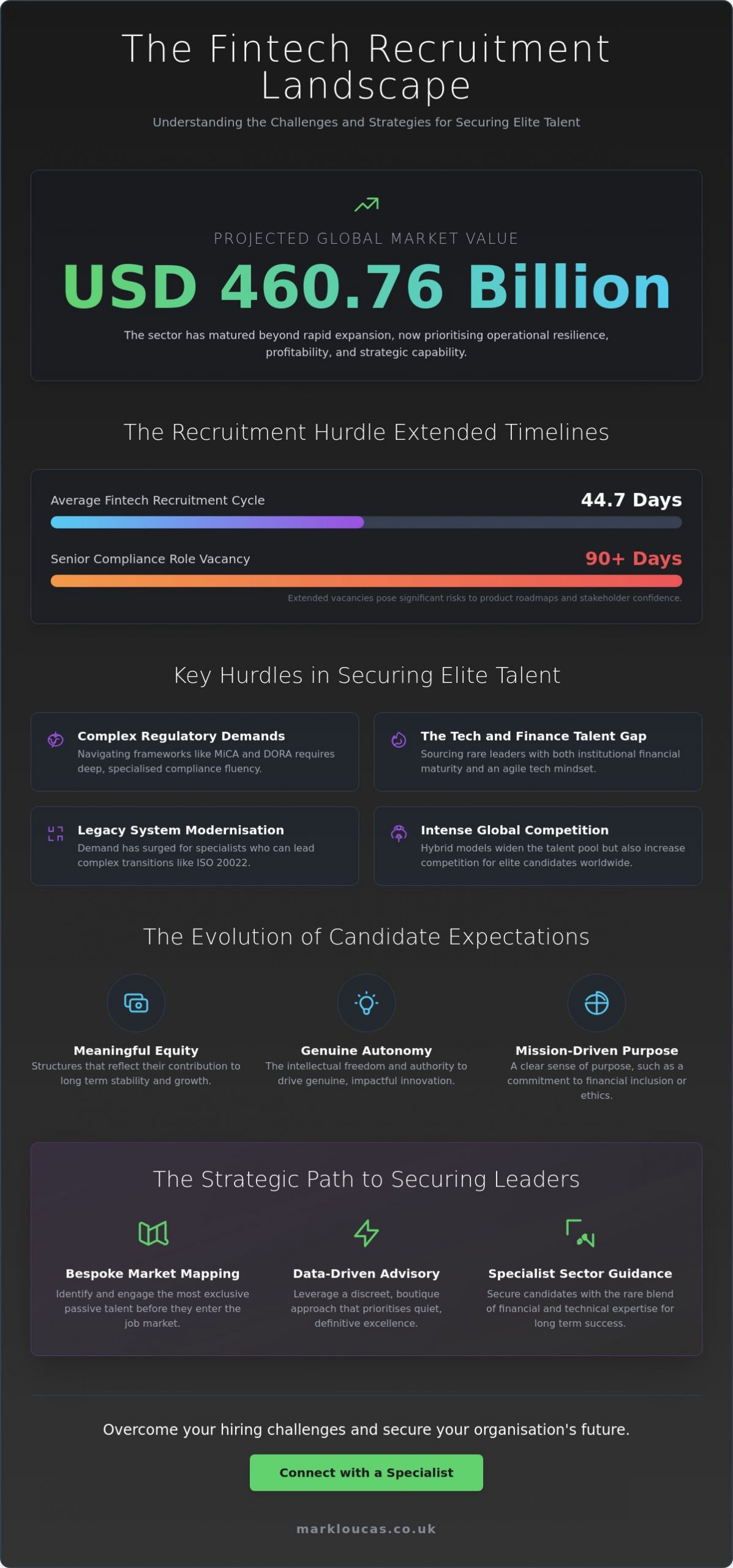
Whilst the global fintech market is projected to reach USD 460.76 billion this year, many firms find their expansion throttled by a recruitment cycle that now averages 44.7 days. This friction is particularly acute for senior compliance roles, which often remain vacant for over 90 days as the industry grapples with the July 1 MiCA deadline. You likely feel the weight of these challenges in fintech hiring, where the search for rare individuals possessing both deep regulatory fluency and technical mastery has become increasingly fraught.
Securing a leader who understands the nuances of the ISO 20022 transition whilst maintaining a vision for scalable architecture requires more than a standard search; it demands a discreet, boutique approach. This guide provides the insights needed to navigate the complex talent landscape and secure elite leadership within the global payments sector. We shall explore the strategic shift towards a data-driven talent advisory model that prioritises market mapping, ensuring your next appointment is one of quiet, definitive excellence.
Key Takeaways
- Understand why the global market has transitioned from rapid headcount growth to a sophisticated focus on operational resilience and regulatory capability.
- Identify the specific technical and leadership roles that constitute the most pressing challenges in fintech hiring for the year ahead.
- Learn how to mitigate the risks that extended vacancies pose to your product roadmaps and the long term confidence of your key stakeholders.
- Discover the value of a proactive recruitment strategy that utilises bespoke market mapping to access the most exclusive passive talent.
- Explore why specialist guidance is the definitive factor in securing candidates who possess the rare blend of financial and technical expertise.
Securing the right leadership for a rapidly scaling firm requires a nuanced understanding of the current market. We invite you to contact Mark Loucas Ltd for expert recruitment support to help solve your most pressing hiring needs.
The Evolving Landscape of Fintech Talent in 2026
As the global fintech market expands towards a projected value of USD 460.76 billion in 2026, the sector has moved decisively beyond the era of rapid, uncalculated expansion. It’s now a landscape defined by operational resilience, profitability, and strategic capability. This shift has intensified the challenges in fintech hiring, as firms no longer seek mere headcount. Instead, they require specific, high-level expertise capable of navigating increasingly complex regulatory frameworks such as MiCA and DORA. The focus has shifted toward quality and long term stability.
The fusion of traditional financial principles with agile, cloud-native technology has created a distinct talent vacuum. Professionals who possess the maturity of institutional finance alongside the disruptive mindset of a tech startup are becoming increasingly rare. Whilst the transition to hybrid and remote models has theoretically widened the talent pool, it has simultaneously heightened competition for elite candidates. Discerning leaders in London, Dubai, or Singapore are now being courted by global entities, making the search for excellence more competitive than ever before. For those scaling operations in Ireland, securing expert Managed IT Support Dublin is a vital step in maintaining the technical infrastructure required to support such high-level talent.
The Intersection of Digital Banking and Traditional Finance
To truly understand what is fintech in 2026, one must appreciate the necessity of bridging legacy systems with modern, API-driven architectures. There is an urgent demand for leaders who can oversee this delicate integration without compromising security or uptime. Specialist digital banking recruitment is essential here. Generalist agencies often fail to grasp the technical duality required. They frequently struggle to distinguish between a standard software engineer and a specialist who understands the intricacies of real-time gross settlement or core banking migrations.
Shifting Candidate Expectations in a Global Market
Senior leaders in 2026 are looking for far more than a competitive salary. They seek equity structures that reflect their contribution to long term stability and the autonomy to drive genuine innovation. Many of the most sought-after professionals are now mission-driven, choosing roles based on a firm’s commitment to financial inclusion or ethical transparency. Firms must refine their value proposition to speak to these sophisticated desires. This is where the challenges in fintech hiring become most visible. If your organisation cannot offer a clear sense of purpose and intellectual freedom, the most talented individuals will simply look elsewhere.
If you find your search for rare technical talent is yielding few results, we invite you to reach out to our team for tailored advice on finding niche specialists who can drive your organisation forward.
Navigating the Scarcity of Specialist Niche Expertise
The search for niche expertise has become one of the most defining challenges in fintech hiring for the current year. As platforms move toward greater interoperability and real-time processing, the demand for specialists who understand the granular mechanics of global payments has surged. We’re seeing a market where “unicorn” candidates, those rare individuals who possess both deep domain knowledge and technical agility, are increasingly difficult to secure. These professionals don’t just understand code; they understand the legacy of financial systems and the future of digital assets.
Rapid technological shifts mean that technical skills now have a shorter shelf-life than ever before. A developer proficient in last year’s protocols may find themselves sidelined by the sudden necessity for AI-driven risk models or decentralised ledger integration. This volatility makes every hiring decision a strategic gamble. Boards must look beyond current proficiency to identify candidates with the cognitive flexibility to adapt as the landscape shifts. Reports such as the GAO on Fintech Challenges highlight how regulatory oversight and technical risks are intertwined, necessitating a high calibre of leadership. To ensure your board has access to these elusive professionals, you might consider how specialist market intelligence can refine your search parameters.
The Demand for Payments Infrastructure and ISO 20022 Specialists
The migration to structured data formats is no longer a future project; it’s a current mandate. Finding talent for RTGS payment consulting and recruitment requires a partner who understands why the November 14 deadline for SWIFT structured addresses is so critical. ISO 20022 specialists are in short supply because the role requires a meticulous attention to detail that generalist tech talent often lacks. This technical depth is the bedrock of modern payments, and without it, firms risk significant operational rejection.
Balancing Regulatory Compliance with Rapid Innovation
Hiring compliance officers who don’t stifle growth is a delicate art. In 2026, regulatory scrutiny from bodies like VARA and the implementation of MiCA makes every compliance hire a high-stakes decision. You need individuals who can navigate complex legal landscapes whilst supporting agile product development. The most successful firms are prioritising candidates with specific traits:
- Expertise in cross-border capital flow management.
- Ability to integrate compliance into the product design lifecycle.
- Fluency in data-driven risk assessments and automated reporting.
It’s about finding those who see regulation as a framework for trust rather than a barrier to speed.
If the search for leadership is beginning to impede your operational momentum, we suggest you get in touch with us to streamline your executive search process and secure the talent your organisation deserves.
Understanding the Impact of Recruitment Friction on Growth
A prolonged vacancy in a senior role isn’t merely an administrative inconvenience; it’s a strategic bottleneck. When a Chief Product Officer or Head of Compliance role remains empty for months, product roadmaps stall and investor confidence can begin to waver. In the fast-paced scale-up environment of 2026, where agility is a core currency, recruitment friction can lead to missed market windows and deferred revenue. The challenges in fintech hiring often tempt boards to settle for a “quick hire” to fill the gap. However, in the complex world of payments and digital banking, a hasty appointment often results in a catastrophic misalignment that costs far more than the initial delay.
Financial implications in a high-growth firm are rarely limited to the recruitment fee itself. The opportunity cost of a delayed launch or a poorly executed regulatory integration can reach millions in lost market share. Scale-ups, in particular, operate on thin margins of time. Every day spent without a definitive leader at the helm is a day where competitors can gain ground. It’s a high-stakes environment where the quality of your human capital directly dictates the ceiling of your success.
The True Cost of a Bad Hire in Senior Leadership
The financial implications of an executive misstep are profound. Industry data suggests that the cost of a bad hire at the leadership level can often reach three times the individual’s annual salary when accounting for recruitment fees, lost productivity, and the disruption of ongoing projects. Beyond the balance sheet, a failed appointment can damage team morale and erode the trust of external stakeholders. This is why a meticulous fintech executive search is essential. By employing a rigorous, data-driven methodology, firms can mitigate these risks and ensure that their leadership team is built on a foundation of genuine expertise and reliability. The UNSW State of Fintech Report underscores how the pressure to innovate often clashes with the need for stable, high-calibre leadership, making the precision of every hire paramount.
Cultural Misalignment and the Risk of High Turnover
Fintech firms often struggle to integrate talent migrating from traditional corporate banking environments. Whilst these candidates bring invaluable institutional knowledge, the transition to a high-pressure startup can trigger a profound culture shock. This misalignment is a primary driver of early departures, which further exacerbates the challenges in fintech hiring by creating a cycle of turnover. To prevent this, boards must adopt a framework that assesses cultural fit with the same rigour as technical prowess. This involves evaluating decision-making speed versus traditional committee-based processes and measuring alignment with the firm’s specific appetite for innovation. A successful hire isn’t just someone who can do the job; it’s someone who thrives within the unique rhythm of your organisation.
We invite you to contact our consultancy for a confidential discussion on market intelligence and how it can refine your long term talent strategy.
Strategic Approaches to Overcoming Hiring Obstacles
The most successful organisations in 2026 don’t wait for a vacancy to appear before they begin their search. They adopt a proactive stance that treats talent acquisition as a continuous strategic function rather than a reactive response to a crisis. This shift is essential to mitigate the challenges in fintech hiring that we’ve previously explored. By moving towards a talent advisory model, firms can build long term workforce resilience, ensuring that they’re never left vulnerable by the sudden departure of a key executive or a shift in regulatory requirements.
Data-driven decision making is the anchor of this approach. It removes the guesswork and emotional bias that often cloud senior placements. By analysing real-time market data, such as shifting salary benchmarks and competitor team structures, boards can make informed choices about their leadership needs. This level of precision reduces uncertainty and ensures that every new hire is perfectly aligned with the firm’s grand vision and operational history.
Leveraging Market Mapping and Talent Intelligence
Market mapping is the art of identifying the best talent in the industry before a vacancy even exists. It involves creating a vivid, detailed picture of the talent landscape within specific prestigious districts and global hubs. This intelligence allows firms to understand how their competitors are organised and where the most rare skills are currently situated. Such a nuanced approach ensures a significantly higher success rate for specialised financial recruitment. It’s about being prepared for the future whilst maintaining a steady, unhurried pulse in the present.
The Role of Executive Search in Securing Elite Leadership
The most elite candidates are rarely found on public job boards. They’re passive, often deeply embedded in their current roles, and require a discreet, personalised approach. This is where the value of a highly connected boutique advisor becomes clear. A professional executive search process acts as a brand ambassador, delivering your value proposition with a sincerity that resonates with discerning professionals. We move logically from identifying these individuals to managing the delicate negotiations required in high-value transactions. This targeted methodology is the definitive answer to the challenges in fintech hiring for the C-suite.
If you wish to secure leadership that reflects your commitment to excellence, you should discuss your requirements with a specialist advisor to begin your search for the industry’s most elusive talent.
To begin your search for excellence and ensure your firm is led by the industry’s most distinguished talent, we invite you to contact Mark Loucas Ltd for a tailored consultation.
Securing the Future of Your Organisation with Specialist Guidance
Volume-driven recruitment models, favoured by large corporate entities, frequently falter when faced with the delicate requirements of a high-stakes fintech environment. These generalist agencies lack the local authority and industry-specific terminology needed to manage the most significant challenges in fintech hiring effectively. They often fail to grasp the grand vision of a service or asset, focusing instead on impersonal metrics that do not reflect the meticulous attention to detail your organisation requires. A boutique approach provides a tone of curated excellence, ensuring that your interests are managed with expert care and a sincerity that elevates the process from a mere transaction to a strategic partnership.
Leadership teams must move beyond viewing recruitment as a traditional cost centre. In the current climate, securing elite human capital is a strategic investment that dictates the long term trajectory of the firm. By prioritising quality and rarity over speed, organisations can build a foundation of reliability and directness. This unhurried pace reflects the patience and diligence required in high-value transactions, ensuring that every new executive is a perfect anchor for the firm’s future growth.
Why Boutique Consultancies Outperform Generalist Agencies
The benefits of a deeply professional, unhurried search are profound. By engaging with fintech and banking technology recruiters who possess a sophisticated understanding of the sector, you gain access to a private network of elite professionals. These are individuals who value privacy and tailored solutions, often existing within exclusive circles in premium urban centres. A boutique firm acts as a knowledgeable insider, painting a vivid picture of the talent landscape that is both elite and approachable. This level of curated excellence is something that volume-driven entities simply cannot replicate, as they lack the intimate, personalised approach required to attract the industry’s most discerning talent.
Building Long Term Workforce Resilience
Building resilience requires a brand that is never in a rush, reflecting the patience and diligence required in high-value transactions. Ongoing market mapping acts as a geographical signature of your commitment to quality, allowing for seamless succession planning and a steady, reassuring pulse within your leadership team. This proactive stance ensures you are always prepared for the evolving challenges in fintech hiring, as you have already identified the specialists who can navigate complex regulatory and technical shifts. The right talent is not just a resource; it is the core brand identity of a successful firm. Investing in specialist guidance ensures that your organisation remains the sole focus of attention, securing a future defined by distinction and meticulous craftsmanship.
To ensure your organisation is equipped for the complexities of the years ahead, you may partner with a specialist to overcome your hiring challenges and begin your journey towards excellence.
Mastering the Future of Your Fintech Leadership
The evolution of the sector has proven that success is no longer a matter of speed, but of strategic precision. Moving beyond the immediate pressures of the 2026 mandates requires a partner who understands the intricate relationship between legacy finance and digital innovation. By addressing the challenges in fintech hiring through a lens of curated excellence, you ensure that your firm remains resilient against market volatility and shifting regulatory expectations.
Mark Loucas Ltd brings over a decade of experience in permanent and executive search, focusing exclusively on the nuances of global fintech and payments. Our specialisation in ISO 20022 and RTGS recruitment provides the local authority needed to secure candidates of the highest calibre. We invite you to collaborate with a partner who values privacy and tailored solutions above all else, ensuring your next appointment is a definitive anchor for your organisation’s grand vision. With the right leadership, your firm will continue to thrive amongst the elite of the global financial landscape.
Frequently Asked Questions
What are the primary challenges in fintech hiring for 2026
The most pressing obstacles include a profound scarcity of niche technical talent and a fiercely competitive market where elite candidates often hold multiple concurrent offers. These challenges in fintech hiring are exacerbated by the dual requirement for deep financial fluency and modern technical mastery. Finding individuals who bridge this gap whilst aligning with a firm’s unique culture remains a significant hurdle for most global organisations.
How can fintech firms overcome the skills gap
Organisations can address this gap by transitioning from reactive recruitment to a proactive model involving market mapping and talent advisory. By partnering with a specialist who understands the granular details of ISO 20022 and RTGS, you gain access to a private pool of passive talent. These individuals aren’t found through public job boards but through discreet, long term networking and industry expertise.
Why is executive search critical for senior fintech roles
Executive search is vital because the most distinguished leaders are rarely active on public platforms. A discreet search process ensures that potential candidates are approached with a sophisticated value proposition that reflects the exclusivity of the role. This unhurried, professional approach protects the reputation of the firm whilst ensuring that only the most qualified individuals are considered for leadership.
What is the impact of regulatory compliance on recruitment
The increasing complexity of frameworks like MiCA and DORA requires leaders who can balance rapid innovation with meticulous legal adherence. This regulatory pressure makes every appointment a high-stakes decision for the board. Identifying candidates who possess this rare blend of skills requires a recruiter with a deep understanding of the local regulatory landscape and a targeted, expert-led search strategy.
How does market mapping improve hiring outcomes
Market mapping provides a data-driven overview of the talent landscape, including competitor team structures and precise salary benchmarks. This intelligence allows firms to identify and engage with top-tier talent long before a vacancy officially exists. It transforms the hiring process into a strategic, unhurried exercise, reducing the uncertainty and pressure often associated with challenges in fintech hiring.
What should a fintech firm look for in a recruitment partner
Organisations should prioritise partners with deep niche expertise in the global fintech and payments sectors rather than generalist agencies. The ideal advisor offers more than just CVs; they provide market intelligence, strategic talent advisory, and a sophisticated approach to executive search. This level of curated excellence ensures that your recruitment strategy aligns perfectly with your firm’s long term vision and culture.

Article by
Liam Henfrey
Liam Henfrey is a seasoned specialist in the payments and banking sectors with over two decades of experience. As the Founder and CEO of FINOPSIS and Managing Director at Mark Loucas Ltd, he advises organisations on complex financial operations and technology. His career includes senior roles at PwC, Deloitte, and Visa Europe.
Related Fintech Recruitment Guides
If you liked this guide then you may also like the following: