


Explaining Redundancy in an Interview for Fintech Professionals
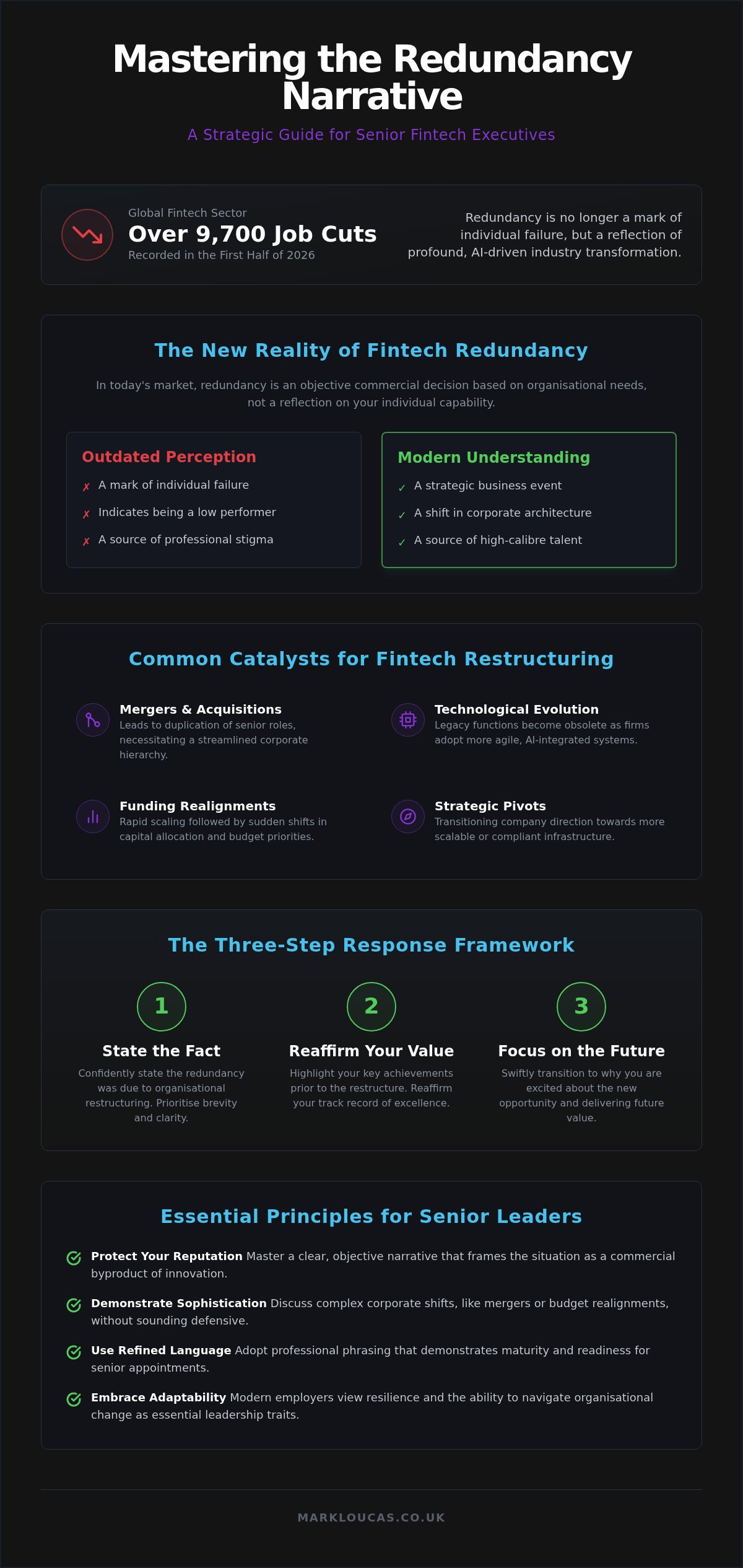
With the global fintech sector recording over 9,700 job cuts in the first half of 2026, a redundancy is no longer a mark of individual failure but a reflection of an industry undergoing profound, AI-driven transformation. You likely feel an understandable anxiety about being perceived as a low performer or struggle to condense a complex corporate restructuring into a concise narrative. This unease is common amongst even the most seasoned executives. Mastering the art of explaining redundancy in an interview is essential for protecting your reputation in this competitive market.
This article provides a refined framework to help you articulate your departure with the quiet confidence that defines a sophisticated fintech leader. You will discover how to transform a commercial realignment into a compelling story of strategic growth and readiness. We shall examine the specific language required to maintain your executive presence whilst ensuring that your next career move is handled with the discretion it deserves. Your reputation remains your most valuable asset.
Key Takeaways
- Understand that redundancy in the modern fintech sector is a commercial byproduct of rapid innovation and organisational restructuring.
- Master the subtle art of explaining redundancy in an interview by prioritising a clear, objective narrative that protects your executive reputation.
- Develop a sophisticated approach to discussing complex corporate shifts, such as mergers or budget realignments, without sounding defensive.
- Adopt professional phrasing and refined vocabulary that demonstrates your maturity and readiness for senior fintech appointments.
- Discover how discreet market mapping and specialist talent advisory services can identify exclusive, non-public career opportunities.
If you require a discreet consultation regarding your career trajectory or wish to explore non-public opportunities, please connect with us through our dedicated contact page.
The Reality of Redundancy in the Modern Fintech Landscape
Redundancy is, at its core, an objective commercial decision based entirely on organisational requirements rather than individual capability. In the sophisticated world of fintech, where innovation moves at an unhurried but relentless pace, firms must frequently re-evaluate their structures to remain competitive. The Reality of Redundancy is that it reflects a shift in the corporate architecture, not a deficit in your professional craftsmanship. When you are explaining redundancy in an interview, it is essential to convey this distinction with a quiet confidence that reassures your interlocutor of your continued value.
The fintech sector is defined by its inherent volatility, often driven by rapid scaling followed by sudden funding realignments. These commercial shifts are rarely related to a leader’s performance, yet a lingering fear of professional stigma persists amongst even the most accomplished executives. It’s vital to shed the anxiety of being perceived as a low performer. Instead, adopt an unhurried tone that suggests a deep understanding of the market’s cyclical nature. This approach ensures that your narrative remains focused on your executive presence and your ability to navigate complex commercial landscapes with grace.
Why Fintech Restructuring is a Strategic Event
Corporate mergers and acquisitions are frequent catalysts for change in digital banking, often resulting in the duplication of senior roles that necessitates a streamlined hierarchy. As technology stacks evolve, certain legacy functions may become obsolete in favour of more agile, AI-integrated systems. In 2026, redundancy in the fintech context is defined as the strategic release of talent resulting from the industry’s transition towards scalable, compliant, and resilient infrastructure. These events are purely strategic, representing a pivot in company direction rather than a reflection of your individual contribution or professional standing.
The Cultural Shift in Professional Perception
Modern employers in premium urban centres now view resilience and adaptability as essential traits for any senior appointment. Specialist fintech executive search firms recognise that redundancy is often the source of the highest-calibre available talent in the market. Many of the most successful leaders in the payments industry have experienced redundancy multiple times, viewing each instance as a rare opportunity to recalibrate their career path. By framing your transition as a strategic pause, you align yourself with an elite group of professionals who understand that career longevity is built on the ability to thrive whilst navigating organisational change.
If you wish to discuss your career trajectory in a private and professional setting, we invite you to reach out to our boutique advisors for a tailored consultation.
Crafting a Narrative that Protects Your Professional Reputation
Articulating the conclusion of a professional chapter requires a refined touch, especially within the high-stakes environment of fintech executive search. Crafting a Narrative that remains both transparent and concise allows you to retain control of the professional dialogue. When explaining redundancy in an interview, the most effective approach is to prioritise brevity and absolute clarity. This prevents the discussion from feeling defensive or unnecessarily explanatory. Focus your energy on the commercial rationale behind the organisational change, such as a strategic realignment of capital or a shift in regional focus, which positions the event as a purely business decision.
It’s equally important to illuminate your personal achievements that occurred prior to the restructure. You might highlight successful digital banking initiatives or the meticulous oversight of a complex compliance programme. Once you’ve reaffirmed your track record of excellence, transition swiftly to the future. Articulating why you are genuinely excited about the new opportunity demonstrates that your professional focus is fixed on delivering future value rather than dwelling on past transitions.
The Three Step Response Framework
Begin by stating the fact of the redundancy with a sense of quiet confidence. A direct, unhurried statement is far more effective than a lengthy justification. Following this, provide the high-level business context, perhaps referencing a departmental closure or a pivot in the firm’s technology stack. Finally, pivot to your current career objectives and how they align with the role at hand. This logical flow ensures that you remain the architect of your own story.
Maintaining Executive Presence and Tone
A leader’s reputation is often defined by their conduct during times of transition. It’s vital to avoid any negative commentary regarding former leadership or colleagues, as such remarks can inadvertently erode your executive presence. Instead, utilise sophisticated vocabulary to describe the change, favouring terms like organisational evolution or commercial transition. For candidates seeking bespoke guidance on these matters, our specialised financial recruitment team provides a discreet environment to refine your presentation. If you’re ready to explore your next strategic move, you might speak with our advisors to ensure your reputation remains unblemished.
For those seeking a discreet advisor to navigate the complexities of the current market, please visit our contact page for a tailored consultation.
Navigating the Nuances of Commercial Restructuring and M&A
In the high-calibre world of financial technology, the landscape is frequently reshaped by macro-economic forces that lie entirely beyond the control of individual leaders. When you find yourself explaining redundancy in an interview, it’s essential to frame these events as the external architectural shifts they truly are. Whether the catalyst was a sudden market exit or a wholesale change in strategic direction, your narrative should remain objective and focused on the commercial logic that dictated the decision. This clarity demonstrates a sophisticated understanding of how global firms manage risk and capital.
These restructures often occur during periods of intense growth or contraction, where budget realignments become a necessity for survival or further investment. By articulating these factors clearly, you distance your professional reputation from the shift, ensuring the focus remains on your ability to deliver excellence within a changing environment. It’s a hallmark of professional maturity to recognise that commercial pivots are a standard feature of the fintech lifecycle.
Explaining Post Merger Integration
Corporate mergers and acquisitions are perhaps the most common drivers of role consolidation in the sector. When firms combine their operations, the resulting corporate synergy often leads to the duplication of senior functions, making certain departures an inevitable outcome of the integration process. You should explain that your role was one of several affected by this strategic consolidation, framing the event as a logical conclusion to the firm’s previous chapter. This perspective highlights your grasp of corporate finance and the unhurried reality of post-merger transitions.
Dealing with Funding and Market Shifts
The rapid pace of series funding rounds can lead to sudden organisational restructures as priorities shift from aggressive customer acquisition to profitability. Additionally, the tightening of regulatory frameworks can necessitate a complete overhaul of team structures to ensure compliance and resilience. Our expertise in payments industry recruitment reveals that these shifts are frequently the catalyst for high-calibre talent becoming available. Explaining redundancy in an interview through the lens of funding cycles or regulatory pivots shows that you are a knowledgeable insider who understands the granular details of sector trends.
If you are preparing for a high-stakes executive interview and require a discreet sounding board, we invite you to contact our specialist consultants for an introductory discussion.
Practical Responses for Senior Fintech Appointments
At the executive level, the language used to describe a career transition must be as precise as the strategic decisions you make in the boardroom. Explaining redundancy in an interview for a C-suite or senior leadership position requires more than a simple script. It demands a vocabulary that denotes professional maturity and an intimate understanding of corporate mechanics. You must move beyond the standard language of job loss, opting instead for descriptors that emphasize quality and the unhurried reality of commercial evolution.
Every response should be framed with a sense of quiet confidence, ensuring that you remain the authority in the room. It is vital that each explanation concludes with a forward-looking statement, seamlessly shifting the conversation from the conclusion of one chapter to the immense potential of the next. This approach ensures that your executive presence remains unblemished whilst demonstrating your readiness to tackle new challenges in the digital banking or payments sectors.
Refined Phrases for Executive Candidates
When discussing your departure, utilise phrases that reflect the grand vision of the firm’s restructuring. You might state that your department was restructured to align with new global strategic priorities, which suggests an objective shift in corporate architecture. Alternatively, explaining that following the acquisition, the organisation consolidated its leadership functions provides a clear, commercial rationale that interviewers will respect. If your departure coincided with a milestone, you could note that having successfully delivered the RTGS migration, the subsequent organisational pivot meant your role reached its natural conclusion as the project moved into a maintenance phase. Each of these options positions you as a high-calibre professional whose value is independent of the firm’s structural changes.
Responding to Technical Follow Up Questions
Enquiries regarding who else was affected or the specific selection criteria for the redundancy should be handled with absolute discretion. You might explain that the restructure was a comprehensive alignment of the EMEA leadership team, affecting several senior functions to ensure a leaner operational model. This keeps the focus on the business strategy rather than individual performance. For broader context on managing complex dialogues, you may find our guide on the best interview questions to ask your compliance expert candidate a useful reference for the level of detail expected in senior fintech appointments. To refine your narrative further and access non-public executive roles, you may speak with our boutique advisors today.
If you wish to explore exclusive roles that are not advertised publicly, we invite you to speak with our specialist advisors for a confidential discussion.
Strategic Career Management Following a Redundancy
Whilst the prospect of explaining redundancy in an interview may initially feel daunting, a dedicated consultant ensures your story is delivered with the necessary executive weight. They provide the market intelligence required to identify firms where your specific craftsmanship is in high demand, often within the non-public market. This unhurried, tailored approach allows you to focus on finding a role that truly aligns with your long-term ambitions, rather than reacting to the immediate pressures of a corporate shift.
Leveraging Specialist Market Intelligence
Specialist consultants offer much more than a list of vacancies; they provide deep market mapping and intelligence that reveals non-public opportunities within digital banking and payments. By accessing these exclusive circles, you avoid the volume-driven nature of large corporate platforms, ensuring your profile is presented only to the most relevant decision-makers. Our expertise in fintech executive search allows senior professionals to navigate these transitions with quiet confidence. This buffer between you and the market is vital for maintaining an elite professional presence whilst exploring your next strategic move.
Final Preparations for the Interview
Success in the boardroom depends on the unhurried delivery of your narrative. You must practise articulating your transition until it feels entirely natural, ensuring that your tone remains objective and focused on the grand vision of your previous firm’s restructuring. Consistency is paramount; therefore, you should coordinate with your references to ensure they reflect the same commercial rationale you provide. For a comprehensive approach to your preparation, you might also consider our guidance on mastering the weakness for job interview question to ensure every aspect of your performance is refined. This level of meticulous attention to detail is what distinguishes a high-calibre leader during a career pivot.
If you are navigating a career transition within the fintech sector, contact our team for expert guidance on managing your professional narrative.
Mastering Your Next Strategic Career Move
Redundancy in the high-stakes fintech sector is frequently the catalyst for a more significant, curated professional chapter. By framing organisational shifts as objective commercial evolutions, you protect your executive presence and ensure your track record remains the focal point of every conversation. Success in explaining redundancy in an interview lies in the delivery of a clear, unhurried narrative that prioritises professional maturity over defensive justification. This refined approach demonstrates that you are not merely a participant in the market but a leader who understands its cyclical architecture.
Since 2011, we have acted as a discreet advisor to the industry’s most discerning leaders, offering specialist fintech recruitment and executive search services with a truly global reach. Our boutique approach ensures that your interests are managed with expert care, providing access to exclusive, non-public interim and permanent solutions that are often unavailable through traditional channels. We invite you to contact our team for expert guidance to begin your next chapter with the quiet confidence you have earned. Your professional reputation is a rare asset that deserves meticulous protection and a strategic path forward.

Article by
Liam Henfrey
Liam Henfrey is a seasoned specialist in the payments and banking sectors with over two decades of experience. As the Founder and CEO of FINOPSIS and Managing Director at Mark Loucas Ltd, he advises organisations on complex financial operations and technology. His career includes senior roles at PwC, Deloitte, and Visa Europe.
Related Fintech Recruitment Guides
If you liked this guide then you may also like the following: