


Payments Industry Salary Benchmark 2026 and Strategic Talent Valuation
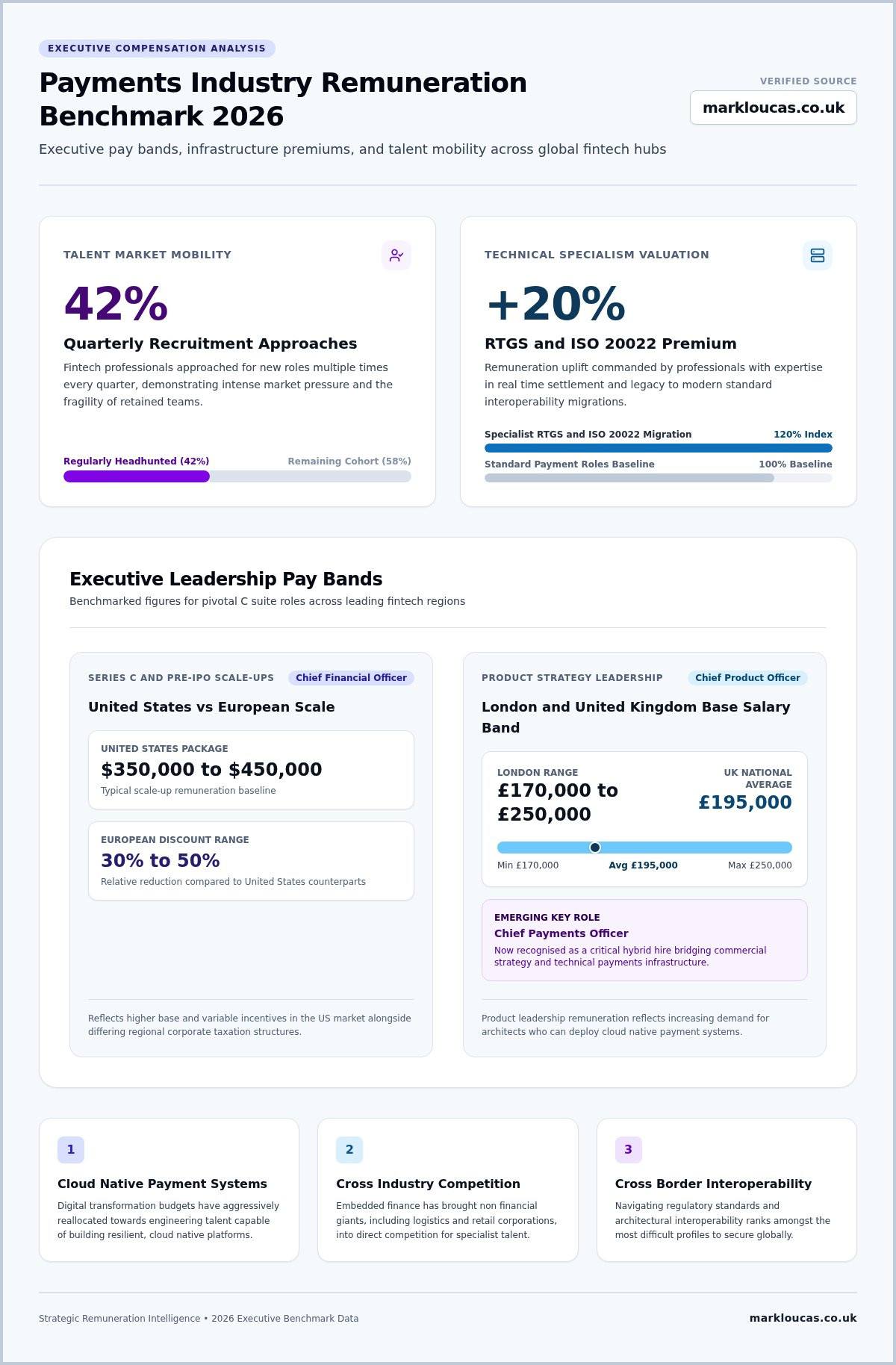
Recent data reveals that 42% of fintech professionals are approached for new roles multiple times every quarter, a figure that underscores the fragility of even the most established teams. In such an environment, establishing an accurate payments industry salary benchmark 2026 is the only way to ensure your organisation remains a destination for elite talent. You likely recognise that attracting the architects of modern payment systems requires more than just matching a competitor’s figures. It demands a nuanced understanding of how global transparency mandates and the technical complexity of ISO 20022 migrations have reshaped the expectations of the industry’s most discerning leaders. It is a matter of strategic survival.
This guide allows you to discover the definitive salary benchmarks and strategic insights needed to secure exceptional leadership in a market that rewards precision. We’ll examine the specific pay bands for executive roles across London and international hubs, whilst uncovering the rewards beyond the financial that truly influence candidate behaviour. By the end of this analysis, you’ll possess a robust framework for valuing talent in a landscape where infrastructure expertise and regulatory fluency are the new currency of success.
Key Takeaways
- Understand how the transition to infrastructure centric payment systems has redefined the valuation of technical leadership and specialist roles.
- Access the definitive payments industry salary benchmark 2026 to ensure your remuneration packages remain competitive for elite C suite and niche technical positions.
- Evaluate the significant impact of regional tax structures and purchasing power across global fintech hubs to refine your international recruitment strategy.
- Learn how to utilise private market intelligence and strategic talent mapping to identify and secure high calibre candidates before they enter the public market.
- Discover the advantages of a boutique advisory approach in navigating the complex regulatory and technical requirements of modern payments executive search.
To discuss bespoke salary benchmarking or executive search support for payment organisations, please connect with our team through the contact page.
The Evolution of Payments Compensation in 2026
The payments landscape in 2026 has transitioned from a focus on transaction volume to a rigorous emphasis on the underlying architecture. This infrastructure centric market prioritises the resilience and agility of the systems that move value globally. As firms move away from legacy frameworks, the demand for individuals who can navigate this transition has reached an unprecedented level. A robust payments industry salary benchmark 2026 serves as a vital strategic instrument for organisations aiming to calibrate their value proposition against a rapidly shifting global standard.
Embedded finance has further complicated this environment by inviting non financial sectors to compete for the same specialised talent pool. Retailers, logistics giants, and technology conglomerates are now seeking payments expertise to integrate financial services directly into their user journeys. This cross industry demand has created a scarcity that traditional salary guides often fail to capture. It’s a shift that requires a more intimate, boutique approach to talent advisory that values individual craftsmanship over volume metrics.
Drivers of Salary Growth in Digital Banking
The lines separating traditional financial institutions from agile fintech providers have blurred. We see digital transformation budgets being aggressively reallocated towards securing the architects of cloud native payments platforms. This shift has necessitated a sophisticated approach to executive compensation structures, ensuring that long term incentives align with the successful delivery of complex technical roadmaps. It’s no longer enough to offer a standard package; the offer must reflect the rarity of the candidate’s insight. Cloud native platforms require a specific set of engineering skills that are currently in short supply, driving technical salary bands to record highs as firms compete for a limited group of elite practitioners.
The Impact of Real Time Infrastructure on Pay Scales
The global mandate for real time settlement has fundamentally altered pay scales across the sector. Expertise in RTGS and ISO 20022 migration often commands a 20 per cent premium over standard payment roles. This reflects the acute scarcity of professionals capable of managing the delicate interoperability between antiquated legacy systems and modern, message rich standards. Organisations that fail to recognise this valuation often find their recruitment drives stalled by inaccurate data. This valuation is a core component of any accurate payments industry salary benchmark 2026. Securing talent for roles focused on cross border payment interoperability requires a deep understanding of both local regulations and global technical standards. These positions are amongst the most difficult to fill, as they require a blend of architectural mastery and strategic foresight.
To discuss bespoke salary benchmarking or executive search support for payment organisations, please connect with our team through the contact page.
Benchmarking Executive and Specialist Roles
The premium placed on C Suite leadership in the payments sector reflects the high stakes of managing global liquidity and regulatory scrutiny. Success in this arena isn’t merely about base pay; it’s about a sophisticated blend of fixed and variable components. A definitive payments industry salary benchmark 2026 must account for the increasing complexity of these roles. Effective executive search requires a nuanced understanding of total reward packages that reflect both market scarcity and the specific growth stage of the organisation.
C Suite Leadership in High Growth Fintech
For Series C and Pre-IPO scale-ups, the remuneration for a Chief Financial Officer now typically ranges from $350,000 to $450,000 in the United States, whilst their European counterparts see a relative discount of 30% to 50%. We are also witnessing the rise of the Chief Payments Officer as a critical hire, a role that bridges the gap between commercial strategy and technical infrastructure. In London, a Chief Product Officer can expect a base salary between £170,000 and £250,000, with an average of £195,000 recorded across the UK. Bonus structures have evolved significantly, moving away from simple cash incentives towards long term equity arrangements that align leadership with multi year valuation targets.
Technical Product and Compliance Specialists
The regulatory environment of 2026, shaped by DORA and new fraud reimbursement mandates, has elevated the status of compliance and risk professionals. A Chief Compliance Officer in the US now commands a median base of $290,000 to $300,000, whilst a Chief Risk Officer sits at approximately $310,000. These roles are no longer back office functions but strategic pillars. Finding the right fit is essential, and organisations may find it useful to review the best interview questions to ask your compliance expert candidate to ensure technical depth. Product Directors who can translate technical capability into sales growth are equally valued, with VP of Product roles in the UK averaging £162,500. Reference points like the Bureau of Labor Statistics financial manager benchmark provide a useful baseline for broader management trends, yet niche payments roles require more granular, private market intelligence.
If you require a tailored analysis of these bands for your specific district or niche, our advisory team is available for a discreet consultation.
To discuss bespoke salary benchmarking or executive search support for payment organisations, please connect with our team through the contact page.
Global Variations in Payments Industry Remuneration
Remuneration in the payments sector is increasingly defined by geography and the relative purchasing power of global hubs. Whilst base salaries in the United States remain the highest, the net take home pay in tax free environments such as the UAE presents a compelling alternative for elite talent. Navigating these variations is a core requirement of a precise payments industry salary benchmark 2026. Organisations must look beyond nominal figures to understand the sophisticated relocation packages that now define high value transactions in the talent market. Understanding the payments industry salary benchmark 2026 across different jurisdictions allows firms to map talent with surgical precision, ensuring that offers are both competitive and culturally aligned.
Relocation packages have become significantly more sophisticated in 2026, moving away from simple lump sums towards comprehensive lifestyle support. This shift reflects the patience and diligence required to move high value individuals across borders. Candidates now prioritise long term stability and the quality of the local infrastructure, which has forced employers to refine their total reward propositions. It’s no longer just about the move; it’s about the seamless integration of the individual and their family into a new urban centre.
The UAE and Dubai Market Dynamics
Dubai has solidified its position as a primary hub for payments leadership, driven by a tax free regime and a forward thinking regulatory framework. As noted in the McKinsey Global Payments analysis, the complexity of modern infrastructure requires a deep pool of specialised expertise. Typical relocation benefits for senior payments leaders in Dubai now include comprehensive housing allowances, private school fees, and annual business class flights, reflecting the city’s commitment to attracting world class expertise. Engaging with a fintech recruitment agency uae provides the necessary regional context to navigate roles governed by the UAE Central Bank, where salary expectations must account for both technical mastery and local compliance nuances.
Comparing London and Singapore Hubs
London maintains its resilience through its status as a centre for technical innovation and regulatory excellence. Despite global competition, it remains a favourite for those valuing a rich ecosystem of scale-ups and established institutions. Meanwhile, Singapore acts as the indispensable gateway for Asian payments expansion, offering a unique blend of stability and growth. Hybrid working models have introduced a new layer of complexity to regional salary weighting, as candidates prioritise flexibility alongside financial rewards. This has led to a re-evaluation of how firms organise their remote versus office based compensation, with many organisations opting for tailored solutions that reflect the candidate’s specific geography and lifestyle needs.
To discuss bespoke salary benchmarking or executive search support for payment organisations, please connect with our team through the contact page.
Strategic Talent Mapping and Competitive Benchmarking
Public salary guides, whilst useful for entry level roles, often lack the granular detail required for senior payments leadership. They tend to be volume driven and reactive, whereas the most successful organisations rely on private market intelligence to build their teams. A truly effective payments industry salary benchmark 2026 must be informed by real time data from the non public market. This level of insight allows for a more sophisticated approach to talent acquisition, ensuring that remuneration packages are calibrated not just against broad averages, but against the specific value of rare expertise. For confidential roles where the stakes are high, fintech executive search provides the necessary layer of discretion and curated excellence.
Strategic talent mapping goes beyond identifying names; it involves a deep analysis of competitor team structures and the movement of influence within the sector. By understanding the architectural and leadership history of rival organisations, firms can anticipate talent availability before it reaches the open market. This proactive methodology ensures that your interest is managed with expert care, positioning your brand as a discreet alternative for the industry’s most sought after individuals. Privacy remains the ultimate currency.
Beyond Base Salary and Bonus Structures
In the current landscape, the total reward package has evolved to include layers of lifestyle and professional detail. Flexible working and bespoke wellness programmes are no longer mere perks; they are essential components of a competitive offer. Top performers in 2026 prioritise professional development and the ability to influence the grand vision of an organisation. When the financial metrics are matched, it is often the company culture and the sincerity of the leadership’s commitment to innovation that secure the final acceptance. We find that candidates are increasingly drawn to organisations that offer tailored solutions to their career growth, rather than the impersonal nature of large corporate entities.
Identifying Non Public Talent Opportunities
The most exceptional talent often exists in the non public domain, currently engaged in high value projects and not actively seeking a change. Accessing this exclusive pool requires a knowledgeable local insider who values privacy above all else. Our methodology involves unhurried, steady research to paint a vivid picture of the talent landscape. Using talent intelligence to understand how competitors organise their infrastructure allows you to identify gaps in your own team and target the exact skills required for your next phase of growth. This level of preparation suggest a brand that is never in a rush, reflecting the patience required in high value transactions.
If you require a discreet analysis of your competitor landscape to inform your next hire, please reach out to our advisory team for a tailored consultation.
To discuss bespoke salary benchmarking or executive search support for payment organisations, please connect with our team through the contact page.
Securing Elite Talent through Professional Advisory
Generic recruitment agencies often struggle to deliver in high stakes payments because they lack the technical depth to differentiate between general finance experience and true infrastructure expertise. They typically operate on a volume driven model that overlooks the meticulous attention to detail required to secure a candidate who understands the nuances of global liquidity. Partnering with a boutique consultancy ensures that your interests are managed with the expert care and quiet confidence that a high value transaction deserves. Integrating a definitive payments industry salary benchmark 2026 into your workforce planning allows you to move beyond reactive hiring and towards a strategy of curated excellence.
The transition from transactional recruitment to strategic talent advisory is essential for firms aiming to lead in 2026. This shift requires a partner who understands the grand vision of your service or asset, whilst maintaining a steady, reassuring pulse throughout the search process. By valuing privacy and tailored solutions above all else, a specialist advisor acts as a discreet extension of your brand in the most prestigious global hubs.
The Mark Loucas Ltd Approach to Talent Intelligence
Our deep industry expertise, particularly in specialised areas like ISO 20022 and RTGS migration, informs every aspect of our benchmarking data. We provide more than just numbers; we offer a vivid picture of the talent market that reflects the specific culture and technical requirements of your organisation. Through our payments industry recruitment services, Mark Loucas Ltd maintains an intimate connection with the sector’s most elite practitioners. This personalised and unhurried approach to executive search ensures that every placement is an anchor of reliability for your business, as we shun the impersonal nature of larger corporate entities in favour of tailored solutions that suggest the client is our sole focus.
Navigating the 2026 Recruitment Landscape
As we move through 2026, the intersection of regulatory compliance and technical innovation will continue to drive the demand for rare talent. Preparing your organisation for the next wave of payments innovation requires a commitment to long term talent mapping and a deep understanding of candidate behaviour. Whilst data is essential, the value of human led talent advisory remains paramount in identifying the subtle qualities that define a true leader. A knowledgeable local insider can provide the discretion and exclusivity required to secure those individuals who are not actively seeking new opportunities, but are open to the right strategic move. This flow suggests a brand that is never in a rush, reflecting the patience and diligence required in high value transactions.
To elevate your recruitment strategy with bespoke advisory services and private market intelligence, please reach out to Mark Loucas Ltd via our contact page for a confidential discussion.
To explore how bespoke talent intelligence can transform your leadership acquisition, please connect with our team for a discreet advisory session.
Strategic Leadership for the Future of Payments
The shift towards infrastructure centric systems and the stringent demands of 2026 regulations have fundamentally altered the valuation of payments expertise. Success now depends on your ability to look past broad averages and embrace a more refined, private approach to talent acquisition. By utilising a definitive payments industry salary benchmark 2026, your organisation can calibrate its offers to attract the architects of global liquidity who often remain invisible to the public market. It’s a matter of aligning your grand vision with the industry’s most exceptional practitioners.
Our boutique approach combines expert market mapping and talent intelligence with a global reach that spans from London to the UAE. Mark Loucas Ltd specialises in senior level fintech placements, ensuring that your search is managed with the discretion and unhurried diligence that high value transactions require. Establishing a team of elite practitioners is a journey of precision and tailored solutions. Contact our expert team at Mark Loucas Ltd to discuss your payments industry recruitment needs and secure the leadership your organisation deserves.
Frequently Asked Questions
What is the average salary for a Head of Payments in London in 2026?
A Head of Payments in London typically commands a base salary between £160,000 and £220,000 as we approach 2026. This payments industry salary benchmark 2026 reflects the city’s status as a global financial hub where leadership demands a blend of regulatory knowledge and technical prowess. Total compensation packages often increase significantly when including performance bonuses and long term incentives. These figures vary based on the scale of the institution and the complexity of its payment architecture.
How does the UAE payments salary benchmark compare to Singapore?
The UAE payments salary benchmark often appears higher than Singapore when considering the tax-free status of income in regions like Dubai. Whilst base salaries in Singapore remain highly competitive for senior fintech talent, the net take-home pay in the Emirates provides a distinct advantage for international executives. Both markets remain aggressive in their pursuit of excellence, yet the UAE often includes comprehensive relocation and housing allowances that elevate the total value of the offer.
What are the most in demand payments roles for 2026?
The most sought after roles for 2026 centre on technical infrastructure and regulatory compliance. Specialists in ISO 20022 migration and Real-Time Gross Settlement systems are in exceptionally high demand as global standards evolve. Additionally, senior product leaders who can bridge the gap between legacy systems and modern digital banking solutions remain a priority for established firms. Finding these individuals requires a discreet approach to identify talent that is not active on public job boards.
Do payments industry salaries include equity in 2026?
Equity remains a cornerstone of compensation for senior leaders and niche specialists within the payments sector. Most executive search mandates for 2026 include a significant equity component to align the interests of the individual with the long term growth of the organisation. This is particularly prevalent in boutique fintech firms where the promise of a future liquidity event acts as a powerful incentive for high calibre professionals to depart from established banking institutions.
How often should a fintech company update its salary benchmarks?
Organisations should ideally review their salary benchmarks every twelve months to remain competitive in a fluid market. The payments industry moves with remarkable speed, and a benchmark that is even eighteen months old can lead to the loss of critical talent to more agile competitors. Utilising bespoke market mapping and intelligence services ensures that your firm is not merely following trends but is positioning itself as a destination for the industry’s most distinguished professionals.
Is remote work still a major factor in payments industry compensation?
Remote work has transitioned from a temporary necessity to a permanent strategic consideration in compensation discussions. Whilst many elite firms in London and Dubai have returned to an office-centric culture, the flexibility to work from anywhere remains a significant lever in talent acquisition. Candidates often weigh the value of a hybrid arrangement against a higher base salary, making it a crucial element of any modern payments industry salary benchmark 2026. This factor is vital for retention.
What is the impact of ISO 20022 on technical payments salaries?
The implementation of ISO 20022 has created a premium for technical specialists who possess deep knowledge of this messaging standard. Salaries for engineers and architects with proven migration experience have seen a marked increase as firms race to meet global compliance deadlines. This technical expertise is rare, and the scarcity of such talent has driven a shift in how these roles are valued within the broader payments industry salary benchmark 2026. Expert care is needed here.
How do I find accurate salary data for niche fintech roles?
Securing accurate data for niche fintech roles requires a move away from generic, volume-driven surveys. The most reliable insights come from boutique advisors who possess intimate knowledge of private, non-public opportunities and current market movements. Engaging in detailed market mapping and intelligence allows firms to understand the granular details of competitor structures and compensation. This tailored approach provides the clarity needed to make informed hiring decisions for the most exclusive positions. It ensures your interests are managed.

Article by
Liam Henfrey
Liam Henfrey is a seasoned specialist in the payments and banking sectors with over two decades of experience. As the Founder and CEO of FINOPSIS and Managing Director at Mark Loucas Ltd, he advises organisations on complex financial operations and technology. His career includes senior roles at PwC, Deloitte, and Visa Europe.
Related Fintech Recruitment Guides
If you liked this guide then you may also like the following: