


De-Risking a Senior Leadership Hire in Complex Financial Sectors
Research cited by Harvard Business Review indicates that up to 50% of senior executive appointments fail within their first eighteen months. In heavily regulated financial environments, where board governance is rigorous and market trust is fragile, de-risking a senior leadership hire is an urgent operational priority. You already understand the commercial friction and cultural fallout that follow an executive mis-hire. When standard recruitment agencies rely on informal personal networks and superficial CV screening, the true depth of a candidate’s technical competence, regulatory grasp, and strategic stamina remains largely untested.
Discover a proven, structured methodology designed to eliminate catastrophic appointment errors and secure high-impact executive leadership for your organisation. By moving beyond conventional headhunting, you can safeguard investor capital, protect hard-won institutional momentum, and maintain team morale. In the sections ahead, we examine how forensic market mapping, objective governance assessments, and disciplined onboarding protocols ensure your next senior appointment delivers measurable impact within the first hundred days.
Key Takeaways
- Understand the full commercial exposure of executive misalignment, which extends far beyond basic severance into stalled growth and cultural disruption.
- Discover why de-risking a senior leadership hire demands an evidence-based evaluation model rather than reliance on pedigree and informal networks.
- Learn how multi-competency scorecards and forensic market mapping identify leaders with genuine regulatory grasp and technical agility.
- Master a five-stage strategic framework that safeguards governance, protects investor capital, and accelerates executive impact within the first hundred days.
- Identify the core capabilities required in a boutique talent advisory partner to maintain complete confidentiality across regulated financial sectors.
If your board requires discreet guidance to safeguard its next executive appointment, please speak with our specialist advisory team today.
The Hidden Financial and Strategic Costs of Executive Misalignment
When an executive appointment unravels, boardrooms instinctively tally the damage through basic accounting: base remuneration, contractual severance, and legal settlement costs. This arithmetic fundamentally underestimates the true institutional exposure. Research across executive transitions indicates that the total economic fallout of an executive mis-hire regularly reaches five to ten times annual earnings once operational inertia, stalled funding rounds, and compliance friction take hold. Proactively de-risking a senior leadership hire is therefore not an administrative luxury; it is vital commercial insurance. Sound succession planning and forensic vetting insulate institutions from these compounding losses.
Direct Financial Capital Versus Intangible Commercial Momentum
Severance payouts, legal counsel fees, and emergency search mandates represent only the visible portion of institutional risk. You can eventually replenish lost capital, but you cannot reclaim squandered commercial momentum. In complex fintech and digital banking recruitment scenarios, stalled product roadmaps instantly forfeit market advantage to agile competitors. Enterprise counterparties frequently pause high-value contract negotiations when key leaders depart unexpectedly, suspecting structural instability behind closed doors. Even more critically, governance missteps under rigorous frameworks like the Senior Managers and Certification Regime can invite intrusive regulatory scrutiny, freezing new operational licences and disrupting strategic capital raises.
The Cultural Fallout Across High-Performing Engineering and Commercial Teams
Strategic delays wound an organisation, but internal cultural decay cuts far deeper. When a senior hire exhibits misaligned leadership behaviours or lacks authentic technical credibility, delivery velocity collapses. High-calibre systems architects, compliance directors, and commercial originators do not tolerate ambiguity or defensive management; they simply depart. Industry data reveals that divisions led by a misaligned executive often suffer voluntary turnover rates up to 50% higher than the corporate baseline within a single year. This churn creates a severe multiplier effect as respected mid-tier personnel follow departed leaders out of the business. Boards must learn to spot early warning signals, such as uncharacteristic silence in risk committees and delayed sprint deliveries, before formal resignations mount. Thoroughly de-risking a senior leadership hire prevents this quiet internal destruction before it begins.
To protect your board from costly recruitment missteps, consider consulting our boutique advisory team regarding your next strategic mandate.
Common Failure Modes That Compromise Senior Leadership Appointments
Conventional recruitment workflows are engineered for volume rather than executive governance. When organisations apply standard screening practices to senior appointments, systemic failure modes quickly surface. Selection panels often fall into the trap of confusing articulate charisma with operational competence, or they draft ambiguous role briefs that generate instant friction between the board and the incoming executive. In an insightful analysis, the Harvard Business Review highlighted the high cost of poor succession planning across major organisations, demonstrating that undisciplined searches routinely trigger severe commercial value destruction. Truly de-risking a senior leadership hire requires unmasking these structural blind spots before an offer is extended.
The Illusion of Pedigree and Corporate Brand Halo Effects
A frequent misstep in payments industry recruitment is presuming an executive from a tier-one institution will automatically thrive within an agile, growth-focused environment. Extensive corporate infrastructure, deep analytical teams, and entrenched brand recognition frequently mask individual operational deficiencies. When placed inside a leaner structure, leaders must build systems rather than merely manage them. Boards must rigorously investigate whether past achievements were driven by personal initiative or the momentum of a legacy balance sheet.
Unstructured Chemistry Interviews and Confirmation Bias
Informal dinner discussions and unstructured chemistry meetings remain the most unreliable evaluation tools in executive search. These casual conversations inherently reward social confidence whilst obscuring genuine technical limitations. Interview panels also tend to favour individuals who reflect their own background, mistaking personal rapport for governance capability. Objective scorecards and structured evaluations eliminate this bias, focusing scrutiny on verifiable execution. Initiating an early confidential talent advisory discussion gives nomination committees an impartial, evidence-led perspective on candidate suitability. Ultimately, de-risking a senior leadership hire requires forensic assessment rather than intuitive guesswork.
To implement an evidence-led assessment model tailored to your governance requirements, connect with our fintech talent advisory specialists.
Structured Evaluation Frameworks Versus Traditional Informal Recruitment
| Evaluation Dimension | Traditional Informal Search | Structured Talent Advisory |
|---|---|---|
| Candidate Sourcing | Personal black books and active job seekers | Exhaustive, non-public global market mapping |
| Capability Assessment | Unstructured conversational interviews | Weighted multi-competency scorecards |
| Regulatory Vetting | Superficial CV and credential checks | Scenario testing against governance regimes |
Designing Objective Scorecards Tailored to High-Stakes Mandates
Multi-competency scorecards define the precise operational standards required before candidate engagement begins. Panels weight criteria like capital allocation, engineering velocity, and compliance resilience according to immediate strategic demands. This quantitative consistency prevents final-round discussions from degenerating into subjective debates, ensuring nomination committees evaluate leaders against uniform standards rather than personal affinities.
Conducting Deep Regulatory and Technical Competency Assessments
In highly scrutinised environments, technical fluency cannot be taken on trust. Candidates must demonstrate hands-on composure under rigorous simulated conditions, addressing real-world governance shocks, platform outages, and regulatory audits. Reviewing our curated framework of the best interview questions to ask your compliance expert candidate illustrates how targeted questioning exposes gaps in regulatory reasoning. When managing complex searches across digital banking recruitment, rigorous testing ensures appointed leaders possess the operational depth needed to satisfy both board expectations and supervisory authorities, solidifying the process of de-risking a senior leadership hire.
To implement an executive search strategy built around governance and precision, reach out to our senior search consultants.
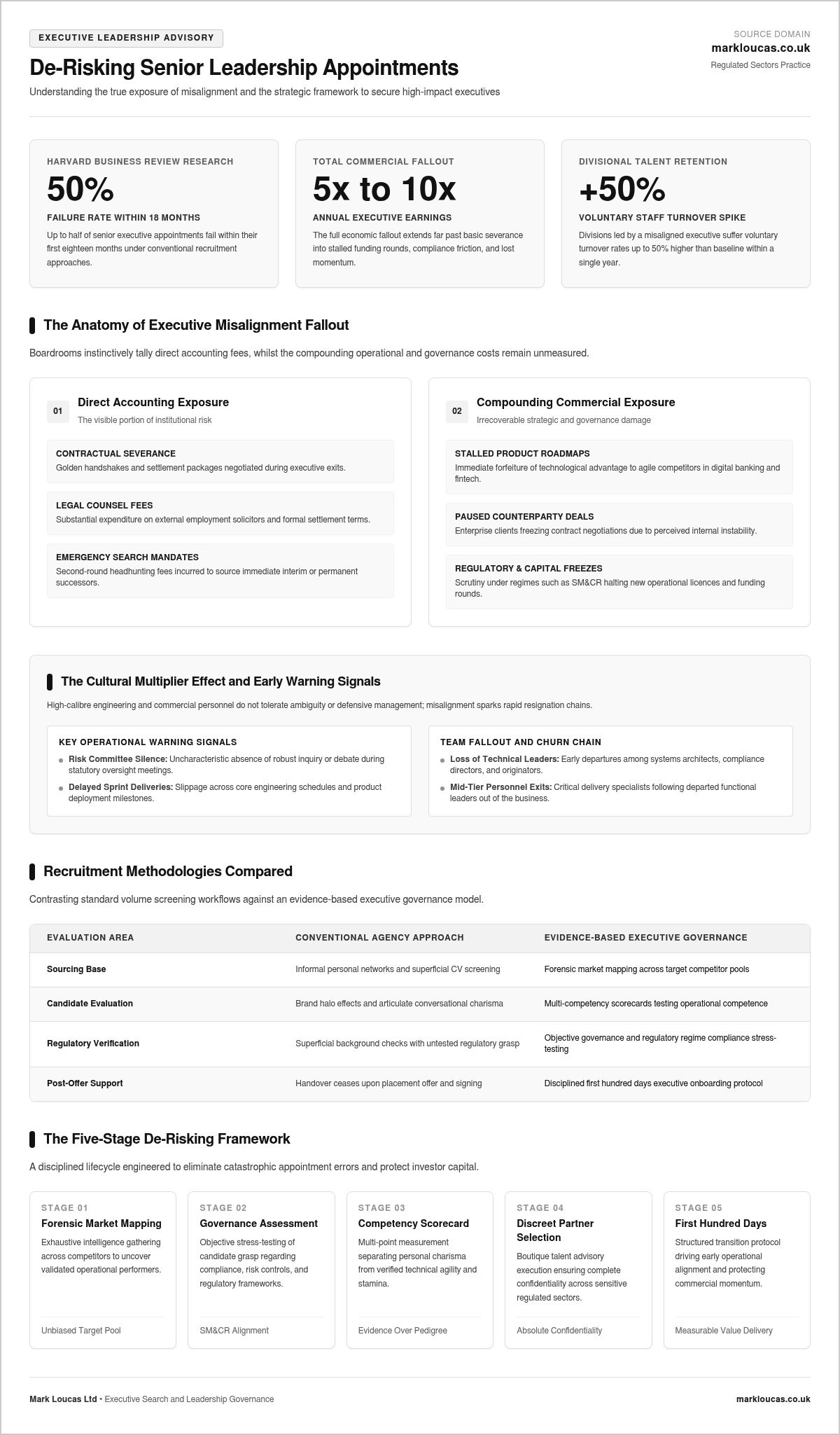
A Step-by-Step Strategic Framework to De-Risk Your Next C-Suite Hire
Securing transformational leadership requires moving past reactive hiring into a disciplined, multi-phase methodology. De-risking a senior leadership hire depends on treating talent acquisition as an exhaustive due diligence project rather than an administrative sprint. A robust five-stage blueprint safeguards board capital across each transition:
- Comprehensive market mapping and non-public talent engagement
- Structured, blind competency benchmarking
- Multi-tiered regulatory and technical stress testing
- Discreet, 360-degree forensic referencing
- Active onboarding governance across the first hundred days
Exhaustive Market Mapping and Confidential Passive Candidate Engagement
Elite operators rarely monitor commercial job boards or circulate speculative CVs. They are actively delivering results in high-performing enterprises. Engaging this tier demands rigorous market intelligence to map target ecosystems discreetly. Through specialised fintech recruitment and market mapping, boards gain access to passive industry leaders who can execute complex strategies without publicly signalling internal changes.
Forensic Referencing and Background Due Diligence
Candidate-supplied reference lists inevitably produce rehearsed praise. True risk mitigation requires confidential, 360-degree conversations with former peers, direct reports, and enterprise clients, alongside validation via a professional job reference service to cross-check past roles objectively. This forensic scrutiny verifies whether stated metrics, like balance-sheet growth or payments platform migrations, were direct individual achievements. It also exposes interpersonal friction and operational blind spots before a binding employment contract is executed.
Active Onboarding Governance and Milestone Integration
Conventional recruitment stops at the contract signature, yet onboarding remains the most vulnerable phase of executive transition. Thoroughly de-risking a senior leadership hire requires formal thirty, sixty, and ninety-day performance benchmarks, backed by an independent board sponsor. Regular pulse reviews clarify strategic priorities early, resolving operational friction before momentum is lost. If you are preparing for a critical appointment, contact our team today to secure your executive leadership pipeline.
To protect your institutional momentum and discuss tailored advisory solutions, contact our specialist executive search partners.
Selecting an Executive Search Partner to Protect Critical Appointments
Evaluating potential recruitment partners requires boards to distinguish between high-volume CV brokers and specialist talent advisors. When appointing senior leadership in complex financial sectors, transactional speed is often the enemy of thorough governance. Critical appointments demand an advisory partner capable of quiet diligence, objective market intelligence, and deep regulatory fluency. Viewing retained executive search as essential insurance against strategic disruption is the cornerstone of de-risking a senior leadership hire.
The Essential Differences Between Contingency Brokering and Retained Advisory
Why Niche Domain Knowledge Trumps Generalist Executive Networks
Generalist search conglomerates often possess broad directories, but they regularly lack the technical depth required to evaluate specialised leadership. In rapidly shifting regulatory environments, executives must understand complex compliance architectures, cross-border settlement protocols, and digital banking platforms. Since 2011, Mark Loucas Ltd has operated as an independent boutique advisory focusing exclusively on permanent leadership across these disciplines. Through dedicated payments industry recruitment and global market mapping, our consultants engage non-public, high-performing executives who never engage with generalist agencies. This tailored sector intimacy provides the definitive safeguard when de-risking a senior leadership hire.
To discuss your leadership succession or initiate a confidential mandate, please speak with our specialist search advisors.
Securing Institutional Resilience Through Evidence-Based Leadership
Building an exceptional executive team requires rigorous methodology rather than optimistic assumptions. Boardrooms safeguard enterprise capital and protect team momentum by replacing conversational chemistry with objective scorecards, exhaustive market intelligence, and structured milestone onboarding. When commercial and regulatory stakes are this significant, de-risking a senior leadership hire is fundamental to long-term operational resilience.
Since 2011, Mark Loucas Ltd has delivered discreet executive search and fintech talent advisory across the UK, the UAE, and international hubs. Our boutique practice ensures confidential access to proven leadership across payments infrastructure, compliance, and digital banking. You don’t have to leave mission-critical appointments to chance. Discuss your upcoming executive appointment with our specialist talent advisors to ensure your next transition strengthens governance and delivers lasting commercial value.
Frequently Asked Questions
What does de-risking an executive appointment mean in practice?
De-risking an executive appointment means replacing subjective assumptions with systematic due diligence across candidate evaluation. It involves forensic market intelligence, multi-competency scorecards, compliance stress-testing, and milestone-driven integration. Instead of relying on charisma or pedigree, boards verify whether an individual possesses the precise technical agility and governance discipline needed to deliver strategic objectives without stalling commercial operations.
Why do so many senior leadership hires fail within their first eighteen months?
Most executive failures stem from cultural misalignment and incompatible leadership behaviours rather than technical incompetence. Research shows that roughly 60% of mis-hires occur because incoming leaders cannot adapt to the organisation’s decision-making velocity or governance expectations. When organisations fail to assess interpersonal styles and operational stamina during interviews, critical frictions emerge quickly once market pressure mounts.
How does structured competency interviewing differ from informal board meetings?
Structured competency interviewing evaluates candidates against predefined, weighted rubrics rather than conversational chemistry. Informal board chats often reward superficial confidence and shared backgrounds, creating powerful confirmation biases. In contrast, a structured framework tests specific operational problem-solving, compliance handling, and strategic decision-making across identical scenarios. This discipline provides nomination committees with objective, comparable performance data across all prospective leaders.
What is the commercial danger of hiring senior leaders through personal networks?
Relying on personal networks creates severe institutional blind spots and limits candidate diversity. Leaders hired through personal familiarity often face less rigorous scrutiny regarding regulatory capabilities or technical depth. If the appointee underperforms, boards struggle to hold them accountable due to personal relationships. This practice frequently causes project delays, damages investor confidence, and demoralises internal teams who expect merit-based governance.
How can organisations conduct forensic referencing without breaching candidate confidentiality?
Organisations conduct forensic referencing by engaging discreet third-party search partners who maintain extensive industry trust. These advisors speak to former superiors, peers, and subordinates through blind inquiries, never disclosing the mandate or the candidate’s active exploration. This independent outreach validates true delivery records, leadership habits, and integrity while completely safeguarding the executive’s professional standing within their current firm.
Why is retained executive search safer than working with contingency agencies?
Retained executive search aligns the consultant’s incentives with long-term retention rather than placement speed. Contingency agencies operate on fast turnaround and high volume, rarely conducting exhaustive market mapping or deep background checks. A retained advisory partner commits dedicated research resources to conduct forensic vetting, ensuring that de-risking a senior leadership hire remains the central priority throughout the entire search lifecycle.
What role does onboarding governance play in de-risking a senior leadership hire?
Onboarding governance bridges the critical gap between contract execution and full operational contribution. By establishing clear thirty, sixty, and ninety-day deliverables alongside active board mentorship, organisations prevent early strategic misunderstandings. Structured milestone tracking surfaces friction points before they escalate. This structured support proves indispensable for de-risking a senior leadership hire across high-stakes, tightly regulated commercial environments.

Article by
Liam Henfrey
Liam Henfrey is a seasoned specialist in the payments and banking sectors with over two decades of experience. As the Founder and CEO of FINOPSIS and Managing Director at Mark Loucas Ltd, he advises organisations on complex financial operations and technology. His career includes senior roles at PwC, Deloitte, and Visa Europe.
Related Fintech Recruitment Guides
If you liked this guide then you may also like the following: