


Co-CFO in Fintech and the Right Finance Leadership Model
What if the right finance leader for your fintech isn’t one person? For UAE firms considering a co-cfo fintech model, dividing responsibilities may seem a practical response to growing demands. Yet the term has no single, widely accepted meaning. Without clear decision rights, adding a second leader can create as much uncertainty as it resolves.
As a fintech grows, its finance needs can shift. One leader might focus on fundraising and investor relations, whilst another oversees operational finance and reporting. Alternatively, a fractional or interim CFO may provide the required expertise without creating a permanent co-leadership structure. The distinction matters: responsibilities and accountability need to be clear from the outset.
This article explains what a co-CFO arrangement can mean, how it compares with permanent, fractional and interim finance leadership, and which model may suit your organisation’s stage and priorities. It also considers how specialist fintech recruitment, executive search and market mapping can help shape a clear leadership brief before a search begins. The aim is to support a considered decision, not simply choose a title because it sounds novel.
Key Takeaways
- Clarify what a co-CFO arrangement means for your fintech, as the term can describe genuinely shared responsibilities or different leadership structures.
- Design each remit around business priorities, with clear decision ownership, escalation routes and board communication.
- Compare co-CFO, fractional, interim and permanent models by the capacity, continuity and accountability your organisation needs.
- Assess whether a co-CFO fintech model addresses a defined leadership need, and document who owns each key decision to reduce ambiguity.
- Shape a precise hiring brief before choosing a route, whether that is permanent executive search or contract and interim recruitment.
For a considered discussion about fintech finance leadership, speak with the Mark Loucas team.
What a co-CFO means in a fintech business
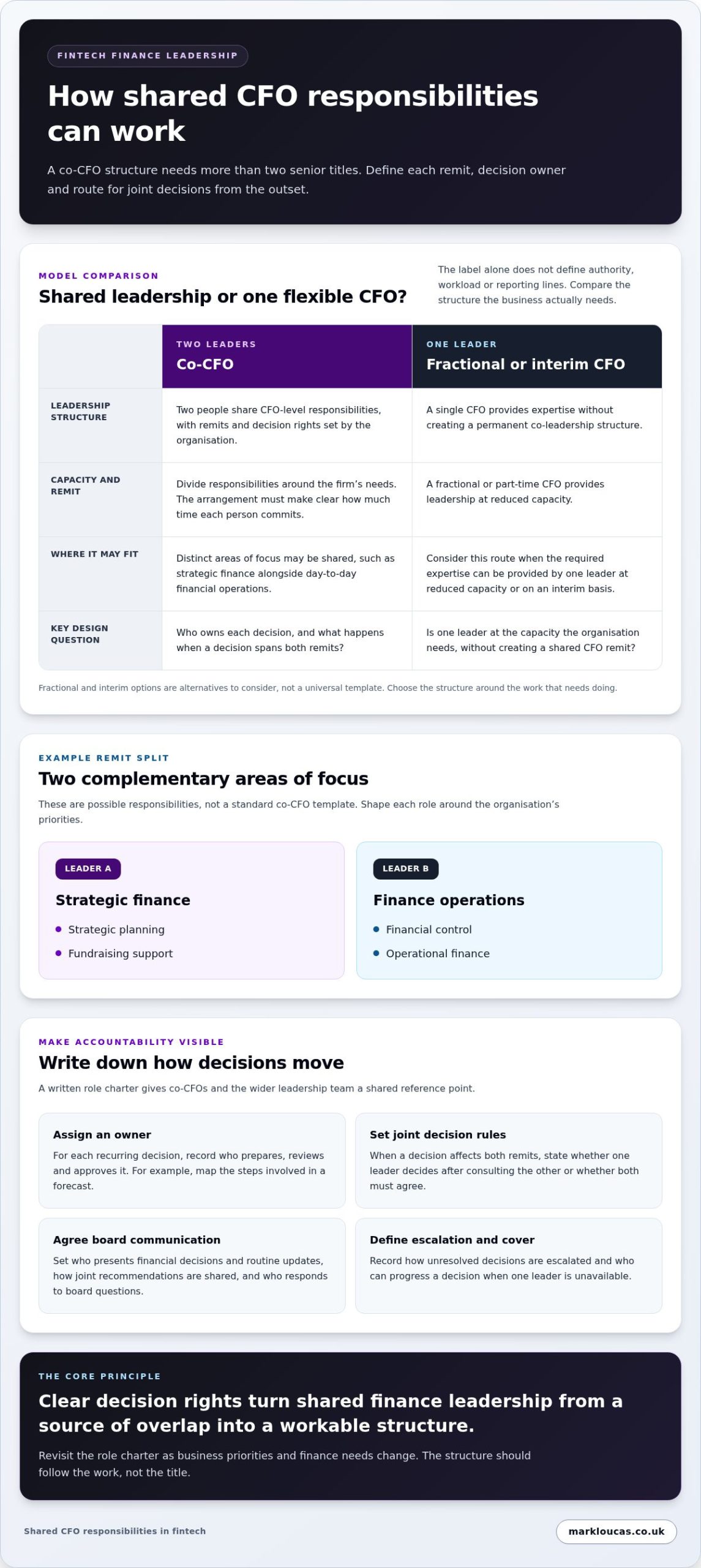
A co-CFO arrangement is a finance leadership model in which two people share CFO-level responsibilities, with their remits and decision rights set by the organisation. The term is used differently across businesses, so it doesn’t, by itself, explain who leads the function, how much time each person commits or who makes the final decision.
A co-CFO is two finance leaders sharing CFO-level responsibility under an agreed division of remit and authority. That differs from having one fractional or part-time CFO, who provides leadership at reduced capacity. Two people may hold senior finance roles without sharing the CFO remit, so the details of the arrangement matter more than the label.
The CFO role provides the baseline. A Chief Financial Officer (CFO) commonly leads financial planning, risk management and financial analysis within an organisation. In a co-CFO structure, the organisation needs to decide how these and other responsibilities are shared, and where authority sits when a decision spans both remits.
Is co-CFO a defined fintech job title
The title doesn’t set out authority, workload or reporting lines. An organisation may use it for two leaders jointly holding CFO responsibilities, but the practical arrangement can differ considerably between firms. Define each remit, decision rights and reporting relationships directly. A clear role description helps the board and wider leadership team understand who owns each decision.
Why fintech organisations may consider shared finance leadership
Finance needs can become more demanding as a fintech grows, raises funding or develops its forecasting and operational processes. A payments business may need close financial insight into transaction flows and operating performance, whilst a digital banking firm may have different priorities as its products and operations expand. These examples aren’t a universal template. They show why leadership design should follow the firm’s actual priorities, rather than a fashionable title.
Shared leadership may be considered when one remit needs to cover distinct areas of focus, such as strategic finance and day-to-day financial operations. But splitting responsibilities only helps if colleagues know how decisions are made, who communicates with the board and how disagreements are resolved. Without that clarity, two senior appointments can create overlap rather than stronger leadership.
In practice, a co-cfo fintech structure should start with the work the business needs done, not the title it wants to use. List the required outcomes, the decisions each leader can make and the areas requiring joint agreement. This gives the organisation a sound basis for deciding whether responsibilities should genuinely be shared or whether a single leader with part-time capacity is a better fit.
For support shaping a clear finance leadership brief, speak with a specialist fintech recruitment team.
How co-CFO responsibilities can work across a fintech
There’s no single division of CFO work that suits every fintech. Start with the decisions and outcomes the business needs its finance leaders to own, then shape the roles around those priorities. Splitting tasks by function alone can miss important links between financial planning, control and operations.
Which responsibilities might be divided
Depending on the organisation’s needs, one leader might focus on strategic planning and fundraising support, whilst another leads financial control and operational finance. These are examples, not a standard co-CFO template. Complementary experience can inform the split, but both remits should connect to the organisation’s objectives and the decisions its leaders must make.
A useful exercise is to map recurring decisions and assign an owner to each. For example, specify who prepares a forecast, who reviews its assumptions and who approves changes to financial plans. Where a decision has both strategic and operational effects, state whether one leader decides after consulting the other or whether joint agreement is required. A collaborative model, such as the Team CFO Approach, also highlights the value of clearly defined contributions across finance leadership.
How to make accountability clear
Put the arrangement in a written role charter. Record each leader’s remit, decision ownership, approval boundaries and escalation route. This gives the wider leadership team a reliable reference point, particularly where responsibilities meet or a decision cannot be resolved between the co-CFOs.
Board communication needs the same care. Agree who presents financial decisions and routine updates, how joint recommendations are represented, and who responds when the board needs clarification. Without an agreed approach, directors may receive conflicting messages or be unsure who is accountable for a recommendation.
Clear decision rights turn shared finance leadership from a source of overlap into a workable structure. They also help preserve continuity when one leader is unavailable: colleagues should know who can progress a decision and which matters must wait for joint review. For a co-cfo fintech arrangement, revisit the charter as the business develops and its finance needs change. A structure that once fitted may need adjustment as priorities, responsibilities or the leadership team evolve.
To define the right finance leadership brief for your fintech, speak with a specialist recruitment team.
Co-CFO compared with fractional, interim and permanent CFO models
These models address different needs. The key distinction is whether the organisation needs shared leadership, reduced capacity, time-limited cover or an ongoing executive appointment. The title alone won’t settle the question: the agreed remit, continuity and decision-making arrangements matter.
| Model | Remit and continuity | Shared ownership | Likely hiring route |
|---|---|---|---|
| Co-CFO | Two leaders share CFO-level responsibilities. Continuity depends on the agreed appointments and structure. | Yes, with ownership divided or shared by agreement. | Permanent appointments, contract or interim solutions, or a combination, depending on the need. |
| Fractional CFO | A CFO provides part-time or otherwise limited capacity. The arrangement may be ongoing. | Not necessarily. The role may have a distinct remit without another CFO. | A fractional or part-time appointment. |
| Interim CFO | A time-bound appointment to cover a defined period or requirement. | Not inherently. The interim leader may hold a sole remit or work alongside another leader. | Contract or interim recruitment. |
| Permanent CFO | An ongoing senior finance role within the organisation. | Usually one appointed CFO holds the remit, though the organisation defines its reporting and decision structure. | Permanent recruitment or executive search. |
These are broad distinctions, not fixed specifications. Actual scope depends on the organisation and the agreed appointment. A fractional role describes capacity, not automatically shared accountability. An interim role describes a time-limited appointment, whilst a permanent role is intended to provide continuing leadership.
Which model may fit different business needs
A co-CFO structure may suit a business with complementary finance leadership needs that can be clearly separated, such as distinct strategic and operational remits. It requires explicit ownership, or shared leadership can blur accountability. A fractional appointment may be appropriate where the organisation needs senior finance input but not full-time capacity.
An interim CFO can provide time-bound leadership through a defined transition or requirement. A permanent CFO may be the better fit when the organisation needs an ongoing executive remit. The choice isn’t a ranking of models; it’s a decision about the work, continuity and authority the business requires.
For a continuing leadership need, discuss a permanent fintech executive search that reflects the remit and experience required. A well-defined brief helps distinguish whether the organisation needs one enduring appointment, temporary cover or genuinely shared leadership.
For a considered finance leadership brief, discuss your fintech’s recruitment needs.
How to decide if a co-CFO arrangement suits your fintech
Begin with the business need, not the title. A co-CFO structure may be suitable when the organisation has distinct finance leadership priorities that benefit from complementary expertise. If the need is simply an unfilled senior finance role, splitting the title between two people may add complexity without resolving the underlying gap.
Questions to resolve before defining the role
Work through the finance outcomes the business needs from its senior leaders. Then distinguish decisions that need one accountable owner from areas where shared input would add value. Map the existing finance team, reporting lines and current capability, alongside expected changes to business priorities. This helps identify whether the gap is about capacity, experience, continuity or leadership structure.
For example, a fintech may need stronger financial planning and fundraising support, whilst also requiring experienced operational finance leadership. That does not automatically mean two CFOs are needed. First consider whether one leader could cover the responsibilities, whether the existing team can provide support, or whether the work should be divided between people with complementary remits.
How to prepare a clear co-CFO brief
If shared leadership appears appropriate, record the proposed scope and decision authority for each role. Set out reporting relationships, approval boundaries and how the two leaders will work together. Clarify who owns each important decision, which matters need joint agreement, and how unresolved issues will be escalated. Documented ownership addresses the main concern about ambiguity: colleagues can see who is accountable, even when both leaders contribute.
The brief should also describe the experience needed across the pair. Depending on the firm’s priorities, this may include relevant experience in fintech, payments or digital banking, alongside strengths that complement rather than duplicate one another. Market mapping can help the organisation understand relevant leadership profiles and shape a focused search before approaching candidates.
Finally, match the hiring route to the need. A continuing requirement may call for permanent recruitment, whilst contract or interim recruitment can suit a defined, flexible requirement. Review the arrangement as the business and its finance priorities change, so the remit remains useful rather than becoming a fixed structure that no longer fits.
A clear brief turns the co-cfo fintech question into a practical decision about outcomes, accountability and capability. Discuss a specialist fintech finance leadership search to define the remit and hiring route.
To shape a finance leadership search around your organisation’s needs, speak with a specialist fintech recruitment team.
Finding fintech finance leaders for a shared or specialist remit
A well-defined brief gives a search direction. For a co-CFO fintech appointment, it should explain why shared leadership is needed, where each remit begins and ends, and what expertise the leaders must bring together. This helps distinguish genuinely complementary appointments from two profiles competing for the same authority.
What specialist fintech recruitment can contribute
Finance leadership requirements can vary across fintech, payments and digital banking. A specialist recruitment approach can help calibrate the brief to the organisation’s context, clarifying which experience is essential and where complementary expertise matters. The focus is on the work the leaders need to do, not simply matching candidates to a title.
Market mapping can add a considered view of relevant senior finance profiles and inform the search strategy. It can help an organisation assess the range of experience that may suit its remit, including leaders whose backgrounds align with payments, digital banking or broader fintech. For wider finance hiring context, Mark Loucas provides specialist recruitment focused on fintech, digital banking and payments.
Choosing a recruitment route for the agreed brief
Once the remit is clear, select a route that reflects the nature of the need. An ongoing leadership requirement may call for permanent recruitment and executive search, particularly where the organisation is appointing a lasting senior finance leader. A shared structure may require careful assessment of how each person’s experience complements the other’s and how the pair will work within the agreed decision framework.
Contract or interim recruitment may suit a defined, flexible requirement, such as a time-limited period of leadership cover or a specific need for senior expertise. Choose the route after the organisation has settled what it needs, taking account of the role’s intended scope and continuity.
A considered search begins with a practical brief: the outcomes required, each leader’s remit, the experience sought and the intended appointment type. Specialist fintech recruitment and market mapping can help refine that brief and guide the search towards relevant leadership profiles. The result is a clearer basis for deciding whether the organisation needs shared CFO leadership, one permanent appointment or flexible interim support.
Discuss a tailored finance leadership brief and the recruitment route that best reflects your fintech’s requirements.
Discuss your fintech finance leadership requirements with Mark Loucas.
Choose finance leadership that fits
A co-CFO fintech arrangement can suit an organisation with distinct finance priorities and complementary leadership needs, but the title alone won’t create clarity. Define each leader’s remit, decision rights and accountability first. Then compare shared leadership with fractional, interim and permanent models against the work and continuity your business requires.
A precise brief also makes the recruitment route clearer. Permanent executive search can support an ongoing leadership appointment, whilst contract and interim solutions may fit a defined, time-limited need. Market mapping and talent advisory can help clarify the leadership profiles relevant to your organisation.
Founded in 2011, Mark Loucas Ltd is an independent specialist consultancy focused on fintech, digital banking and payments recruitment. Its work spans permanent recruitment, executive search, contract and interim solutions, market mapping and talent advisory.
Discuss your fintech finance leadership requirements with Mark Loucas and take a considered next step towards a finance structure that supports your organisation’s priorities.
Frequently Asked Questions
What does co-CFO mean in fintech?
In fintech, co-CFO usually describes two leaders sharing CFO-level responsibilities, although organisations use the term differently. A co-CFO fintech model might divide strategic finance and fundraising support from financial control and operational finance. The title alone doesn’t define authority, workload or reporting lines. Set out each leader’s remit, decision rights and accountability so the board and wider team know who owns each decision.
Is a co-CFO the same as a fractional CFO?
No. A co-CFO arrangement centres on shared CFO-level responsibilities, whilst a fractional CFO generally provides leadership at part-time or otherwise limited capacity. One describes how responsibility is shared, the other describes the capacity in which a leader works. They can overlap in practice, but don’t assume they are interchangeable. Clarify whether the business needs two leaders with complementary remits or one leader providing less than full-time support.
Can a fintech have two CFOs?
A fintech can organise its senior finance leadership around two CFO-level roles, provided the organisation defines how they work together. It should be clear who leads the finance function, which decisions each person owns, and how matters requiring joint input are resolved. The title may vary between organisations. What matters is that reporting relationships and accountability are clear to the board, leadership team and finance colleagues.
When should a fintech consider a co-CFO arrangement?
Consider shared leadership when the business has distinct finance priorities that call for complementary senior expertise, and the responsibilities can be clearly allocated. For example, one remit might focus on strategic planning whilst another leads operational finance. First assess whether one CFO could cover the need, perhaps with additional team support. A co-CFO structure is most useful when it addresses a defined leadership requirement rather than an unclear vacancy.
What is the difference between a co-CFO and an interim CFO?
A co-CFO arrangement describes shared CFO-level responsibilities. An interim CFO appointment is time-bound, usually to meet a defined need or provide leadership during a transition. The terms describe different features, so they can sometimes overlap: an interim leader might join an existing CFO in a shared structure. In either case, define the remit, decision authority and expected continuity before appointing someone.
How should a fintech divide responsibilities between co-CFOs?
Start with the organisation’s priorities and map the decisions its finance leaders must make. Assign a clear owner to each responsibility, then identify where consultation or joint approval is needed. Strategic planning, fundraising support, financial control and operational finance are possible areas to consider, not a fixed template. Record approval boundaries, escalation routes and board communication in a written role charter, and review it as business needs change.
Does a fintech need a co-CFO or a permanent CFO?
Choose according to the work and continuity the organisation needs. A permanent CFO may suit an ongoing requirement for one senior finance leader. A co-CFO structure may fit distinct, complementary responsibilities that genuinely benefit from shared leadership. If the need is temporary or for limited capacity, an interim or fractional appointment may be more appropriate. A clear brief helps compare these routes without treating any model as universally best.

Article by
Liam Henfrey
Liam Henfrey is a seasoned specialist in the payments and banking sectors with over two decades of experience. As the Founder and CEO of FINOPSIS and Managing Director at Mark Loucas Ltd, he advises organisations on complex financial operations and technology. His career includes senior roles at PwC, Deloitte, and Visa Europe.
Related Fintech Recruitment Guides
If you liked this guide then you may also like the following: