


Recruiting AI Talent for Fintech in 2026
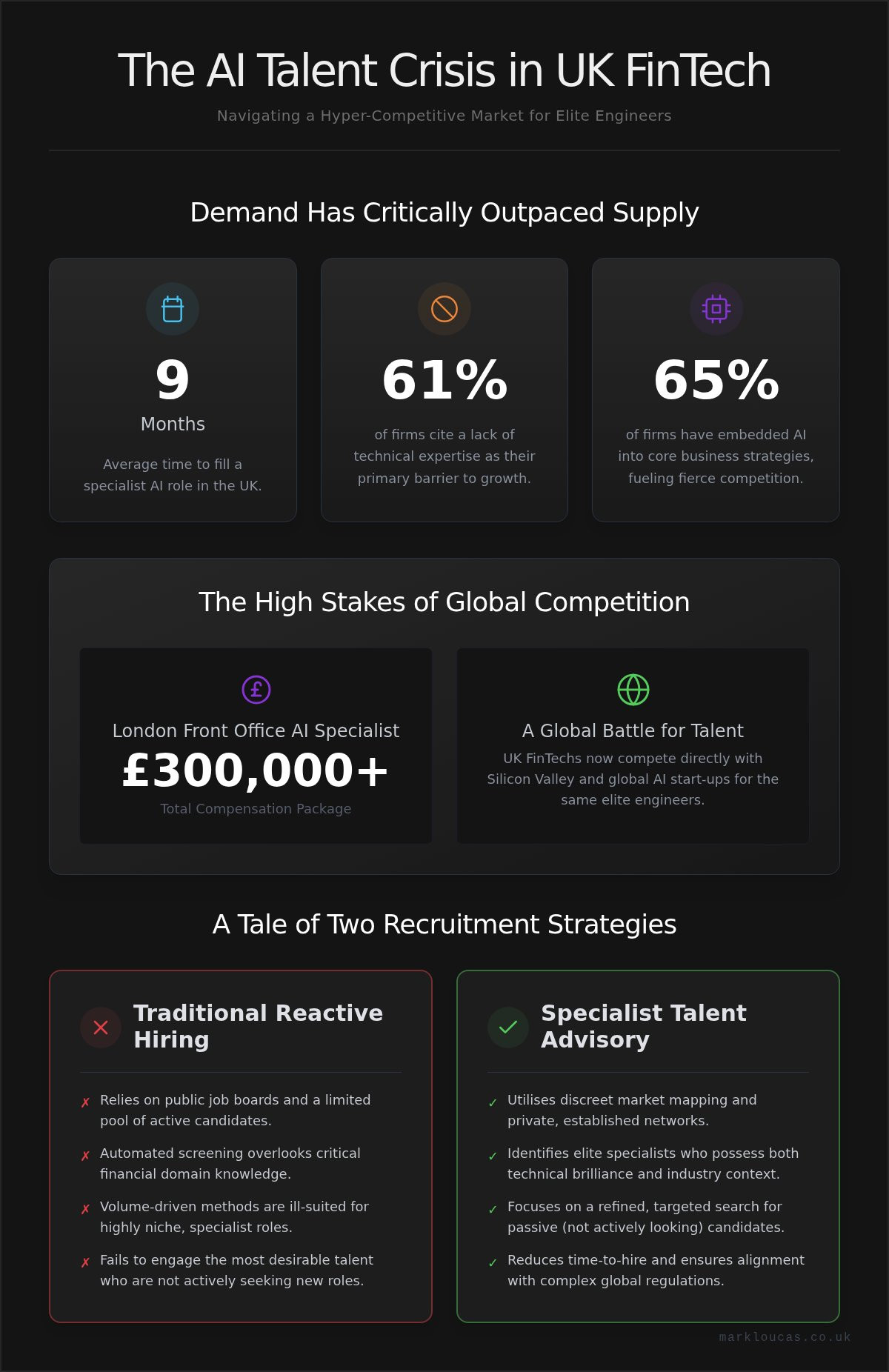
Did you know that the average time to fill a specialist AI role in the UK has stretched to nine months, whilst 61 per cent of firms cite a lack of technical expertise as their primary barrier to growth? In this climate, recruiting ai talent for fintech is no longer a standard recruitment exercise; it is a high-stakes pursuit of rare, multidisciplinary brilliance. You’ve likely felt the pressure of losing a preferred candidate to a global technology giant or discovered that a brilliant engineer lacks the fundamental understanding of financial domain knowledge.
It’s a common frustration to watch salary inflation and aggressive bidding wars disrupt your strategic roadmap. Discover how to navigate this hyper-competitive market to secure the elite talent your organisation needs to lead the financial sector. This article outlines a robust strategy to identify niche AI specialists and reduce your time to hire for critical engineering roles. We explore how to move beyond the commodity of pure code to find the architectural excellence and regulatory alignment that will define the next era of digital banking.
Key Takeaways
- Understand why traditional hiring models are failing in a market where 61 per cent of firms face critical skill shortages and extended hiring timelines.
- Master the nuances of recruiting ai talent for fintech by prioritising candidates who possess both technical brilliance and deep financial domain knowledge.
- Identify the specific AI functions, from payments infrastructure to regulatory compliance, that are essential for maintaining a competitive edge in 2026.
- Learn how to transition from public job boards to discreet market mapping to reach elite specialists who are not actively seeking new roles.
- Discover how a tailored talent advisory approach reduces time to hire and ensures your AI projects align perfectly with complex global regulations.
If you are looking to strengthen your leadership team with elite technology professionals, please contact us today to discuss your requirements.
The Evolving Landscape of AI Talent Scarcity in Financial Services
In 2026, the global talent pool for Financial Technology (Fintech) has reached a critical juncture. Whilst 65 per cent of firms have now embedded artificial intelligence into their core business strategies, the supply of qualified engineers has failed to keep pace with this rapid adoption. This imbalance has created a hyper competitive environment where recruiting ai talent for fintech requires more than just a generous salary package. It demands a nuanced understanding of why this deficit exists and how it impacts your long term growth.
Demand has outpaced supply because the required skill set has shifted from generalist machine learning to highly specialised applications within regulated environments. A significant 61 per cent of UK financial services organisations now cite a shortage of digital skills as their primary obstacle to expansion. Technology giants often act as a vacuum for top tier graduates, inflating compensation expectations to unprecedented levels. In London, front office AI specialists can now command total packages exceeding £300,000. Relying on traditional, reactive hiring methods is no longer a viable strategy for firms that wish to lead the sector.
The Pressure of Global Competition
Fintech organisations are no longer just competing with local rivals; they’re in a direct battle with Silicon Valley and AI native startups for the same elite engineers. The shift towards borderless, remote acquisition means a specialist in Dubai or Singapore can work for a firm in London without the need for relocation. In this transparent market, your brand reputation as an innovator is as important as the role itself. Elite engineers seek environments where their work has a tangible impact on payments infrastructure and global markets. They’re drawn to firms that offer intellectual challenge alongside financial reward.
Why Traditional Recruitment Methods Fail
Generalist agencies often rely on a volume driven approach that is ill suited for such a refined search. Automated screening tools frequently overlook the most qualified candidates because they cannot assess the depth of financial domain knowledge required for high stakes projects. A more sophisticated, discreet method is needed to identify individuals who aren’t actively seeking new roles. This is where fintech and banking technology recruitment specialists provide a distinct advantage. By moving beyond public job boards and into private, established networks, we identify the individuals who possess both technical brilliance and the industry context necessary for success.
Our team provides bespoke solutions for firms seeking high calibre specialists, so please get in touch to explore our search capabilities.
Identifying the Critical AI Roles for Modern Fintech Infrastructure
Identifying the specific functions required for a resilient platform is the first step in building a high performance team. Whilst general data science focuses on broad insights, applied machine learning in finance demands a focus on precision and low latency. The Use and Oversight of AI in Financial Services report highlights how specialised roles are essential for managing the unique risks inherent in digital banking. Recruiting ai talent for fintech involves finding professionals who can translate complex algorithms into operational tools that protect assets and improve user experience. These roles must be integrated into the existing infrastructure with meticulous care.
The distinction between theoretical research and applied engineering is often where firms struggle. Successful organisations prioritise individuals who understand the friction between rapid innovation and regulatory stability. This requires a shift in focus towards engineers who can maintain production grade models. AI leads are also becoming indispensable; they act as the vital link between technical engineering teams and the broader business objectives. They ensure that every model deployed serves a clear commercial purpose whilst adhering to strict compliance standards.
Machine Learning and Data Science Specialists
These individuals are the architects of proprietary fraud detection systems. They design models that scan millions of transaction logs in milliseconds to identify anomalies that suggest illicit behaviour. This level of scrutiny requires a deep understanding of financial patterns. Our expertise in data analytics recruitment ensures that firms find specialists capable of unlocking value from complex datasets whilst maintaining the highest standards of data integrity. They turn raw information into a formidable defensive asset.
AI Infrastructure and MLOps Engineers
The transition from an experimental model to a production grade system requires robust MLOps. These engineers ensure that AI applications remain stable and scalable during real time financial processing. The role of DevOps in fintech has evolved to include the continuous integration and deployment of machine learning models. Security and resilience are paramount here. A model must not only be accurate but also resistant to adversarial attacks and system failures. If your organisation requires a partner to navigate these complex requirements, you might consider how a bespoke talent advisory service can clarify your recruiting ai talent for fintech roadmap.
To learn more about how we identify candidates with both technical and regulatory expertise, please reach out to our consultants for a private discussion.
Bridging the Gap Between Engineering Excellence and Financial Intelligence
In the pursuit of technical brilliance, many organisations overlook the reality that an algorithm is only as valuable as its context. Recruiting ai talent for fintech requires a departure from the “move fast and break things” ethos that characterises pure technology firms. In a high stakes financial environment, an engineer’s ability to navigate complex regulatory landscapes is just as critical as their proficiency in Python or PyTorch. We define this as Regulatory Intelligence; it’s the capacity to design AI systems that are inherently compliant, transparent, and auditable from the very first line of code.
When tech first engineers enter finance first organisations, cultural friction is often inevitable. A developer used to the unrestricted freedom of a startup may find the guardrails of a retail bank stifling. Conversely, a firm that fails to integrate these engineers properly risks stagnant innovation. Evaluating a candidate’s ability to work within strict compliance frameworks isn’t just about ticking boxes. It’s about finding individuals who view regulation as a design challenge rather than an obstacle. This perspective is vital for any successful recruiting ai talent for fintech initiative.
The Necessity of Regulatory Knowledge
AI engineers in 2026 cannot afford to be ignorant of GDPR or evolving financial data privacy laws. As models become more complex, the requirement for transparency and auditability increases. Regulators now demand to know why a model made a specific decision, especially in areas like lending or fraud detection. Integrating compliance experts into the recruitment process ensures that your technical hires understand these nuances. This collaboration prevents the deployment of “black box” systems that could lead to significant legal exposure.
Evaluating Domain Specific Experience
The needs of a retail bank differ vastly from those of a high frequency trading firm. Whilst the former requires AI for customer behaviour analysis, the latter demands ultra low latency for market execution. Experience in RTGS payment consulting is particularly valuable for AI architects working on settlement systems. Testing for financial literacy during the interview process is essential. You might ask a candidate to explain the impact of a model’s latency on liquidity or how they would handle data drift in a volatile market. This ensures your recruits possess the depth of understanding required for the most prestigious roles in the sector.
If you require a tailored strategy to source rare talent in a competitive market, please contact our London office for more information.
Strategic Sourcing Methods for Elite Machine Learning Specialists
Traditional hiring models often falter when applied to the most sophisticated tiers of the technology market. Public job boards are frequently saturated with candidates who lack the specific intersection of skills required for high stakes financial environments. In 2026, successful recruiting ai talent for fintech requires a departure from these volume driven tactics. Instead, firms must adopt a proactive, intelligence led approach that identifies elite specialists before they enter the open market. This shift ensures that your organisation isn’t merely reacting to the talent shortage but is actively shaping its competitive future.
Building a compelling employer value proposition for AI talent must transcend the baseline of compensation. Whilst competitive salaries are expected, elite engineers are primarily motivated by the complexity of the problems they solve and the autonomy they are granted. Your grand vision must be articulated with clarity and sophistication. It’s about demonstrating how their work on payments infrastructure or digital banking models will reshape the global financial sector. When you offer a role that promises genuine impact and intellectual challenge, you attract individuals who are driven by more than just financial reward.
The Art of the Discreet Approach
The top 5 per cent of AI professionals rarely apply for advertised roles; they’re often deeply embedded in prestigious projects at global technology giants. Reaching these passive candidates requires the refined touch of fintech executive search. Confidentiality is paramount in these high level interactions. A discreet approach protects the interests of both the hiring organisation and the candidate, ensuring that conversations remain private until a mutual interest is established. This bespoke method allows for a tailored introduction that aligns your firm’s strategic objectives with the individual’s long term career aspirations.
Leveraging Market Intelligence and Mapping
Understanding where talent clusters exist is essential for a truly strategic search. Market mapping involves a granular analysis of the competitor landscape to identify high performing teams and specific individuals with the required niche expertise. By using data driven intelligence, firms can pinpoint exactly where the most relevant talent resides, whether in London, Dubai, or Singapore. Fintech recruitment agencies in London provide a significant local advantage in this regard. The density of talent in prestigious districts like Canary Wharf allows for deep, long term relationships with a community of specialists. If you are ready to secure the future of your technology team, our consultants can provide the market mapping and intelligence required to identify your next elite hire.
For an unhurried discussion regarding your long term talent strategy, please visit our contact page to speak with a specialist.
Securing Future Growth Through Specialist AI Executive Search
Recruiting ai talent for fintech is an investment in the foundational architecture of your firm. Partnering with a boutique advisor ensures your requirements are managed with the meticulous attention they deserve. Large corporate entities often focus on volume; yet, elite AI appointments require a more tailored, unhurried approach. This partnership significantly reduces the risk of expensive bad hires, which can cost an organisation far more than just a salary in lost time and disrupted projects. A single misplaced hire in a critical engineering role can delay a product roadmap by years.
Talent advisory plays a crucial role in workforce planning for the next decade. It’s not merely about filling a current vacancy but about understanding how that role will evolve as machine learning becomes even more integrated into financial services. Mark Loucas Ltd acts as a discreet, highly connected partner, positioning your organisation at the forefront of high stakes fintech appointments. We provide the expert care required to manage your most sensitive and critical leadership transitions, ensuring your interests are protected at every stage of the search.
The Value of Niche Expertise
Generalist agencies often struggle with the granular technicalities of AI roles, frequently failing to distinguish between theoretical brilliance and practical application. Our deep connections within the payments industry allow us to identify candidates who possess a rare blend of engineering skill and domain specific wisdom. A specialist understands the subtle details of the role, from the nuances of real time settlement to the complexities of cross border data flows. This ensures every candidate presented is a precise fit for your unique ecosystem rather than just a qualified name on a list.
Building a Sustainable AI Pipeline
Succession planning is vital for maintaining momentum in your AI initiatives. Securing elite talent is only the first step; retaining them through curated career paths and intellectual challenge is what ensures long term success. A sustainable pipeline requires a commitment to unhurried and diligent recruitment, where the focus remains on quality over speed. By aligning an individual’s personal aspirations with the grand vision of your firm, you create a culture of loyalty and innovation. This strategic foresight is what allows a fintech to lead rather than follow in a market that rewards those with the best human capital.
If you wish to secure the elite AI talent required to drive your organisation’s growth, please contact Mark Loucas Ltd for a confidential consultation.
Leading the Next Era of Financial Innovation
Success in 2026 isn’t merely about technical brilliance. It requires individuals who possess the regulatory intelligence necessary to operate within the world’s most complex financial frameworks. By moving away from public job boards and embracing discreet, intelligence led sourcing, your organisation can secure the niche AI talent required to lead the sector. This proactive approach ensures you no longer lose your preferred candidates to global technology giants who operate with unlimited budgets.
With over 15 years of experience in the global recruitment market, Mark Loucas Ltd offers a specialist focus on senior level fintech and payments appointments. Our expertise in navigating complex regulatory environments ensures that every hire is strategically aligned with your long term goals. Recruiting ai talent for fintech is a journey that requires patience, diligence, and expert care. We look forward to helping you build a legacy of excellence.
Frequently Asked Questions
What are the most in demand AI roles in fintech for 2026?
The most in demand roles in 2026 include Applied Machine Learning Engineers, AI Infrastructure specialists, and MLOps Engineers who can operationalise models at scale. There is also a significant surge in demand for AI Product Managers who possess deep regulatory knowledge. These individuals are essential for ensuring that every technical innovation serves a clear commercial purpose whilst remaining compliant with global standards. Finding these specific profiles requires a highly targeted approach to recruiting ai talent for fintech.
How does recruiting AI talent for fintech differ from general tech hiring?
Recruiting ai talent for fintech differs from general technology hiring because it demands a unique intersection of high level engineering and financial intelligence. Whilst a generalist firm might prioritise rapid deployment and experimental code, a fintech organisation requires precision and an inherent understanding of risk. Candidates must be able to navigate the friction between innovation and strict regulatory guardrails. This necessitates a more sophisticated screening process that values domain specific wisdom alongside pure technical proficiency.
Why is financial domain knowledge important for AI engineers?
Financial domain knowledge is vital because AI models do not operate in a vacuum. An engineer who understands the nuances of payments infrastructure or the complexities of ISO 20022 can build more resilient and effective systems. Without this context, models may produce technically accurate but practically useless or even hazardous results. This industry specific expertise ensures that AI projects align with the granular details of liquidity management, fraud detection, and capital requirements.
What is the average salary for a machine learning engineer in London?
In 2026, a senior machine learning engineer in London can expect a base salary ranging from £90,000 to £125,000. For rare PhD graduates or front office specialists, these figures increase significantly, with base salaries often reaching £250,000 and total compensation packages exceeding £320,000. These rates reflect the hyper competitive nature of the London market. High salary inflation remains a persistent challenge for firms attempting to secure elite talent against global technology giants.
How can a boutique recruitment firm help find passive AI candidates?
Boutique firms provide access to the top 5 per cent of talent who are not actively seeking new opportunities. Through discreet market mapping and private, long term networks, a boutique advisor can identify passive candidates who would never engage with public job boards. This approach relies on personalised, unhurried outreach that emphasises the grand vision of your organisation. It ensures that your search remains confidential whilst reaching specialists with the exact niche expertise your firm requires.
Should I hire permanent or contract AI specialists for my fintech project?
The choice depends on the long term strategic importance of the project. Permanent hires are essential for building core intellectual property and establishing a sustainable AI leadership pipeline. Conversely, contract and interim solutions are ideal for specific, high stakes implementations or when niche expertise is required for a finite period. Many firms utilise a hybrid model, securing a permanent leadership core whilst augmenting their teams with specialists for critical, time sensitive engineering phases.
What impact does AI regulation have on hiring strategies?
AI regulation has transformed hiring strategies by making explainability a non negotiable requirement for technical talent. Firms now prioritise candidates who can design models that are transparent and auditable, ensuring compliance with evolving global standards. This shift has increased the demand for professionals who understand the legal implications of automated decision making. Consequently, the recruitment process now involves a more rigorous assessment of a candidate’s ability to align technical innovation with complex regulatory obligations.
How do I evaluate the technical skills of an AI lead candidate?
Evaluating an AI lead requires a departure from standard coding tests, which can now be easily manipulated using AI tools. Instead, firms should use case based assessments that require the candidate to solve problems within a financial context. You might ask them to describe how they would handle data drift in a volatile market or ensure model transparency during a regulatory audit. This approach reveals their genuine technical depth and their ability to lead high stakes projects.

Article by
Liam Henfrey
Liam Henfrey is a seasoned specialist in the payments and banking sectors with over two decades of experience. As the Founder and CEO of FINOPSIS and Managing Director at Mark Loucas Ltd, he advises organisations on complex financial operations and technology. His career includes senior roles at PwC, Deloitte, and Visa Europe.
Related Fintech Recruitment Guides
If you liked this guide then you may also like the following: