


Market Entry Talent Strategy Framework for Global Expansion in 2026
Expanding into high-growth international jurisdictions fails far more often from an inverted hiring sequence than from commercial or technical deficiency. When establishing operations across competitive business centres such as Dubai and the wider United Arab Emirates, deploying commercial sales staff before securing proven regulatory and compliance leadership invites severe friction. You likely recognise the frustration of deciphering unfamiliar licensing mandates and opaque compensation structures without an established regional brand to attract candidates. Partnering with Mark Loucas Ltd to design an agile market entry talent strategy isn’t merely an operational checklist; it’s an indispensable risk mitigation measure that protects your capital before committing to full-scale expansion.
In this guide, backed by the expertise of Mark Loucas Ltd, you’ll discover the structured framework for building an elite leadership team when entering new international markets. We examine the exact sequential roadmap for international talent deployment, demonstrating how discreet executive talent mapping uncovers pre-vetted regulatory and commercial leadership, eliminates the risk of costly mis-hires, and significantly compresses your timeline to regional profitability.
Key Takeaways
- A structured market entry talent strategy safeguards overseas investment by sequencing local regulatory governance ahead of commercial expansion.
- Comprehensive talent mapping uncovers precise regional remuneration benchmarks and competitor organisational structures before committing capital.
- Appointing certified compliance officers and authorised executive leadership early resolves licensing mandates smoothly across jurisdictions like the United Arab Emirates.
- Partnering with a discreet boutique search specialist unlocks pre-vetted commercial leaders who operate exclusively outside public job boards.
To discuss your international expansion objectives with an experienced boutique advisor, connect with the team at Mark Loucas for discreet executive counsel.
Foundations of an International Market Entry Talent Strategy
A market entry talent strategy is a structured, phased roadmap that aligns human capital deployment directly with regulatory and commercial milestones. Many expanding institutions assume standard domestic recruitment tactics can simply be exported abroad. They can’t. In home territories, established brand equity attracts active applicants naturally; in unfamiliar overseas markets, high-calibre professionals rarely respond to public job boards. Treating international growth as a generic hiring exercise or relying on low-cost offshore arrangements compromises governance. Sustainable international expansion requires curating senior commercial and regulatory capability long before scaling regional headcount, anchoring the venture into a comprehensive market entry strategy that anticipates local complexities.
The True Cost of Strategic Misalignment in New Jurisdictions
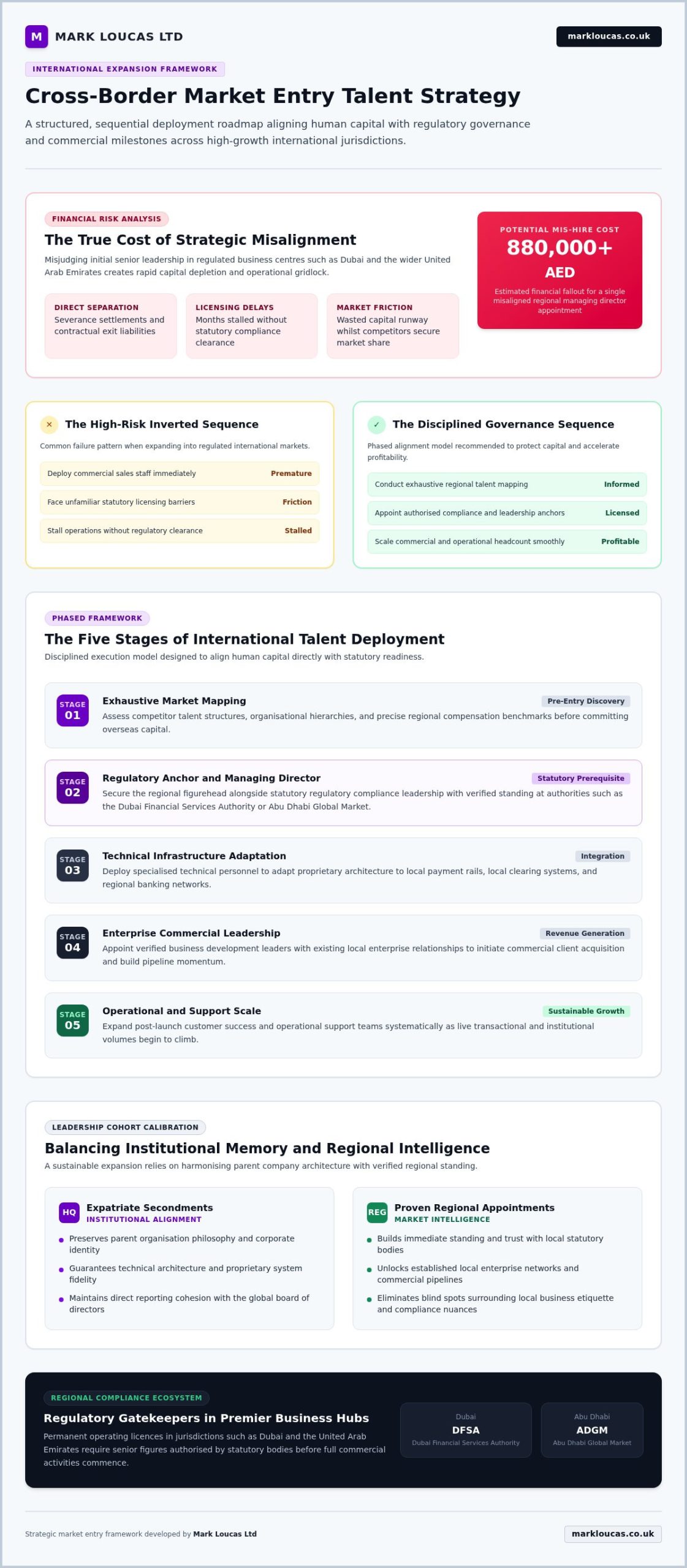
Misjudging initial leadership appointments creates severe financial and operational drag. Securing the wrong regional managing director can easily cost an organisation upwards of 880,000 AED once direct separation settlements, wasted momentum, and replacement overheads are calculated. In highly regulated financial hubs, an unproven compliance officer can stall vital operating licences for months. These administrative delays rapidly consume capital runway whilst competitors seize market share and client goodwill.
Balancing Expatriate Institutional Knowledge with Local Market Intelligence
Balancing institutional memory with regional insight requires careful calibration. Seconding trusted head office personnel preserves technical architecture, yet relying entirely on expatriates creates blind spots regarding regional business etiquette and regulatory subtleties.
- Expatriate secondments protect core brand philosophy, proprietary systems, and reporting alignment with the global board.
- Proven regional appointments secure immediate trust with statutory authorities and unlock established local enterprise networks.
Harmonising these two cohorts bridges executive expectations with day-to-day regional realities. Securing this senior governance demands bespoke search rather than transactional agencies, making dedicated specialised financial recruitment indispensable for engaging discreet, non-public leadership talent.
If you’re preparing to establish an international presence, speak with our specialist consultants to review your expansion timetable.
The Core Strategic Framework for Cross-Border Talent Deployment
Executing an effective market entry talent strategy demands disciplined phased sequencing. Global expansion initiatives falter when organisations hire commercial business developers before laying foundational operational groundwork. Public diplomatic bodies such as the Bureau of Global Talent Management have long stressed the necessity of synchronising talent pipelines with operational readiness; regulated financial institutions face this exact imperative. A structured deployment unfolds across five deliberate stages:
- Phase one: Undertaking exhaustive market mapping to assess competitor talent structures and compensation benchmarks.
- Phase two: Securing the regional figurehead alongside statutory regulatory compliance leadership.
- Phase three: Deploying technical specialists to adapt core platforms to local payment rails and banking networks.
- Phase four: Appointing enterprise business development leaders to build commercial momentum.
- Phase five: Scaling post-launch customer success and operational support teams as transactional volumes rise, where organisations often explore Employer of Record (EOR) Services to manage compliant offshore talent deployment.
Securing the Regulatory Anchor and Managing Director
The initial deployment hinges entirely on appointing an authorised regional managing director and compliance head. These individuals must possess demonstrable standing with statutory bodies, such as the Dubai Financial Services Authority or Abu Dhabi Global Market. While permanent retained executive search progresses, interim leaders often maintain regulatory momentum. The ideal candidate blends board-level strategic gravitas with hands-on operational capability to establish governance from scratch.
Establishing Technical and Operational Foundations
Once regulatory foundations are secure, focus shifts toward adapting software to local financial rails. Connecting platforms with regional clearing systems requires experienced systems engineers. Partnering with proven advisors for digital banking recruitment ensures your underlying platform satisfies strict data sovereignty and operational resilience mandates prior to public launch.
Building Out the Regional Commercial Engine
Commercial acceleration begins only after technical architecture and compliance frameworks receive regulatory sign-off. Secure seasoned business development directors with proven records of closing institutional contracts within the region. Compensation must reflect regional standards, structured in AED with realistic achievement tiers. Engaging a boutique search advisor to identify discreet, non-public producers protects your pipeline; you can request a talent mapping assessment to evaluate prospective sales leadership before entering active negotiations.
To ensure your overseas appointments satisfy local regulatory standards, contact our executive advisory team to discuss bespoke market mapping.
Evaluating Local Regulatory Ecosystems and Human Capital Requirements
Every sovereign financial territory enforces stringent criteria regarding who can hold executive authority within regulated entities. Licensing authorities do not merely inspect financial capital; they thoroughly evaluate human capital. Background qualifications, professional integrity, local residency, and demonstrable supervisory track records face intense scrutiny before permissions are granted. A comprehensive market entry talent strategy evaluates these regional mandates early, ensuring that your senior appointments satisfy local fitness and probity requirements from day one. Failing to anticipate these rules leads to stalled licence applications and unexpected operational friction.
Remuneration packages must also reflect local realities. Highly sought-after personnel, particularly certified anti-money laundering officers and financial officers holding regulatory approvals, command substantial premiums. Transparent compensation structures benchmarked accurately in local currency prevent prolonged vacancies in these non-negotiable positions.
Navigating Middle East Expansion via the UAE Financial Hubs
Operating within the United Arab Emirates requires understanding distinct regulatory environments. Expanding organisations typically weigh the common-law frameworks of the Dubai Financial Services Authority within the Dubai International Financial Centre against the Abu Dhabi Global Market. Both authorities require mandatory resident approved individuals for key roles, including the senior executive officer and compliance officer. Tapping into the established talent network in the DIFC demands discreet headhunting, making specialised fintech recruitment agency uae expertise critical for identifying candidates with verified regulatory standing.
Mastering European and United Kingdom Governance Demands
Entering the UK and European ecosystems introduces a different set of governance expectations. The Financial Conduct Authority enforces rigorous scrutiny through the Senior Managers and Certification Regime, requiring clear individual accountability for senior figures. Meanwhile, post-Brexit passporting changes make secondary hubs like Cyprus and Continental Europe essential for servicing wider EU markets. Securing leaders who understand cross-border compliance demands deep local networks, which is why top firms engage bespoke fintech recruitment agencies london to access proven executive talent.
To commission an exhaustive competitive talent intelligence report before entering a new jurisdiction, schedule a private briefing with our partners today.
Talent Mapping versus Traditional Recruitment for Global Expansion
Traditional contingency recruitment is inherently reactive. Advertising openings on public job boards relies entirely on active jobseekers, ignoring the substantial proportion of passive executives who rarely track public listings. For an international market entry talent strategy, this scattergun model presents intolerable operational exposure. Intelligence-led market mapping replaces guesswork with meticulous competitive analysis, identifying non-obvious specialists across rival organisations before any formal approach occurs. You gain full visibility over existing team compositions, reporting lines, and tenure patterns across your target territory. Applying talent intelligence for financial services allows UAE organisations to test whether a hiring plan reflects the skills actually available in the market, rather than relying on assumptions or broad, outdated data.
Approaching cross-border growth through structured talent intelligence delivers decisive advantages over conventional recruitment methods:
- Proactive talent discovery: Pinpoints high-performing institutional leaders who aren’t visible on open candidate databases.
- Precise salary calibration: Validates real-time compensation expectations across local peer organisations to prevent costly overpayment.
- Strategic confidentiality: Protects your commercial roadmap by assessing the regional landscape entirely under non-disclosure protocols.
Deconstructing Competitor Operational Blueprints Through Intelligence
Deep talent mapping uncovers exactly how regional competitors structure their functional units. By charting rival headcounts, reporting lines, and division ratios across finance centres like London or Dubai, your leadership team gains actionable intelligence on optimal local team sizing. This data identifies firms undergoing structural reorganisations, creating timely opportunities to secure top-tier producers who possess active institutional books of business.
Benchmarking Compensation Packages to Secure Premium Leadership
Remuneration structures vary radically between international markets. In the United Arab Emirates, compensation centres on tax-free base salaries, housing allowances, and comprehensive family relocation provisions quoted in AED. Conversely, European markets frequently structure packages around equity participation, performance bonuses, and strict statutory benefits. For organisations establishing a presence in Continental hubs such as the Netherlands, you can learn more about ICSPayroll to navigate regional employment compliance and payroll management seamlessly. Bespoke competitor salary benchmarking establishes validated compensation parameters, preventing costly overbidding whilst ensuring your formal offers successfully secure elite leadership.
Maintaining Total Market Discretion During Early Exploratory Phases
Announcing international ambitions prematurely invites intense competitor defence and unwanted commercial speculation. Retaining a discreet boutique search partner allows you to evaluate regional candidate pools through trusted third-party representation without disclosing your corporate identity. Proprietary architectures and operational timelines stay strictly confidential until your institutional licences are approved. If you want to evaluate leadership availability in your target territory quietly, contact our executive search specialists to initiate confidential talent mapping.
To accelerate your overseas appointments through discreet retained search, speak directly with our boutique practice leaders.
Executing Your Expansion Roadmap with a Specialist Search Partner
Executing a cross-border market entry talent strategy exposes the operational limitations of transactional agencies. Generalist recruitment consultancies operate on volume, rarely possessing the technical literacy or regulatory relationships required for pivotal fintech appointments. When launching into competitive centres across the United Arab Emirates, Europe, or the United Kingdom, partnering with a dedicated boutique search firm provides immediate credibility. Established since 2011, Mark Loucas delivers tailored advisory rather than resume distribution, introducing expanding institutions directly to private leadership networks that remain entirely inaccessible to open commercial platforms.
Engaging a sector-specific boutique consultancy provides decisive strategic safeguards during international deployment:
- Direct peer-to-peer engagement: Connects your board with accomplished leaders who engage solely through trusted executive advisors.
- Precise regulatory alignment: Guarantees shortlisted candidates hold verifiable standing with relevant statutory authorities.
- Cultural integration advisory: Delivers post-placement counsel that aligns incoming regional directors with head-office commercial priorities.
The Advantage of Industry-Specific Global Networks
Elite commercial directors and senior compliance figures rarely respond to generic approaches on social channels. Instead, they operate within discreet professional circles, relying on established search partners to present non-public opportunities. When launching complex clearing solutions or cross-border payment platforms, engaging through specialized payments industry recruitment ensures candidates possess verified technical capabilities. A trusted boutique advisor acts as an articulate ambassador, articulating your firm’s value proposition to passive executives who would otherwise dismiss an emerging brand entering their home market.
Structuring Robust Governance and Retained Search Partnerships
High-stakes international mandates require exclusive retained partnerships rather than multi-agency contingency races. Retained search aligns consultant milestones with key institutional markers, such as submission deadlines for regulatory approvals or capital expenditure reviews. Dedicated partners conduct thorough background due diligence, personal referencing, and cultural calibration before presenting candidates to the executive committee. Leveraging disciplined fintech executive search methodologies eliminates the operational friction of unvetted applicants, delivering a secure foundation for sustained cross-border expansion.
To discuss your global talent requirements with our senior team, contact Mark Loucas for tailored counsel.
Architecting Your International Expansion for Long-Term Growth
Executing a successful overseas expansion requires absolute precision in human capital planning. By sequencing verified regulatory governance before scaling your commercial engine, you protect balance sheet capital and eliminate operational delays. Moving beyond reactive job boards to embrace intelligence-led talent mapping ensures you secure proven regional leaders whilst maintaining complete commercial discretion.
Operating globally since 2011, Mark Loucas delivers bespoke market intelligence tailored exclusively to payments and digital banking leaders. With unrivalled specialist networks spanning London, Dubai, Cyprus, and Singapore, we provide the quiet authority and insider access essential for high-stakes appointments. When you don’t leave regional governance to chance, an agile market entry talent strategy turns complex overseas territory into your next competitive stronghold. Initiate a confidential talent advisory consultation to safeguard your international expansion roadmap.
Frequently Asked Questions
What is a market entry talent strategy?
A market entry talent strategy is a structured operational roadmap that aligns human capital deployment with regional legal, regulatory, and commercial milestones. Rather than conducting ad hoc recruitment, it sequences critical leadership appointments to satisfy local regulatory bodies, establish technical infrastructure, and build enterprise commercial relationships. This framework minimises capital risk by ensuring governance foundations are certified before organisations scale regional overheads.
Why do traditional recruitment agencies often fail during international fintech expansion?
Traditional contingency agencies rely heavily on volume recruitment and public candidate boards. In foreign markets where your brand lacks established recognition, top-tier senior executives rarely apply to public advertisements. Generalist consultancies also lack the specialised regulatory vocabulary and discreet networks required to engage passive leaders across digital banking and payments. Without specialist advisory support, firms often face delayed licensing and expensive hiring misalignments.
Which leadership roles should an organisation hire first when entering a new territory?
Expanding institutions should first appoint a regional managing director alongside an authorised compliance officer or money laundering reporting officer. Securing approved regulatory figures early satisfies local statutory requirements across bodies like the DFSA or ADGM. Deploying technical systems specialists follows to adapt infrastructure to domestic payment networks. Enterprise sales and business development leaders are appointed only after operational and regulatory clearances are fully secured.
How does talent mapping de-risk the international market expansion process?
Executive talent mapping examines competitor organisational structures, reporting hierarchies, and compensation levels before you commit capital to a new region. This intelligence uncovers hidden specialist performers and identifies firms undergoing structural reorganisations. By evaluating talent availability under non-disclosure protocols, your executive committee gains complete visibility over the regional candidate pool without alerting competitors or local market authorities to your planned launch.
Can an expanding firm rely on relocated expatriates rather than hiring local talent?
Relocating expatriates helps preserve headquarters culture and proprietary technical processes, but relying exclusively on them introduces substantial commercial risk. Foreign expatriates frequently lack personal relationships with local regulators, understanding of domestic employment conventions, and established networks with regional enterprise buyers. A balanced approach pairs select secondees with proven local leadership to satisfy statutory licensing rules and accelerate commercial integration.
What makes compensation benchmarking critical when opening an overseas office?
Executive remuneration varies significantly across global hubs. Packages in Dubai often incorporate tax-free base salaries, housing allowances, and schooling provisions denominated in AED, whilst London structures emphasise equity incentives. Misinterpreting local norms leads to uncompetitive offers or unnecessary overpayment. Competitor salary benchmarking for fintech teams provides empirical salary data across direct regional competitors, ensuring your offers secure elite talent whilst maintaining strict fiscal discipline.
How do local regulatory licensing requirements influence cross-border talent acquisition?
Statutory supervisory bodies mandate that specific senior functions are filled by resident professionals holding proven supervisory track records. In jurisdictions such as the United Arab Emirates or the United Kingdom, authorities evaluate personal integrity, professional certifications, and domestic regulatory standing before granting licences. Executing a successful market entry talent strategy requires identifying pre-vetted candidates capable of clearing these formal regulatory vetting procedures without delay.

Article by
Liam Henfrey
Liam Henfrey is a seasoned specialist in the payments and banking sectors with over two decades of experience. As the Founder and CEO of FINOPSIS and Managing Director at Mark Loucas Ltd, he advises organisations on complex financial operations and technology. His career includes senior roles at PwC, Deloitte, and Visa Europe.
Related Fintech Recruitment Guides
If you liked this guide then you may also like the following: