


Payments Industry Recruitment in the UAE for Specialist Hiring
Payments hiring rarely fails because finance experience is hard to find. It falters when a broad brief overlooks the specialist knowledge needed at a particular stage of the payment lifecycle. A clear role brief is central to payments industry recruitment uae, especially when adjacent experience may not cover the systems, processes or risks the position requires.
It’s understandable to want a candidate who can contribute quickly, but the right fit depends on more than a fintech title. Employers need to distinguish payment expertise from general financial services experience and understand where relevant talent sits across the UAE market.
This article explains how to define the capabilities a role needs, assess specialist experience and choose an approach suited to your hiring plans. It covers permanent recruitment, executive search, contract and interim solutions, alongside market mapping and talent advisory, to help you build a precise brief and understand the candidates you need.
Key Takeaways
- Define the vacancy around its place in the payment lifecycle, then separate essential experience from preferred exposure.
- Use payments industry recruitment uae to focus the search on candidates whose experience matches the role’s specific responsibilities.
- Choose permanent recruitment, executive search, contract or interim support according to the role’s seniority and duration.
- Build a focused brief by setting out the business outcome, reporting context and evidence candidates should bring.
- Use specialist recruitment and market mapping to understand relevant talent and inform workforce decisions.
For a discussion about specialist payments hiring in the UAE, share your recruitment requirements.
Why payments industry recruitment in the UAE needs a specialist lens
A payments vacancy calls for someone who understands the organisation’s payment activity, not simply the wider financial technology sector. A candidate may have relevant finance or fintech experience, yet still lack the expertise needed for a particular payments function.
Payments industry recruitment is the specialist hiring of people whose experience matches the payment activities and responsibilities of a business or role. That distinction matters. Payments industry recruitment uae should start with the work the person will do, rather than a broad fintech label that may attract candidates whose experience only partly fits.
What makes payments roles distinct from general fintech roles
The payment function shapes the knowledge a role requires. Someone in payment operations may need experience with the organisation’s processes, whilst a technology position may call for knowledge of the systems supporting payment activity. A commercial role, by contrast, may focus on how payment services are positioned and developed. These examples show why a single sector label does not define a role’s requirements.
Adjacent experience can transfer when it meets the vacancy’s needs. A background in banking or financial services may be relevant if the candidate has worked with processes or technology closely connected to the role. A job title alone is not evidence of fit. Identify the responsibilities that matter, then look for examples of work that demonstrate the required knowledge.
Where UAE hiring needs fit into the wider payments market
For employers hiring in the UAE, location provides useful context, but it does not replace a clear job definition. CBUAE, DIFC and ADGM have distinct roles in the country’s financial environment. Explain the organisation’s setting and the position’s remit in the brief, without assuming that all payments work carries the same responsibilities.
It also helps to distinguish specialist payments hiring from broader fintech recruitment. Fintech can cover a wider range of technology and financial roles, whilst a payments search centres on the activity and capability the vacancy requires. For more regional context, explore fintech and banking technology recruitment.
Understanding the parts of a payment system can help employers describe how a role fits into the wider flow of activity. The brief can then focus on the relevant function, responsibilities and evidence of experience, rather than treating every fintech candidate as interchangeable.
For support in defining a focused payments role, discuss your hiring needs.
For help prioritising the capabilities your role needs, discuss your recruitment requirements.
Which payments capabilities should your UAE hiring brief prioritise
A focused brief starts with the work the successful candidate will own. Map the vacancy to the relevant parts of your payment lifecycle, then describe the capabilities needed to deliver those responsibilities. Capability requirements should follow the role’s specific payment remit, not a generic fintech job title.
For payments industry recruitment uae, this distinction helps employers avoid briefs that ask for every desirable skill at once. Separate must-have experience from preferred exposure. Each essential requirement should connect directly to a core responsibility or business outcome. Preferred experience can widen the search without obscuring what the person must be able to do.
Payment functions and specialist experience
Role families call for different expertise. A merchant acquiring position may require experience relevant to that business function, whilst payment analytics may require the ability to interpret payment data in the context of the organisation’s needs. For a technology vacancy, specify the systems or delivery responsibilities involved instead of relying on a broad label such as “payments technology”.
For example, an employer seeking analytical capability can define the data questions the role must address and the decisions its work will inform. This gives candidates a clear way to demonstrate relevant experience. The payments analytics recruitment page is relevant to this role family. Include RTGS or DevOps experience only where that expertise is part of the actual remit.
Seniority, scope and candidate evidence
Seniority changes the scope of the work, not simply the number of years on a CV. An individual contributor may carry out defined tasks and provide evidence of relevant delivery. A specialist may own a complex area of work and apply deeper expertise to solve problems. A leader may set direction, make decisions within an agreed remit and take responsibility for delivery through others.
Describe the level of ownership clearly. State whether the person will execute, advise, set priorities or lead delivery, and explain how the role works with other teams. This helps distinguish hands-on technical depth from experience that is adjacent but does not meet the brief.
Assess candidates against evidence tied to the position. Useful examples include:
- Responsibilities held in a comparable payment function.
- Work delivered, with a clear account of the candidate’s contribution.
- Understanding of the payment systems and processes relevant to the remit.
- Decisions made or problems addressed at a similar level of ownership.
Keep essential and preferred requirements distinct throughout assessment. If you’re shaping a specialist payments brief for a UAE hire, discuss your recruitment requirements.
To discuss the recruitment approach that fits your role, share your hiring requirements.
How to assess specialist payments recruitment options in the UAE
The right recruitment approach depends on what the organisation needs, how complex the role is, its seniority and whether the requirement is ongoing or time-bound. A permanent vacancy with continuing ownership calls for a different search from a defined project or a temporary leadership gap.
Specialisation needn’t make a search too narrow. It focuses attention on candidates whose experience aligns with the payment remit, rather than producing a broad selection of profiles that may not fit. The aim is a relevant search that still considers transferable experience where it meets the role’s needs.
| Approach | Best suited to | Hiring consideration |
|---|---|---|
| Permanent recruitment | An ongoing role with continuing responsibilities | Define the position’s remit and how it contributes to the organisation over time. |
| Executive search | A senior appointment with a distinct leadership brief | Align the search with decision-making scope, organisational context and desired leadership contribution. |
| Contract support | A time-bound need or defined body of work | Set out the deliverables, specialist skills and expected scope of the assignment. |
| Interim support | A temporary requirement for experienced resource or leadership | Clarify the immediate remit and the outcomes the interim appointment will own. |
Permanent recruitment and executive search
Permanent recruitment suits a role that forms part of the organisation’s continuing capability. The brief should describe its responsibilities, working relationships and contribution to business priorities. For senior appointments, executive search can focus on leadership scope and organisational context. The authority and outcomes attached to the role matter more than the title alone.
For a senior payments appointment, consider how the role will shape priorities, guide teams or influence delivery. Clear context helps assess candidates against the demands of the position, rather than relying on seniority or sector labels alone.
Contract, interim and market-mapping support
Contract and interim support can suit needs with a defined duration, project scope or temporary purpose. Establish what must be delivered, where responsibility sits and which capabilities the assignment requires. These flexible solutions are suited to specific needs, rather than treated as a substitute for every permanent hire.
Market mapping provides intelligence on the talent landscape relevant to a hiring need. It can help an organisation refine its brief and inform workforce planning. Use it to understand how a search is positioned and to support hiring decisions.
A precise role definition and market insight can help employers make a considered choice about search scope and recruitment model. For a tailored discussion about payments recruitment in the UAE, share the role’s purpose and hiring context.
To shape a specialist payments brief around the responsibilities and outcomes that matter, discuss your UAE payments hiring needs.
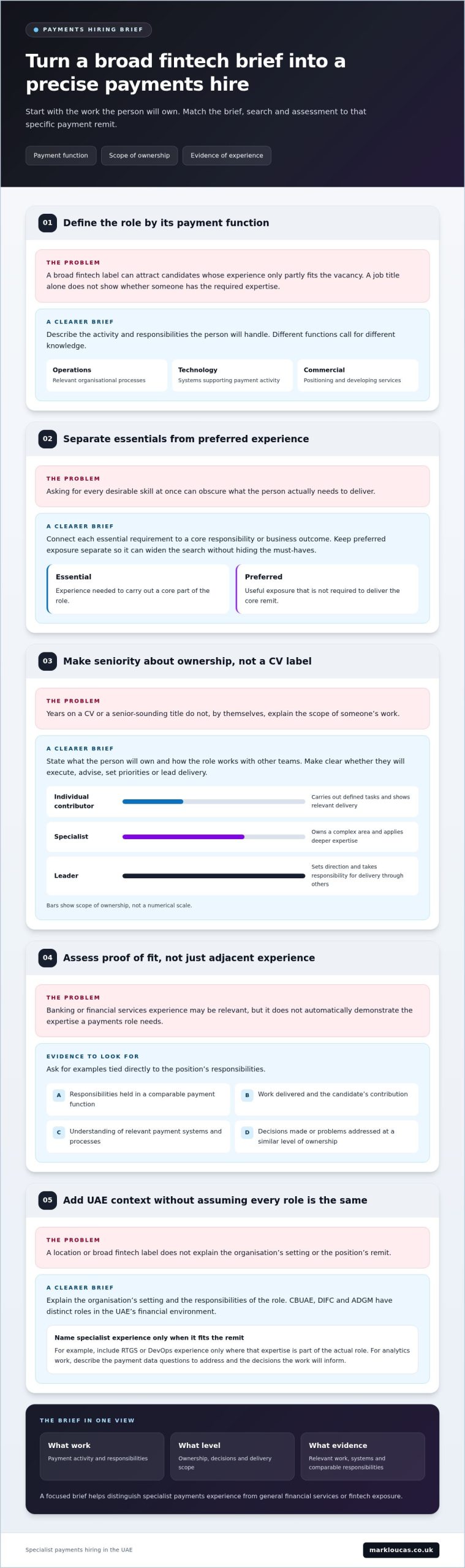
How to prepare a focused UAE payments recruitment brief
A clear brief translates a business need into a role that candidates can understand and employers can assess. Start with the issue or opportunity behind the hire, then set out what the successful person will own. A list of qualifications alone rarely explains the work.
Turn the business need into role outcomes
Work through these steps in order, so the search begins with purpose rather than a generic job title.
- Define the business need. State what the organisation wants the hire to address or deliver. Keep the description tied to its payment activity and operating context.
- Describe the role’s scope. Set out the main responsibilities, decision-making authority and expected ownership. If the remit spans several payment functions, identify the core one and explain how the others support it.
- Show the working context. Explain who the role reports to, which teams or stakeholders it works with, and how its work connects to wider priorities.
- Specify candidate evidence. Identify the responsibilities, outcomes and relevant payment-system experience that would demonstrate capability. Ask for examples showing what the candidate personally delivered.
- Choose the search approach. Clarify whether the need is permanent, senior, contract or interim, and define relevant location and working requirements for the UAE role.
This sequence keeps the brief centred on the position instead of combining unrelated requirements from different teams. It also gives everyone involved in the hiring decision a shared basis for assessing candidates.
Set candidate criteria and search boundaries
Separate criteria into essential capabilities, transferable experience and advantageous background. Essential requirements should be necessary to carry out the core responsibilities. Consider transferable experience where it provides clear evidence of relevant capability, whilst preferred exposure can add value without becoming an unnecessary barrier.
For a role combining payment operations and analytics, decide which function takes priority. If the central need is analytical work, make that the essential focus and treat operations exposure as preferred unless the job requires it. This keeps the search from becoming a request for several different specialists in one person.
Be precise about seniority and employment model, and include any location or working requirements that apply to the position. A focused brief sets clear boundaries without narrowing the search beyond the role’s real needs.
A useful specialist brief sets out the business outcome, role scope, reporting context, essential evidence and search boundaries. This gives a payments industry recruitment uae search a clear foundation, whilst leaving room to assess relevant experience on its merits.
To turn a business requirement into a focused payments brief, share your hiring requirements.
How Mark Loucas supports payments industry recruitment in the UAE
Mark Loucas Ltd is an independent specialist recruitment consultancy, founded in 2011, focused on fintech, payments and digital banking. This sector focus keeps the role’s actual remit at the centre of the hiring conversation, whether the need is for a specialist contributor, an experienced leader or flexible support for a defined requirement.
A specialist approach across payments and digital banking
Payments roles sit within a wider landscape of fintech and digital banking, but each vacancy calls for an understanding of its responsibilities and relevant experience. Mark Loucas Ltd works with employers to shape a search around the position’s purpose, scope and required capabilities. Its payments industry recruitment service helps employers frame specialist requirements rather than rely on a broad fintech label.
A well-defined search makes assessment more relevant. The brief can distinguish essential payment experience from adjacent skills, clarify the expected level of ownership and explain how the role fits the organisation. This gives employers and candidates a clearer account of the opportunity.
Choose a recruitment route that fits the requirement
Different hiring needs call for different approaches. Permanent recruitment supports an ongoing position, whilst executive search suits a senior appointment with a distinct leadership remit. Contract or interim support can fit a time-bound project, a temporary resource need or a defined period of specialist input. The appropriate route depends on the role’s purpose, seniority and expected scope.
Market mapping and intelligence add context before or during a search. By clarifying the relevant talent landscape, they can help employers refine role requirements, consider how a search is positioned and inform wider workforce planning.
Talent advisory supports decisions about how a role fits into a broader hiring plan. An employer might use market insight to distinguish an immediate vacancy from a longer-term capability need, or consider whether a role should be permanent or time-bound. The aim is a better-informed decision grounded in the organisation’s priorities.
For payments industry recruitment uae, the value lies in connecting the hiring route to the role’s specific payment remit. A focused discussion can cover the business need, essential experience, seniority, employment model and context for the search. These details help shape an approach suited to the vacancy.
If you’re planning a payments hire in the UAE, discuss your requirement with Mark Loucas Ltd.
To discuss your next step, share your hiring plans.
Set your next payments hire up for success
A well-judged hiring decision can do more than fill an immediate vacancy. It can help your organisation build capability that supports changing priorities, whether you’re strengthening a key function or planning for future needs. Treat the role brief as a practical decision-making tool that keeps the search connected to the work your team needs done.
For payments industry recruitment uae, a clear view of the role and its place in your organisation gives you a stronger starting point for conversations with candidates and stakeholders. Refine the scope as priorities become clearer, while keeping the appointment’s essential purpose in view.
Mark Loucas brings a specialist perspective to payments hiring, with recruitment approaches shaped around the requirement rather than a standard template. If you’re considering a new appointment or reviewing how to approach a specialist search, take the next step at a pace that suits your organisation.
Discuss your UAE payments hiring needs and explore a considered way forward.
Frequently Asked Questions
Is payments industry recruitment different from general fintech recruitment?
Yes. Payments recruitment centres on experience relevant to payment activities, whilst a general fintech search may cover a wider range of financial technology work. For example, a candidate who has worked on a digital finance product may not have handled the payment processes or systems central to your vacancy. In payments industry recruitment uae, assess how closely a candidate’s past responsibilities match the payment work they would take on.
Which payment roles can a specialist recruitment search cover?
A specialist search can cover roles across payment operations, technology, analytics, commercial activity and leadership. The search may focus on a particular area, such as merchant acquiring, or a position that supports several connected functions. Describe the work the person will own instead of assuming a particular title means the same thing across organisations. This makes it easier to identify relevant experience and assess candidates against the real remit.
Can experience in banking transfer to a payments role?
Yes, banking experience can transfer when it includes responsibilities that match the payments vacancy. Someone who has worked with transaction processes, payment technology or related operational activity may bring relevant knowledge. Look beyond the organisation’s name and the candidate’s title, then explore what they personally handled and how closely it relates to the new role. Banking experience alone doesn’t demonstrate payments capability.
When should an employer use market mapping for payments hiring?
Market mapping can be useful before a vacancy is finalised, particularly when an employer is planning a new capability or has limited insight into the relevant talent landscape. It can inform decisions about role scope and search priorities, or support workforce planning before a hiring need becomes immediate. Treat it as market intelligence that can guide planning.
How should employers assess candidates with experience across several payment functions?
Assess candidates against the function that matters most to the vacancy, then explore how their other experience supports it. Ask for a specific example of work they delivered, their personal contribution and the payment context involved. A candidate with broad exposure may offer useful perspective, but breadth shouldn’t be mistaken for depth. Look for clear evidence that they can take responsibility for the position’s central tasks.
Should a UAE payments employer recruit permanently or use interim support?
Choose according to the purpose and expected duration of the work. A permanent appointment may fit a continuing responsibility that forms part of the organisation’s ongoing capability. Interim support may suit a temporary gap or a defined period of work with a clear remit. A continuing function and a specific project need may call for different approaches. Be clear about what the person must deliver and for how long.
What does ISO 20022 mean for payments recruitment?
ISO 20022 is an international standard for financial messaging that provides a common structure for exchanging payment and related financial information. Its relevance to recruitment depends on the role. A position involving payment messaging, systems change or data handling may require familiarity with the standard, whilst another payments role may not. State the connection to the job clearly and assess practical experience rather than treating the standard as a universal requirement.
Can a recruitment brief include candidates from outside the UAE?
Yes. Employers can define a search that considers candidates based outside the UAE where that fits the position and their hiring plans. State whether relocation is relevant, where the role will be based and what working arrangements apply. These details help set clear expectations from the outset. Avoid assuming every suitable candidate can relocate or work in the same way, and assess each person against the role’s stated requirements.

Article by
Liam Henfrey
Liam Henfrey is a seasoned specialist in the payments and banking sectors with over two decades of experience. As the Founder and CEO of FINOPSIS and Managing Director at Mark Loucas Ltd, he advises organisations on complex financial operations and technology. His career includes senior roles at PwC, Deloitte, and Visa Europe.
Related Fintech Recruitment Guides
If you liked this guide then you may also like the following: