


Executive Search for Series B Startups That Are Ready to Scale
What if the executive who helped your fintech reach Series B isn’t the right person to lead its next stage? For founders in the UAE, executive search for series b startups starts with this question, not with a title or a shortlist.
As a company prepares to scale, it may need leadership strengths that weren’t essential earlier. The challenge is to define what the business needs now, then find senior fintech candidates with the right mix of commercial judgement, operational discipline and sector expertise. Many strong candidates won’t be actively applying.
This article explains how to set a clear leadership mandate around business priorities, use focused market mapping and discreet outreach, and choose a search structure that fits the role. It also explores how specialist fintech knowledge can sharpen the brief and support a more considered assessment. The aim is to give you a practical framework for building a search around the next phase of growth.
Key Takeaways
- Anchor the leadership mandate in the outcomes your fintech needs to achieve as it scales.
- Use executive search for series b startups to reach relevant senior candidates beyond active applicants.
- Set clear criteria for sector expertise, leadership behaviour and role scope before assessing candidates.
- Compare contingent, exclusive and retained search by how each structure fits the appointment.
- Use market mapping and a disciplined process to focus the search and inform workforce planning.
Discuss your executive search and clarify the leadership priorities behind your next stage of growth.
Why executive search for Series B startups starts with the next growth mandate
Executive search is a targeted approach to appointing senior leaders. It starts with a defined role and a considered search for people with the right experience. Unlike recruitment for a high volume of general vacancies, it focuses on a small number of influential appointments and can reach executives who aren’t actively looking for a new role. The overview of executive search also explains how the approach differs across search models.
For a fintech preparing to scale, the central question is not simply who could fill a vacancy. It is what the business needs its leadership team to deliver next. An organisation chart shows reporting lines and current responsibilities, but may not reveal new priorities, capability gaps or where decision-making needs to sit as the operating model develops. A well-framed mandate connects the appointment to those priorities.
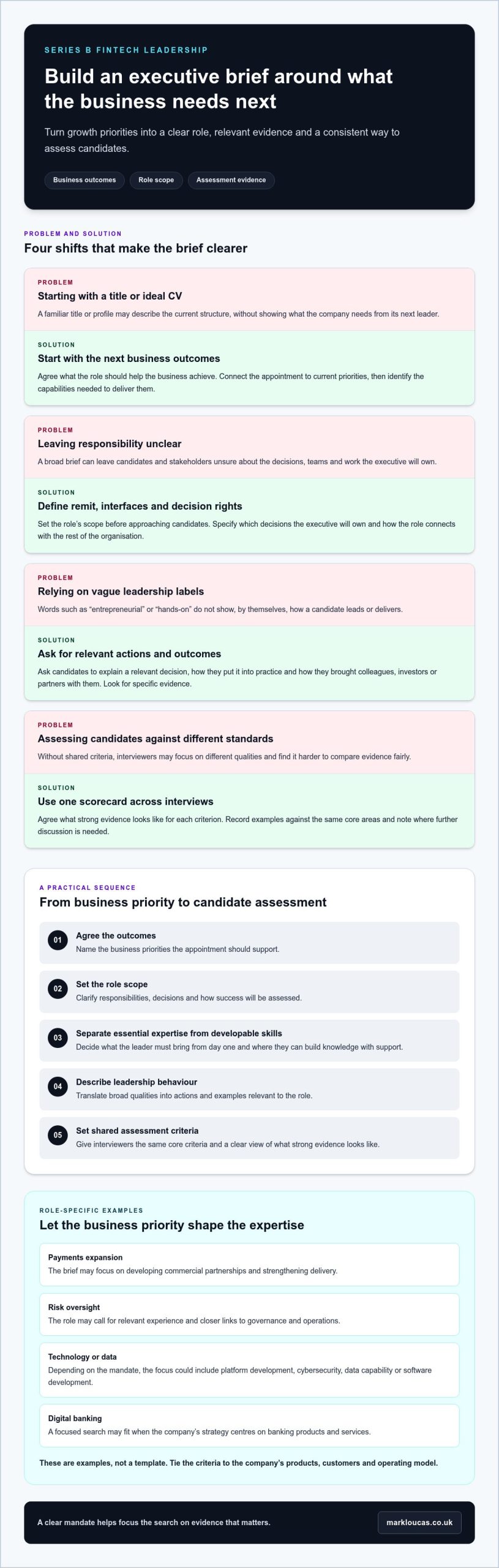
Before settling on a preferred candidate profile, founders and board members can agree the business outcomes the role should support, the decisions the executive will own and how success will be assessed. This gives the search a clear reference point, helping stakeholders distinguish essential experience from qualities that are attractive but not central to the appointment.
What changes in a Series B leadership brief
A changing growth plan can change the leadership brief. A fintech prioritising payments expansion may need an executive who can develop commercial partnerships and strengthen delivery. If the immediate focus is improving risk oversight, the role may call for different experience and closer links to governance and operations. These are examples, not a template. Define the business priority first, then identify the capabilities needed to address it.
Start by asking what must change in the organisation, which decisions are difficult to make, and where existing leaders need additional support. The answers can shape the remit before a title or ideal CV becomes fixed. That is the foundation of executive search for series b startups: finding a leader whose contribution fits the company’s next operating priorities, rather than simply reproducing its current structure.
Which fintech leadership needs merit a focused search
A growth-stage executive mandate is a senior role with clear responsibility for advancing the business priorities that will shape its next phase. Depending on strategy, a focused search might be appropriate for leadership in payments, risk, digital banking, technology or data. The remit should reflect the organisation’s products, customers and operating model, not a generic view of what every fintech needs.
For example, a technology leader may be expected to guide platform development, while a data leader could be tasked with improving how the business uses information to support decisions. Digital banking recruitment may be relevant when the company’s strategy centres on banking products and services. Define the actual scope, interfaces and decision rights before approaching candidates.
Shape your search brief around the outcomes the appointment needs to support.
Define your executive profile with a clear view of the role’s priorities and evidence of success.
How to define the right executive profile for a Series B fintech
A useful profile turns business priorities into a clear, assessable brief. Work through the sequence deliberately: agree the outcomes, define the role’s scope, separate essential expertise from skills that can be developed, describe the leadership behaviours required, then set consistent assessment criteria. This gives founders, board members and interviewers a shared basis for decisions.
Series B funding is commonly associated with scaling operations and expanding market reach. Priorities vary, so don’t translate the funding stage into a standard executive profile. Start with your plans: which capabilities must the new leader bring from day one, and where can they build knowledge with support after joining?
Turn business priorities into measurable role criteria
Connect each priority to a responsibility and evidence. If the goal is to strengthen payment operations, specify what the executive will own and what relevant delivery experience would demonstrate readiness. For a risk priority, define the decisions and teams within scope. A technology brief might require platform expertise, cybersecurity leadership, data capability or software development experience, depending on the mandate.
Role clarity focuses the search on evidence that matters.
Specialist platform needs may call for experience in architecture, delivery and technology leadership. A fintech recruitment specialist can help distinguish deep platform expertise from broader technology leadership. Keep the criteria tied to the actual operating model, rather than treating a particular background as essential by default.
Assess leadership fit without relying on vague labels
Terms such as “entrepreneurial” or “hands-on” are too broad to guide a decision on their own. Ask candidates to describe a relevant decision they made, how they put it into practice and how they brought colleagues, investors or partners with them. Look for specific actions and outcomes, not simply confidence in describing their style.
Build a scorecard that gives every interviewer the same core criteria. It can cover business outcomes, role scope, essential fintech expertise, decision-making, execution and stakeholder leadership. For each point, define what strong evidence looks like and record examples from the interview. This makes it easier to compare candidates fairly and identify where further discussion is needed.
Keep must-haves distinct from capabilities that can be developed. Direct experience in a specialist payment model or a particular risk environment may be essential if the role depends on it immediately. Other knowledge, such as familiarity with an internal reporting structure, may be learned after appointment. A considered scorecard helps the search reach relevant executives without narrowing the brief to a replica of one existing career path.
If you’re refining a senior fintech mandate, discuss the role criteria with our team.
Compare search options and consider which structure best fits the appointment.
Contingent, exclusive or retained search for a Series B appointment
The search structure affects how an executive appointment is approached. For a Series B fintech, the right model depends on the role’s seniority, the need for confidentiality and the brief agreed with the recruitment partner. No single option suits every vacancy. The key difference is how the search is engaged and how focused the process can be.
Use this comparison as a starting point, then align the model with the role’s requirements and your preferred way of working.
| Search model | Structure | May suit |
|---|---|---|
| Contingent | No win, no fee permanent recruitment. | A clearly defined vacancy where this is the chosen search approach. |
| Exclusive | One external recruitment partner leads the search. | A role where the company wants a single partner to focus on the brief. |
| Retained | An exclusive and confidential search for senior roles. | A senior or sensitive appointment requiring a discreet, focused process. |
When contingent recruitment may fit the brief
Contingent recruitment offers a no win, no fee model for permanent hiring. It may fit a vacancy with a settled remit and clear requirements, where the company has chosen this approach for its search. Share a precise brief, including responsibilities, essential experience and the decision process, so candidate introductions can be assessed against the same needs.
This model is one option within executive search for series b startups, but the label alone doesn’t determine whether it is suitable. Consider the role’s complexity and how closely the search needs to be managed. If the appointment calls for highly specific fintech expertise or discretion, the company may prefer a more exclusive structure.
When exclusive or retained search may be appropriate
Exclusive recruitment means working with one external recruitment partner on the search. That gives the partner a single point of engagement and allows the brief and candidate discussions to be managed through one relationship. It may suit a company seeking a focused process without positioning the appointment as a confidential retained search.
Retained search is exclusive and confidential, making it an option for senior appointments where discretion and a considered approach matter. It can be relevant for C-suite roles or leadership positions with a specialised fintech remit. Mark Loucas provides fintech executive search for senior appointments and global leadership needs.
Before deciding, confirm the role’s seniority, how sensitive the appointment is and what level of focus the brief requires. Discussing these points helps founders and boards choose a structure that supports the mandate, rather than selecting a model by habit.
Plan a focused search around the agreed leadership priorities.
Set out your search priorities and the process that best fits the appointment.
A disciplined executive search process from brief to appointment
A considered search gives each stage a clear purpose, from agreeing the appointment brief to supporting a final decision. For executive search for Series B startups, market intelligence can test whether the target profile reflects the talent landscape, while consistent evaluation keeps the process anchored to the role rather than shifting preferences.
A practical sequence is:
- Agree the brief. Confirm the business need, responsibilities, essential experience and assessment criteria with the decision-makers.
- Map the market. Identify relevant fintech talent pools and explore how the profile aligns with the sector and operating context.
- Engage candidates. Approach suitable executives discreetly, explain the mandate clearly and understand their interest and motivations.
- Evaluate evidence. Assess candidates consistently against the agreed criteria, then gather structured feedback from interviewers.
- Support the appointment. Compare the evidence, align stakeholders on the preferred candidate and manage communication through the decision.
Map the relevant fintech talent market
Market mapping helps show where relevant experience sits, which adjacent sectors or roles may offer transferable skills, and how broad or specialised the search needs to be. For example, a fintech seeking a payments leader may need to consider executives from different parts of the payments ecosystem, depending on the remit. This intelligence can reveal when an initial profile is too narrow or a requirement needs refining.
Mark Loucas’ search work includes access to passive candidates among the top 5% of London fintech talent. This can extend the search beyond people actively applying for roles. Market intelligence informs the search strategy, but it cannot guarantee that a particular individual will be available or interested.
Evaluate candidates against the agreed mandate
Interviews and evidence gathering should return to the role criteria established at the outset. Explore relevant sector experience through specific examples, then consider the candidate’s judgement, execution and ability to lead stakeholders in situations that relate to the startup’s priorities. A strong discussion tests what the person did, the choices they made and the results, rather than relying on broad claims of fit.
Evidence-led executive assessment connects each recommendation to the mandate and the candidate’s demonstrated experience.
After each interview, ask stakeholders to record observations against the same criteria before discussing their views. This makes differences in judgement easier to examine and helps prevent a persuasive presentation or personal preference from outweighing relevant evidence. Clear feedback also allows the search team to refine the assessment while preserving a consistent basis for comparison.
For a search shaped around your fintech leadership priorities, discuss a focused executive search.
Talk through your hiring priorities and the leadership capability your fintech needs next.
How Mark Loucas supports executive search for fintech startups
Mark Loucas Ltd is a specialist consultancy for fintech and digital banking recruitment and executive search. Operating since 2007, the business has offices in London, Singapore, Cyprus and Dubai. Its sector focus brings relevant context to senior mandates across fintech, where a role may span commercial growth, technology delivery, risk oversight or several areas of the operating model.
For a Series B business, permanent search can help identify and engage executives for a defined leadership appointment. Market mapping can show relevant talent pools and help refine the target profile. Talent advisory can support role definition and workforce planning, so the appointment is considered alongside the company’s wider capability needs. These services help shape a focused process without assuming that every fintech requires the same leadership structure.
Specialist fintech search with international reach
Fintech experience is not one uniform category. A payments appointment may call for understanding of the relevant business model and ecosystem, while a digital banking role may require leadership experience closer to the product and platform. Risk, strategy and technology mandates each bring distinct demands. Mark Loucas Ltd’s specialist focus keeps these differences in view as the search brief and candidate profile are developed.
With offices in London, Singapore, Cyprus and Dubai, Mark Loucas Ltd has an international presence across established fintech centres. This provides context when a search considers candidates or experience connected to more than one market. The search remains centred on the agreed mandate and the experience the appointment requires.
Choose a search conversation that fits the appointment
The right engagement structure depends on the role and the brief. Contingent recruitment is a no win, no fee option for permanent hiring. Exclusive recruitment uses one external recruitment partner, while retained search is an exclusive and confidential approach for senior roles. Discussing seniority, discretion and the desired structure helps establish a suitable basis for the work.
Mark Loucas Ltd’s client testimonials include MasterCard, Visa Europe and Euronet Worldwide. For a company considering executive search for series b startups, specialist sector knowledge can bring useful perspective to the mandate, from initial role definition through to candidate discussions. The focus is on understanding the appointment and tailoring the search approach to its requirements, rather than applying a standard profile or process.
If you’re shaping a senior fintech appointment, discuss your search with Mark Loucas Ltd.
Discuss your next leadership appointment and turn the mandate into a focused search.
Set the next leadership decision in motion
The value of executive search for series b startups lies in treating a senior appointment as a decision about the business’s direction, not simply a vacancy to fill. Before opening a search, bring founders and board members together around the decisions the incoming leader will need to make, the authority they will hold and the outcomes that matter most. That shared view gives the mandate a stronger foundation and helps keep the process aligned as candidates are considered.
From there, a focused conversation can turn growth priorities into a practical search brief, with the right level of sector expertise and a suitable approach to candidate engagement. The brief need not predict every challenge ahead. It should give the incoming executive a clear remit and the organisation a sound basis for assessing fit.
Discuss your fintech executive search with Mark Loucas and take a considered next step towards the leadership your plans require.
Frequently Asked Questions
How does executive search for a Series B startup work?
It begins by agreeing what the appointment must achieve and which experience is essential. The search then identifies relevant fintech talent, including executives who may not be actively applying, and engages suitable candidates discreetly. Interviews and evidence are assessed against the role’s requirements, with stakeholder feedback guiding the decision. For a UAE fintech, the brief can also clarify which market knowledge, customer relationships or operating experience the role calls for.
When should a Series B fintech startup use executive search?
Use executive search when a senior appointment requires a specific combination of sector knowledge, leadership judgement or discretion that a general vacancy campaign may not reach. For example, a fintech introducing a new payments capability might need a leader who understands both the product environment and the commercial relationships around it. It can also suit a business that needs to define a new leadership remit before approaching potential candidates.
Is retained search suitable for a confidential senior appointment?
Yes. Retained search is an exclusive and confidential option for senior roles, so it can suit a company that wants to manage an appointment discreetly. This may matter if the role is sensitive or the business wants to explore the market without public advertising. Agree how the opportunity will be described to candidates and how information will be handled during discussions.
What is the difference between contingent, exclusive and retained search?
Contingent recruitment is a no win, no fee option for permanent hiring. Exclusive recruitment means one external recruitment partner leads the search. Retained search is exclusive and confidential, and is used for senior roles. The appropriate structure depends on the appointment, the level of discretion required and the agreed brief. Clarifying these points at the outset helps set expectations for how the search will be conducted.
How can a startup define the right executive profile?
Start with the business need, not a list of impressive job titles. Identify the decisions the leader will own, the outcomes they need to influence and the teams or stakeholders they must work with. Then separate essential fintech experience from skills that can be developed after appointment. A scorecard with observable evidence, such as relevant decisions made or initiatives delivered, helps interviewers assess candidates consistently.
Can executive search reach passive fintech candidates?
Yes. Executive search can involve discreet outreach to experienced people who aren’t actively applying for roles. This helps a startup consider candidates whose work may be relevant even if they haven’t signalled an intention to move. Interest and availability will vary, so outreach should present the role clearly, respect confidentiality and give candidates enough context to decide whether a conversation is worthwhile.
Which senior roles can fintech executive search cover?
Fintech executive search can cover senior appointments across payments, digital banking, risk, strategy, technology, cybersecurity, data and software development. The right remit depends on the company’s products, operating model and immediate priorities. For example, a technology leadership role may focus on platform direction, while a risk appointment may centre on oversight and decision-making. The brief should define the scope rather than assume a standard title.

Article by
Liam Henfrey
Liam Henfrey is a seasoned specialist in the payments and banking sectors with over two decades of experience. As the Founder and CEO of FINOPSIS and Managing Director at Mark Loucas Ltd, he advises organisations on complex financial operations and technology. His career includes senior roles at PwC, Deloitte, and Visa Europe.
Related Fintech Recruitment Guides
If you liked this guide then you may also like the following: