


How to reduce time to hire for Fintech roles in 2026
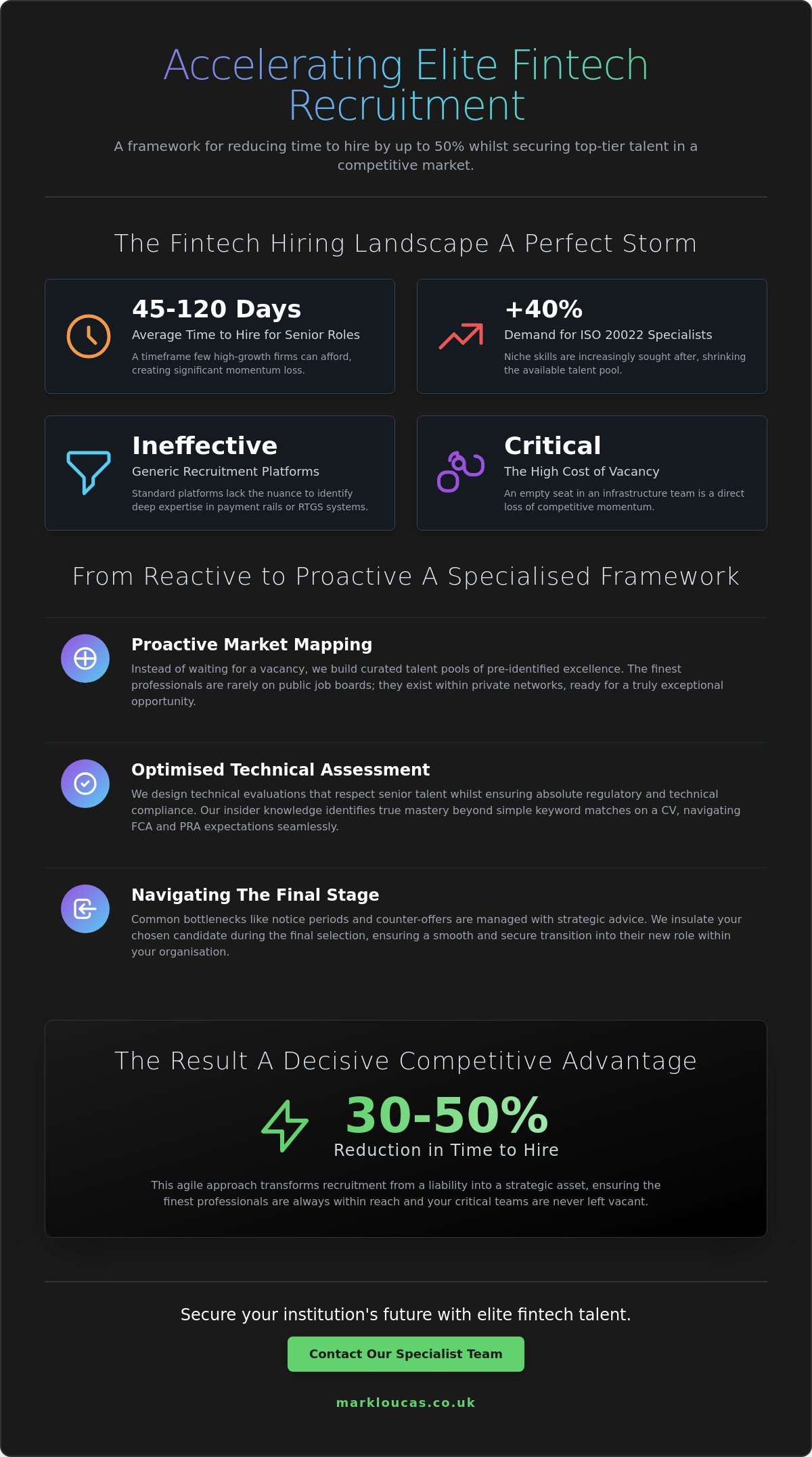
Did you know that the average time to hire for senior fintech roles has climbed to 42 days in 2026, whilst demand for ISO 20022 specialists has risen by 40 per cent since 2023? For many leaders, the primary challenge is understanding how to reduce time-to-hire for fintech roles without losing the industry’s most gifted architects to more agile competitors. You are likely all too familiar with the high cost of vacancy in your critical infrastructure teams. It’s a delicate balance to maintain, especially when the complexity of screening for niche skills like RTGS requires such meticulous attention to detail.
We understand that for a discerning institution, the search for excellence cannot be rushed, yet it must be efficient. You will discover how to accelerate your recruitment cycles for elite fintech talent without compromising on quality or regulatory compliance. In the following sections, we will share a repeatable framework designed to reduce your hiring time by 30 to 50 per cent. We’ll explore how curated talent pools and discreet market mapping allow you to move with quiet confidence, ensuring that the finest professionals in the market are always within reach.
Key Takeaways
- Learn how to reduce time-to-hire for fintech roles by addressing the hidden costs of vacancy and the limitations of generic recruitment platforms.
- Shift from reactive hiring to proactive market mapping to identify key players in the payments industry before a position becomes available.
- Optimise your assessment phase with technical evaluations that respect senior talent whilst ensuring absolute regulatory and technical compliance.
- Navigate the complexities of notice periods and counter-offers with strategic advice that insulates your candidate during the final selection stage.
- Gain a competitive advantage by leveraging the deep industry roots and private networks of a specialist fintech and banking technology recruiter.
To explore how our bespoke approach can secure the niche talent your institution requires, please get in touch with our specialist team.
Understanding the unique challenges of Fintech recruitment speed
The cost of a vacant seat in a critical infrastructure team is often more than just a financial metric; it’s a loss of momentum in an industry that never sleeps. In 2026, the average time to hire for senior fintech engineering roles has stretched to between 45 and 120 days, a timeframe that few high-growth firms can comfortably afford. Generic recruitment platforms, whilst useful for broad roles, often fail to surface the rare individuals who possess a deep understanding of the Fintech industry. These platforms lack the nuance to distinguish between a standard developer and a specialist who can navigate the intricacies of modern payment rails.
Efficiency is paramount. Many leaders wonder how to reduce time-to-hire for fintech roles without sacrificing the meticulous standards their firm represents. The competitive landscape now includes AI-first entities that move with startling speed, making a slow recruitment process a significant liability. A refined, agile approach isn’t a luxury; it’s a necessity for survival in a market where the most gifted professionals are often off the market in days.
The impact of technical complexity on hiring cycles
Finding a professional who understands both the elegance of clean code and the rigidity of financial systems is a rare feat. Screening for knowledge in RTGS systems or specialised DevOps in banking requires more than a simple keyword search. Traditional CV filtering often misses the most qualified individuals because their expertise is frequently hidden behind project titles that don’t reflect the depth of their craftsmanship. It takes a knowledgeable insider to look beyond the surface and identify the technical mastery required for these high-stakes positions.
Regulatory requirements and the vetting bottleneck
Speed must never come at the expense of integrity. Navigating the expectations of the FCA and PRA requires a steady hand and a thorough process. Integrating comprehensive background checks into the candidate journey without causing a stall is an art form. By embedding compliance into the early stages of our digital banking recruitment process, we ensure that the final selection is as smooth as it is secure. It’s about moving logically from the grand vision to the granular detail without ever losing the rhythm of the search.
To ensure your organisation remains ahead of the curve with a tailored talent strategy, you may reach out to our consultants for a private discussion.
Building a proactive talent strategy through market mapping
The most sophisticated institutions recognise that waiting for a vacancy to arise before beginning a search is a strategy fraught with risk. In the competitive environment of 2026, the finest professionals are rarely found amongst those actively browsing public job boards. Instead, they exist within private networks, often content in their current roles until a truly exceptional opportunity is presented to them. Understanding how to reduce time-to-hire for fintech roles involves moving away from reactive posting towards a model of continuous market mapping and intelligence. This proactive stance ensures that when a critical role opens, the search doesn’t begin from zero; it begins with a curated list of pre-identified excellence.
The judicious use of data analytics allows for a more granular understanding of talent movement. By monitoring the pulse of the industry, we can anticipate when senior leaders might be ready for their next challenge. Whilst many firms experience a predictable spike in applications early in the year, the most discreet acquisitions often happen outside these windows. Strategic advisory allows a firm to align its long term hiring goals with actual business growth, ensuring that the infrastructure is ready for expansion before the need becomes a crisis. Our methodology effectively demonstrates how to reduce time-to-hire for fintech roles by eliminating the traditional sourcing lag that plagues larger, less specialised agencies.
The benefits of a pre-mapped talent pool
Market mapping is the systematic identification of all potential candidates within a specific sector. By maintaining a warm pipeline of elite professionals, organisations can reduce the time spent in the sourcing phase from several weeks to just a few days. This methodology grants access to non public opportunities and passive candidates who value privacy, whilst ensuring your firm remains their primary focus. It’s a more refined way to build a team, ensuring every hire is a deliberate choice rather than a hurried necessity.
Leveraging intelligence for niche roles
The search for specialists in RTGS payment consulting or those with experience in ISO 20022 migrations requires a global perspective. Identifying these individuals involves mapping the landscape of digital banking leadership across major financial hubs. This level of granular detail allows for a swifter transition from identification to engagement. If you wish to discuss how our market mapping and intelligence services can benefit your specific requirements, our team is available for a confidential consultation at Mark Loucas Ltd.
For those seeking to refine their internal selection processes and secure the industry’s most sought after professionals, you may consult our executive search team for tailored advice.
Optimising the assessment phase for high stakes roles
The assessment of elite talent requires a level of precision that automated tools simply cannot replicate. Whilst 84 per cent of fintech talent leaders plan to expand their use of AI in 2026, a purely algorithmic approach often lacks the nuance needed for senior appointments. High stakes roles demand a process that is as rigorous as it is respectful of a candidate’s time. Refining this evaluation stage is a vital component of how to reduce time-to-hire for fintech roles without diluting the quality of the final appointment. A protracted series of interviews is no longer a sign of thoroughness; it is often perceived as a lack of organisational decisiveness.
Decisive hiring starts with a unified vision amongst the leadership team. When every stakeholder is aligned on the essential criteria, the process moves with a steady, reassuring pulse. Training hiring managers to conduct more effective, targeted interviews ensures that every interaction adds value. This approach prevents the candidate fatigue that often leads to drop outs in the final stages. In the context of digital banking recruitment, technical assessments must be integrated seamlessly, acting as a natural extension of the conversation rather than a disjointed hurdle. This maintains the momentum of the search whilst ensuring that technical mastery is verified with absolute certainty.
Creating a streamlined interview framework
- Define clear scorecards and essential criteria before the search commences to ensure objective evaluation.
- Use a focused initial screening call to filter for cultural alignment and foundational competence.
- Combine technical and behavioural assessments into a single, comprehensive session to respect the candidate’s schedule.
- Ensure all primary decision makers are present in the final round to facilitate an immediate conclusion.
The importance of the candidate experience
A slow or disjointed recruitment process acts as a silent deterrent to top tier talent. It reflects a culture that may struggle with agility, a trait that is highly prized in the fintech sector. Providing timely, constructive feedback is essential to maintain engagement amongst those who have multiple offers on the table. By favouring a personal, boutique approach over the volume driven methods of large corporates, you differentiate your firm as one that values individual excellence. This intimate level of attention ensures that the candidate feels like the sole focus of your interest, which significantly improves offer acceptance rates. It is this meticulous attention to detail that transforms a standard hiring process into a premium experience.
To discuss how our discreet approach can assist in navigating these complex final negotiations for your next senior appointment, please contact our executive search team for a private consultation.
Overcoming common bottlenecks in the final selection stage
The final stages of a recruitment journey are often the most delicate, requiring a level of finesse that mirrors a high end concierge service. It is here that the momentum of a well orchestrated search can be lost to administrative friction or a lack of candidate insulation. When considering how to reduce time-to-hire for fintech roles, one must address the fragility of the offer stage. With compensation inflation for senior positions reaching between 10 and 18 per cent in 2026, the threat of a counter-offer from a candidate’s current employer is ever present. A sophisticated strategy involves more than just a competitive salary; it requires the constant reinforcement of the firm’s unique value proposition from the very first interaction.
A common misconception amongst some leaders is that a swift process implies a lack of due diligence. In reality, speed is a byproduct of the pre-mapped intelligence and expert vetting established in the earlier phases of our search. By the time an offer is extended, the candidate’s suitability should be a matter of absolute certainty. Addressing this bottleneck ensures that the onboarding process begins the moment the offer is accepted, maintaining the candidate’s excitement and commitment during their notice period. Managing notice periods and buyout negotiations requires a knowledgeable insider who can navigate these complexities with a steady, reassuring pulse.
Managing offers and negotiations
Transparency is the cornerstone of a successful negotiation. Setting salary and equity expectations early in the process prevents late stage surprises that can stall a transaction. We craft compelling offers that go beyond basic compensation, focusing instead on the long term impact the individual will have on the firm’s architecture and growth. A swift and professional delivery of the offer is essential. Delaying this final step, even by a few days, can signal a lack of enthusiasm that top tier talent will find discouraging.
Securing the commitment
Building a relationship of trust during the final phase is paramount for securing elite talent. We often utilise the best interview questions to ask your compliance expert to ensure that even the most niche regulatory requirements are met with precision. This thoroughness provides the candidate with the confidence that they are joining an institution that values craftsmanship and meticulous attention to detail. A successful hire is ultimately secured through the deep alignment of a grand vision, rather than through financial incentives alone. This intimate, personalised approach ensures that your firm remains the sole focus of the candidate’s attention throughout the transition.
To discover how our discreet, boutique approach can transform your talent acquisition strategy, please connect with our specialist advisors for a private consultation.
Leveraging expert advisory to secure elite Fintech talent
Generalist recruitment agencies often operate on the principle of volume, a method that is fundamentally ill-suited to the refined needs of a premium fintech institution. Understanding how to reduce time-to-hire for fintech roles requires more than just a faster screening process; it requires access to the 80 per cent of top tier talent who are not actively seeking new opportunities. These elite professionals exist within private, non-public networks, often requiring a discreet introduction from a trusted advisor. A boutique consultancy acts as a knowledgeable local insider, managing these delicate relationships with the expert care that a high value transaction deserves.
By moving from a transactional model to a long-term talent advisory partnership, your organisation gains a significant competitive advantage. This collaborative approach allows for the integration of deep market intelligence into your annual workforce planning, ensuring you are never in a rush when a critical vacancy arises. It is this foresight, combined with a steady and reassuring pulse, that truly demonstrates how to reduce time-to-hire for fintech roles whilst maintaining a culture of curated excellence. Our focus remains on tailored solutions that suggest your firm is the sole focus of our attention, ensuring a perfect alignment between institutional vision and individual ambition.
The boutique advantage in Fintech search
A specialised focus leads to higher quality placements and significantly lower attrition rates amongst senior leadership. As fintech and banking technology recruiters with deep industry roots, we navigate the prestigious districts of global financial centres, from the City of London to Canary Wharf, to identify rare talent. Our expertise in fintech executive search is built on a foundation of trust and meticulous attention to detail. We shun the impersonal nature of large corporate entities, opting instead for a refined service that feels both elite and approachable to the industry’s most sought after professionals.
Future-proofing your hiring strategy
Staying ahead of industry shifts, such as the 40 per cent surge in demand for ISO 20022 specialists since 2023, is essential for maintaining a resilient infrastructure. With 84 per cent of fintech talent leaders planning to expand their use of AI in 2026, your recruitment strategy must be equally forward-thinking to attract those who understand the granular details of high performance computing and AI operations. Developing a reputation as a fast moving and desirable employer starts with a recruitment process that is as smooth and unhurried as a high-end concierge service. By projecting a persona of quiet confidence and reliability, you ensure that the finest talent in the market is always within your reach.
To discuss how we can accelerate your search for elite talent, please contact our specialist team today.
Securing the future of your Fintech leadership
The landscape of 2026 demands a departure from the traditional, volume driven recruitment models of the past. Success now hinges on a firm’s ability to transition from reactive hiring to a proactive strategy of continuous market mapping. By refining your assessment frameworks and prioritising the candidate experience, you establish a culture of agility that appeals to the industry’s most gifted architects. We have explored how to reduce time-to-hire for fintech roles by leveraging deep industry roots and private networks that remain inaccessible to larger, impersonal entities.
Since 2011, Mark Loucas Ltd has remained exclusively focused on the nuances of Fintech and Digital Banking. Our expertise in high-stakes payments infrastructure ensures that your search for excellence is managed with meticulous attention to detail. As a discreet and highly connected boutique advisory, we provide the quiet confidence required to navigate complex talent acquisitions. To discuss how we can accelerate your search for elite talent, please contact our specialist team today. We look forward to helping you build a resilient, world-class team that defines the next era of financial technology.
Frequently Asked Questions
What is the average time to hire for a Fintech role in London
The average time to hire for senior fintech roles in London reached 42 days in the first quarter of 2026, reflecting a steady increase from the previous year. For more technical positions, such as senior payment systems engineers or KYC specialists, the process can often exceed 100 days. These timelines are frequently influenced by the scarcity of niche expertise and the rigorous regulatory vetting required in the capital’s financial districts.
How can I reduce hiring time without sacrificing candidate quality
You can accelerate your recruitment by shifting from a reactive model to a proactive strategy of continuous market mapping and intelligence. This allows you to identify and engage with elite professionals before a vacancy even arises, ensuring that you are selecting from a pre-vetted pool of excellence. By maintaining these private relationships, you ensure that quality remains high whilst the traditional sourcing phase is significantly shortened.
Is it better to use a generalist or a specialist Fintech recruiter
A specialist fintech recruiter is almost always the superior choice for high stakes roles due to their deep industry roots and access to non-public talent pools. Whilst generalists operate on volume, specialists understand the technical nuances of skills like RTGS and ISO 20022. A boutique advisor can often reduce the initial sourcing time to just a few days by leveraging a pre-mapped network of passive candidates.
How do notice periods in the UK banking sector affect time to hire
Notice periods for senior leaders in the UK banking sector typically range from three to six months, which naturally extends the duration between an offer and a start date. Whilst these contractual obligations are fixed, you can mitigate their impact by accelerating the earlier stages of the recruitment cycle. Maintaining a steady, reassuring pulse of communication during the notice period is essential to ensure the candidate remains committed to the transition.
Can automated screening tools really speed up executive recruitment
Whilst 84 per cent of fintech talent leaders plan to expand their use of AI in 2026, automated tools often lack the sophistication required for executive search. High level appointments demand a discreet, human led assessment of strategic vision and cultural alignment that algorithms cannot replicate. For senior roles, a personalised approach remains the most reliable way to ensure a successful placement that stands the test of time.
What are the most common causes of delays in Fintech hiring
The most frequent causes of delay include a lack of alignment amongst internal decision makers and a protracted, multi stage interview process that leads to candidate fatigue. When stakeholders haven’t defined clear criteria from the outset, the search often stalls during the final selection phase. Additionally, the complexity of negotiating buyout packages and notice periods for senior professionals can create significant bottlenecks if not managed with expert care.
How does a faster hiring process improve my offer acceptance rate
A swift and decisive hiring process significantly improves offer acceptance rates by projecting a culture of agility and institutional confidence. Top tier professionals are often managing multiple opportunities and are more likely to commit to an organisation that demonstrates clear interest and respect for their time. A slow process can be perceived as a lack of organisational decisiveness, which often leads candidates to favour faster moving competitors.
What role does market mapping play in reducing time to hire
Market mapping is a vital component in how to reduce time-to-hire for fintech roles as it effectively eliminates the traditional sourcing lag. By systematically identifying all potential candidates within a specific sector, you gain immediate access to the 80 per cent of talent who are not actively looking. This preparation allows you to move with quiet confidence the moment a critical infrastructure role becomes vacant, transforming a months long search into a matter of days.

Article by
Liam Henfrey
Liam Henfrey is a seasoned specialist in the payments and banking sectors with over two decades of experience. As the Founder and CEO of FINOPSIS and Managing Director at Mark Loucas Ltd, he advises organisations on complex financial operations and technology. His career includes senior roles at PwC, Deloitte, and Visa Europe.
Related Fintech Recruitment Guides
If you liked this guide then you may also like the following: