


The Hidden Costs of a Vacant Executive Position in the 2026 Fintech Sector
Could the most significant drain on your firm’s capital be the seat that currently sits empty? As we look towards the complexities of the 2026 fintech landscape, many boards mistakenly view a leadership hiatus as a period of fiscal restraint. You likely recognise the subtle tension that arises when a key role remains unfilled, sensing the quiet strain placed upon your remaining directors whilst strategic initiatives begin to lose their momentum and regulatory anxiety starts to mount. This guide will help you uncover the hidden costs of a vacant executive position, moving beyond simple salary savings to reveal the true impact on your market standing and revenue stability.
We shall examine the precise financial risks of delay and offer a sophisticated framework to justify a meticulous, discreet executive search to your board. By understanding these nuances, you can ensure your organisation secures the elite leadership required to navigate shifting global requirements with absolute confidence. This exploration provides a swift path to securing the calibre of talent that defines industry excellence.
Key Takeaways
- Understand why the immediate savings on an executive salary are significantly outweighed by the loss of strategic momentum and revenue generation.
- Discover how to calculate the hidden costs of a vacant executive position to provide the board with a clear financial justification for immediate recruitment.
- Identify the specific regulatory vulnerabilities and potential fines that arise when key compliance or risk leadership roles remain unfilled in the 2026 fintech market.
- Learn how leadership gaps trigger secondary talent attrition amongst your high performing staff, creating a more extensive and expensive recruitment crisis.
- Recognise the importance of engaging a specialist fintech executive search partner to secure elite talent whilst maintaining the privacy of your strategic goals.
If you require expert guidance on securing elite leadership for your firm, please reach out to our professional team through our contact us page.
Quantifying the Immediate Financial Impact of Leadership Gaps
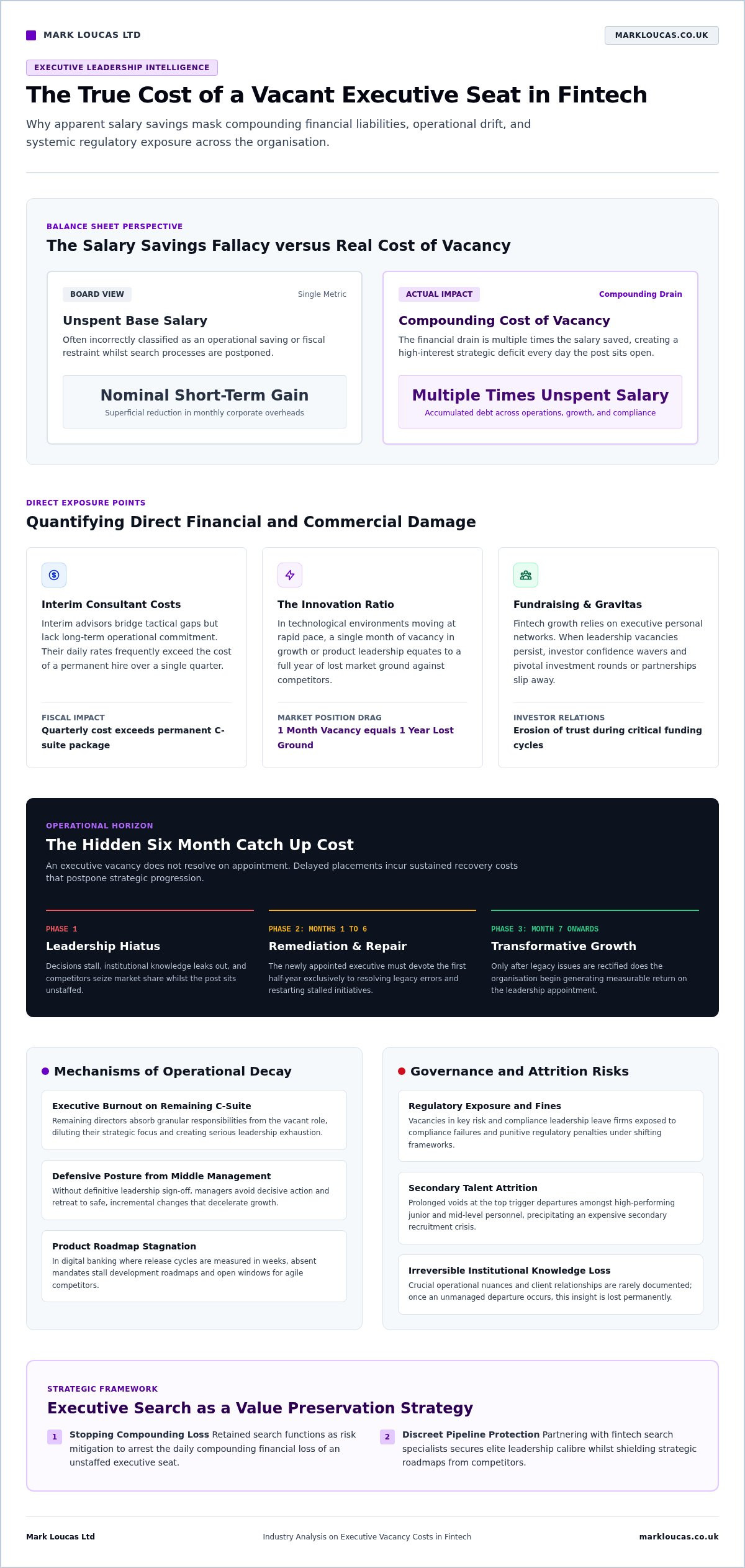
In the fast moving world of 2026 fintech, an empty executive chair is often viewed as a temporary reduction in overheads. This perspective is dangerously narrow. The concept of the Cost of Vacancy (COV) reveals the hidden costs of a vacant executive position, suggesting that the actual financial drain is multiple times the salary saved. For a C-suite leader, this includes the evaporation of strategic direction and the stalling of key initiatives. It’s a high interest debt that compounds every day the position remains open, often creating a vacuum that competitors are only too happy to fill.
Whilst an organisation waits for the perfect candidate, strategic partnerships and investment rounds often slip through the cracks. Fintech success relies on the personal networks and gravitational pull of its leaders. Without that figurehead, trust amongst potential investors can waver during critical funding cycles. Many firms attempt to bridge this gap with interim consultants. Whilst useful for maintaining operations, these experts often lack the long term skin in the game required for transformative growth; their daily rates frequently exceed the cost of a permanent hire when viewed over a fiscal quarter.
Direct Revenue Loss and Missed Market Opportunities
A vacant sales or growth leader does more than just pause the pipeline; they effectively hand your market share to competitors. In the 2026 market, where technological cycles move at a blistering pace, a single month of vacancy can equate to a year of lost ground in product development or customer acquisition. Firms often find that specialised financial recruitment is the only way to arrest this decline before the damage becomes irreversible.
The Salary Savings Fallacy
Reporting unspent salary as a benefit is a misleading metric that masks the true erosion of value within a fintech firm. This surface level saving ignores the ‘Catch Up’ cost that follows a vacancy. When a new executive eventually arrives, they must spend their first six months repairing the legacy issues and stalled projects left behind. Utilising sophisticated retained executive search practices ensures that the search fee is viewed correctly. It’s a strategic investment meant to stop the compounding daily loss of an empty chair.
To ensure your leadership team remains resilient and your operational standards stay impeccable, we invite you to discuss your strategic requirements with our boutique advisory team.
Operational Decay whilst the Executive Chair Remains Empty
When an executive departs without an immediate successor, the delicate architecture of cross departmental communication often begins to crumble. The remaining C-suite members, already managing significant and complex portfolios, find themselves absorbed by the granular details of the vacant role; this inevitably leads to executive burnout and a dilution of focus. Beyond the visible strain on the team, the hidden costs of a vacant executive position manifest as a slow leak of institutional knowledge. This unique understanding of internal culture and long term client nuances is difficult to document and even harder to replace once it has dissipated.
The absence of a clear visionary creates a ripple effect that touches every layer of the organisation. Without a definitive leader to provide sign off, mid level managers often default to a defensive posture. They prioritise safe, incremental changes over the bold, transformative decisions that define the fintech sector. This operational drift is not merely a pause in progress; it is an active decay of the firm’s competitive edge.
Strategic Stagnation and Delayed Product Roadmaps
From the perspective of fintech banking technology recruiters, the impact on product roadmaps is particularly severe. In the digital banking space, where innovation cycles are measured in weeks rather than years, a leadership gap causes immediate stagnation. This ‘innovation lag’ provides a window of opportunity for more agile competitors to seize market share, launching features that your team has the capability to build but lacks the executive mandate to execute. The result is a product that feels dated before it even reaches the market.
Decision Paralysis amongst Senior Management
Teams without a direct leader frequently enter a ‘holding pattern’ behaviour, where strategic momentum is sacrificed for administrative maintenance. This paralysis is especially damaging for 2026 digital transformation projects that require constant, high level steering to navigate technical and cultural hurdles. Credible research on the cost of poor succession planning suggests that these leadership voids can destroy significant market value by stalling growth and eroding investor confidence. Engaging in a discreet fintech executive search is the most effective way to restore this lost momentum. If you are sensing a decline in your firm’s operational pace, it may be time to seek a tailored solution to bridge the gap.
If you are reviewing your firm’s governance structure and require discreet assistance in securing a permanent leader, we invite you to connect with our team through our contact us page for a confidential discussion.
Regulatory Exposure and Compliance Vulnerabilities in 2026
The UAE fintech landscape in 2026 is defined by increasingly rigorous oversight from authorities such as the DFSA and ADGM, particularly regarding payments infrastructure and data integrity. Within this high stakes environment, the hidden costs of a vacant executive position in compliance or risk management extend far beyond the lack of daily supervision. Regulators increasingly view a leadership gap as a symptom of poor governance, which can trigger invasive audits or mandate expensive remedial work that diverts resources from growth. For firms in the midst of fundraising or seeking new banking partnerships in Dubai or Abu Dhabi, this ‘Key Person Risk’ is often a deal breaker. Investors scrutinise the stability of the C-suite with meticulous care, knowing that a single oversight can lead to catastrophic fines that dwarf any potential salary savings.
Maintaining a steady hand at the helm ensures that regulatory obligations are met with the precision and diligence that modern authorities demand as standard. A leadership void here doesn’t just stall projects; it actively invites external scrutiny that can paralyse an organisation for months.
The High Price of Unattended Governance
Securing the right leadership is essential for maintaining the absolute integrity of your payments systems within the Middle East. In 2026, the regulatory focus has shifted heavily towards operational resilience and anti money laundering protocols. When these roles sit empty, missed regulatory reporting deadlines become a tangible risk, often resulting in public censures that damage a firm’s reputation for years. Understanding the nuances of identifying a compliance expert is the first step in closing these dangerous gaps before they attract unwanted attention.
Relationships with Regulators and Banking Partners
Vacancies in senior leadership signal instability to external stakeholders, particularly banking partners who provide essential infrastructure. Renegotiating Banking as a Service (BaaS) contracts becomes significantly more difficult without a permanent CFO or Head of Risk to provide assurance. Following the interagency guidance on third-party risk management, partners are more cautious than ever about the governance controls of their fintech clients. Ensuring continuity through expert digital banking recruitment is not just about filling a seat; it’s about preserving the institutional trust that allows your business to scale. The hidden costs of a vacant executive position are ultimately found in the friction and lost leverage during these critical negotiations.
If you are concerned about the stability of your internal culture and wish to protect your talent pipeline in the Middle East, please contact our specialist advisors for a confidential consultation.
The Cultural Toll and Secondary Talent Attrition
Leadership instability within the C-suite often acts as a catalyst for a broader exodus of talent, particularly in the highly mobile markets of Dubai and Abu Dhabi. High performing employees, who are frequently the most sought after professionals in the UAE fintech sector, often perceive an executive vacancy as a signal of strategic drift or internal turmoil. This perception triggers a significant ‘flight risk’ that can lead to the departure of mid level staff who feel unsupported or uncertain about the firm’s future direction. The hidden costs of a vacant executive position are thus compounded by the expensive and time consuming necessity of replacing several layers of management simultaneously. Rebuilding a fractured company culture after a prolonged vacancy is a delicate process that requires significant emotional and financial investment.
The departure of a single executive can create a vacuum that pulls in the most capable members of the team, forcing them to overextend themselves. This creates a fragile environment where the next departure could lead to a systemic failure of a particular department or product line, especially within the competitive DIFC and ADGM hubs.
Decreased Morale and Team Burnout
When a leadership role remains unfilled, the vital responsibilities of that position don’t simply vanish. Instead, they are often absorbed by lower level staff as ‘shadow work’. These individuals find themselves performing tasks far beyond their remit without the corresponding authority or compensation. Over time, this leads to profound team burnout and a measurable decline in productivity. Professionals familiar with the strategic search for global talent observe that leadership voids are the primary driver for high turnover rates in otherwise successful UAE teams. The cost of replacing these mid level professionals often rivals the expense of the executive search itself.
Employer Brand Damage in the Competitive Fintech Sector
The fintech community in the UAE is remarkably tight knit, and news of a prolonged vacancy travels quickly through professional networks and social circles. Negative reviews or industry gossip regarding a ‘headless’ department can cause lasting damage to your employer brand. This makes it increasingly difficult to attract ‘passive’ executive talent who value stability and discreet, expert management above all else. These elite candidates are unlikely to entertain an approach from a firm seen as unstable. Utilising market mapping and intelligence is a proactive way to identify potential talent before a vacancy even occurs, ensuring your reputation remains impeccable. If your organisation’s reputation is being challenged by leadership gaps, you should speak with us today to secure your future.
If you are ready to mitigate the risks associated with leadership gaps, we invite you to discuss your executive requirements with our bespoke search team.
Navigating Executive Search for Swift and Precise Placements
Transitioning from a state of vacancy crisis to a strategic hiring plan requires a shift in perspective. The hidden costs of a vacant executive position continue to erode your market standing every day the seat remains empty. However, a rushed appointment can be just as detrimental as a prolonged gap. A precise search process, conducted with the quiet confidence of a boutique advisor, ensures that your firm’s reputation is protected whilst you secure a leader who truly understands the 2026 landscape. Market mapping and intelligence are essential tools here, allowing us to identify elite talent within private, non public circles before a formal search even begins.
The Case for Specialist Executive Search
The nuances of payments industry recruitment in 2026 require a partner who understands the granular technicalities of cross border settlement and decentralised finance. Generalist recruiters often struggle to navigate these complexities, resulting in a slower time to hire and a higher risk of cultural mismatch. A specialist firm leverages a pre-existing network of elite fintech leaders, significantly reducing the search duration. When you contrast the investment in a specialist search with the compounding daily loss of an empty chair, the fiscal choice becomes clear. Precision and speed are not mutually exclusive when guided by expert hands.
Utilising Interim Solutions to Bridge the Gap
For organisations facing an immediate leadership void, interim solutions provide a vital buffer. These high calibre professionals can step into a role at short notice, arresting the financial and operational decay described in previous sections. An interim leader does not merely maintain the status quo; they often provide the strategic clarity required to prepare the organisation for a permanent successor. This approach effectively mitigates the hidden costs of a vacant executive position whilst the search for a permanent leader continues. We encourage you to connect with our consultants to explore how our interim fintech solutions can protect your market position.
If you are concerned about the impact of a leadership gap on your organisation, our consultants are ready to assist. Please visit our contact page to arrange a discreet and professional consultation regarding your executive search requirements.
Securing Your Strategic Advantage
The compounding nature of a leadership void in the fintech sector cannot be ignored. We’ve seen how unspent salary is a misleading metric that fails to account for lost revenue and the slow erosion of institutional trust. In the 2026 market, where regulatory scrutiny and technological pace are relentless, the hidden costs of a vacant executive position represent a significant risk to your firm’s market share and cultural stability. Choosing to act decisively today prevents the long term decay of your competitive edge.
Since 2011, our boutique firm has specialised in managing these high stakes transitions with absolute discretion. We provide sophisticated market mapping and talent advisory services that ensure your leadership gaps are closed with precision. By choosing a partner committed to individualised attention and curated excellence, you secure the elite talent necessary to thrive. We invite you to contact our team today to protect your organisation’s future with quiet confidence.
Frequently Asked Questions
What is the standard formula for calculating the cost of a vacant executive position?
The hidden costs of a vacant executive position are often calculated by taking the annual salary and benefits package, then multiplying this figure by a factor of three or more to account for lost productivity and strategic delays. This total is then divided by the number of working days in a year. Such a formula provides a granular view of the daily financial drain that an empty boardroom seat imposes on a growing enterprise.
How does an executive vacancy affect a fintech firm’s valuation during a funding round?
It’s common for investors to view a leadership gap as a significant risk factor during a funding round, which can lead to a reduced valuation or delayed investment. A vacant seat suggests a lack of strategic continuity and can signal internal instability to discerning venture capitalists. Maintaining a complete and high calibre leadership team ensures that the firm projects an image of curated excellence and operational readiness, which is vital for securing premium capital.
Can an interim executive really mitigate the hidden costs of a permanent vacancy?
Engaging an interim executive is a sophisticated way to provide immediate stability whilst a permanent search is conducted. These experienced professionals bring a wealth of niche expertise that prevents the stagnation of critical projects and maintains team morale. For organisations seeking high-level commercial direction and growth continuity during leadership transitions, visit Carter Strategies to explore fractional executive and strategic advisory support. By addressing the hidden costs of a vacant executive position through such tailored interim solutions, a firm protects its long term interests and ensures that its strategic momentum remains entirely undisturbed during a period of transition.
What are the most common regulatory risks associated with a vacant C-level role in 2026?
Within the regulatory environment of 2026, a vacant C-level role often triggers increased scrutiny from bodies such as the FCA. Without a designated individual to oversee compliance and risk management, a firm faces the threat of heavy fines or the suspension of operating licences. This lack of clear accountability can damage a firm’s reputation amongst its elite clientele and disrupt the meticulous governance required in the modern digital banking sector.
How long does a typical fintech executive search take to complete in the UK?
A comprehensive executive search within the UK fintech sector typically requires a period of three to six months to reach a successful conclusion. This timeline allows for a deep and unhurried exploration of the market to identify individuals who possess both the rare skills and the cultural alignment necessary for such a role. Our London fintech recruitment team focuses on delivering a discreet and highly personalised service that ensures every placement is precise and reliable.
Why is the cost of vacancy higher in fintech compared to traditional retail banking?
The pace of innovation in fintech is significantly faster than in traditional retail banking, meaning that leadership absences result in more rapid competitive displacement. Every day a role remains empty, the firm misses opportunities to implement new technologies or respond to shifting market trends. These hidden costs of a vacant executive position are amplified by the scarcity of talent capable of navigating the complex intersection of high finance and cutting edge software in premium urban centres.
Should a fintech firm always use a retained search model for executive roles?
For senior leadership roles, a retained search model’s almost always preferable because it guarantees a level of dedicated focus and exclusivity that contingency models cannot match. This approach allows a boutique advisor to conduct a thorough and private search, accessing non public talent pools that are often invisible to the wider market. It ensures that the firm’s specific needs are met with a bespoke solution that reflects its unique culture and high standards.
How can we prevent secondary talent attrition during a leadership transition?
Preventing secondary attrition requires a proactive strategy that includes transparent communication and the use of professional talent advisory services. When a leadership role’s empty, junior staff may feel uncertain about their future, leading them to seek opportunities elsewhere. By providing a clear roadmap for the transition and demonstrating a commitment to finding a high quality successor, a firm can reassure its team and maintain the internal stability of the organisation through a period of change.

Article by
Liam Henfrey
Liam Henfrey is a seasoned specialist in the payments and banking sectors with over two decades of experience. As the Founder and CEO of FINOPSIS and Managing Director at Mark Loucas Ltd, he advises organisations on complex financial operations and technology. His career includes senior roles at PwC, Deloitte, and Visa Europe.
Related Fintech Recruitment Guides
If you liked this guide then you may also like the following: