


Talent intelligence for financial services and better hiring decisions
What if the right hiring decision is to change the role before you begin searching? Talent intelligence for financial services can help UAE organisations test whether a hiring plan reflects the skills available in the market, rather than relying on assumptions or broad, outdated data. If specialist talent is hard to find, the issue may lie in the role’s requirements, the target market or the balance between hiring and developing existing teams.
It’s understandable to want a clear view of candidate availability, especially when business priorities depend on specialist capability. Useful insight starts with a defined question and brings relevant internal workforce information together with evidence about the external talent market. It should help answer a practical question, such as whether a role brief is too restrictive, rather than simply produce more data.
This article explains what talent intelligence can reveal and how it differs from talent mapping, salary benchmarking and recruitment. You’ll see when each approach is useful, what to consider when assessing market insight, and how to apply it to a workforce decision across financial services, fintech, digital banking or payments. The aim is a more informed plan, grounded in the market you need to hire from.
Key Takeaways
- Start with a specific business decision so talent intelligence for financial services focuses on evidence that can guide action.
- Distinguish market intelligence from talent mapping and salary benchmarking by considering the question each approach is designed to answer.
- Use market findings to refine role requirements and shape a realistic sourcing strategy for the UAE talent market.
- Set review points so hiring plans can respond when priorities or market conditions change.
- Consider specialist sector insight when your internal team needs added context, while keeping the decision grounded in your organisation’s needs.
If you’re defining a talent market question for fintech, digital banking or payments, discuss your talent intelligence needs.
What talent intelligence means for financial services hiring
Talent intelligence for financial services is structured insight used to understand relevant talent markets and inform workforce decisions. It connects a defined business need with evidence about where skills may sit, how roles are changing and what that could mean for a hiring plan.
This is more than a list of possible candidates. A list can show names, but not necessarily whether the market is broad enough for the role, which requirements may be limiting the search, or whether adjacent skills could be suitable. Nor is intelligence simply an individual’s impression of the market. Its value comes from gathering relevant evidence, interpreting it in context and making the basis for a decision clear.
Talent management is the broader practice of attracting, developing and retaining people. Talent intelligence provides a focused, evidence-led input to those workforce decisions. It can help leaders assess whether to recruit, adjust a role, develop existing employees or consider a different talent pool. It informs decisions, but can’t guarantee a hiring outcome.
What questions can talent intelligence answer
For a financial services employer in the UAE, useful questions might include where a particular capability is found across banks, fintech firms, payments providers or other relevant organisations, and whether the search should include other sectors or locations. The answer depends on the role and the evidence available, not on an assumption that similar job titles mean similar skills.
Role scope matters. A payments position requiring deep experience in a specific product area may draw from a narrower market than one where adjacent experience is acceptable. Intelligence can help test which skills are essential, which could be developed after appointment and how those choices may affect the potential candidate market.
Which signals matter in financial services
Relevant signals may include the role’s responsibilities, essential and transferable skills, the types of organisations employing those capabilities, and changes affecting the work. The useful signals vary by specialism. A digital banking role may call for different experience from a payments position, even where both involve technology and financial services.
Regulatory or technical references should be included only where they relate directly to the role. For example, FCA or Bank of England material may provide context for roles connected to their relevant areas of focus. SWIFT or ISO 20022 may matter when a position involves payments messaging or related systems. Their mention alone doesn’t establish a hiring requirement.
For a related perspective on financial managed services, consider how the work connects to the capabilities your organisation needs. Mark Loucas Ltd focuses on fintech, digital banking and payments, and can bring sector context to the question you are defining.
To explore how a focused market question could support your hiring decisions, discuss your talent intelligence needs.
How talent intelligence turns market signals into hiring insight
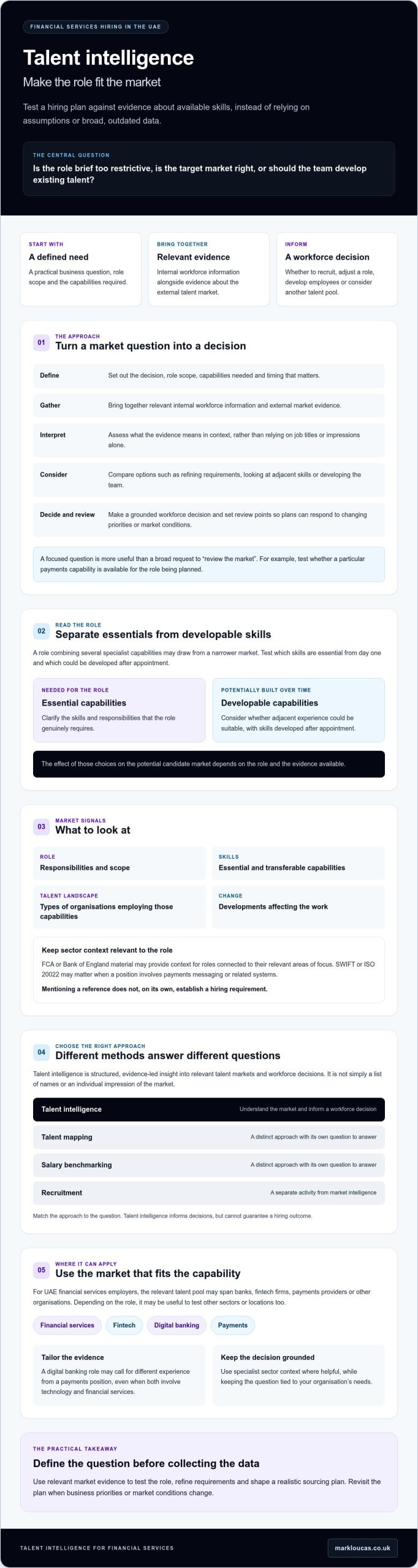
Useful intelligence follows a disciplined sequence: define the business question, gather relevant evidence, interpret what it shows, consider the available options and make a decision. This keeps research connected to a real need, rather than collecting information simply because it is available.
Start with the business decision
First, clarify what the organisation needs to decide. Is it planning a hire in the UAE, entering a market or reviewing how a team is structured? Define the role’s scope, the capabilities needed and the timing that matters. A question such as “Can we find someone with experience in this specific payments capability for this role?” gives the research a clear direction. A broad request to “review the market” may produce interesting detail without helping anyone act.
A focused question also makes trade-offs visible. If a specialist role combines several capabilities, the organisation can test which are essential from day one and which might be developed after appointment. That distinction may affect the size and shape of the potential market, but it doesn’t establish how many suitable people are available or guarantee a successful hire.
Interpret evidence before acting
Next, gather evidence that relates to the question. Depending on the role, this could involve comparing relevant organisation types, role profiles, locations and adjacent capabilities. Keep observable signals separate from interpretation. For example, identifying that similar responsibilities appear in more than one type of organisation is an observation; concluding that professionals from those organisations could meet the brief is an interpretation to examine.
Consider a firm seeking a specialist in payments technology. The initial brief may require direct experience in one narrowly defined area. Research could compare roles across payments providers, banks and financial technology businesses, then examine whether adjacent technical or operational experience is relevant. The result should set out what the evidence supports, what remains uncertain and whether broadening the brief is a sensible option. Avoid presenting an estimate as a confirmed count unless the research supports it.
Record source dates, coverage and gaps before drawing conclusions. Evidence may not capture every suitable professional, and role titles can differ between organisations. Describe a forecast or emerging signal as an indication, not a confirmed fact. This helps leaders weigh options, such as maintaining the brief, adjusting essential criteria or reviewing team structure, before deciding on a course of action.
Talent mapping can support this work by structuring research on relevant organisations and potential talent pools. It is one way of examining a market, while talent intelligence interprets relevant evidence in light of the business decision. For specialist fintech, digital banking or payments questions, discuss the market insight you need.
To choose the right form of insight for your hiring question, discuss the right approach for your hiring question.
Talent intelligence compared with talent mapping and salary benchmarking
These activities can inform one another, but they answer different questions. Talent intelligence builds understanding of a market. Talent mapping organises relevant organisations or talent pools for a defined search. Salary benchmarking compares pay against a reference. None is, by itself, a hiring solution or a guarantee that a suitable candidate will be appointed.
| Approach | Purpose | Typical output | Suitable question | Likely next step |
|---|---|---|---|---|
| Talent intelligence | Understand a talent market and inform a workforce decision. | Evidence-based view of relevant skills, market context, options and limitations. | What does the market suggest about our hiring plan? | Refine the plan, role scope or search question. |
| Talent mapping | Identify and organise relevant organisations or talent pools for a specific search. | A structured view of potential sources and relevant profiles. | Where should we focus a search for this capability? | Agree a sourcing strategy or begin recruitment. |
| Salary benchmarking | Compare proposed reward with a suitable reference. | A comparison to inform pay discussions, subject to the relevance and date of the data. | Is our proposed reward aligned with the reference we’re using? | Review the reward position alongside the role and hiring plan. |
When to use intelligence, mapping or benchmarking
Use talent intelligence for financial services when you need market context before committing to a hiring plan, such as testing whether a role’s requirements appear realistic. Choose mapping when the role and search scope are defined and you need to organise relevant organisations or talent pools. Use salary benchmarking to inform reward discussions, checking that any reference is relevant to the role, location and date. A fintech salary benchmarking guide may offer further context, but check what roles and locations its information covers before applying it.
The sequence may vary. Intelligence can help shape a search, mapping can make the target market more specific, and benchmarking can inform reward decisions. One activity may reveal a need for another, but none should be treated as an automatic substitute for the rest.
Does talent intelligence replace recruiter judgement
No. Evidence supports professional judgement; it doesn’t replace it. Data alone can’t establish a person’s motivation, suitability for a particular team or future performance. Hiring teams should test assumptions through discussion with relevant stakeholders and, where recruitment begins, conversations with candidates. Those conversations add context and allow the organisation to assess factors that market research cannot establish.
To turn market insight into a practical hiring plan, discuss a financial services hiring plan.
How to use talent intelligence in a financial services hiring plan
Market insight becomes useful when it changes a hiring decision. For a UAE financial services organisation, use the findings to shape the role, decide where to look and agree how the plan will be reviewed. Treat each step as a choice to test, not as an automatic instruction to recruit.
Turn market findings into a clearer role brief
Begin with the business need, then check each requirement against it. Separate essential capabilities from preferences that may narrow the candidate market without being central to the work. Ask whether adjacent sector experience could meet the need, and whether an existing team member could contribute or develop into part of the solution.
Before opening a search, align stakeholders on:
- Scope and seniority: What outcomes will the role own, and what level of experience is genuinely necessary?
- Skills: Which capabilities must be present at appointment, and which can be developed?
- Location: Is the location requirement essential, or is it an assumption that should be tested against the relevant market?
- Evidence: What supports each requirement, and where is the information incomplete?
This shared brief helps keep later decisions consistent. For a payments role, the team could clarify which experience is central to the work before deciding whether related backgrounds should be considered. Explore payments industry recruitment for relevant role context.
Choose an appropriate hiring route
Once the role is clear, consider the nature and duration of the need. Permanent recruitment may suit a continuing capability requirement. Executive search may be appropriate for a senior appointment where a focused search is needed. Contract or interim support may be worth considering for a defined period or project. These are options to assess against the business requirement, not conclusions that market intelligence makes on its own.
Also check whether timing, internal capacity and the availability of adjacent skills affect the choice. For digital banking roles, the relevant capabilities depend on the responsibilities involved, so a job title alone may not provide enough context. Further detail is available through digital banking recruitment.
Set review points before acting. Agree what evidence would prompt a change to the brief, search scope or hiring route, and who will make that decision. This gives the organisation a measured way to respond as new information emerges. To discuss how specialist market insight could support your hiring plan, contact Mark Loucas Ltd.
For sector context on a specific hiring question, discuss specialist financial services talent insight.
How specialist talent advisory supports financial services decisions
External sector context can be useful when an internal team has a clear workforce question but limited visibility of relevant talent markets. This may be the case when assessing an unfamiliar specialist role, testing whether a brief is realistic or considering how a business priority could affect hiring needs. Not every decision requires outside input. The value depends on whether it helps the organisation make a better-informed choice.
Mark Loucas Ltd is an independent specialist consultancy founded in 2011, focused on fintech, digital banking and payments. Its services include market mapping and intelligence, talent advisory and recruitment. Sector experience can help place a hiring question in context, while the organisation remains responsible for deciding what its business needs and which evidence is appropriate to that decision.
What to expect from a specialist advisory conversation
A useful discussion can begin with a defined business question, the role or team involved, and known constraints such as scope, location or timing. It may help to explain what the organisation already understands about the market and where uncertainty remains. This gives the conversation a clear focus, whether the relevant option is market mapping, talent intelligence or talent advisory. These are possible approaches, not predetermined deliverables or assurances of a particular result.
For talent intelligence for financial services, the aim is to bring sector context to the question, identify what can and cannot be concluded, and clarify possible next steps. The discussion should not be taken as a promise of access to particular candidates, exclusive data or a specific hiring outcome.
When to move from insight to recruitment
Recruitment becomes relevant once the organisation has agreed the role, its essential requirements and the need to hire. The appropriate route depends on the position and circumstances. Permanent recruitment may suit an ongoing role; executive search may be considered for a senior appointment; contract or interim solutions may fit a defined temporary need. These options should follow the hiring decision, rather than replace careful market assessment.
If your team has a specific question about fintech, digital banking or payments talent, Mark Loucas Ltd can discuss whether market mapping and intelligence, talent advisory or recruitment is the appropriate next step. Not every question calls for a search. Start with a conversation about your talent requirements.
To discuss your organisation’s hiring priorities, get in touch with Mark Loucas Ltd.
Make your next hiring decision with confidence
Better hiring decisions start with a clear business question. Talent intelligence for financial services helps bring relevant market evidence into view, so teams can test role requirements and hiring assumptions before committing to a plan.
Keep the purpose of each activity distinct. Use intelligence to understand the market, mapping to organise relevant talent pools, and salary benchmarking to inform reward discussions. Then translate what you learn into a practical role brief, sourcing approach and review points. Evidence can guide the decision, but professional judgement and conversations with candidates remain essential.
Mark Loucas Ltd specialises in fintech, digital banking and payments. If you’re weighing a specialist hiring question or considering the right next step, discuss your financial services talent needs. A well-framed question is a useful place to begin, and a measured plan can help your organisation move forward with greater clarity.
Frequently Asked Questions
What is talent intelligence in financial services?
Talent intelligence in financial services is structured insight into relevant talent markets, used to inform workforce and hiring decisions. It brings together evidence about role requirements, skills, organisation types and locations, then interprets it in the context of a business question. It is more than a list of names or an individual’s opinion. Its purpose is to help teams assess options, while recognising that evidence cannot guarantee a hiring outcome.
How does talent intelligence help financial services hiring?
It helps hiring teams test whether a role brief and sourcing plan reflect the market they need to reach. For example, a firm can consider which capabilities are essential, whether adjacent experience may be relevant and whether its location assumptions are reasonable. This can help leaders refine the role or compare hiring with other workforce options. The insight supports a decision, but professional judgement and candidate conversations remain important.
What is the difference between talent intelligence and talent mapping?
Talent intelligence helps an organisation understand a market and consider what that evidence means for a workforce decision. Talent mapping is a more focused activity that organises relevant organisations, talent pools or profiles for a defined search. Intelligence may help shape the mapping question, and mapping may provide useful evidence for broader analysis. They are connected, but mapping alone does not explain every market factor or decide what the organisation should do.
Can talent intelligence predict whether a candidate will accept a role?
No. Talent intelligence cannot reliably determine whether a specific candidate will accept an offer. Market evidence may help a team examine whether its role scope, location or reward assumptions need review, but an individual’s motivation and circumstances require direct discussion. Hiring teams should use evidence to frame useful questions, then speak with candidates about their interest and expectations. Treat any indication as context, not a promise of acceptance.
What data is used for talent intelligence in financial services?
The evidence depends on the question. It may include role requirements, skills, relevant organisation types, locations, role profiles and market changes, alongside internal workforce information where appropriate. For specialist work in payments, fintech or digital banking, adjacent capabilities may also be worth examining. Good practice is to note where information came from, when it was gathered and what it does not cover, rather than treating incomplete evidence as a complete picture.
When should a financial services firm use talent intelligence?
Use it when a business decision depends on understanding a talent market, especially before committing to a specialist hiring plan or changing role requirements. It can help a UAE firm assess whether to recruit, consider adjacent skills, review internal capability or refine a search. It may be unnecessary for a straightforward decision where the role and market are already well understood. Begin with a clear question so the research stays relevant.
Is talent intelligence the same as salary benchmarking?
No. Talent intelligence provides wider context about a talent market to inform workforce decisions. Salary benchmarking compares proposed or current reward with a chosen reference, which should be relevant to the role, location and date. Benchmarking may contribute evidence to a talent intelligence exercise, but it does not show the full shape of a candidate market. Neither activity guarantees that a role will attract or secure a suitable candidate.
Can a recruitment consultancy provide talent intelligence?
Yes, if it offers the relevant service and can explain how its insight relates to the organisation’s question. Mark Loucas Ltd provides market mapping and intelligence, alongside talent advisory and recruitment, with a focus on fintech, digital banking and payments. The consultancy can discuss the appropriate approach, but recruitment is not a substitute for impartial analysis. Any next step should follow a clear role or workforce need.

Article by
Liam Henfrey
Liam Henfrey is a seasoned specialist in the payments and banking sectors with over two decades of experience. As the Founder and CEO of FINOPSIS and Managing Director at Mark Loucas Ltd, he advises organisations on complex financial operations and technology. His career includes senior roles at PwC, Deloitte, and Visa Europe.
Related Fintech Recruitment Guides
If you liked this guide then you may also like the following: